
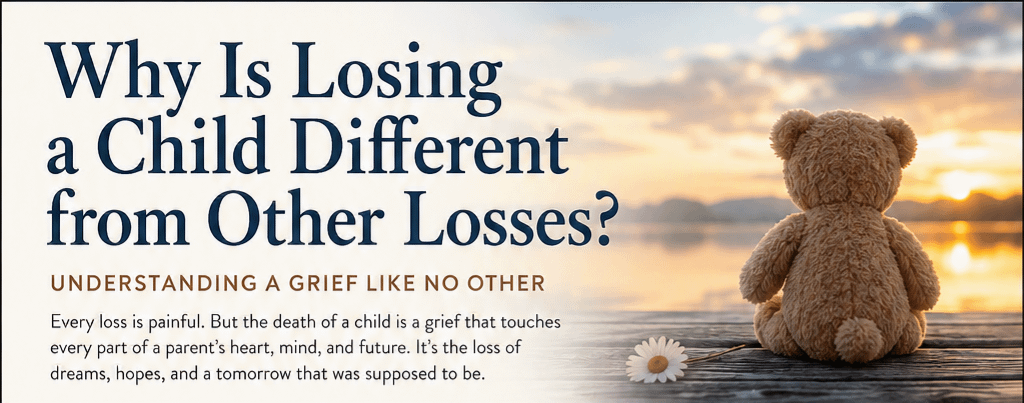
There is no easy loss.
The death of a parent can leave us feeling untethered. The loss of a spouse can create an overwhelming emptiness. The death of a sibling, friend, or loved one can change the course of our lives forever.
Every loss matters because every relationship matters.
Yet many who have experienced the death of a child often say there is something uniquely devastating about it. It is a grief that touches every corner of a parent’s life and often stays with them in ways that are difficult for others to understand.
Losing a child is not simply the loss of a loved one. It is the loss of hopes, dreams, expectations, identity, and a future that was supposed to unfold naturally.
For many parents, it feels as though the world has been turned upside down.
It Violates the Natural Order of Life
One of the reasons losing a child feels different is because it goes against the way we believe life is supposed to work.
Parents expect to grow old.
Children are expected to grow up.
A parent imagines watching their child graduate, start a career, get married, raise a family, and build a life of their own. Even when children become adults, parents still imagine years and decades of future memories together.
When a child dies, those expectations are shattered.
The mind struggles to accept what the heart knows is true.
Many grieving parents find themselves repeatedly thinking:
“This isn’t supposed to happen.”
Parents are not prepared to bury their children. The emotional shock of losing someone whose life was expected to continue long after their own creates a unique type of heartbreak.
The loss feels unnatural because it is the exact opposite of what parents spent their entire lives preparing for.
A Child Is Part of a Parent’s Heart
The relationship between a parent and child is unlike any other relationship in life.
A spouse may enter your life later.
Friends may come and go.
Even parents eventually step back as we become adults.
But the bond between a parent and child begins at birth and grows with every passing year.
Parents sacrifice sleep, time, energy, money, and often their own dreams to help their children thrive.
Every accomplishment becomes a source of pride.
Every setback becomes a source of concern.
A child’s happiness often becomes a parent’s happiness.
A child’s pain often becomes a parent’s pain.
Because of this connection, many parents describe losing a child as losing a piece of themselves.
They do not feel separated from their child.
They feel incomplete without them.
The Future Dies Alongside the Child
One of the cruelest aspects of child loss is that parents are forced to grieve not only the life that was lived but also the life that never will be.
When someone loses an elderly parent, they grieve memories that already existed.
When a parent loses a child, they grieve memories that were never allowed to happen.
They grieve:
- Future birthdays
- Graduations
- Weddings
- Family vacations
- Grandchildren
- Holiday traditions
- Retirement visits
- Everyday conversations
The mind constantly revisits the future that should have been.
Parents find themselves wondering:
“What would they be doing today?”
“What would they look like now?”
“Who would they have become?”
These questions often remain for the rest of a parent’s life.
The Guilt Can Be Crushing
Many grieving parents carry guilt even when they had absolutely no control over what happened.
The parental instinct is designed to protect.
From the moment a child is born, parents become guardians, problem-solvers, and protectors.
When tragedy occurs, many parents automatically look inward.
They ask:
- Could I have done more?
- Should I have seen warning signs?
- What if I had made a different choice?
- Could I have prevented this?
Even when logic says the answer is no, the heart often continues searching for answers.
This burden of guilt is one of the reasons child loss can feel so isolating.
Parents frequently carry invisible questions that may never be fully resolved.
The World Moves Forward While Parents Remain Behind
One of the most painful realities of child loss is watching the rest of the world continue as if nothing happened.
Life goes on.
People return to work.
Friends resume normal routines.
Social media fills with celebrations and milestones.
Meanwhile, grieving parents often feel frozen in time.
The date of their child’s death becomes permanently etched into their memory.
Every birthday becomes a reminder.
Every holiday carries an empty space.
Every family gathering highlights someone who should be there.
The world may move forward, but many parents feel emotionally connected to the moment everything changed.
This can create profound loneliness.
Fathers Often Grieve in Silence
While every parent grieves differently, many fathers face unique challenges after losing a child.
Society often teaches men to be strong, composed, and emotionally controlled.
Many fathers feel pressure to:
- Take care of everyone else
- Handle practical responsibilities
- Support their spouse
- Return to work quickly
- Hide their emotions
As a result, fathers frequently suffer in silence.
They cry alone.
They think about their child while driving.
They struggle during sleepless nights.
They carry memories privately while appearing strong on the outside.
Unfortunately, this can lead others to believe they are not grieving as deeply.
Nothing could be further from the truth.
Many fathers simply grieve behind closed doors.
Mothers and Fathers May Feel Alone Together
The death of a child can place enormous stress on relationships.
Couples often discover they grieve in different ways.
One parent may want to talk frequently.
The other may withdraw.
One may seek support groups.
The other may focus on work.
One may cry openly.
The other may grieve quietly.
Neither approach is wrong.
The challenge is that different grieving styles can create misunderstandings.
Many couples find themselves feeling alone even while experiencing the same tragedy.
Learning to respect each other’s grief becomes one of the most important parts of surviving child loss together.
Faith Is Often Tested
For many parents, losing a child creates spiritual questions unlike anything they have ever faced.
Questions such as:
- Why did this happen?
- Why my child?
- Why didn’t God stop it?
- What purpose could there be in this pain?
Some parents find their faith strengthened.
Others struggle with anger, doubt, confusion, and disappointment.
Many experience both.
Faith after child loss is often less about having answers and more about continuing to trust despite unanswered questions.
For grieving parents, healing frequently involves discovering that faith is not the absence of pain.
Faith is finding the strength to keep going while carrying the pain.
The Grief Never Completely Ends
One of the greatest misconceptions about child loss is the belief that parents eventually “get over it.”
They don’t.
What actually happens is they learn how to live with it.
The grief changes shape over time.
The sharp pain may soften.
The constant tears may become less frequent.
The overwhelming shock may fade.
But the love remains.
And because the love remains, the grief remains too.
Years later, a photograph, a song, a birthday, or a familiar scent can instantly bring memories rushing back.
Parents do not move on from their child.
They move forward while carrying their child in their hearts.
The Love Continues Beyond Death
Perhaps this is what makes losing a child so different from every other loss.
The relationship does not truly end.
The conversations may stop.
The hugs may disappear.
The physical presence may be gone.
But the love remains alive.
Parents continue thinking about their children every day.
They celebrate birthdays.
They honor anniversaries.
They tell stories.
They share memories.
They carry their child into every future moment.
Death may separate parent and child physically, but it cannot erase the bond that was created through love.
Finding Purpose After the Unthinkable
Many grieving parents eventually discover that healing is not about forgetting.
It is about learning to carry the love forward.
Some honor their child through charity work.
Some help other grieving families.
Some share their stories.
Some dedicate themselves to living in a way that reflects the values their child embodied.
The pain never disappears entirely, but purpose can emerge alongside it.
A parent may never be the same person they were before the loss.
Yet they can still find reasons to live, love, laugh, and hope again.
Final Thoughts
Losing a child is different because it affects every part of a parent’s life. It challenges identity, destroys expectations, tests faith, and leaves an empty space that can never be fully filled.
It is the loss of a future, the loss of dreams, and the loss of someone whose life was deeply intertwined with your own.
Yet even in the deepest grief, love remains.
That love becomes the bridge between sorrow and healing.
And while a parent’s heart may never completely recover from losing a child, it can learn to carry both grief and hope at the same time.
Because the depth of grief is not a measure of weakness.
It is a reflection of the depth of love.
And there is no greater love than that of a parent for a child.
A Father’s Guide to Surviving the Loss of a Child
Leave a ReplyCancel reply