Day: February 19, 2026

  • I Love With All My Heart

    I Love With All My Heart

    Love is often spoken about casually — in text messages, in passing conversations, in songs that drift through everyday moments. Yet the words “I love with all my heart” carry a weight far beyond romance or habit. They describe a way of living, a way of giving, and a way of seeing another person with sincerity that leaves nothing hidden.

    To love with all your heart is not simply to feel strongly. It is to choose depth over distance, honesty over comfort, and connection over emotional safety. It is love without calculation — affection that is not measured, negotiated, or withheld.

    It is love that says: I am fully here.

    The Meaning of Loving Completely

    Wholehearted love begins with presence. In a world filled with distraction and emotional guardedness, giving someone your full attention becomes one of the purest forms of care.

    Loving completely means:

    Listening not just to respond, but to understand.

    Seeing someone’s struggles without trying to fix or judge them.

    Remaining emotionally present even during difficult conversations.

    It is an active awareness of another person’s humanity — their joys, fears, imperfections, and dreams.

    When love is whole, it stops being about possession and becomes about partnership.

    The Courage Required to Love Deeply

    Loving with all your heart is brave because it involves risk. Every person carries memories of disappointment or loss, and the heart naturally learns to protect itself. Yet wholehearted love asks us to soften anyway.

    It requires courage to:

    Trust again after heartbreak.

    Express feelings without knowing how they will be received.

    Care deeply in a world that sometimes rewards emotional detachment.

    Courageous love does not ignore fear; it moves forward despite it. It recognizes that vulnerability is not a flaw but the doorway through which real connection enters.

    Love as a Daily Practice

    Many imagine love as a powerful emotion that sustains itself effortlessly. In truth, lasting love is built through consistent actions rather than dramatic moments.

    Loving with all your heart looks like ordinary devotion:

    Checking in after a long day.

    Offering patience during stress.

    Remembering small details that matter to someone else.

    Choosing kindness when misunderstandings arise.

    Grand gestures may create memories, but small acts create trust. Over time, these quiet choices become the foundation of enduring love.

    Love is less about intensity and more about reliability.

    Vulnerability: The Heart Without Armor

    To love fully is to allow yourself to be seen — not just at your best, but in uncertainty, insecurity, and imperfection.

    This openness can feel uncomfortable because it removes emotional shields. Yet vulnerability creates intimacy. When someone sees your authentic self and stays, love deepens into something steady and real.

    Wholehearted love says:

    “I trust you with the parts of me that are still healing.”

    And often, that shared honesty becomes the space where both people grow stronger.

    Loving Without Losing Yourself

    A common misunderstanding is that loving deeply means giving everything away. True wholehearted love does not erase identity; it strengthens it.

    Healthy love includes:

    Boundaries that protect emotional well-being.

    Mutual respect for individuality.

    Encouragement of personal growth.

    Space for both closeness and independence.

    When love is genuine, it expands who you are rather than asking you to shrink. You become more yourself, not less.

    The Quiet Power of Steady Love

    The strongest love is rarely dramatic. It does not always announce itself loudly or demand attention. Instead, it appears in consistency — in the person who stays through ordinary days and difficult seasons alike.

    It is found in:

    Shared silence that feels comfortable.

    Support offered without being asked.

    Forgiveness that values connection over pride.

    Steady love becomes a safe place, a reminder that someone chooses you not just during happiness but during uncertainty.

    Loving Through Imperfection

    To love with all your heart is also to accept imperfection — both yours and another person’s. Real relationships include misunderstandings, growth, and moments of doubt.

    Wholehearted love understands that people evolve. It allows room for mistakes while still holding onto respect and compassion.

    Love does not demand flawlessness; it invites effort.

    And sometimes, loving fully means learning when to heal together — and when to grow individually while still caring deeply.

    Love Beyond Romance

    Although often associated with romantic relationships, loving with all your heart extends beyond romance. It appears in friendships, family bonds, and even acts of kindness toward strangers.

    It is present when:

    A friend listens without judgment.

    A parent sacrifices quietly for a child’s future.

    Someone offers compassion to another person in pain.

    Wholehearted love is ultimately a way of moving through the world — choosing empathy over indifference.

    A Final Reflection: Living With an Open Heart

    To say “I love with all my heart” is not a promise of perfection. It is a commitment to sincerity. It means showing up honestly, loving bravely, and allowing connection to matter — even when vulnerability feels uncomfortable.

    In the end, wholehearted love becomes less about what we receive and more about who we become through giving it.

    Because a fully open heart does something extraordinary:
    it transforms ordinary moments into meaningful ones, relationships into safe spaces, and life itself into something richer and more deeply felt.

    Loving with all your heart is not simply an emotion — it is a way of being alive.
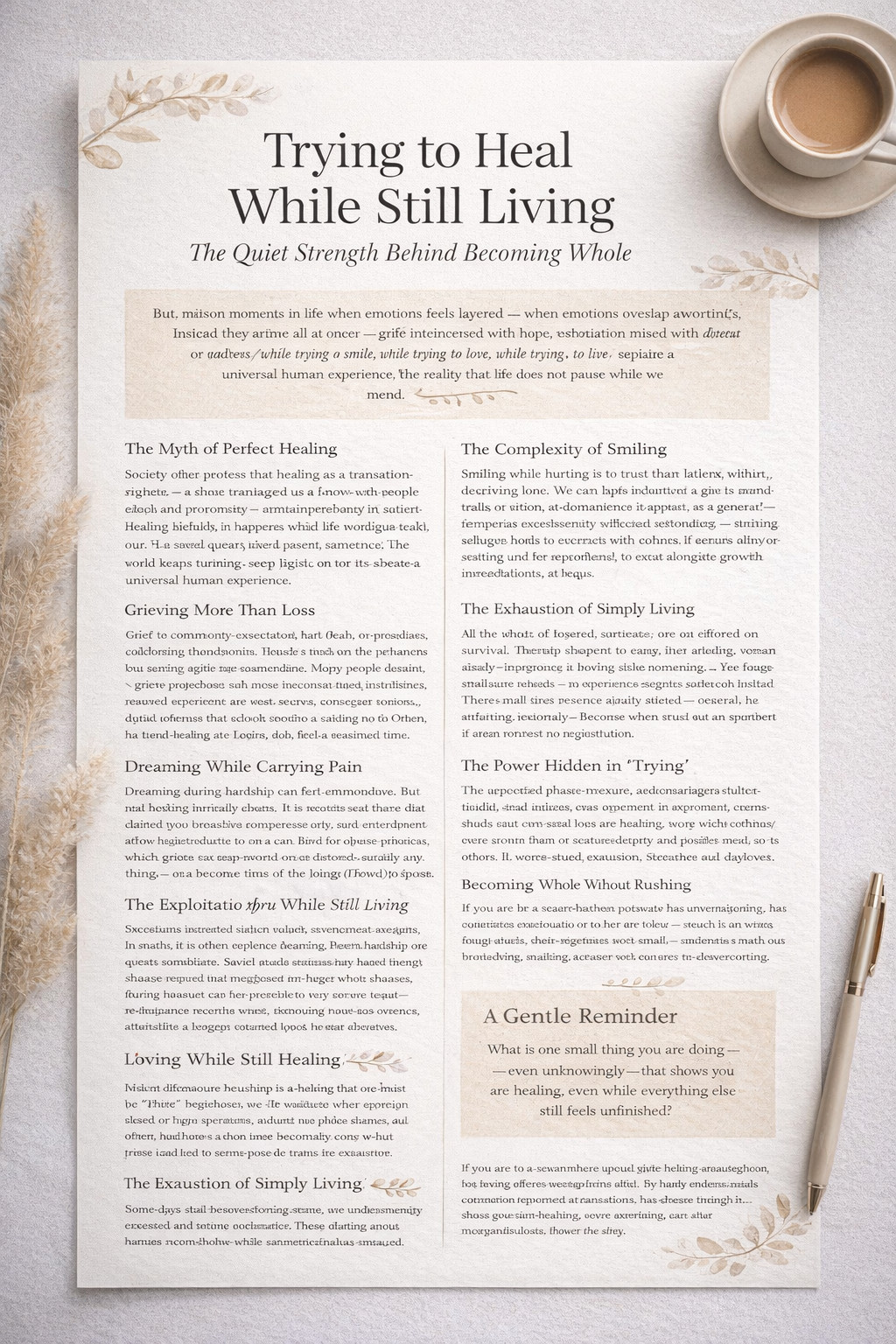
  • Trying to Heal While Still Living: The Quiet Strength Behind Becoming Whole

    Trying to Heal While Still Living: The Quiet Strength Behind Becoming Whole

    There are moments in life when emotions refuse to stand in orderly lines. Instead, they arrive all at once — grief intertwined with hope, exhaustion mixed with determination, sadness walking beside love. The words “Trying to heal while trying to grieve while trying to dream, while trying to smile, while trying to love, while trying to live” speak to a universal human experience: the reality that life does not pause while we mend.

    We are often taught to believe that healing happens after hardship ends. Yet most people discover the opposite is true. Healing unfolds in the middle of ordinary days — during conversations, responsibilities, and quiet nights when thoughts grow loud. It happens while life continues asking us to participate.

    This is not weakness. It is one of the deepest forms of strength.

    The Myth of Perfect Healing

    Society often portrays healing as a clean transformation — a clear “before” and “after.” Movies end when characters overcome adversity. Social media celebrates breakthroughs, not the long uncertainty leading up to them.

    But real healing is rarely dramatic. It is repetitive, subtle, and often invisible. Some days feel like progress; others feel like setbacks. Emotions revisit without warning. Memories resurface when least expected.

    Healing is not linear because humans are not linear. We carry experiences in layers, and each layer reveals itself when we are ready — or sometimes when we are not.

    To heal while living means accepting unfinishedness. It means understanding that growth does not require perfection; it requires persistence.

    Grieving More Than Loss

    Grief is commonly associated with death, yet many of life’s deepest griefs are quieter and less acknowledged. We grieve:

    Relationships that changed or ended

    Versions of ourselves we outgrew

    Opportunities that never came

    Expectations that reality could not fulfill

    Time we cannot reclaim

    This kind of grief can feel isolating because it often goes unseen. People may expect recovery quickly, not realizing that emotional loss reshapes identity.

    Grief asks us to let go of certainty. It teaches us that love leaves echoes — and those echoes take time to soften.

    Yet grief also reveals depth. The ability to mourn proves the ability to care deeply. Pain becomes evidence of connection, not failure.

    Dreaming While Carrying Pain

    Dreaming during hardship can feel almost rebellious. When life feels heavy, imagining a brighter future requires courage. Doubt whispers that hope may lead to disappointment again.

    But dreams are not promises; they are directions.

    They remind us that the future remains unwritten. Even small dreams — feeling peaceful again, rediscovering passion, rebuilding confidence — can become lifelines during dark seasons.

    Often, dreaming begins quietly. A new idea. A small goal. A moment of curiosity about what could still be possible.

    Hope rarely arrives as a grand announcement. More often, it appears as a gentle question: What if things can still get better?

    The Complexity of Smiling

    Smiling while hurting is sometimes misunderstood as pretending. In truth, it is often resilience in action.

    A smile during difficult times can mean:

    Choosing gratitude despite pain

    Protecting others from burdens we carry

    Recognizing moments of beauty that still exist

    Allowing joy to coexist with sadness

    Humans are capable of holding contradictory emotions simultaneously. We can laugh while grieving. We can feel hopeful while afraid. Emotional complexity is not confusion — it is maturity.

    Smiling does not deny suffering; it proves suffering has not erased our capacity for light.

    Loving While Still Healing

    One of the hardest fears during healing is the belief that we must become “whole” before we deserve love. Many people withdraw, convinced their struggles make them too complicated or too broken for connection.

    But love has never required perfection.

    Healthy love grows in honesty, not flawlessness. When we allow ourselves to love — friends, family, partners, or even ourselves — we create spaces where healing accelerates.

    Love teaches patience. It reflects back worth when self-doubt grows loud. It reminds us we are more than our hardest moments.

    Most importantly, self-love becomes the foundation. Learning to speak kindly to ourselves, to forgive our own pace, and to honor our emotional limits transforms healing from a battle into a partnership with ourselves.

    The Exhaustion of Simply Living

    Sometimes survival itself feels like a full-time job. Getting out of bed, completing tasks, maintaining routines — these actions can require immense effort during emotional struggle.

    Yet these small acts are victories.

    Living does not always look inspiring. Often it looks ordinary: making coffee, answering a text, taking a walk, finishing a day you weren’t sure you could handle.

    Each small continuation is proof of resilience.

    Life is not measured only by achievements but by endurance — by the quiet decision to keep going even when motivation feels distant.

    The Power Hidden in “Trying”

    The repeated phrase “trying” carries profound meaning. It removes the pressure of perfection and replaces it with compassion.

    Trying means:

    You have not given up.

    You are still open to change.

    You believe effort matters even without immediate results.

    In a culture that celebrates outcomes, trying honors the process. It recognizes that growth often happens invisibly long before results appear.

    Trying is hope in motion.

    Becoming Whole Without Rushing

    Healing does not mean returning to who you were before pain. Instead, it creates someone new — someone shaped by experience, empathy, and deeper understanding.

    Wholeness is not the absence of scars but the integration of them.

    Over time:

    grief becomes memory rather than weight,

    dreams feel reachable again,

    smiles come naturally,

    love feels safe,

    and living becomes less about survival and more about presence.

    You may not notice the change immediately. Healing often reveals itself only when you look back and realize something that once hurt intensely now feels softer.

    A Gentle Reminder

    If you are in a season where you are healing while grieving, dreaming while uncertain, smiling while struggling, loving while learning, and living while tired — you are not failing at life.

    You are participating in one of its most honest phases.

    Growth rarely looks graceful while it is happening. But every effort, every breath, every small step forward is shaping a stronger and more compassionate version of you.

    And one day, without realizing when it happened, trying will quietly transform into living fully again.

  • National Hickey Day: A Playful Celebration of Love, Passion, and Human Connection

    National Hickey Day: A Playful Celebration of Love, Passion, and Human Connection

    Every year on February 19, an unusual yet widely talked-about unofficial holiday appears on social calendars — National Hickey Day. At first glance, the celebration may seem humorous or even a little awkward, but beneath the jokes and memes lies something far more meaningful: a reflection of intimacy, affection, and the ways people express closeness in romantic relationships.

    While it may never appear on government calendars or come with greeting cards lining store shelves, National Hickey Day has grown into a cultural moment that blends humor, nostalgia, romance, and honest conversations about relationships.

    Understanding the Hickey: Science Meets Symbolism

    A hickey — also known as a love bite or kiss mark — forms when suction breaks tiny capillaries beneath the skin, creating a temporary bruise. Most commonly found on the neck or shoulder, the mark fades naturally over several days.

    Scientifically simple, yet socially complex, the hickey has evolved into a symbol carrying layered meanings. For some, it represents passion and attraction. For others, it is a playful reminder of youth, spontaneity, or emotional closeness.

    The mark itself is temporary, but the moment behind it often reflects something lasting: trust and vulnerability between two people.

    Why National Hickey Day Exists

    Unlike traditional holidays rooted in history or religion, National Hickey Day emerged from internet culture and social sharing. Its popularity grew as people began celebrating quirky, relatable experiences — especially those connected to relationships and everyday life.

    The appeal comes from relatability. Nearly everyone has either:

    Experienced a hickey,

    Known someone embarrassed by one,

    Or laughed at stories involving creative cover-ups.

    The day taps into shared human experiences, turning something once considered embarrassing into a collective inside joke.

    The Psychology of Visible Affection

    Human beings naturally seek connection. Psychologists often note that physical affection plays a powerful role in bonding, emotional reassurance, and relationship satisfaction.

    Visible affection — whether holding hands, hugs, or even a hickey — can symbolize:

    Emotional security

    Attraction and desire

    Playfulness within a relationship

    Mutual comfort and trust

    For many couples, these moments are less about appearance and more about emotional closeness. The humor surrounding hickeys often masks a deeper truth: people crave connection and affirmation.

    From Teen Embarrassment to Adult Nostalgia

    For many adults, National Hickey Day sparks memories of adolescence — school days filled with scarves, high collars, or strategic makeup attempts. These experiences have become almost universal rites of passage, blending awkwardness with discovery.

    What once felt embarrassing often becomes nostalgic later in life, representing:

    First experiences with romance

    Emotional vulnerability

    Learning boundaries and communication

    The excitement of young relationships

    As people grow older, the meaning often shifts from rebellion or impulsiveness to playful intimacy shared within mature partnerships.

    Social Media and Modern Romance

    In the digital age, National Hickey Day thrives online. Social platforms fill with:

    Relationship humor

    Couple selfies

    Jokes about hiding marks

    Lighthearted debates about whether hickeys are cute or cringe

    The internet has reframed the narrative, transforming what was once private into something openly discussed with humor and acceptance. Rather than shame, the day encourages laughter and storytelling.

    This shift reflects broader cultural changes where conversations about relationships, consent, and emotional openness are more normalized than in past generations.

    Consent, Comfort, and Respect

    Despite its playful nature, National Hickey Day also provides an opportunity to emphasize healthy relationship values. Affection should always be grounded in:

    Clear consent

    Communication between partners

    Respect for personal and professional boundaries

    Awareness of comfort levels

    Not everyone enjoys visible signs of affection, and preferences vary widely. Celebrating the day responsibly means prioritizing mutual understanding over trends or expectations.

    Healthy intimacy is never about pressure — it’s about shared enjoyment and trust.

    The Humor Factor: Why We Laugh

    Part of the enduring appeal of National Hickey Day lies in humor. Hickeys exist at the intersection of romance and awkwardness — a combination people naturally find funny.

    Humor allows people to talk about intimacy without discomfort. Laughing at shared experiences reduces embarrassment and builds social connection, reminding us that relationships are rarely perfect and often wonderfully messy.

    Sometimes the laughter matters more than the mark itself.

    A Reminder of Human Connection

    In a world dominated by screens, schedules, and constant digital communication, National Hickey Day quietly points back to something deeply human: physical presence and emotional closeness.

    It reminds us that relationships are built not only through grand gestures but also through small, spontaneous moments — laughter late at night, shared vulnerability, and affection expressed without overthinking.

    These imperfect moments often become the stories people remember most.

    Celebrating National Hickey Day Your Way

    You don’t have to take the holiday literally to enjoy it. People celebrate in many ways:

    Sharing funny relationship stories

    Spending intentional time with a partner

    Reflecting on love and connection

    Posting lighthearted content online

    Simply appreciating affection in all its forms

    For some, the day is romantic. For others, it’s comedic. And for many, it’s just another reason to smile.

    Final Reflection

    National Hickey Day may be unofficial, quirky, and slightly mischievous, but its popularity reveals something universal: people cherish connection. Behind every joke is a reminder that affection, vulnerability, and closeness are essential parts of the human experience.

    The marks fade quickly — but the emotions, memories, and relationships behind them often last much longer.

    In the end, National Hickey Day isn’t really about hickeys at all.
    It’s about celebrating the moments when love leaves an impression — even if only for a little while.