Category: Grief

  • The Price We Pay for Love

    The Price We Pay for Love

    Love is often celebrated as life’s greatest gift. Songs are written about it, poems are inspired by it, and entire lives are built around it. Love gives us purpose, creates lasting memories, and connects us to others in ways that nothing else can. It is the force that encourages us to care deeply, sacrifice willingly, and hope endlessly.

    But hidden within every great love story is a truth many people do not fully understand until they experience it themselves:

    The price we pay for love is pain.

    Not because love itself hurts, but because every meaningful connection comes with the possibility of loss.

    The deeper the love, the greater the vulnerability.

    The stronger the bond, the more significant the ache when circumstances change.

    And yet, despite knowing this, we continue to love.

    Why?

    Because the rewards of love far outweigh the cost.

    Love Requires Vulnerability

    From the moment we allow ourselves to care about someone, we become vulnerable.

    Parents know this the day they hold their newborn child for the first time. Suddenly, their heart exists outside their body. Every scraped knee, every disappointment, every challenge that child faces affects them deeply.

    Spouses and partners understand it when they commit their lives to one another. They know there are no guarantees. Life may bring illness, hardship, separation, or loss. Yet they choose love anyway.

    Friends experience it when they become part of each other’s lives. They celebrate successes together and help carry burdens when life becomes difficult.

    Love asks us to open doors that fear would rather keep locked.

    It requires trust in a world that offers very few certainties.

    To love someone is to accept that one day they may hurt you, leave you, change, or be taken from you.

    Most people spend their lives trying to protect themselves from pain. Yet true love requires us to lower our defenses and risk heartbreak.

    That is the first price we pay.

    The Cost of Deep Connections

    The greatest joys in life often come from our relationships.

    The laughter shared over dinner.

    The quiet conversations that last late into the night.

    The traditions built over years.

    The memories created during ordinary moments that become extraordinary because of who shared them with us.

    We often don’t realize how valuable these moments are until they become memories.

    A favorite chair sits empty.

    A phone call no longer comes.

    A birthday arrives with someone missing.

    A holiday feels different.

    A song plays and suddenly transports us back to a moment we wish we could relive one more time.

    The pain we feel in those moments isn’t evidence that something went wrong.

    It’s evidence that something beautiful existed.

    Grief: Love With Nowhere To Go

    One of the hardest lessons life teaches is that grief is not separate from love.

    Grief is love’s continuation.

    When someone we love dies, leaves, or becomes unreachable, the love remains. The relationship changes, but the love does not disappear.

    Many people wish they could simply “move on” from grief. They wonder why the pain continues months or years later.

    The answer is simple.

    Love does not operate on a timeline.

    The heart doesn’t follow a schedule.

    When we lose someone important, we are not just grieving their absence. We are grieving future moments that will never happen.

    The conversations we won’t have.

    The milestones they won’t witness.

    The memories we will never create together.

    This is why grief can feel so overwhelming. It is not merely sadness.

    It is love searching for a place to go.

    The Price Parents Pay

    Perhaps nowhere is the price of love more evident than in the love between a parent and child.

    From the moment a child enters the world, a parent begins investing their heart completely.

    Every first step becomes a treasured memory.

    Every achievement brings pride.

    Every struggle brings concern.

    Parents spend years teaching, protecting, encouraging, and loving.

    They dream about their child’s future.

    They imagine the life that lies ahead.

    When loss enters that relationship, the pain can feel impossible to describe.

    The world expects life to move forward.

    Calendars continue turning.

    Seasons continue changing.

    But a parent’s heart often remains connected to someone who is no longer physically present.

    The grief never fully disappears because the love never disappears.

    The price paid is enormous.

    Yet if given the choice, most parents would still choose every moment they had with their child.

    Even knowing the pain that would eventually follow.

    Because love is worth it.

    Loving Again After Being Hurt

    One of the most difficult challenges people face is learning how to love again after experiencing heartbreak.

    Loss has a way of convincing us that closing our hearts is safer.

    If we never love deeply again, perhaps we can avoid future pain.

    But protecting ourselves from heartbreak often means protecting ourselves from joy as well.

    Walls built to keep pain out also keep connection out.

    Healing does not mean forgetting.

    It does not mean replacing someone.

    It does not mean pretending the past never happened.

    Healing means finding the courage to remain open despite knowing what loss feels like.

    That takes tremendous strength.

    Perhaps more strength than loving for the first time.

    Because now we understand the risks.

    And we choose love anyway.

    The Scars Love Leaves Behind

    Many people see emotional scars as signs of weakness.

    In reality, they are evidence of courage.

    Every scar represents a relationship that mattered.

    A person who touched your life.

    A chapter that changed you forever.

    Some scars are visible through tears.

    Others appear in quiet moments of reflection.

    Some emerge during anniversaries, holidays, birthdays, or unexpected reminders.

    But scars are not signs that we failed.

    They are reminders that we loved.

    And loving deeply is never a failure.

    Would We Choose Differently?

    Imagine knowing ahead of time exactly how much pain a relationship would eventually cause.

    Would you avoid it?

    Would you refuse to love?

    Would you walk away before the first memory was ever made?

    For most people, the answer is no.

    Because while grief is painful, a life without love would be far more painful.

    The memories.

    The laughter.

    The adventures.

    The lessons.

    The growth.

    The comfort.

    The connection.

    All of it becomes part of who we are.

    The loss hurts because the love mattered.

    And a life filled with meaningful love is worth every tear it may someday bring.

    Love Is Still Worth It

    The truth is that love always asks for something from us.

    It asks for vulnerability.

    It asks for trust.

    It asks for sacrifice.

    It asks for courage.

    And eventually, it may ask us to endure heartbreak.

    That is the price we pay.

    But the reward is extraordinary.

    Love gives meaning to our lives.

    It gives purpose to our days.

    It provides strength during our darkest moments.

    It reminds us that we were never meant to walk through life alone.

    Yes, love leaves scars.

    Yes, it can break our hearts.

    Yes, it can leave us carrying grief for years.

    But even then, most people would not trade the love they experienced for a life free from pain.

    Because in the end, the greatest tragedy is not loving and losing.

    The greatest tragedy is never loving at all.

    The price we pay for love may be grief, heartache, vulnerability, and loss.

    But the reward is a life filled with memories, meaning, connection, and purpose.

    And for those who have truly loved, that price will always be worth paying.
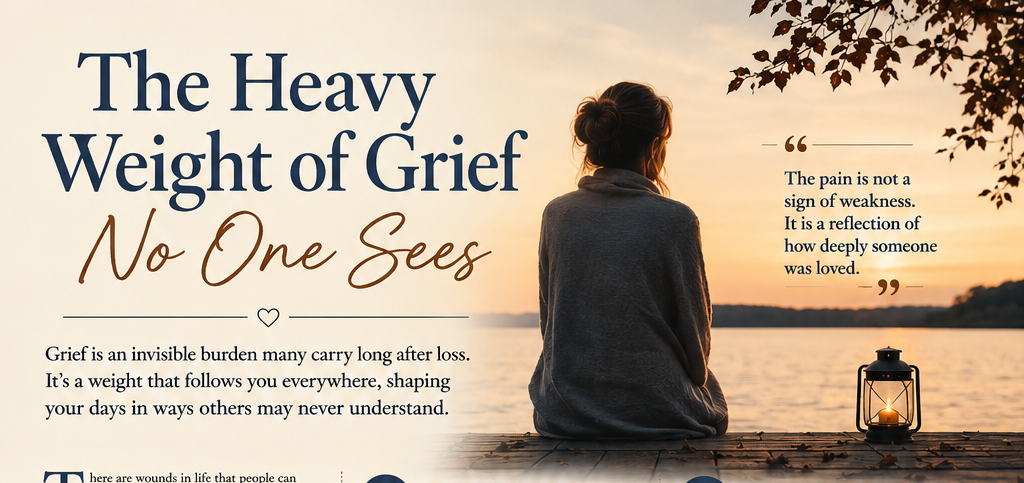
  • The Heavy Weight of Grief No One Sees

    The Heavy Weight of Grief No One Sees

    Grief is often misunderstood because most people only recognize the visible parts of it. They see the tears at a funeral, the difficult anniversaries, or the moments when someone openly talks about their loss. What they do not see is the heavy weight grief carries every single day long after everyone else has returned to their normal lives.

    For those who have experienced deep loss, grief becomes an invisible burden. It follows them into grocery stores, family gatherings, workplaces, and quiet evenings at home. It sits beside them during moments that should bring happiness. It whispers reminders when they hear a familiar song, see a photograph, or catch the scent of a memory that instantly transports them back to a time before everything changed.

    The hardest part is that this weight is often carried alone.

    The world tends to expect grief to follow a timeline. People offer support in the beginning, send cards, make phone calls, and attend services. But as weeks turn into months and months turn into years, many assume healing has happened. They believe life has returned to normal.

    The grieving person knows differently.

    There is no returning to the person you were before a significant loss. The loss becomes part of your story. The absence becomes woven into your daily life. You learn how to function, how to smile again, and even how to experience moments of joy, but the weight never completely disappears.

    For parents who have lost a child, the burden can feel especially overwhelming. They carry birthdays that no longer arrive with celebrations. They carry holidays that feel incomplete. They carry dreams of future milestones that will never happen. They carry questions that may never have answers.

    Yet most people never see these struggles.

    They do not see the tears that come unexpectedly in the car.

    They do not see the sleepless nights spent replaying memories.

    They do not see the empty chair that still catches your eye.

    They do not see how much courage it takes just to get through an ordinary day.

    Grief is exhausting because it requires constant emotional work. The grieving heart is always balancing memories, emotions, and the challenge of continuing to live while carrying profound pain. Some days the weight feels manageable. Other days it feels impossible.

    And still, people keep moving forward.

    Not because the pain has disappeared.

    Not because they have “gotten over it.”

    But because love gives them the strength to keep going.

    The truth is that grief exists because love exists. The deeper the love, the heavier the loss can feel. Every tear, every memory, and every ache is evidence of a bond that mattered. The pain is not a sign of weakness. It is a reflection of how deeply someone was loved.

    If you know someone carrying grief, remember that their struggle may not always be visible. Offer patience. Offer understanding. Check in long after the funeral is over. Speak the name of the person they miss. Let them know they do not have to carry the weight alone.

    And if you are the one carrying that invisible burden, know this:

    Your grief is real.

    Your pain is valid.

    Your love still matters.

    The weight you carry may be unseen by others, but it is not unnoticed by those who understand this journey. Every day you continue moving forward, even while carrying that heavy load, is an act of remarkable strength.

    Grief changes us. It leaves scars that never fully fade. But those scars tell a story of love, and love is always worth remembering.

    The weight may never completely disappear, but neither will the love that created it.

  • The Loneliness of Losing a Child When Family and Friends Do Not Support You

    The Loneliness of Losing a Child When Family and Friends Do Not Support You

    One of the most painful realities about losing a child is discovering that not everyone will walk beside you through the grief. Many grieving parents expect family and close friends to become their greatest source of comfort and strength. Sometimes they do. But sometimes the people you thought would hold you up emotionally begin to disappear, grow distant, avoid conversations, or act as though your grief should eventually fade away.

    That kind of abandonment creates a second heartbreak on top of the loss itself.

    Losing a child already leaves an emptiness no parent should ever experience. But when support from family and friends is missing, the grief can become even heavier. You begin feeling isolated not only from the world, but from the very people you thought would stand beside you during the darkest moment of your life.

    Many grieving parents quietly ask themselves painful questions:
    “Why has everyone stopped checking on me?”
    “Why do people act uncomfortable when I mention my child’s name?”
    “Why do I feel alone even when surrounded by people?”

    The truth is, grief makes many people uncomfortable. Some people simply do not know how to respond to a loss this deep. They fear saying the wrong thing, so they say nothing at all. Others expect grief to follow a timeline and become frustrated when months or years later you are still carrying pain. Some family members may even avoid your grief because it forces them to face emotions they do not want to deal with themselves.

    But understanding why people pull away does not erase the hurt when they do.

    For many parents, support disappears shortly after the funeral. In the beginning, people may send flowers, messages, and prayers. But as time passes, the calls become less frequent. The visits stop. The world moves on while the grieving parent remains stuck trying to survive each day without their child.

    That silence can feel devastating.

    It hurts when people stop speaking your child’s name as though mentioning them no longer matters. It hurts when birthdays and anniversaries are ignored. It hurts when people expect you to return to “normal” even though your entire life has been permanently changed.

    Some grieving parents also experience judgment instead of compassion. They may hear hurtful comments like:
    “You need to be strong.”
    “You should focus on the children you still have.”
    “Everything happens for a reason.”
    “At some point you have to move on.”

    Words like these can deepen emotional wounds because they dismiss the reality of child loss. There is no “moving on” from losing a child. Parents learn how to carry the pain, but they never stop loving or missing their child.

    Even within families, grief can create division. Some relatives may avoid talking about the child because it is too painful. Others may disagree about how grief should be expressed. One person may want to openly share memories while another shuts down emotionally. Over time, these differences can create tension, misunderstandings, and emotional distance.

    There are also grieving parents who feel unsupported because their loss is not acknowledged the way they hoped. Some people minimize miscarriages, stillbirths, infant loss, addiction-related deaths, or adult child loss as though the pain somehow matters less. But every child is deeply loved, and every loss leaves a permanent scar on the parent’s heart.

    The loneliness becomes especially difficult during holidays and special occasions. Watching other families celebrate while carrying the absence of your child can already feel unbearable. When family and friends fail to acknowledge your pain during those moments, it can make you feel invisible.

    Yet despite all of this, many grieving parents continue finding ways to survive. They become stronger than they ever wanted to be. They learn to lean on faith, support groups, counseling, online grief communities, or the few people who truly understand their pain. Sometimes complete strangers offer more compassion than lifelong friends.

    And while support from others matters, it is important to remember this truth: your grief is valid even when others fail to recognize it.

    Your child mattered.
    Your love still matters.
    Your pain deserves compassion.
    And your healing does not depend on other people’s ability to understand your loss.

    Some people will never fully understand the depth of child loss because they have never experienced it. But there are others who do understand — parents who have cried the same tears, carried the same silence, and survived the same heartbreak. In time, many grieving parents discover that healing often begins by connecting with people who are willing to sit with their pain instead of trying to erase it.

    If you are grieving without support from family or friends, know this: you are not weak for feeling hurt by their absence. Grief was never meant to be carried alone. The lack of support can leave emotional wounds that run deep. But even when others fail you, your child’s memory, your love, and your story still matter.

    And no amount of silence from others can ever erase the bond between a parent and their child.

  • When Grief Is Holding You Back From Opening Up

    When Grief Is Holding You Back From Opening Up

    Grief has a way of changing how a person sees the world. It can make conversations feel heavier, trust feel riskier, and vulnerability feel almost impossible. After experiencing deep loss, many people begin to protect themselves by staying quiet about what they truly feel. They stop opening up, not because they do not care, but because grief has taught them how painful emotional exposure can become.

    For some, the fear comes from being misunderstood. They may have tried to explain their pain before and felt dismissed, ignored, or rushed to “move on.” Others fear becoming a burden to people around them. They convince themselves that staying silent is easier than risking rejection, judgment, or pity. Over time, silence becomes a shield — one that feels safe, but also isolating.

    Grief can also make a person emotionally exhausted. When you are carrying heartbreak every day, opening up may feel like reliving the pain all over again. Sometimes people avoid talking because they know the moment they start, the emotions waiting beneath the surface may come pouring out. It can feel easier to say “I’m okay” than to explain the storm happening inside.

    Another difficult part of grief is that it changes trust. Loss can make the world feel unpredictable and uncertain. If someone you deeply loved is suddenly gone, your heart may struggle to believe that emotional security still exists. You may begin to guard yourself more carefully, afraid that if you let someone close again, you could eventually lose them too.

    But while grief may explain the walls around your heart, it does not mean those walls have to stay there forever.

    Healing does not always begin with dramatic breakthroughs. Sometimes it begins with small moments of honesty. A simple conversation. A quiet admission that you are struggling. A message to someone you trust. Opening up does not require telling your entire story at once. It simply means allowing yourself to be seen a little at a time.

    The truth is, grief was never meant to be carried completely alone.

    There are people who may not fully understand your pain, but who genuinely want to sit beside you in it. Sometimes healing comes not from finding the perfect words, but from discovering that someone is willing to listen without trying to fix you.

    It is also important to remember that opening up is not weakness. After loss, vulnerability can feel terrifying because your heart already knows what pain feels like. But choosing to trust again, even slowly, is a sign of courage. It means you are refusing to let grief completely close the door on connection, love, and hope.

    There will be days when grief still tells you to stay silent. Days when it feels safer to retreat inward. But healing often begins the moment you stop carrying every emotion by yourself. You deserve support. You deserve understanding. And you deserve spaces where your pain can exist without apology.

    Grief may have changed you, but it does not have to permanently isolate you.

    Sometimes the first step toward healing is simply allowing someone to say, “You don’t have to go through this alone.”

  • The Fear of Loving Again After Loss

    The Fear of Loving Again After Loss

    There is a kind of heartbreak that changes a person forever.
    Not just emotionally, but spiritually. Deeply. Permanently.

    When you lose someone you loved with your whole heart — especially a child, spouse, partner, or someone who became part of your soul — something inside you learns a painful lesson:

    Love can disappear.

    And once you have experienced devastating loss, the idea of opening your heart again can feel terrifying.

    Not because you no longer want love.
    But because you now understand how much it can hurt.

    When Love Becomes Connected to Pain

    After loss, many people begin to associate love with grief.

    The deeper the love was, the deeper the wound became.
    So the heart quietly starts trying to protect itself.

    You may tell yourself:

    “I can’t survive losing someone again.”
    “What if I get hurt all over again?”
    “What if I open up and they leave too?”
    “What if loving again somehow dishonors the person I lost?”

    These fears are not weakness.
    They are the scars of loving deeply.

    Grief changes the way we trust people. It changes how safe the world feels. It can make vulnerability feel dangerous, even when part of us still longs for companionship, understanding, and connection.

    The Loneliness Behind Emotional Walls

    Many grieving people become experts at hiding.

    They smile when they need to.
    They keep conversations light.
    They avoid getting too attached.
    They convince themselves they are “better off alone.”

    But underneath those walls is often someone who still wants love — someone who misses connection, warmth, laughter, affection, and emotional safety.

    The problem is that grief teaches caution.

    You start guarding your heart because you know what it feels like to watch life shatter in a single moment.

    And sometimes the fear is not just losing someone again.
    Sometimes the fear is allowing yourself to feel alive again.

    Because healing can feel strangely unfamiliar after living in survival mode for so long.

    Loving Again Does Not Mean Forgetting

    One of the biggest struggles grieving people face is guilt.

    They wonder:

    “Am I replacing them?”
    “Would they want me to move forward?”
    “Do I deserve happiness after all this pain?”

    But love is not limited.

    The heart does not erase one love to make room for another.
    It expands.

    Loving again does not mean forgetting the person you lost.
    It does not erase memories.
    It does not diminish grief.

    It simply means your heart is still capable of connection despite everything it has endured.

    That is not betrayal.
    That is courage.

    Fear Changes the Way We Love

    Loss can make people hesitant to trust.

    You may pull away when someone gets too close.
    You may overthink every interaction.
    You may expect abandonment before it even happens.

    Some people stop replying to messages because attachment scares them.
    Others become emotionally guarded because vulnerability feels unsafe.

    And some people sabotage relationships before they can become meaningful because losing another person feels unbearable.

    Grief can create a constant internal battle:

    wanting connection,
    while fearing emotional devastation.

    It is exhausting.

    Healing Does Not Mean the Fear Disappears

    The truth is, the fear may never fully disappear.

    When you have loved deeply and lost deeply, a part of you will always understand how fragile life really is.

    But healing teaches you something else too:

    Avoiding love does not protect you from pain.
    It only protects you from connection.

    And while loss changes us forever, it does not mean life is over.

    There are still people capable of bringing light into dark places.
    There are still conversations that can make you smile unexpectedly.
    There are still moments of peace waiting to be experienced.

    Taking Small Steps Toward Trust Again

    Loving again after loss does not have to happen all at once.

    Sometimes healing begins with:

    allowing yourself to talk honestly,
    letting someone understand your pain,
    accepting kindness without pushing it away,
    believing you are still worthy of love,
    allowing yourself to hope again.

    Trust is rebuilt slowly.

    One conversation.
    One safe moment.
    One act of vulnerability at a time.

    Final Thoughts

    The fear of loving again after loss is real.

    When grief has broken your heart, protecting it can feel safer than risking more pain. But human beings were never meant to live completely closed off from love and connection.

    You are not weak for being afraid.
    And you are not wrong for wanting companionship again either.

    Both things can exist at the same time.

    The heart that has been shattered is often the same heart that knows how to love the deepest.

    And maybe one of the bravest things a grieving person can do is believe that even after unbearable loss, life can still hold moments of warmth, connection, and hope.

    Because loving again is not forgetting the past.

    It is choosing to keep living despite it.

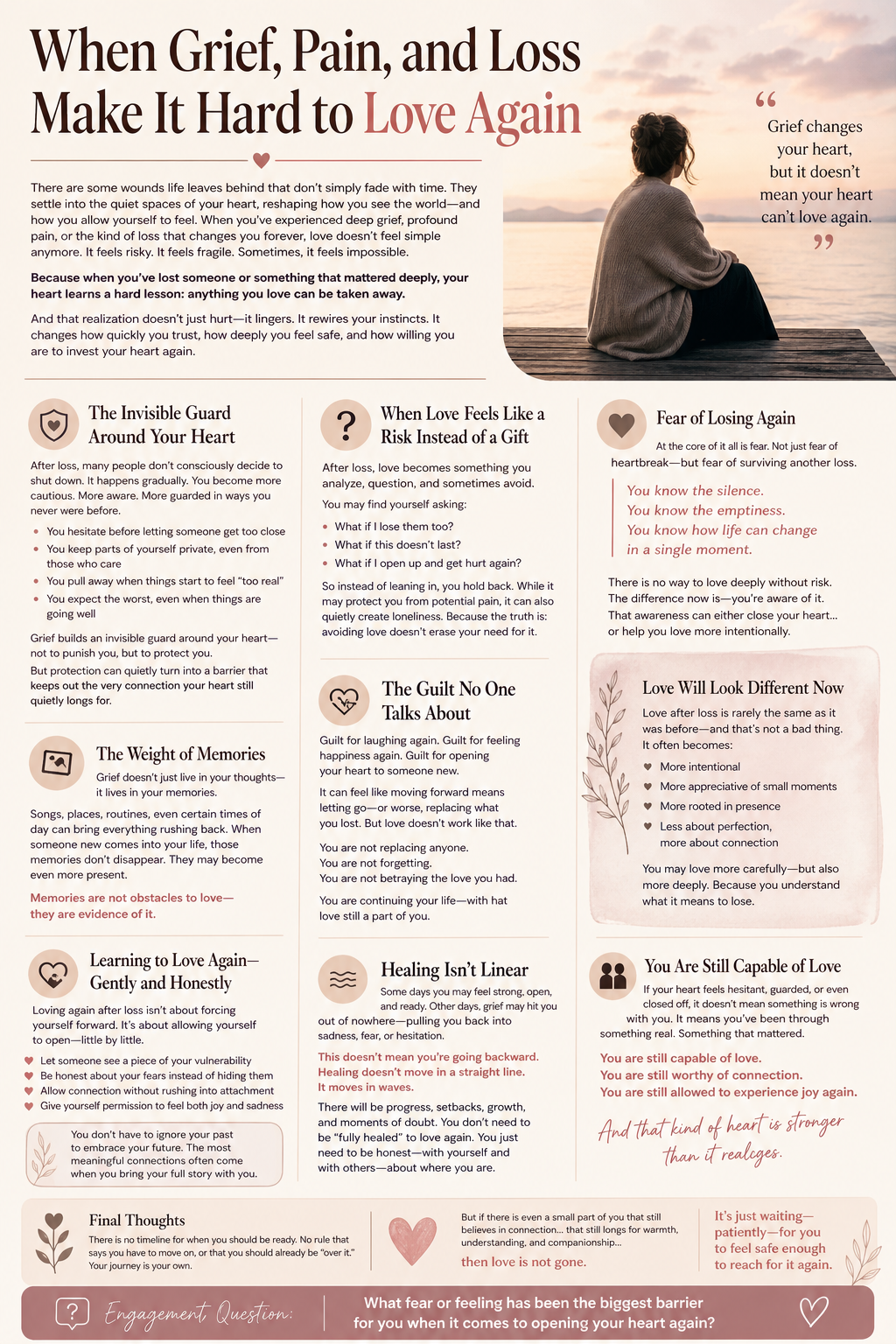
  • When Grief, Pain, and Loss Make It Hard to Love Again

    When Grief, Pain, and Loss Make It Hard to Love Again

    There are some wounds life leaves behind that don’t simply fade with time. They settle into the quiet spaces of your heart, reshaping how you see the world—and how you allow yourself to feel. When you’ve experienced deep grief, profound pain, or the kind of loss that changes you forever, love doesn’t feel simple anymore. It feels risky. It feels fragile. Sometimes, it feels impossible.

    Because when you’ve lost someone or something that mattered deeply, your heart learns a hard lesson: anything you love can be taken away.

    And that realization doesn’t just hurt—it lingers. It rewires your instincts. It changes how quickly you trust, how deeply you feel safe, and how willing you are to invest your heart again.

    The Invisible Guard Around Your Heart

    After loss, many people don’t consciously decide to shut down. It happens gradually. You become more cautious. More aware. More guarded in ways you never were before.

    You might notice:

    You hesitate before letting someone get too close
    You keep parts of yourself private, even from those who care
    You pull away when things start to feel “too real”
    You expect the worst, even when things are going well

    Grief builds an invisible guard around your heart—not to punish you, but to protect you.

    It whispers:

    “Don’t get too attached.”
    “Don’t feel too deeply.”
    “You won’t survive that kind of pain again.”

    And in a way, that voice is rooted in truth—you did go through something painful. You did survive something that changed you. But the protection it offers can slowly become a barrier that keeps out the very connection your heart still quietly longs for.

    When Love Feels Like a Risk Instead of a Gift

    Before loss, love may have felt natural—something you leaned into without overthinking. But after loss, love becomes something you analyze, question, and sometimes avoid altogether.

    You may find yourself constantly asking:

    What if I lose them too?
    What if this doesn’t last?
    What if I open up and get hurt again?

    So instead of leaning in, you hold back.

    You might choose emotional distance over vulnerability. You may convince yourself that being alone is easier—safer—less complicated. And while that may protect you from potential pain, it can also quietly create loneliness.

    Because the truth is: avoiding love doesn’t erase your need for it.

    The Weight of Memories

    Grief doesn’t just live in your thoughts—it lives in your memories.

    Songs, places, routines, even certain times of day can bring everything rushing back. If you lost a partner, a child, or someone deeply connected to your life, those memories can feel sacred—and sometimes overwhelming.

    When someone new comes into your life, those memories don’t disappear. In fact, they may become even more present.

    You might compare without meaning to.
    You might feel emotional when you least expect it.
    You might struggle with moments where past and present collide.

    And that can make loving again feel complicated.

    But memories are not obstacles to love—they are evidence of it.

    The Guilt No One Talks About

    One of the quietest struggles people face after loss is guilt.

    Guilt for laughing again.
    Guilt for feeling happiness again.
    Guilt for opening your heart to someone new.

    It can feel like moving forward means letting go—or worse, replacing what you lost.

    But love doesn’t work like that.

    You are not replacing anyone.
    You are not forgetting.
    You are not betraying the love you had.

    You are continuing your life—with that love still a part of you.

    Grief and love can coexist. You can carry what you lost and still make space for something new.

    Fear of Losing Again

    At the core of it all is fear.

    Not just fear of heartbreak—but fear of surviving another loss.

    Because you already know what that feels like.

    You know the silence.
    You know the emptiness.
    You know how life can change in a single moment.

    And that kind of awareness changes you.

    It makes you more careful. More guarded. Sometimes even distant.

    But here’s the reality most people struggle to accept:
    There is no way to love deeply without risk.

    Love has always carried the possibility of loss. The difference now is—you’re aware of it.

    And that awareness can either close your heart… or help you love more intentionally.

    Healing Isn’t Linear

    Some days you may feel strong, open, and ready. Other days, grief may hit you out of nowhere—pulling you back into sadness, fear, or hesitation.

    This doesn’t mean you’re going backward.

    Healing doesn’t move in a straight line.

    It moves in waves.

    There will be progress, setbacks, growth, and moments of doubt. You might feel ready one day and unsure the next. That’s part of the process.

    You don’t need to be “fully healed” to love again. You just need to be honest—with yourself and with others—about where you are.

    Learning to Love Again—Gently and Honestly

    Loving again after loss isn’t about forcing yourself forward. It’s about allowing yourself to open—little by little.

    It may look like:

    Letting someone see a piece of your vulnerability
    Being honest about your fears instead of hiding them
    Allowing connection without rushing into attachment
    Giving yourself permission to feel both joy and sadness

    You don’t have to ignore your past to embrace your future.

    In fact, the most meaningful connections often come when you bring your full story with you.

    Love Will Look Different Now

    Love after loss is rarely the same as it was before—and that’s not a bad thing.

    It often becomes:

    More intentional
    More appreciative of small moments
    More rooted in presence than expectation
    Less about perfection, more about connection

    You may love more carefully—but also more deeply.

    Because you understand what it means to lose.

    You Are Still Capable of Love

    If your heart feels hesitant, guarded, or even closed off, it doesn’t mean something is wrong with you.

    It means you’ve been through something real.

    Something that mattered.

    Something that changed you.

    And that kind of heart—the one that has loved deeply, lost painfully, and still continues—is not broken beyond repair.

    It’s stronger than it realizes.

    You are still capable of love.
    You are still worthy of connection.
    And you are still allowed to experience joy again.

    Final Thoughts

    There is no timeline for when you should be ready. No rule that says you have to move on, or that you should already be “over it.”

    Your journey is your own.

    But if there is even a small part of you that still believes in connection…
    that still longs for warmth, understanding, and companionship…

    then love is not gone.

    It’s just waiting—patiently—for you to feel safe enough to reach for it again.

    And when you do, it won’t erase your past.

    It will simply become part of your healing.

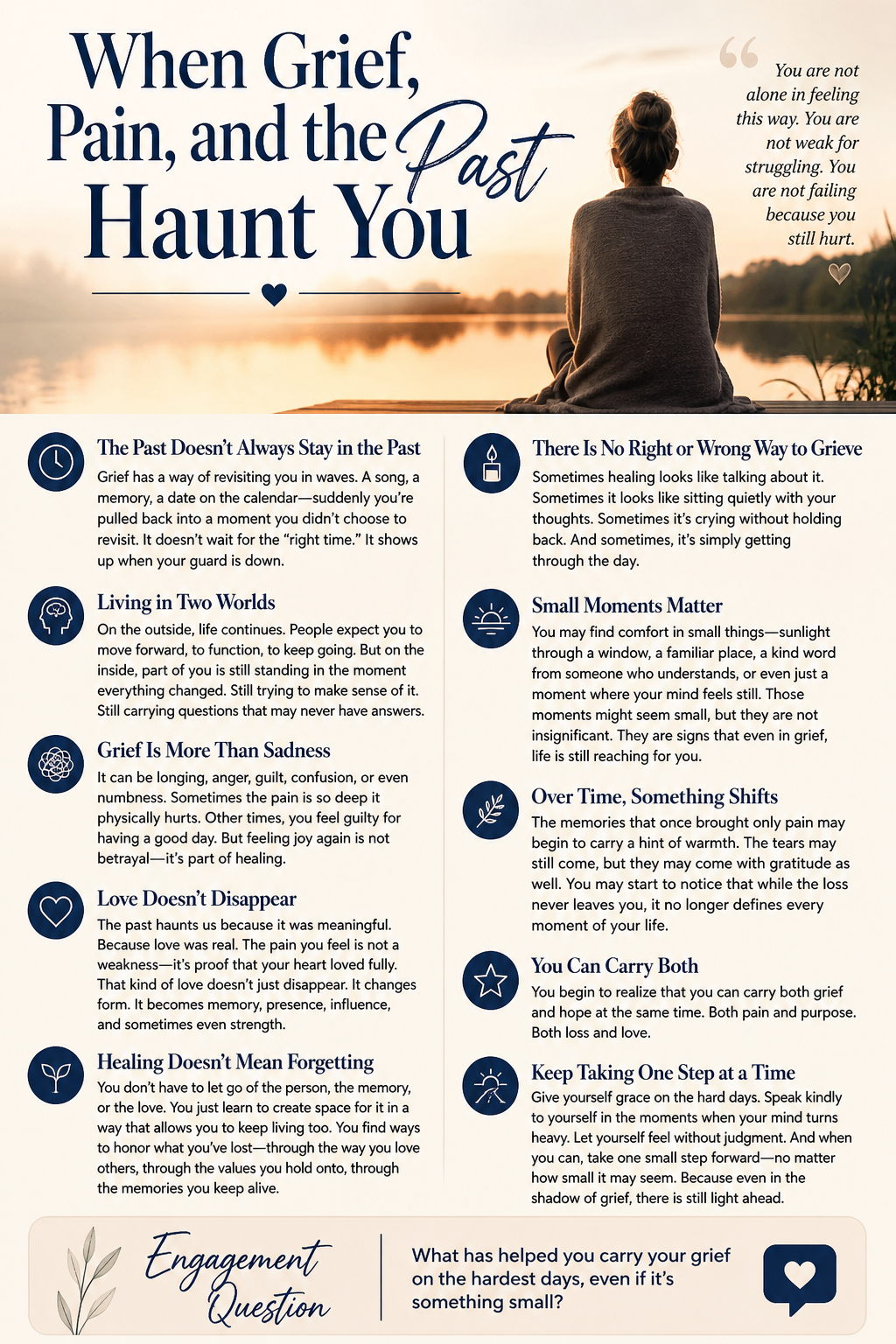
  • When Grief, Pain, and the Past Haunt You

    When Grief, Pain, and the Past Haunt You

    There are moments in life when the past refuses to stay behind you. It doesn’t fade quietly into memory—it lingers, it whispers, it presses on your heart when you least expect it. Grief has a way of revisiting you in waves, sometimes gentle, sometimes overwhelming, reminding you of what was, what mattered, and what was lost.

    You might be going about your day—driving, working, laughing with others—and suddenly, something shifts. A song plays. A memory surfaces. A date on the calendar hits harder than expected. And just like that, you’re pulled back into a moment you didn’t choose to revisit. That’s how grief works. It doesn’t wait for the “right time.” It shows up when your guard is down.

    When grief, pain, and the past haunt you, it can feel like you’re living in two worlds at once. On the outside, life continues. People expect you to move forward, to function, to keep going. But on the inside, part of you is still standing in the moment everything changed. Still trying to make sense of it. Still carrying questions that may never have answers.

    There’s a quiet exhaustion that comes with that. Not just physical—but emotional. The kind of tired that comes from holding yourself together when everything inside feels like it’s falling apart. The kind that comes from pretending you’re okay when you’re not sure you ever will be in the same way again.

    Grief is not just sadness. It’s a mixture of emotions that can be hard to untangle. It can be longing, anger, guilt, confusion, even moments of numbness where you feel nothing at all. Sometimes you miss what you lost so deeply it physically hurts. Other times, you feel guilty for having a good day—as if smiling somehow means you’re leaving them behind.

    But feeling joy again is not betrayal. It’s part of healing.

    The past haunts us because it was meaningful. Because love was real. Because the connection you had mattered deeply. If it didn’t matter, it wouldn’t hurt this much. The pain you feel is not a weakness—it’s proof that your heart loved fully. And that kind of love doesn’t just disappear. It changes form. It becomes memory, presence, influence, and sometimes even strength.

    Still, that doesn’t make the hard days easier.

    There will be nights when the silence is too loud. When your thoughts won’t slow down. When you replay conversations, wish for one more moment, one more word, one more chance to hold on a little longer. There will be days when the weight feels heavier than usual, when something small triggers something big, and you don’t even fully understand why.

    In those moments, it’s important to remind yourself: you are not broken—you are grieving.

    Healing from grief doesn’t mean you “get over it.” It means you learn how to live with it. You learn how to carry it differently. At first, it may feel like grief carries you—but over time, slowly, gently, you begin to carry it instead. Not perfectly, not consistently, but enough to keep moving forward.

    And moving forward doesn’t mean forgetting.

    You don’t have to let go of the person, the memory, or the love. You just learn to create space for it in a way that allows you to keep living too. You find ways to honor what you’ve lost—through the way you love others, through the values you hold onto, through the memories you keep alive.

    Sometimes healing looks like talking about it.
    Sometimes it looks like sitting quietly with your thoughts.
    Sometimes it’s crying without holding back.
    And sometimes, it’s simply getting through the day.

    There is no right or wrong way to grieve.

    You may find comfort in small things—sunlight through a window, a familiar place, a kind word from someone who understands, or even just a moment where your mind feels still. Those moments might seem small, but they are not insignificant. They are signs that even in grief, life is still reaching for you.

    And slowly, over time, something begins to shift.

    The memories that once brought only pain may begin to carry a hint of warmth. The tears may still come, but they may come with gratitude as well. You may start to notice that while the loss never leaves you, it no longer defines every moment of your life.

    You begin to realize that you can carry both grief and hope at the same time.
    Both pain and purpose.
    Both loss and love.

    If you are being haunted by the past, know this:

    You are not alone in feeling this way.
    You are not weak for struggling.
    You are not failing because you still hurt.

    You are human. And you are healing—even when it doesn’t feel like it.

    Give yourself grace on the hard days. Speak kindly to yourself in the moments when your mind turns heavy. Let yourself feel without judgment. And when you can, take one small step forward—no matter how small it may seem.

    Because even in the shadow of grief, there is still light ahead. It may be distant. It may be faint. But it is there.

    And so are you—still standing, still breathing, still moving forward.

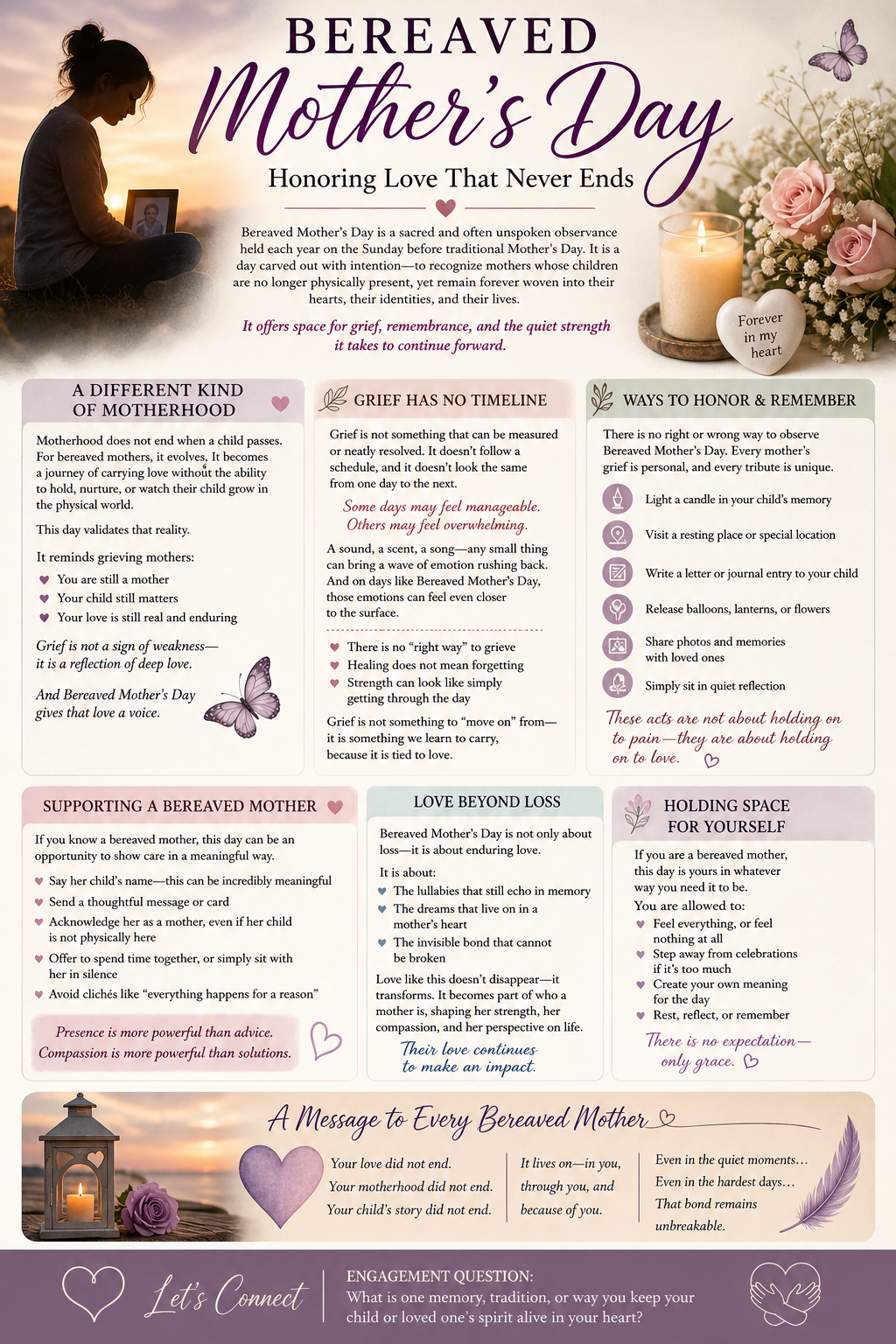
  • 🌸 Bereaved Mother’s Day: Honoring Love That Never Ends

    🌸 Bereaved Mother’s Day: Honoring Love That Never Ends

    Bereaved Mother’s Day is a sacred and often unspoken observance held each year on the Sunday before traditional Mother’s Day. It is a day carved out with intention—to recognize mothers whose children are no longer physically present, yet remain forever woven into their hearts, their identities, and their lives.

    While the world prepares for flowers, cards, and celebrations, this day gently acknowledges a different reality—one where love remains, but the arms ache with absence. It offers space for grief, remembrance, and the quiet strength it takes to continue forward.

    💔 The Depth of a Mother’s Love

    There is no loss quite like the loss of a child. It reshapes everything—how time feels, how memories are held, how the future is imagined.

    For a bereaved mother:

    Every milestone becomes a reminder
    Every holiday carries both light and heaviness
    Every “what could have been” lingers in the heart

    And yet, through all of it, one thing never changes: she is still a mother.

    Motherhood is not defined by presence alone—it is defined by love. And that love does not end. It stretches beyond what we can see, beyond what we can hold, and into something eternal.

    🕊️ Grief Has No Timeline

    Grief is not something that can be measured or neatly resolved. It doesn’t follow a schedule, and it doesn’t look the same from one day to the next.

    Some days may feel manageable. Others may feel overwhelming.

    A sound, a scent, a song—any small thing can bring a wave of emotion rushing back. And on days like Bereaved Mother’s Day, those emotions can feel even closer to the surface.

    It’s important to remember:

    There is no “right way” to grieve
    Healing does not mean forgetting
    Strength can look like simply getting through the day

    Grief is not something to “move on” from—it is something we learn to carry, because it is tied to love.

    🌷 Creating Space for Remembrance

    Bereaved Mother’s Day is not about grand gestures—it’s about meaningful ones. It’s about allowing yourself to feel, to remember, and to honor your child in a way that feels true to you.

    Some mothers find comfort in tradition, while others create new rituals each year.

    You might choose to:

    Light a candle and sit in quiet reflection
    Write your child a letter, saying the things still in your heart
    Visit a place that holds special meaning
    Cook a favorite meal or play a song that brings memories alive
    Look through photos and speak their name out loud
    Release something symbolic—like a balloon or flower—into the sky or water

    These acts are not about holding on to pain—they are about holding on to love.

    🤍 The Power of Being Seen

    One of the most painful parts of child loss can be the silence that follows. The world keeps moving, while a mother’s heart remains tethered to someone who is no longer visible to others.

    Bereaved Mother’s Day helps break that silence.

    It says:

    Your child mattered
    Your motherhood matters
    Your grief deserves acknowledgment

    Sometimes, the most healing thing is simply being seen and understood.

    🌼 Supporting a Bereaved Mother with Compassion

    If you know a bereaved mother, this day can be an opportunity to show care in a meaningful way. You don’t need perfect words—you just need a willing heart.

    Here are gentle ways to support:

    Say her child’s name—this can be incredibly meaningful
    Send a message letting her know you’re thinking of her
    Acknowledge her as a mother, even if her child is not physically here
    Offer to spend time together, or simply sit with her in silence
    Avoid clichés like “everything happens for a reason”

    Presence is more powerful than advice. Compassion is more powerful than solutions.

    🌅 Love That Transcends Time

    Bereaved Mother’s Day is not only about loss—it is about enduring love.

    It is about:

    The lullabies that still echo in memory
    The dreams that live on in a mother’s heart
    The invisible bond that cannot be broken

    Love like this doesn’t disappear—it transforms. It becomes part of who a mother is, shaping her strength, her compassion, and her perspective on life.

    Many bereaved mothers go on to honor their children in powerful ways—through acts of kindness, advocacy, creativity, or simply by living with deeper intention.

    Their love continues to make an impact.

    🌹 Holding Space for Yourself

    If you are a bereaved mother, this day is yours in whatever way you need it to be.

    You are allowed to:

    Feel everything, or feel nothing at all
    Step away from celebrations if it’s too much
    Create your own meaning for the day
    Rest, reflect, or remember

    There is no expectation—only grace.

    ✨ A Message to Every Bereaved Mother

    Your love did not end.
    Your motherhood did not end.
    Your child’s story did not end.

    It lives on—in you, through you, and because of you.

    Even in the quiet moments…
    Even in the hardest days…
    That bond remains unbreakable.

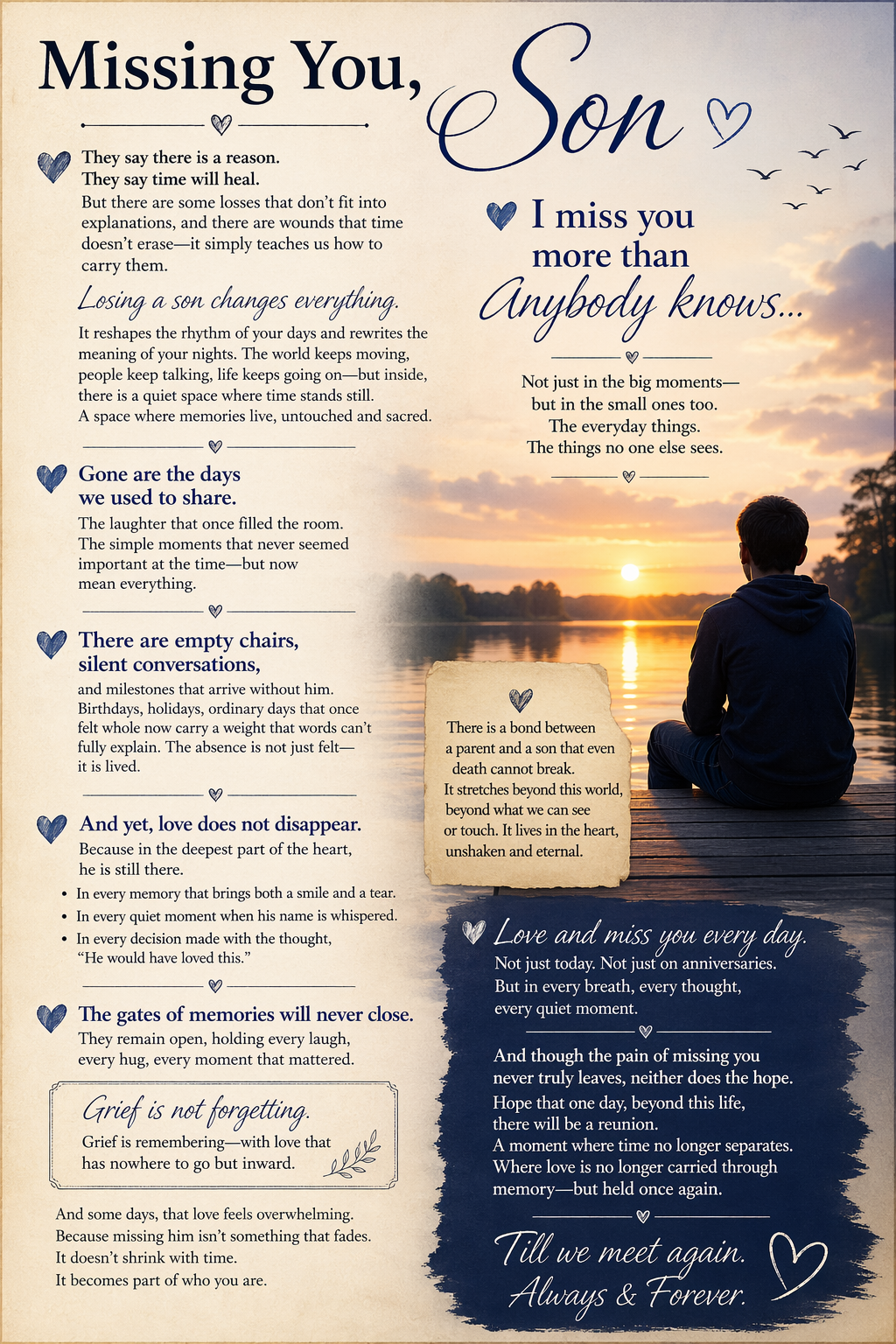
  • Missing You, Son

    Missing You, Son

    They say there is a reason.
    They say time will heal.
    But there are some losses that don’t fit into explanations, and there are wounds that time doesn’t erase—it simply teaches us how to carry them.

    Losing a son changes everything.

    It reshapes the rhythm of your days and rewrites the meaning of your nights. The world keeps moving, people keep talking, life keeps going on—but inside, there is a quiet space where time stands still. A space where memories live, untouched and sacred.

    Gone are the days we used to share.
    The laughter that once filled the room.
    The simple moments that never seemed important at the time—but now mean everything.

    There are empty chairs, silent conversations, and milestones that arrive without him. Birthdays, holidays, ordinary days that once felt whole now carry a weight that words can’t fully explain. The absence is not just felt—it is lived.

    And yet, love does not disappear.

    Because in the deepest part of the heart, he is still there.

    In every memory that brings both a smile and a tear.
    In every quiet moment when his name is whispered.
    In every decision made with the thought, “He would have loved this.”

    The gates of memories will never close.
    They remain open, holding every laugh, every hug, every moment that mattered.

    Grief is not forgetting.
    Grief is remembering—with love that has nowhere to go but inward.

    And some days, that love feels overwhelming.
    Because missing him isn’t something that fades. It doesn’t shrink with time. It becomes part of who you are.

    I miss you more than anybody knows.

    Not just in the big moments—but in the small ones too.
    The everyday things.
    The things no one else sees.

    There is a bond between a parent and a son that even death cannot break. It stretches beyond this world, beyond what we can see or touch. It lives in the heart, unshaken and eternal.

    Love and miss you every day.
    Not just today. Not just on anniversaries.
    But in every breath, every thought, every quiet moment.

    And though the pain of missing you never truly leaves, neither does the hope.

    Hope that one day, beyond this life, there will be a reunion.
    A moment where time no longer separates.
    Where love is no longer carried through memory—but held once again.

    Till we meet again.

    Always and forever.

  • There’s No Way Around It: Walking Through Grief and Loss

    There’s No Way Around It: Walking Through Grief and Loss

    There’s a quiet truth about grief that most people don’t want to hear—because it asks something of us we don’t feel ready to give.

    There’s no way around it.

    No shortcut. No detour. No way to outrun something that lives in your heart.

    You can dodge it for a while. You can stay busy, fill your days, keep the noise going so there’s no room for silence. You can tell yourself you’re fine, convince others you’re strong, and maybe even believe it for a moment. But grief doesn’t operate on denial. It doesn’t fade just because we refuse to look at it.

    It waits.

    Patiently. Quietly. Faithfully.

    And sooner or later, it asks you to come back and face it.

    The World That Changed Overnight

    Grief begins the moment something—or someone—you love is taken from your world.

    And in that instant, everything shifts.

    The world keeps moving. People keep talking. Life goes on like nothing happened. But for you, everything has changed. The familiar becomes unfamiliar. The normal becomes distant. Even the smallest routines can feel unbearable, because they remind you of what used to be.

    You don’t just lose a person—you lose the version of life that existed with them in it.

    You lose conversations that will never happen.
    Moments that will never be shared.
    A future that will never unfold the way you imagined.

    And there’s no preparing for that.

    No manual on how to carry something so heavy and invisible at the same time.

    The Illusion of Avoidance

    In the early days—or even months or years—many people try to avoid grief.

    It’s not weakness. It’s survival.

    You do what you have to do to get through the day. You put one foot in front of the other. You show up where you’re needed. You learn how to function, even when everything inside you feels broken.

    Some people bury themselves in work.
    Some isolate themselves from the world.
    Some try to stay strong for everyone else.
    Some numb the pain in ways that only delay it.

    And for a while, it might seem like it’s working.

    But grief is not something you can outwork, outthink, or outlast.

    Because grief is tied to love.

    And love doesn’t disappear just because we’re not ready to feel it.

    Going Into It

    There comes a moment—different for everyone—when the distractions stop working.

    It might be triggered by something small. A song. A smell. A memory. A random Tuesday that feels heavier than it should. Or it might come crashing in all at once, without warning, without mercy.

    That’s when you realize:

    You can’t go around this.

    You have to go through it.

    Going through grief doesn’t mean you understand it. It doesn’t mean you accept it. It doesn’t even mean you’re ready.

    It simply means you allow yourself to feel it.

    The sadness.
    The anger.
    The confusion.
    The guilt.
    The longing.

    All of it.

    It means sitting in the quiet when the world gets too loud. It means letting tears fall without trying to stop them. It means acknowledging the depth of your loss instead of minimizing it.

    And that’s not easy.

    Because going into grief feels like stepping into something endless.

    Like you might never find your way back out.

    The Weight of Love

    One of the hardest realizations in grief is this:

    The pain you feel is a reflection of how deeply you loved.

    Grief is not a sign of weakness.

    It’s proof of connection.

    It’s what remains when love has nowhere to go.

    And that’s why it hurts so much.

    Because the love is still there.

    Still present.
    Still alive.
    Still searching for a place to land.

    You don’t stop loving someone just because they’re gone.

    And so, you carry it.

    In your memories.
    In your thoughts.
    In the quiet moments no one else sees.

    Learning to Carry It

    As time passes, something begins to shift—not in a way that erases the pain, but in a way that changes your relationship with it.

    You start to learn how to carry your grief.

    Not perfectly. Not consistently. But gradually.

    At first, it feels like it’s carrying you.

    Every step is heavy. Every day feels like a mountain. The weight of it presses down on everything—your thoughts, your energy, your ability to move forward.

    But slowly, you find small ways to hold it.

    You learn what helps, even just a little.
    You learn when to rest.
    You learn when to let yourself feel and when to step back.

    And over time, the grief that once consumed every part of you begins to settle into something you carry alongside you.

    It’s still there.

    But it doesn’t define every moment.

    The Days That Still Break You

    Even as you begin to move forward, grief doesn’t follow a straight line.

    There will be days that feel okay.

    And then there will be days that feel like the beginning all over again.

    Anniversaries.
    Birthdays.
    Holidays.

    Or sometimes nothing at all—just a random moment that hits you out of nowhere.

    A memory surfaces.
    A feeling returns.
    A wave of emotion you didn’t expect crashes in.

    And suddenly, you’re right back in it.

    That doesn’t mean you’re not healing.

    It means you’re human.

    Grief doesn’t disappear—it evolves.

    The Other Side of Grief

    When people talk about “coming out the other side,” it can sound misleading.

    Because there’s no finish line.

    No moment where grief is completely gone.

    But there is a shift.

    A quiet transformation.

    One day, you notice that the pain doesn’t feel as sharp.
    That your breathing feels a little easier.
    That you can remember without completely falling apart.

    You begin to experience moments of peace.

    Moments of gratitude.
    Moments of connection.
    Moments where you feel something other than loss.

    And those moments matter.

    Because they remind you that life still exists—even after everything you’ve been through.

    A Different World

    When you come through grief, you don’t return to the same world you left.

    That world is gone.

    And so is the version of you that lived in it.

    But what emerges is someone who has walked through something deep and life-changing.

    Someone who understands the fragility of life.
    The value of time.
    The importance of presence.

    You may find yourself softer.

    More compassionate.
    More aware of others who are hurting.

    And at the same time, stronger.

    More grounded.
    More resilient.
    More capable than you ever thought possible.

    Still Capable of Love

    One of the greatest fears in grief is the idea that you’ll never feel whole again.

    That the loss has taken something from you that can never be replaced.

    And in some ways, that’s true.

    There are parts of your life that will never be the same.

    But grief doesn’t take away your ability to love.

    If anything, it deepens it.

    It reminds you how precious it is.

    How important it is to show up, to speak, to hold on to the moments you have.

    You don’t stop loving.

    You learn to love differently.

    With more intention.
    More awareness.
    More heart.

    Step by Step

    If you’re in the middle of grief right now, standing at the edge of something you don’t want to face, hear this:

    You don’t have to do it all at once.

    You don’t have to be strong every day.

    You don’t have to have the answers.

    All you have to do is take the next step.

    And then the next.

    Some days that step might be getting out of bed.
    Some days it might be letting yourself cry.
    Some days it might be finding a moment of peace in the middle of the chaos.

    Every step counts.

    Every breath matters.

    The Quiet Strength of Survival

    There’s a kind of strength that only comes from walking through grief.

    It’s not loud.
    It’s not obvious.
    It doesn’t look like what people usually think strength looks like.

    It’s quiet.

    It’s the strength to keep going when everything in you wants to stop.
    The strength to feel when it would be easier to shut down.
    The strength to carry love and loss at the same time.

    And if you’re here—if you’re still moving, still breathing, still trying—then you already have it.

    Because the truth is this:

    There’s no way around grief and loss.

    But there is a way through.

    And while the world you find on the other side will never be the same as the one you left…

    You will still be here.

    Stronger than you know.

    Still standing.

    Still loving.

    Still becoming someone who carries both the weight of loss and the beauty of what remains.