Category: History

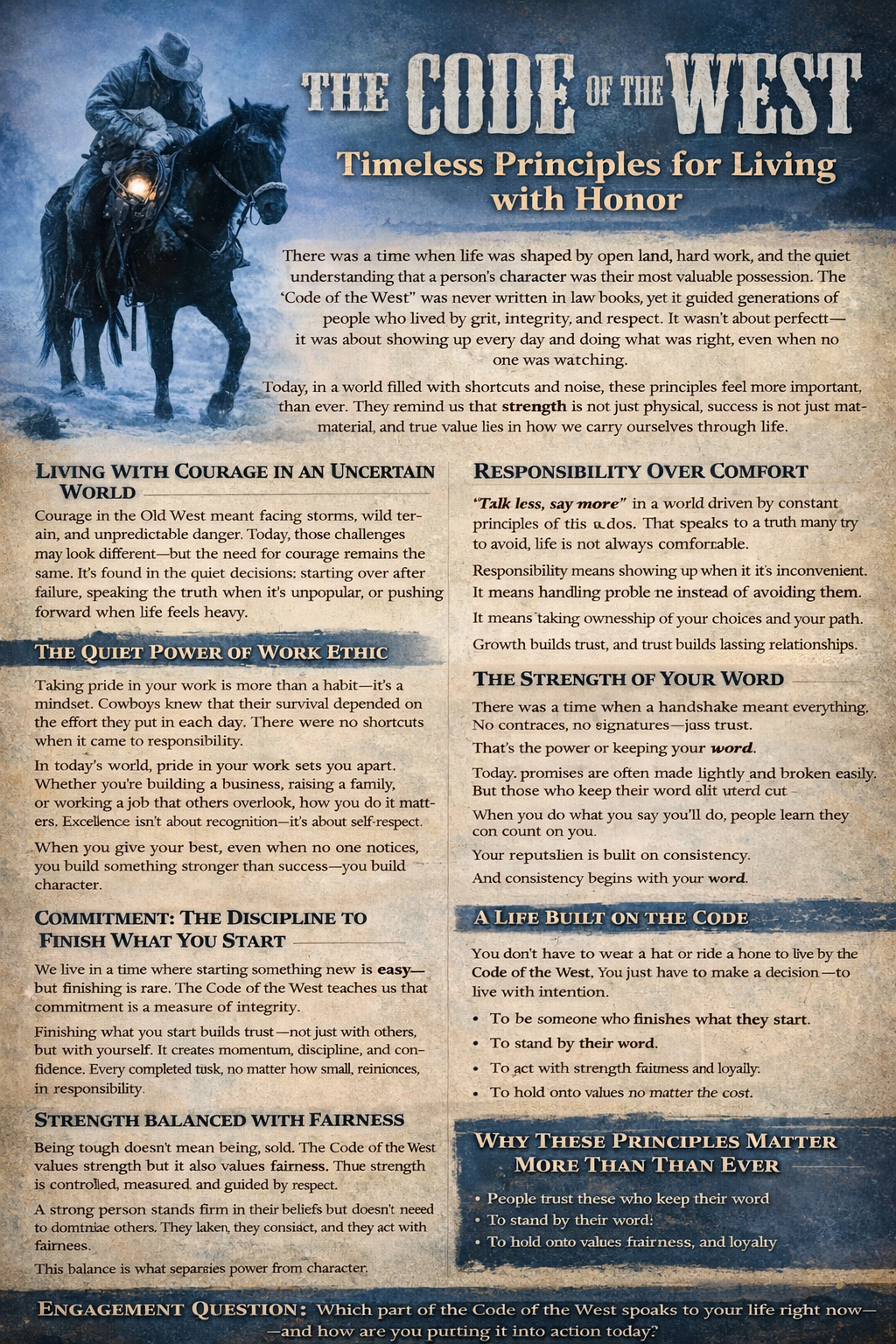
  • The Code of the West: Timeless Principles for Living with Honor

    The Code of the West: Timeless Principles for Living with Honor

    There was a time when life was shaped by open land, hard work, and the quiet understanding that a person’s character was their most valuable possession. The “Code of the West” was never written in law books, yet it guided generations of people who lived by grit, integrity, and respect. It wasn’t about perfection—it was about showing up every day and doing what was right, even when no one was watching.

    Today, in a world filled with shortcuts and noise, these principles feel more important than ever. They remind us that strength is not just physical, success is not just material, and true value lies in how we carry ourselves through life.

    Living with Courage in an Uncertain World

    Courage in the Old West meant facing storms, wild terrain, and unpredictable danger. Today, those challenges may look different—but the need for courage remains the same. It’s found in the quiet decisions: starting over after failure, speaking the truth when it’s unpopular, or pushing forward when life feels heavy.

    Courage is not always loud. Sometimes, it’s simply choosing not to quit.

    The Quiet Power of Work Ethic

    Taking pride in your work is more than a habit—it’s a mindset. Cowboys knew that their survival depended on the effort they put in each day. There were no shortcuts when it came to responsibility.

    In today’s world, pride in your work sets you apart. Whether you’re building a business, raising a family, or working a job that others overlook, how you do it matters. Excellence isn’t about recognition—it’s about self-respect.

    When you give your best, even when no one notices, you build something stronger than success—you build character.

    Commitment: The Discipline to Finish What You Start

    We live in a time where starting something new is easy—but finishing is rare. The Code of the West teaches us that commitment is a measure of integrity.

    Finishing what you start builds trust—not just with others, but with yourself. It creates momentum, discipline, and confidence. Every completed task, no matter how small, reinforces the belief that you are someone who follows through.

    Responsibility Over Comfort

    “Do what has to be done” is one of the most powerful principles of the Code. It speaks to a truth many try to avoid: life is not always comfortable.

    Responsibility means showing up when it’s inconvenient. It means handling problems instead of avoiding them. It means taking ownership of your choices and your path.

    Growth doesn’t happen in comfort—it happens in responsibility.

    Strength Balanced with Fairness

    Being tough doesn’t mean being cold. The Code of the West values strength, but it also values fairness. True strength is controlled, measured, and guided by respect.

    A strong person stands firm in their beliefs but doesn’t need to dominate others. They listen, they consider, and they act with fairness.

    This balance is what separates power from character.

    The Value of Your Word

    There was a time when a handshake meant everything. No contracts, no signatures—just trust. That’s the power of keeping your word.

    Today, promises are often made lightly and broken easily. But those who keep their word still stand out. When you do what you say you’ll do, people learn they can count on you.

    Your reputation is built on consistency. And consistency begins with your word.

    Loyalty: Riding for the Brand

    “Ride for the brand” meant standing by your ranch, your crew, and your responsibilities—no matter what. It was about loyalty, not convenience.

    In modern life, loyalty shows up in how you support your family, your friends, and your purpose. It means standing by people when it’s hard, not just when it’s easy.

    Loyalty builds trust. And trust builds lasting relationships.

    The Strength of Silence

    “Talk less, say more.” In a world driven by constant communication, this principle feels almost revolutionary.

    There is strength in listening. There is power in speaking with intention. You don’t need to prove yourself with endless words when your actions speak clearly.

    Quiet confidence often carries more weight than loud declarations.

    Integrity: Knowing Some Things Aren’t for Sale

    The Code reminds us that not everything should be traded for gain. Money, status, and recognition may come and go—but integrity stays with you.

    When you compromise your values, you lose something far greater than what you gain. But when you stand firm in what you believe, you build a foundation that cannot be shaken.

    Integrity is what you keep when everything else is gone.

    Drawing the Line: Knowing Your Boundaries

    Every person needs a line they will not cross. The Code teaches that knowing your limits—your values, your standards—is essential.

    Without boundaries, you drift. With them, you stand firm.

    Knowing where to draw the line gives you clarity, strength, and direction in a world that often tries to blur all three.

    Why These Principles Matter More Than Ever

    The modern world moves fast. It rewards attention, convenience, and instant results. But beneath all of that, the same truths still apply:

    People trust those who keep their word
    Respect is earned through actions, not words
    Strength is built through hardship
    Character defines legacy

    The Code of the West isn’t about living in the past—it’s about bringing timeless values into the present.

    It’s about choosing discipline over distraction.
    Integrity over shortcuts.
    Purpose over comfort.

    A Life Built on the Code

    You don’t have to wear a hat or ride a horse to live by the Code of the West. You just have to make a decision—to live with intention.

    To be someone who finishes what they start.
    To stand by their word.
    To act with strength, fairness, and loyalty.
    To hold onto values, no matter the cost.

    Because at the end of the day, life isn’t measured by what you accumulate—it’s measured by who you become.

    And the Code of the West offers a simple, powerful truth:

    Live right. Stand tall. Leave a legacy worth remembering.
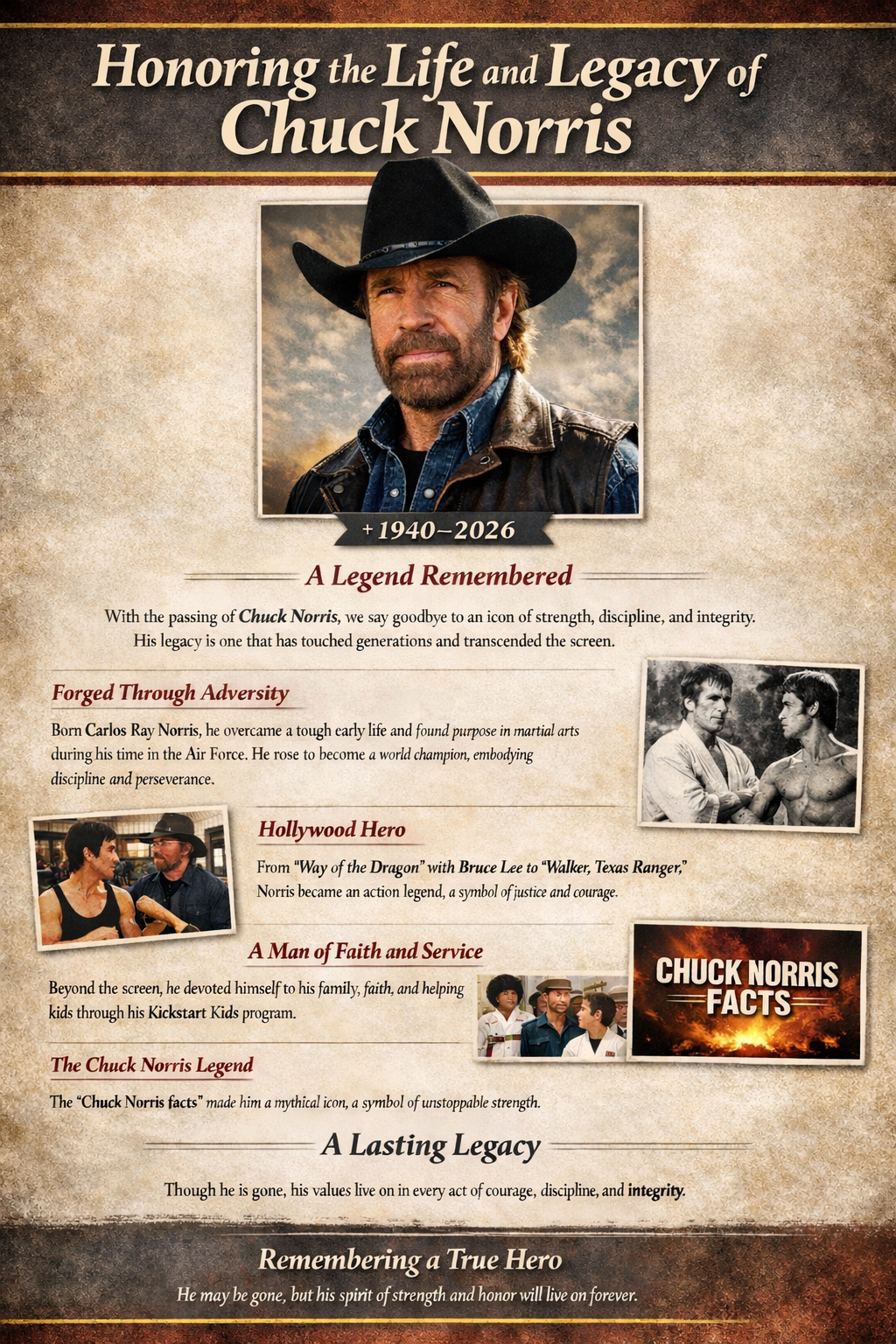
  • Honoring the Life and Legacy of Chuck Norris

    Honoring the Life and Legacy of Chuck Norris

    There are icons, there are legends—and then there are those rare individuals whose lives become a blueprint for strength, discipline, and purpose. Chuck Norris was one of those individuals. His passing is not simply the loss of a cultural figure; it is the closing of a chapter that helped define what resilience and integrity look like in modern times.

    For decades, he stood as a symbol of unwavering strength. Not just the kind displayed in action scenes or martial arts competitions—but the kind built quietly, through hardship, conviction, and consistency. To honor his life is to look beyond the myth and into the man who shaped it.

    A Beginning Forged in Adversity

    Long before the world knew his name, Chuck Norris was simply Carlos Ray Norris—a young man navigating a difficult upbringing. Born in 1940, his early years were marked by instability and struggle. These were not the conditions that typically produce icons, but they were exactly what forged his character.

    Adversity did not defeat him. It defined him.

    His life took a transformative turn when he joined the United States Air Force. While stationed overseas, he discovered martial arts. What began as a curiosity quickly became a calling. In martial arts, Norris found structure, discipline, and a path forward.

    He immersed himself completely, training relentlessly. Over time, he rose through the ranks to become a world champion in karate. But more importantly, he developed a philosophy—one rooted in respect, perseverance, and self-mastery.

    It wasn’t about being the strongest in the room. It was about being the most disciplined.

    The Rise of a New Kind of Action Hero

    Chuck Norris didn’t just step into Hollywood—he brought something entirely new with him.

    At a time when action stars were often defined by spectacle, Norris brought authenticity. His movements weren’t choreographed illusions; they were grounded in real skill. His presence wasn’t manufactured—it was earned.

    One of his most iconic moments came in Way of the Dragon, where he faced off against Bruce Lee in a battle that remains legendary. That scene wasn’t just a cinematic highlight—it was a meeting of two philosophies, two masters, and two legacies.

    From there, Norris built a career that would make him a household name. Films like Missing in Action and Delta Force showcased his no-nonsense approach to heroism. But it was Walker, Texas Ranger that cemented his place in American culture.

    As Cordell Walker, Norris represented something audiences deeply craved: a hero who stood for justice without compromise. He wasn’t cynical. He wasn’t morally conflicted. He was steady, principled, and unshakable.

    In a world growing more complex, Chuck Norris remained clear.

    Beyond the Screen: A Life of Purpose

    What truly set Chuck Norris apart was not his success—but what he chose to do with it.

    Behind the fame was a man deeply committed to faith, family, and service. He understood that influence carries responsibility, and he embraced that responsibility fully.

    Through his organization, Kickstart Kids, Norris worked tirelessly to mentor young people. Using martial arts as a foundation, the program taught discipline, respect, and confidence to students who needed it most.

    He believed that strength wasn’t just physical—it was moral, emotional, and spiritual.

    Norris also became a voice for values that often feel overlooked in modern society. Through books, interviews, and public speaking, he emphasized the importance of integrity, perseverance, and accountability.

    He didn’t just play a hero. He lived like one.

    The Myth, the Humor, and the Man

    Few public figures ever reach the level of cultural transcendence that Chuck Norris achieved.

    The “Chuck Norris facts” phenomenon turned him into something larger than life—an unstoppable force capable of the impossible. While humorous, these exaggerated tales carried a deeper truth: people saw in him a symbol of ultimate strength.

    But what made those jokes endure wasn’t just their humor—it was their foundation. They worked because Chuck Norris already felt larger than life.

    And yet, beneath the myth was a man of humility.

    He never chased the legend. He simply lived his values—and the legend followed.

    A World in Mourning

    With the passing of Chuck Norris, the world pauses.

    For some, it is the loss of a childhood hero. For others, it is the loss of a role model. For many, it is the loss of a symbol—a reminder of what it means to stand strong in a world that often demands compromise.

    His absence is deeply felt because his presence was so impactful.

    He represented a kind of strength that feels increasingly rare: quiet, steady, and rooted in principle. Not loud. Not boastful. Just unshakable.

    And while his physical presence may be gone, the imprint he leaves behind is undeniable.

    The Enduring Legacy of Strength

    Legacies are not measured in years—they are measured in impact. And Chuck Norris’ impact is immeasurable.

    His life continues to ripple outward:

    In every person who chooses discipline over distraction

    In every young student who finds confidence through structure and guidance

    In every act of courage that stands firm in the face of pressure

    In every reminder that true strength begins within

    He showed the world that resilience is built, not given. That character matters more than recognition. That the strongest people are often the quietest ones in the room.

    Final Reflection: Carrying the Torch

    To honor Chuck Norris is to do more than remember him—it is to carry forward what he stood for.

    It is to live with intention.
    To act with integrity.
    To stand firm when it would be easier to fold.
    To build strength not just in body, but in spirit.

    His life was a testament to what is possible when discipline meets purpose. And though he has passed, the principles he embodied remain within reach for all of us.

    Legends never truly leave. They live on in the choices we make, the values we uphold, and the strength we choose to build within ourselves.

    Chuck Norris may be gone—but what he stood for will never fade.

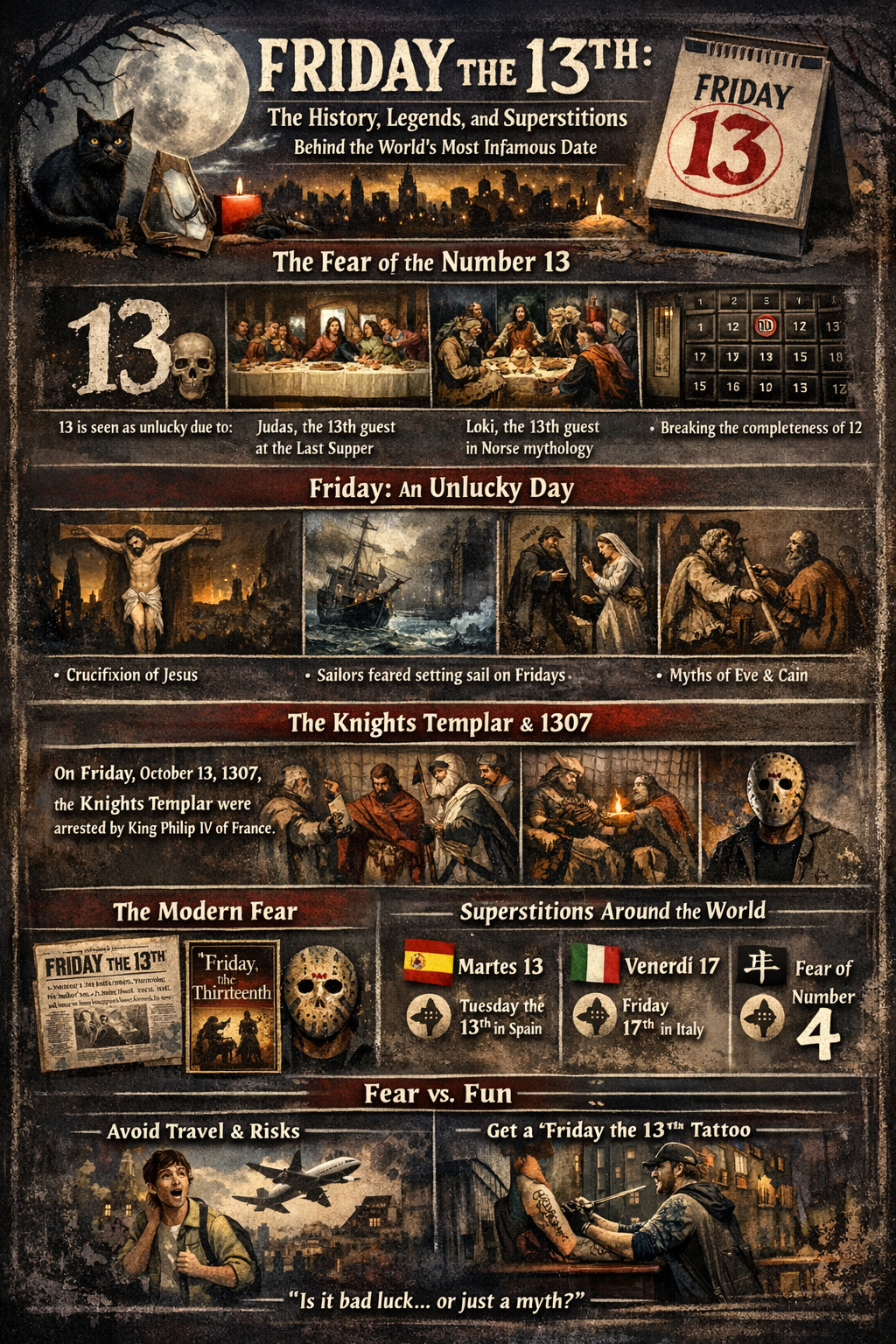
  • Friday the 13th: The History, Legends, and Superstitions Behind the World’s Most Infamous Date

    Friday the 13th: The History, Legends, and Superstitions Behind the World’s Most Infamous Date

    Few dates on the calendar carry the same chilling reputation as Friday the 13th. For generations, this day has been surrounded by mystery, superstition, and a lingering sense of unease. Many people associate it with bad luck, strange accidents, or unfortunate events, while others see it as nothing more than an entertaining myth.

    Despite its eerie reputation, Friday the 13th is not tied to a single origin story. Instead, its legend developed slowly over centuries, blending religious symbolism, ancient mythology, historical events, and cultural storytelling. The result is one of the most widely recognized superstitions in the modern world.

    Whether someone fears the date or laughs it off, the mystique of Friday the 13th continues to capture imaginations across cultures.

    The Fear of the Number 13

    Long before the date Friday the 13th gained its dark reputation, the number 13 itself had already been viewed with suspicion. The fear of the number is known as triskaidekaphobia, a term used to describe the irrational fear or avoidance of the number.

    Many scholars believe the superstition stems from the idea that 12 represents completeness or harmony, while 13 disrupts that balance. Throughout history and across cultures, the number 12 appears repeatedly as a symbol of order:

    12 months in a year

    12 zodiac signs

    12 Olympian gods in Greek mythology

    12 tribes of Israel

    12 apostles in Christian tradition

    12 hours on a clock face

    When the number 13 appears after this symbolic completeness, it seems to break the pattern, creating a sense of imbalance.

    One of the most frequently cited examples comes from Christian tradition. During the Last Supper, there were thirteen people at the table: Jesus and his twelve disciples. Judas Iscariot, the disciple who later betrayed Jesus, is often described as the 13th guest. Over time, this story fueled the belief that gathering thirteen people together would bring bad luck or tragedy.

    Another myth originates from Norse mythology. In the story, twelve gods gathered for a feast in Valhalla. Loki, the mischievous trickster god, arrived as the uninvited 13th guest. His presence led to deception and ultimately to the death of the beloved god Balder. This story reinforced the symbolic danger of the number thirteen.

    Because of these traditions, the number has long been treated cautiously. Even today, many buildings skip the 13th floor, hospitals avoid room number 13, and some airlines omit row 13 entirely.

    Why Friday Was Considered Unlucky

    Just as the number 13 had its own negative associations, Friday itself was once considered an unlucky day in many Western traditions.

    In Christian belief, Good Friday, the day Jesus was crucified, was a day of sorrow and sacrifice. Because of this association, Friday gradually became linked with misfortune in folklore.

    During the Middle Ages, a variety of superstitions developed around the day. Many believed it was unlucky to begin a journey, start a business venture, or hold an important event on a Friday. Sailors were said to be particularly wary of setting sail on that day, fearing storms or disaster.

    Some legends even claimed that major biblical events occurred on Fridays, including:

    Eve giving Adam the forbidden fruit

    Cain killing Abel

    The Great Flood beginning

    While historians debate the accuracy of these claims, the stories helped cement Friday’s reputation as a day when things might go wrong.

    When this already suspicious day eventually combined with the feared number 13, it created a superstition that seemed doubly ominous.

    The Knights Templar and Friday the 13th

    One historical event often associated with the superstition took place on Friday, October 13, 1307.

    On that day, King Philip IV of France ordered the mass arrest of the Knights Templar, a powerful religious military order that had gained immense wealth and influence during the Crusades. The king, deeply in debt to the order, accused the Templars of heresy, blasphemy, and other crimes.

    Hundreds of knights were arrested across France in a coordinated raid. Many were imprisoned, tortured into confessions, and eventually executed. The order was later dissolved by the Church.

    Because the arrests occurred on a Friday the 13th, some historians believe this tragic event helped fuel the superstition. However, there is little evidence that people at the time viewed the date as cursed. The connection between the event and the superstition appears to have been emphasized much later in history.

    Nevertheless, the dramatic story of betrayal, secrecy, and persecution fits perfectly into the mythology surrounding the infamous date.

    The Birth of the Modern Friday the 13th Legend

    Interestingly, the widespread fear of Friday the 13th as a specific date did not become common until relatively recently.

    One major influence came in 1907 with the publication of the novel Friday, the Thirteenth by Thomas W. Lawson. The book tells the story of a stockbroker who exploits public superstition about the date to manipulate the stock market and cause financial panic. The novel was widely read and helped popularize the idea that the day itself carried special misfortune.

    In the late 20th century, the superstition gained even more visibility through entertainment. The Friday the 13th horror film series, beginning in 1980, turned the date into a symbol of terror for an entire generation. The iconic hockey mask worn by the villain Jason Voorhees became one of the most recognizable images in horror history.

    These films did not create the superstition, but they amplified it in popular culture.

    Friday the 13th Around the World

    Interestingly, not every culture fears Friday the 13th.

    In some countries, other dates carry the unlucky reputation:

    In Spain and Greece, the unlucky day is Tuesday the 13th

    In Italy, the feared date is often Friday the 17th

    In parts of East Asia, the number 4 is considered unlucky because its pronunciation is similar to the word for death

    These variations show how superstition is shaped by cultural traditions rather than universal truths.

    Real-World Effects of the Superstition

    Even though there is no scientific evidence that Friday the 13th brings bad luck, the superstition still has measurable effects.

    Studies have shown that on Friday the 13th:

    Some people avoid flying or traveling

    Fewer weddings and major events are scheduled

    Businesses occasionally experience lower sales

    Anxiety increases among those who believe in the superstition

    Economists have even estimated that fear of the date costs businesses hundreds of millions of dollars in lost productivity and travel each year.

    Ironically, some researchers suggest that accidents may slightly increase on the day—not because it is cursed, but because anxious people behave differently when they expect bad luck.

    Turning Fear Into Celebration

    In recent years, many people have begun embracing Friday the 13th rather than fearing it.

    Tattoo shops around the world often hold Friday the 13th tattoo events, offering small themed tattoos at discounted prices. These gatherings attract long lines of customers eager to celebrate the day’s rebellious spirit.

    Others treat the date as a chance to challenge superstition by doing things they might normally avoid. For them, Friday the 13th becomes a reminder that fear often comes from stories rather than reality.

    In this way, the once-feared date has slowly transformed into a cultural phenomenon—part spooky tradition, part playful myth.

    The Power of Superstition

    The enduring legend of Friday the 13th reveals something powerful about human nature. People have always searched for patterns and meaning in the events around them. When misfortune happens on a certain day, it is easy to connect the two, even when the link may not exist.

    Over centuries, scattered myths about the number 13, the symbolism of Friday, historical tragedies, and modern storytelling combined into one unforgettable superstition.

    Yet for all its mystery, Friday the 13th ultimately reminds us that sometimes the scariest things in life are the stories we pass down from generation to generation.