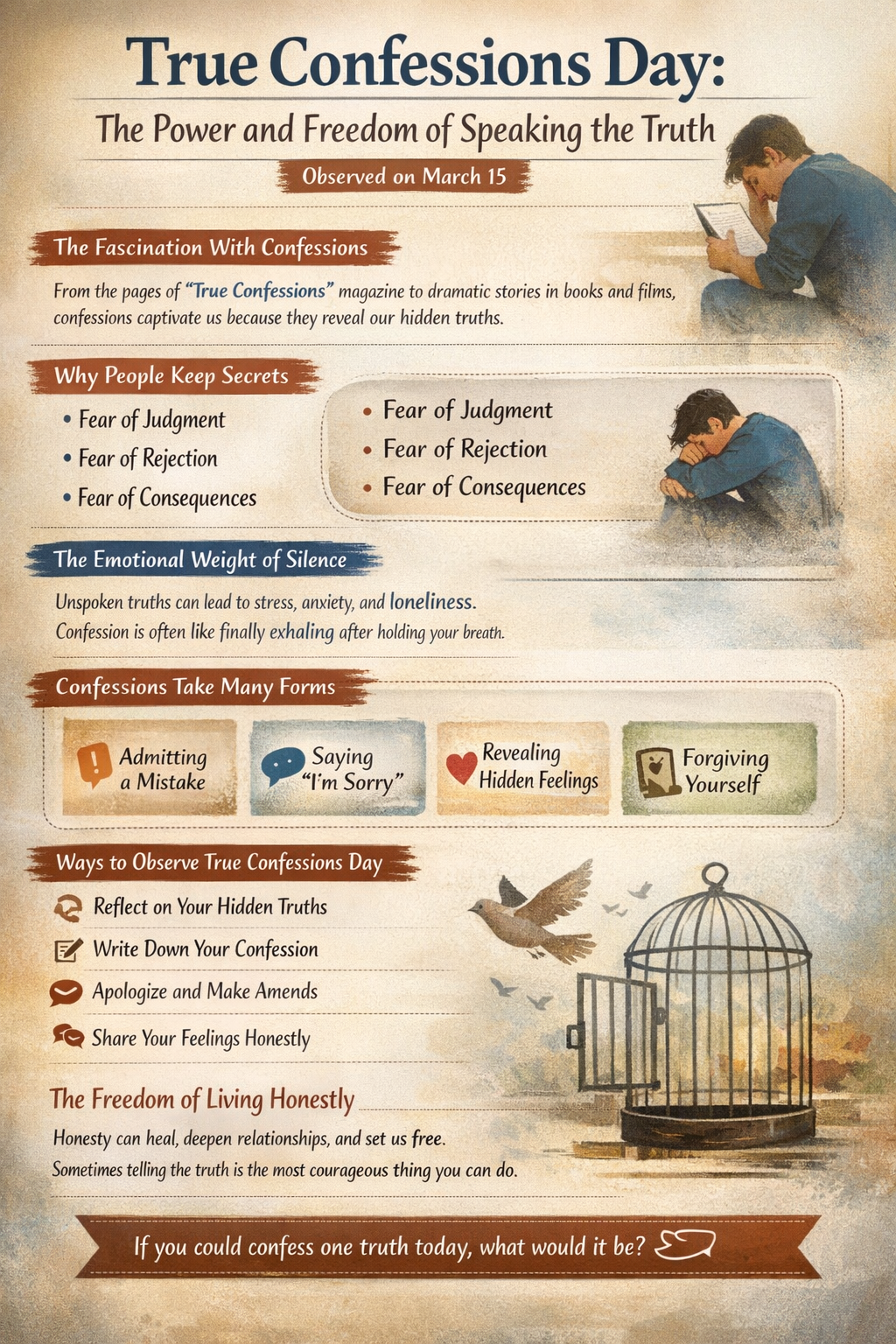
Every year on March 15, a little-known but deeply meaningful holiday invites people to confront something many of us struggle with—honesty. True Confessions Day is not about celebration in the traditional sense. There are no decorations, gifts, or parties. Instead, it is a day devoted to reflection, courage, and the possibility of emotional freedom.
We all carry secrets. Some are small—thoughts we never shared or words we wish we had said differently. Others run deeper—regrets, hidden feelings, apologies left unspoken, or truths we feared might change everything. True Confessions Day reminds us that sometimes the most powerful thing a person can do is simply tell the truth.
For many people, confession is not about guilt or shame. It is about release. It is about lifting the weight of silence that has been sitting on the heart for far too long.
The Fascination With Confessions
Human beings have always been drawn to confessions. There is something deeply compelling about hearing someone reveal a truth they have carried quietly for years. Confessions appear everywhere in our culture—literature, movies, television, and even social media.
One cultural influence connected to the spirit of the holiday is True Confessions, a publication that began in the early 1900s. The magazine featured dramatic personal stories filled with love, betrayal, mistakes, redemption, and emotional revelations. Readers were fascinated because these stories reflected real human struggles.
The appeal of confession is simple: when someone tells the truth about their life, others often recognize pieces of themselves in that story. It reminds us that we are not alone in our mistakes, fears, or complicated emotions.
Why People Keep Secrets
If honesty is so freeing, why do people hide the truth?
The answer usually comes down to fear.
People fear being judged.
They fear losing someone they care about.
They fear rejection, embarrassment, or consequences.
Sometimes people also stay silent because they believe the moment to speak has already passed. A person might think, “It’s been too long. I should have said something years ago.”
But the truth is that unspoken feelings rarely disappear. Instead, they linger quietly in the background of our lives. Over time, those unsaid words can grow heavier.
Many people know the feeling of replaying a moment in their mind—wishing they had apologized, admitted their feelings, or told someone how much they mattered.
The Emotional Weight of Silence
Holding onto secrets can be exhausting.
When people suppress their truth, it can lead to stress, anxiety, and emotional isolation. They may feel disconnected from others because part of their real self remains hidden.
Psychologists often talk about the emotional relief that comes from honest expression. When people share something they have been holding inside, they frequently experience a sense of release—almost like finally exhaling after holding their breath for a long time.
Confession can be healing because it allows people to stop pretending.
Instead of carrying the burden alone, they allow someone else to see the real story.
Confessions Come in Many Forms
When people hear the word confession, they sometimes imagine dramatic revelations—like those seen in movies. But in reality, most confessions are simple, quiet, and deeply human.
A confession might be:
Admitting you made a mistake.
Telling someone you forgive them.
Saying “I’m sorry” after years of silence.
Revealing feelings you’ve been afraid to express.
Acknowledging something painful you’ve been denying.
Sometimes the most important confession is not spoken to another person at all.
Sometimes the hardest truth to admit is the one we finally say to ourselves.
The Courage Behind Honesty
Speaking the truth requires vulnerability, and vulnerability takes courage.
When someone confesses something meaningful, they are taking a risk. They are choosing authenticity over comfort. They are allowing themselves to be seen without the protection of silence.
Not every confession will lead to the outcome someone hopes for. Some truths may change relationships. Some may bring difficult conversations.
But even when the outcome is uncertain, honesty has a powerful way of creating clarity. It removes the confusion that secrets create and replaces it with reality—something people can finally face and move forward from.
Truth may not always be easy, but it is often freeing.
Ways to Observe True Confessions Day
You do not have to reveal your deepest secret to the world to participate in True Confessions Day. Instead, the day can be used as a moment for thoughtful honesty and personal reflection.
Here are some meaningful ways to observe the day:
Reflect on What You’ve Been Holding Inside
Take a moment to ask yourself if there is something you’ve been carrying emotionally. Is there a truth that might bring peace if it were spoken?
Write a Confession
Writing can be a powerful outlet. Even if you never share it with anyone, putting your truth on paper can help you process it.
Offer a Long-Overdue Apology
Sometimes the most healing words a person can say are simply, “I’m sorry.”
Tell Someone How You Really Feel
Many people go through life without ever hearing how much they mean to someone. True Confessions Day can be a chance to change that.
Forgive Yourself
Not every confession needs an audience. Sometimes the most important truth is acknowledging your past and allowing yourself to move forward.
The Freedom of Living Honestly
The real message behind True Confessions Day is not about exposing secrets—it is about embracing authenticity.
Life becomes lighter when people stop hiding parts of themselves. When honesty replaces silence, relationships can deepen, healing can begin, and individuals can grow into more genuine versions of themselves.
Truth has a strange but powerful way of setting people free.
And sometimes all it takes is one moment of courage—one honest conversation, one sincere apology, or one heartfelt admission—to change everything.
Leave a Reply