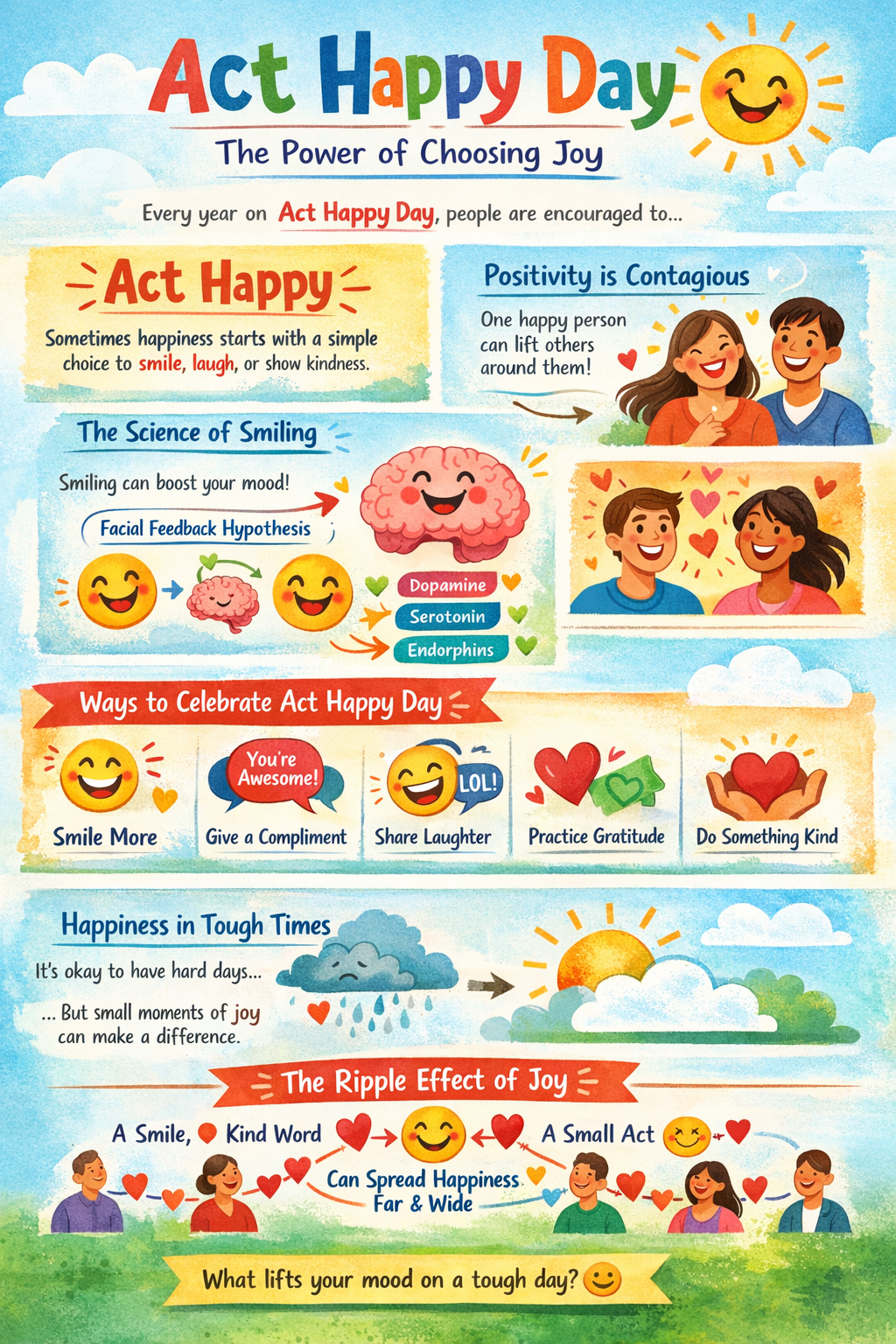
Every year on Act Happy Day, people are encouraged to try something surprisingly simple—act happy. At first glance, the idea may sound a little strange. How can someone act happy if they don’t actually feel happy? Yet the meaning behind this day goes far deeper than just putting on a smile.
Act Happy Day is a reminder that our emotions and actions are more connected than we often realize. Sometimes happiness follows life’s good moments. Other times, happiness begins with a decision to change how we approach the day.
In a world that can feel heavy with stress, responsibilities, and uncertainty, this lighthearted holiday encourages people to rediscover the power of positivity—even if it starts as an intentional effort.
The Idea Behind Acting Happy
Many people believe happiness is something that simply happens to them. We wait for good news, success, love, or a peaceful moment before allowing ourselves to feel joy. But Act Happy Day challenges that way of thinking.
Instead of waiting for happiness to arrive, the day encourages people to practice it.
Acting happy might mean smiling a little more, speaking kindly to others, laughing at something silly, or choosing gratitude instead of frustration. These small actions might seem insignificant, but they often have a surprising effect.
When you behave in positive ways, your brain begins to respond. Mood can shift. Stress can ease. Perspective can change.
What started as a simple action can slowly turn into a genuine emotional experience.
The Science of Smiling
One of the reasons Act Happy Day works is rooted in psychology and biology. Researchers have studied something called the facial feedback hypothesis, which suggests that our facial expressions influence our emotional state.
In simple terms, when you smile—even if it begins as a forced smile—your brain releases chemicals like dopamine, serotonin, and endorphins. These chemicals are associated with feelings of happiness and relaxation.
Your body begins to respond as if the happiness were real.
It’s a fascinating example of how the mind and body constantly influence each other. Just as sadness can affect posture and energy levels, positive physical expressions can influence mood.
This doesn’t mean a smile magically erases pain or struggles, but it does show that small positive actions can create meaningful emotional changes.
The Power of Positive Energy
Another reason acting happy can have such a strong effect is that emotions are often contagious. Humans naturally mirror the moods of the people around them.
If someone enters a room frustrated or angry, that energy can spread quickly. But the same is true for positivity. A cheerful attitude, a warm greeting, or a simple laugh can change the entire atmosphere of a room.
When one person chooses kindness or joy, others often respond the same way.
This ripple effect is one of the most beautiful aspects of Act Happy Day. A single positive action can travel far beyond the moment it was created.
Simple Ways to Celebrate Act Happy Day
Celebrating Act Happy Day doesn’t require anything elaborate. In fact, the spirit of the day lies in the smallest gestures.
Here are a few simple ways people embrace the holiday:
Smile More Often
A smile can instantly change the tone of a conversation. It signals openness, warmth, and positivity.
Compliment Someone
A sincere compliment can brighten someone’s entire day. It might be as simple as telling someone they did a great job or that you appreciate them.
Share Laughter
Watch something funny, tell a joke, or reminisce about a hilarious memory with a friend. Laughter has a powerful way of lifting spirits.
Practice Gratitude
Take a moment to think about the good things in your life—even the small ones. Gratitude can quickly shift perspective.
Do Something Kind
Helping someone else often creates happiness for both people involved. Whether it’s offering encouragement, lending a hand, or simply listening, kindness spreads joy.
Take a Break From Negativity
Spend a day stepping away from negative news, arguments online, or stressful conversations. Protecting your peace can help your mind reset.
Happiness Doesn’t Mean Ignoring Reality
It’s important to understand that Act Happy Day isn’t about pretending everything in life is perfect. Everyone experiences sadness, stress, grief, or loneliness at times. Those emotions are part of being human.
Instead, the day is about remembering that moments of joy can still exist even during difficult seasons.
Acting happy is not about denying pain—it’s about allowing yourself to experience light alongside the darkness.
Sometimes a small moment of laughter or kindness can make a hard day feel just a little more manageable.
Why the World Needs More Happiness
Modern life often moves quickly. People are busy with work, responsibilities, financial pressures, and endless distractions. Stress can build quietly over time, leaving many people feeling overwhelmed.
Days like Act Happy Day serve as gentle reminders to slow down and reconnect with something simple: joy.
Happiness doesn’t always come from big accomplishments or dramatic life changes. Often it lives in the quiet moments—sharing a laugh, hearing a favorite song, watching a sunset, or receiving a message from someone who cares.
When people intentionally seek out these moments, life begins to feel a little brighter.
The Ripple Effect of Joy
Perhaps the most powerful lesson of Act Happy Day is how far happiness can travel.
One smile can encourage another.
One act of kindness can inspire several more.
One person choosing positivity can shift an entire environment.
These ripples can move through families, workplaces, communities, and even strangers passing on the street.
You may never fully know how much a small gesture affects someone else. But sometimes the smallest actions leave the biggest impact.
A Simple Choice
At its heart, Act Happy Day reminds us that happiness is not always something we must wait for. Sometimes it begins with a simple choice.
A choice to smile.
A choice to be kind.
A choice to laugh.
A choice to look for something good in the middle of an ordinary day.
And sometimes, by acting happy—even just a little—we give ourselves permission to truly feel it.
Leave a Reply