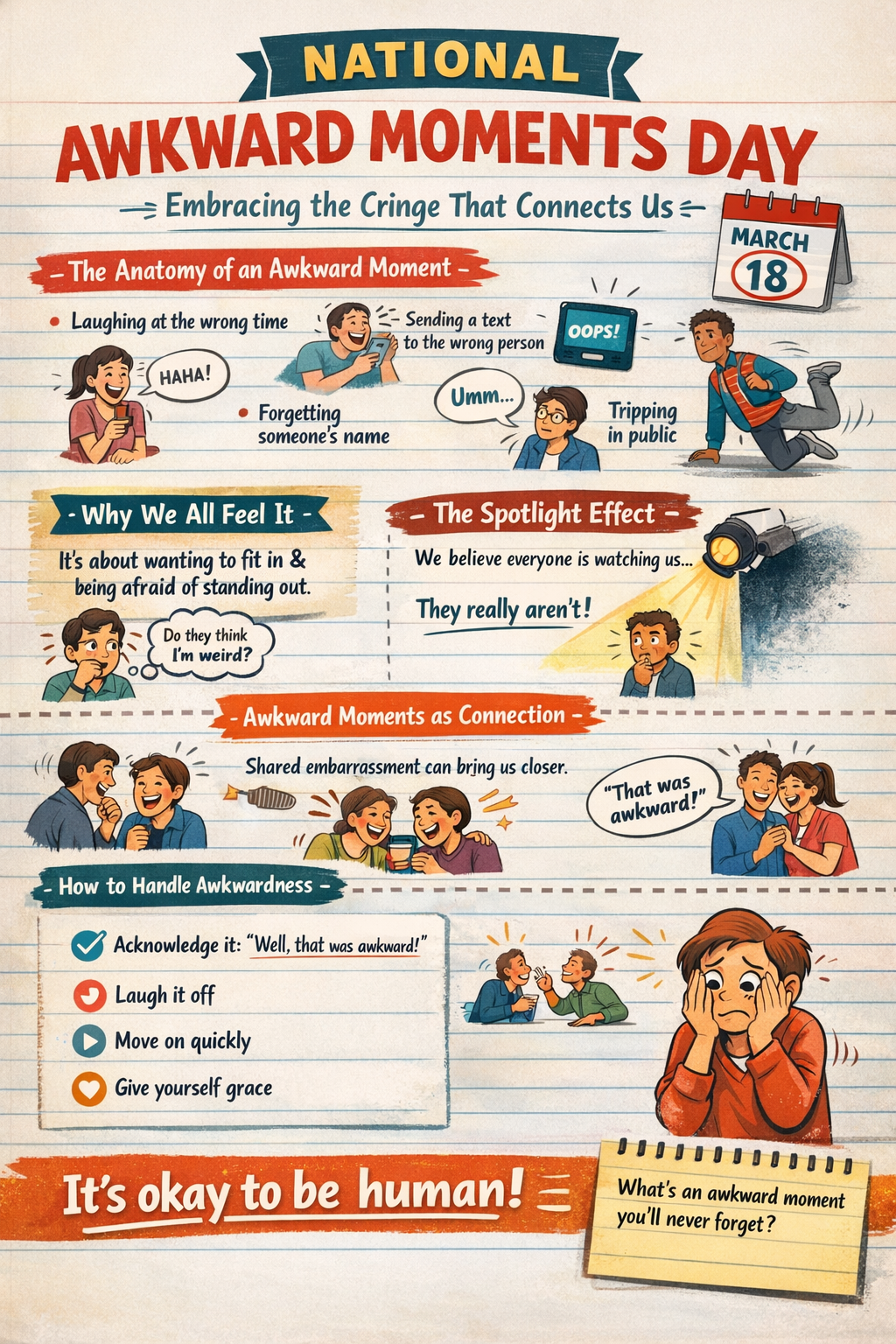
Every year on March 18th, we celebrate something deeply human, wildly uncomfortable, and often unintentionally hilarious—National Awkward Moments Day. It’s a day that invites us to stop hiding from our most cringe-worthy memories and instead lean into them, laugh at them, and maybe even learn from them.
Because the truth is, awkward moments aren’t rare accidents—they’re part of the shared experience of being alive.
The Anatomy of an Awkward Moment
An awkward moment usually arrives uninvited. It’s that sudden shift in energy when something doesn’t land right—when a joke falls flat, a handshake turns into a hug collision, or you confidently say something completely wrong.
It’s:
Laughing at the wrong time
Forgetting someone’s name mid-conversation
Sending a text to the wrong person
Walking into a room and forgetting why you’re there
Or worse… realizing everyone noticed
What makes these moments powerful isn’t the mistake itself—it’s the awareness of it. That instant when you know something is off, and there’s no graceful exit.
Why Awkwardness Feels So Intense
Awkward moments hit hard because they tap into something deeper than embarrassment—they challenge our sense of belonging.
Humans are wired for connection. We want to be accepted, understood, and liked. So when something awkward happens, it can feel like we’ve disrupted that connection, even if only for a second.
Your brain reacts quickly:
“Did I just ruin that interaction?”
“Do they think I’m weird?”
“Why did I say that?”
And just like that, a five-second moment turns into a five-day mental replay.
The “Spotlight Effect” Trap
One of the biggest reasons awkward moments stick with us is something psychologists call the spotlight effect—the tendency to believe people are paying far more attention to us than they actually are.
In reality? Most people:
Didn’t notice
Didn’t care
Or forgot almost immediately
Meanwhile, you’re still thinking about it years later.
That’s the irony of awkwardness—we carry moments that no one else is holding onto.
Awkwardness Across Life Stages
Awkward moments evolve as we do. They don’t disappear—they just change form.
As kids:
It’s tripping in class, saying something “wrong,” or being called out in front of others.
As teenagers:
Awkwardness intensifies. Social pressure, identity, and self-awareness peak. Everything feels magnified—from how you talk to how you stand.
As adults:
It becomes more subtle but no less real:
Workplace misunderstandings
Social misreads
Dating misfires
Saying “you too” when the waiter says “enjoy your meal”
The stakes feel different, but the feeling is the same.
When Awkward Turns Into Anxiety
For some, awkward moments aren’t just funny memories—they can trigger deeper anxiety.
If you’ve ever avoided speaking up, meeting new people, or putting yourself out there because of fear of embarrassment, you’re not alone.
Awkwardness can:
Make you overanalyze conversations
Cause you to replay interactions repeatedly
Lead to self-doubt or withdrawal
But here’s the important distinction: awkward moments are temporary—avoidance can become permanent.
Growth lives on the other side of discomfort.
The Hidden Gift of Awkward Moments
As uncomfortable as they feel, awkward moments can actually be powerful teachers.
They:
Build humility
Strengthen resilience
Improve self-awareness
Help you develop social intuition
More importantly, they remind you that perfection isn’t required to connect with others.
In fact, imperfection often makes you more relatable.
Awkward Moments as Social Glue
Think about the last time something awkward happened in a group—and everyone laughed.
That shared moment likely:
Broke tension
Made people feel more comfortable
Created a memory
Awkwardness, when embraced, becomes a bridge instead of a barrier.
It says, “Hey, I’m human too.”
And that’s something everyone understands.
Rewriting the Narrative
What if awkward moments weren’t something to recover from—but something to accept?
Instead of:
“That was terrible.”
Try: “That was human.”
Instead of:
“I embarrassed myself.”
Try: “I had a moment.”
This shift doesn’t erase the feeling—but it softens it. It gives you space to move forward without carrying unnecessary weight.
How to Handle Awkward Moments in Real Time
When awkwardness strikes, you don’t have to panic. Try this:
1. Acknowledge it
A simple “Well, that was awkward” can instantly diffuse tension.
2. Laugh if you can
Humor is one of the fastest ways to reset a moment.
3. Don’t over-explain
Most situations don’t need a long recovery speech.
4. Move on quickly
The faster you let it go, the less power it has.
5. Give yourself grace
You’re allowed to be imperfect.
Celebrating the Cringe
National Awkward Moments Day is more than just a quirky observance—it’s a reminder to stop taking ourselves so seriously.
Today is a chance to:
Share a story that once made you cringe
Laugh at something you used to overthink
Forgive yourself for a moment that still lingers
Because those moments? They didn’t break you.
They shaped you.
Final Reflection
Awkward moments are proof that you’re living, interacting, risking, and showing up. They’re not signs of failure—they’re signs of participation.
And in a world where so many people hold back out of fear, there’s something quietly powerful about being willing to be a little awkward.
So the next time it happens—and it will—remember:
You’re not alone.
You’re not broken.
You’re just human.
Leave a Reply