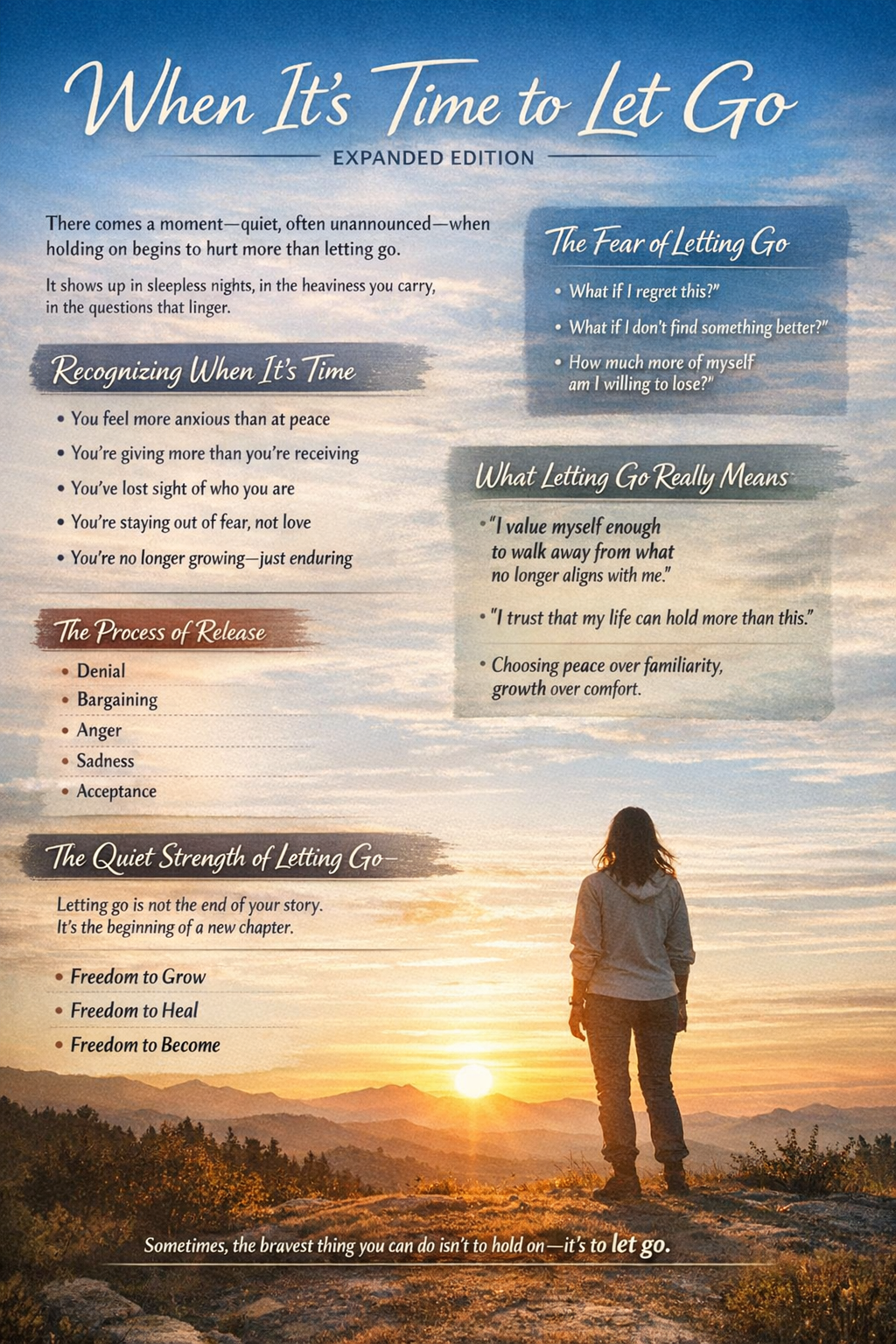
There comes a moment—quiet, often unannounced—when holding on begins to hurt more than letting go. It doesn’t arrive with a loud declaration or a clear signpost. Instead, it seeps into your life slowly. It shows up in sleepless nights, in overthinking conversations, in the way your energy feels constantly drained. It lives in the silence after everything has been said, and in the tension of things left unsaid.
Letting go is one of the most difficult emotional experiences we face—not because we don’t understand how, but because we don’t want to accept why. We hold on out of love, loyalty, history, and hope. Especially hope.
Hope can be beautiful, but it can also keep us stuck in places we’ve outgrown.
We hold on to people who no longer meet us where we stand. We hold on to relationships that once felt like home but now feel like obligation. We hold on to dreams we built in a different version of ourselves—dreams that no longer align with who we’re becoming.
And still, we stay.
We tell ourselves:
“Maybe things will change.”
“Maybe I just need to try harder.”
“Maybe this is just a rough season.”
But deep down, there’s a voice—quiet but persistent—that whispers the truth. And the truth is this: not everything is meant to stay.
Some connections are meant to teach you, not keep you. Some experiences are meant to shape you, not define your forever.
The Weight of Holding On
Holding on can feel like strength. It can feel like commitment, resilience, even love. But there is a line where holding on stops being strength and starts becoming self-abandonment.
You begin to lose pieces of yourself:
Your peace
Your confidence
Your sense of direction
Your emotional stability
You start making excuses for things you once said you would never tolerate. You silence your own needs to keep something—or someone—intact. You shrink to fit into spaces that no longer have room for your growth.
And the hardest part? You remember what it used to be. You remember the laughter, the connection, the potential. You’re not just holding on to what is—you’re holding on to what was.
That’s what makes letting go so painful. You’re not just releasing a person, a situation, or a dream—you’re releasing the version of yourself that existed within it.
Recognizing When It’s Time
Letting go doesn’t come with a clear instruction manual, but there are signs—subtle at first, then undeniable:
You feel more anxious than at peace
You’re constantly overthinking instead of feeling secure
You’re giving more than you’re receiving, and it’s no longer sustainable
You feel emotionally exhausted, even when nothing “major” has happened
You’ve lost sight of who you are outside of the situation
You stay because you’re afraid of what life looks like without it
Perhaps the clearest sign is this: you’re no longer growing—you’re just enduring.
Growth feels expansive, even when it’s hard. Endurance feels heavy, even when it’s familiar.
The Fear of Letting Go
Letting go forces you to confront uncertainty. And uncertainty is uncomfortable. It asks you to step into the unknown without guarantees.
You might ask yourself:
What if I regret this?
What if I don’t find something better?
What if this was my chance?
These fears are real, and they deserve to be acknowledged—not dismissed. But they shouldn’t be the reason you stay in something that’s slowly breaking you.
Because there’s another set of questions you need to ask:
What happens if I stay?
How much more of myself am I willing to lose?
Is this the life I truly want?
Sometimes, staying is the greater risk.
What Letting Go Really Means
Letting go is often misunderstood. It’s not about erasing the past or pretending something didn’t matter. It’s not about anger or resentment. And it’s definitely not about weakness.
Letting go is an act of self-respect.
It’s saying:
“I acknowledge what this was, but I also recognize what it has become.”
“I value myself enough to walk away from what no longer aligns with me.”
“I trust that my life can hold more than this.”
It’s choosing peace over familiarity. Growth over comfort. Truth over illusion.
And sometimes, it’s choosing yourself for the first time in a long time.
The Process of Release
Letting go isn’t a single decision—it’s a process. A layered, emotional journey that unfolds over time.
You might cycle through:
Denial (“It’s not that bad”)
Bargaining (“If I just try harder…”)
Anger (“Why did this happen?”)
Sadness (“I didn’t want it to end like this”)
Acceptance (“This is what needs to happen”)
These stages don’t come in order, and they don’t follow a timeline. Some days you’ll feel strong. Other days, you’ll feel like you’re starting over.
That’s okay.
Healing is not linear. Letting go is not perfect.
What matters is that you keep choosing forward.
Rebuilding After Letting Go
After you let go, there is a space that feels unfamiliar. At first, it might feel like emptiness. But it’s not emptiness—it’s openness.
It’s space that was once filled with stress, confusion, or emotional weight.
Now, it’s yours.
This is where rebuilding begins:
Rediscovering who you are
Reconnecting with what brings you joy
Setting new boundaries
Learning to trust yourself again
You begin to realize that your identity was never meant to be tied to one person, one outcome, or one chapter of your life.
You are bigger than what you had to release.
The Quiet Strength of Letting Go
Letting go is not loud. It doesn’t always come with closure or a clear ending. Sometimes, it’s simply a quiet decision you make within yourself:
“I’m done carrying this.”
And that decision changes everything.
Over time, the weight lifts. The overthinking fades. The emotional noise quiets. And what replaces it isn’t just relief—it’s clarity.
You start to see things as they truly were, not just as you hoped they would be.
And with that clarity comes peace.
Closing Thoughts
Letting go will always carry a sense of loss. That’s the price of caring deeply. But it also carries something else—something powerful:
Freedom.
Freedom to grow.
Freedom to heal.
Freedom to step into a life that feels aligned, genuine, and whole.
Sometimes, the bravest thing you can do isn’t to keep holding on.
It’s to release—with grace, with gratitude, and with the quiet belief that what’s meant for you will never require you to lose yourself to keep it.
Leave a Reply