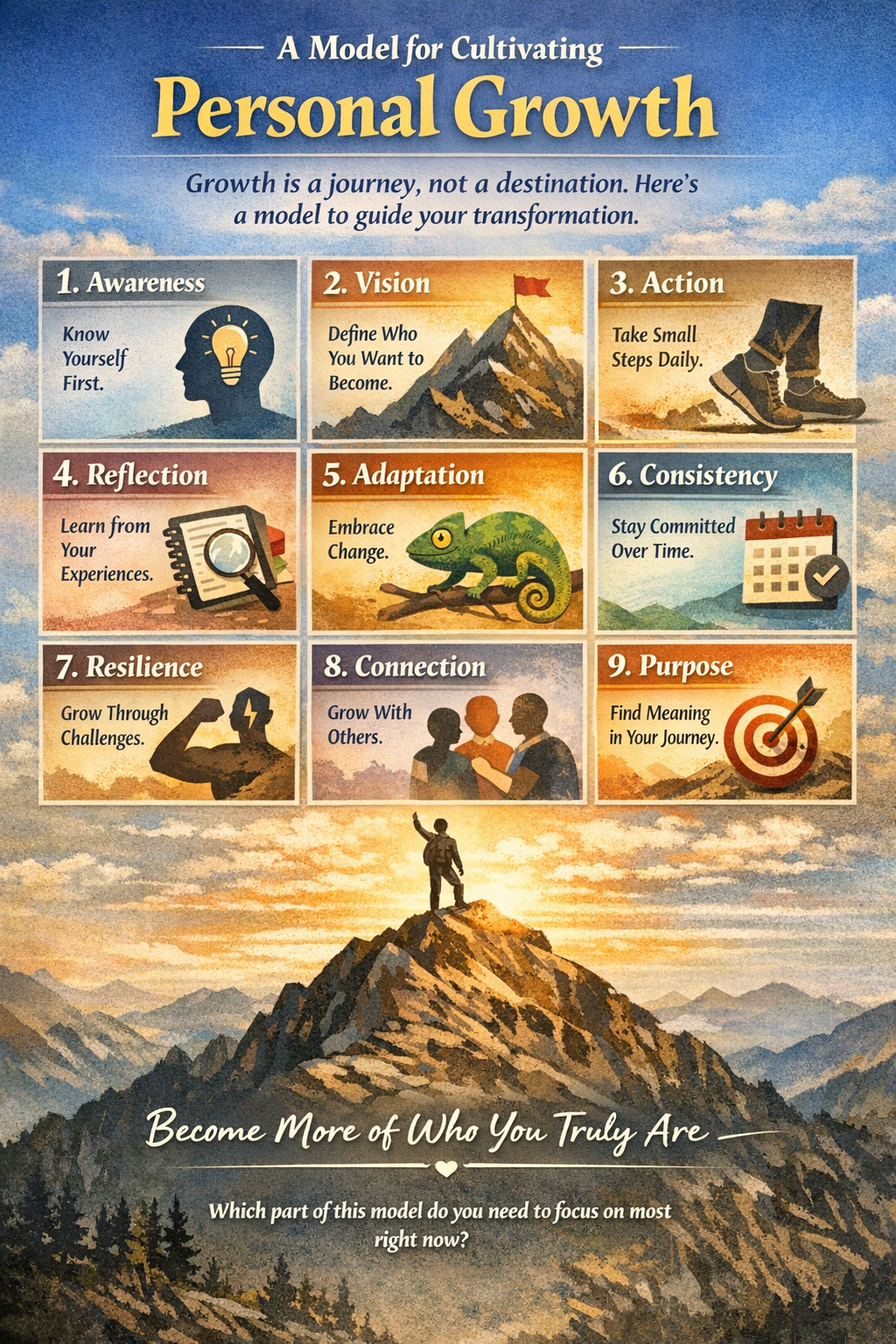
Personal growth is not a finish line you cross—it is a path you walk for the rest of your life. It is built in quiet moments, difficult decisions, and the courage to keep going when no one else sees the effort. Growth is not always loud or visible. Sometimes, it looks like choosing peace over chaos, discipline over comfort, or healing over avoidance.
Many people want to grow, but without a clear model, they often feel stuck, overwhelmed, or unsure where to begin. Growth then becomes something they hope for instead of something they build. What follows is a deeper, more intentional framework—a model not just for improvement, but for transformation.
1. Awareness: The Foundation of All Change
Before growth can take place, awareness must be present. You cannot change what you refuse to see.
Awareness is more than simply recognizing your strengths and weaknesses. It is the willingness to sit with yourself long enough to understand:
Your emotional triggers
Your behavioral patterns
The beliefs that shape your decisions
The stories you tell yourself about who you are
Often, the biggest barriers to growth are not external—they are internal narratives formed over time. Thoughts like “I’m not good enough,” or “This is just who I am,” quietly shape your reality.
Developing awareness requires intentional practices:
Journaling your thoughts and experiences
Paying attention to how you react under stress
Noticing what energizes you versus what drains you
Asking for honest feedback from people you trust
Awareness is uncomfortable at times. It may reveal truths you’ve avoided. But within that discomfort lies clarity—and clarity is the starting point of transformation.
2. Vision: Creating a Future That Pulls You Forward
Once you understand where you are, the next step is deciding where you want to go.
A powerful vision is not just about goals—it’s about identity. Goals can be achieved and forgotten, but identity shapes how you live every day.
Ask deeper questions:
What kind of person do I want to become?
How do I want to show up in my relationships, work, and personal life?
What values do I want to guide my decisions?
What does a meaningful life look like to me—not to others?
When your vision is rooted in identity, your actions become more intentional. You are no longer just chasing outcomes—you are becoming someone.
Visualization can also play a key role. Take time to imagine your future self:
How do they think?
How do they handle challenges?
What habits define their life?
This future version of you becomes a reference point. When faced with decisions, you can ask:
“Is this aligned with who I’m becoming?”
3. Action: Bridging the Gap Between Intention and Reality
Awareness and vision are powerful, but without action, they remain ideas.
Action is where growth becomes real—and it is often where resistance appears. Fear, doubt, procrastination, and perfectionism all try to keep you where you are.
The key is to start small and stay consistent.
Instead of overwhelming yourself with massive change:
Break goals into manageable steps
Focus on daily habits rather than distant outcomes
Take action even when you feel uncertain
For example, if your goal is to improve your mental well-being, your first step might simply be:
Spending 10 minutes a day in reflection
Taking a short walk without distractions
Practicing gratitude before bed
Small actions may seem insignificant, but they build momentum. Momentum builds confidence. Confidence fuels bigger action.
Remember: you do not need to feel ready—you need to be willing.
4. Reflection: Turning Experience Into Wisdom
Growth is not just about doing more—it’s about understanding more.
Without reflection, experiences pass by without meaning. With reflection, they become lessons.
Set aside time regularly to evaluate your journey:
What progress have I made?
What challenges did I face?
How did I respond—and why?
What can I do differently moving forward?
Reflection allows you to recognize patterns, celebrate progress, and correct your course when needed.
It also helps you build self-trust. When you take the time to learn from your experiences, you begin to see yourself not as someone reacting to life—but as someone actively shaping it.
5. Adaptation: Embracing Change as Part of Growth
No path of growth is straight. Life will challenge your plans, shift your priorities, and test your resilience.
Adaptation is the ability to adjust without losing your direction.
This means:
Letting go of goals that no longer align with who you are
Being open to new opportunities and perspectives
Accepting that setbacks are part of progress, not the end of it
Many people struggle here because they associate change with failure. But in reality, the ability to adapt is a sign of strength.
Growth requires flexibility. It asks you to evolve—not just once, but continuously.
6. Consistency: The Discipline That Sustains Growth
Consistency is where transformation truly happens.
It is not the intensity of your efforts that defines your growth—it is the repetition of them.
Anyone can be motivated for a day. Few people remain committed over time.
Consistency looks like:
Showing up even when motivation is low
Doing the work even when results are not immediate
Staying committed even when progress feels invisible
This is where discipline becomes more important than motivation.
Over time, consistent actions reshape your identity. What once required effort becomes natural. What once felt difficult becomes routine.
Growth is built in these quiet, repeated moments—the ones no one applauds, but that change everything.
7. Resilience: Growing Through Adversity
No model for personal growth is complete without resilience.
There will be moments when you feel like quitting. Times when progress stalls. Days when doubt feels louder than belief.
Resilience is what carries you through those moments.
It is built by:
Accepting that setbacks are part of the journey
Learning to separate failure from identity
Continuing forward, even when it’s difficult
Growth is not about avoiding struggle—it is about learning how to move through it.
Every challenge you face strengthens your ability to handle the next one. Over time, what once broke you becomes something you can withstand—and even learn from.
8. Connection: The Role of Others in Your Growth
While personal growth is deeply individual, it is not meant to happen in isolation.
The people around you influence your mindset, your habits, and your beliefs.
Surround yourself with those who:
Encourage your growth
Challenge you to be better
Support you without enabling stagnation
Connection also means being willing to share your journey. When you open up about your experiences, you not only grow—you create space for others to do the same.
Growth becomes more meaningful when it is shared.
9. Purpose: Aligning Growth With Meaning
At its deepest level, personal growth is not just about improvement—it is about meaning.
Why do you want to grow?
What impact do you want to have?
What kind of life do you want to build—not just for yourself, but for others?
When your growth is connected to purpose, it becomes sustainable. You are no longer driven only by personal gain, but by something greater.
Purpose gives your journey depth. It turns growth into something that matters.
Final Thoughts
Personal growth is not about becoming perfect. It is about becoming aware, intentional, and aligned.
There will be days when you feel strong, and days when you feel lost. Both are part of the process.
What matters is that you keep going.
That you keep learning.
That you keep choosing growth—even when it’s hard.
Because in the end, growth is not about reaching a final version of yourself.
It is about continuously becoming someone you are proud to be.
Leave a Reply