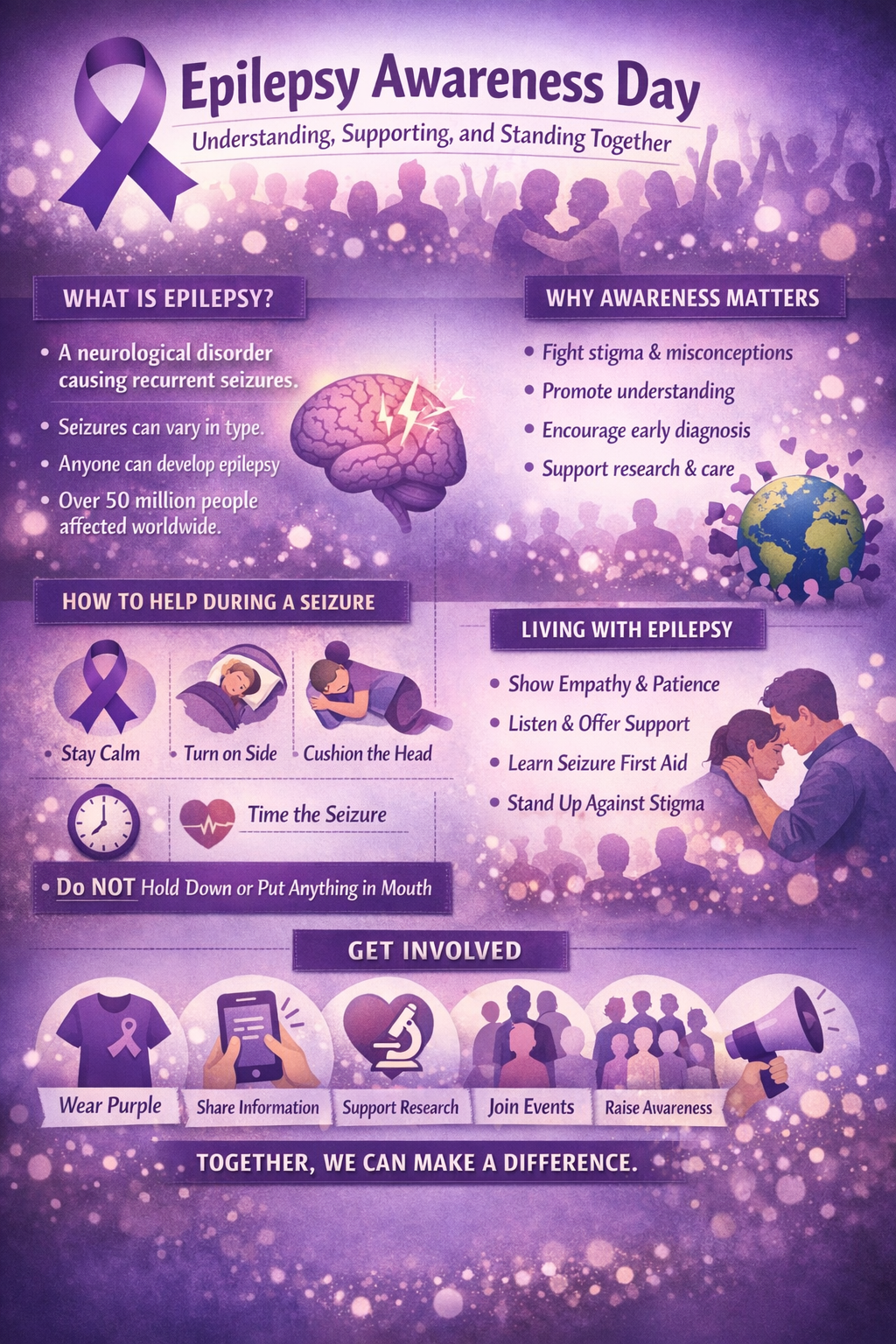
What Is Epilepsy Awareness Day?
Epilepsy Awareness Day is more than a moment—it is a movement. It is a day dedicated to recognizing the millions of people worldwide who live with epilepsy, while also educating communities about a condition that is too often misunderstood.
Marked by the color purple, this day brings together families, advocates, medical professionals, and supporters to amplify one powerful message: you are not alone. From community events to social media campaigns, from quiet personal reflections to global awareness efforts, Epilepsy Awareness Day creates space for voices that deserve to be heard.
Understanding Epilepsy: More Than What You See
Epilepsy is a chronic neurological disorder that causes recurring, unprovoked seizures. But what a seizure looks like can vary greatly from person to person.
Some seizures may involve:
Sudden confusion or loss of awareness
Staring spells
Uncontrolled jerking movements
Temporary loss of consciousness
Others may be so subtle they go unnoticed.
Epilepsy is not a one-size-fits-all condition. There are many types, causes, and levels of severity. For some, seizures are controlled with medication. For others, they remain unpredictable despite treatment.
And that unpredictability is often one of the hardest parts.
The Hidden Struggles
Living with epilepsy goes far beyond the physical experience of seizures. It can affect nearly every part of a person’s life:
Independence: Driving restrictions can limit freedom
Employment: Misunderstanding can impact job opportunities
Education: Students may struggle with concentration or stigma
Mental Health: Anxiety and depression are common companions
There is also the constant question in the back of the mind: “When will the next seizure happen?”
This uncertainty can be exhausting—not just physically, but emotionally.
Breaking the Stigma
One of the biggest challenges people with epilepsy face is stigma. Misconceptions still exist, and they can be harmful.
Some people mistakenly believe:
That epilepsy is contagious
That all seizures are violent
That people with epilepsy cannot live normal lives
None of these are true.
Epilepsy Awareness Day exists to replace myths with facts and fear with understanding. Because when people understand epilepsy, they are more likely to respond with compassion instead of hesitation.
The Power of Knowing What to Do
In a moment of crisis, knowledge can make all the difference.
If you witness someone having a seizure:
Stay calm and remain with them
Move objects away to prevent injury
Place something soft under their head
Turn them gently onto their side once the seizure subsides
Time the seizure if possible
Call for medical help if it lasts longer than 5 minutes
And just as important:
Do not restrain them
Do not put anything in their mouth
After the seizure, your presence matters. Confusion, fear, and exhaustion are common. A calm voice and reassurance can help someone feel safe again.
Strength Behind the Diagnosis
There is incredible strength in those living with epilepsy.
They learn to adapt, to plan, to push forward—even when their own body feels unpredictable. They celebrate small victories. They build resilience in ways others may never fully understand.
They are not defined by epilepsy. They are defined by how they rise in spite of it.
Behind every diagnosis is a story:
A parent advocating for their child
A young adult learning to navigate independence
A worker proving their capability every day
A family standing together through uncertainty
These stories deserve to be seen, heard, and honored.
Supporting Someone with Epilepsy
Support doesn’t require medical expertise—it requires understanding.
You can support someone by:
Learning about their specific condition
Asking how you can help, rather than assuming
Being patient with limitations or changes in plans
Offering encouragement without pity
Standing up against stigma when you hear it
Sometimes, the most powerful support is simply showing up.
The Role of Community and Advocacy
Awareness leads to action.
Advocacy plays a critical role in:
Improving access to treatment and care
Funding research for better therapies and potential cures
Ensuring workplace and school accommodations
Promoting laws that protect those living with epilepsy
Communities that come together create change. Every shared post, every conversation, every act of support helps move the needle forward.
How You Can Make a Difference
You don’t have to be an expert to make an impact.
Here are simple but meaningful ways to get involved:
Wear purple to show solidarity
Share facts and personal stories online
Learn seizure first aid and teach others
Support epilepsy organizations or fundraising efforts
Check in on someone you know who may be struggling
Even a single conversation can change someone’s perspective.
A Message That Matters
Epilepsy Awareness Day is a reminder that awareness is not just about information—it’s about connection.
It’s about seeing people for who they are beyond their diagnosis.
It’s about creating a world where no one feels isolated because of a condition they did not choose.
It’s about replacing silence with understanding, and fear with compassion.
Because when we choose to learn, to care, and to stand together—we become part of something bigger.
We become part of a community that refuses to let anyone face epilepsy alone.
Leave a Reply