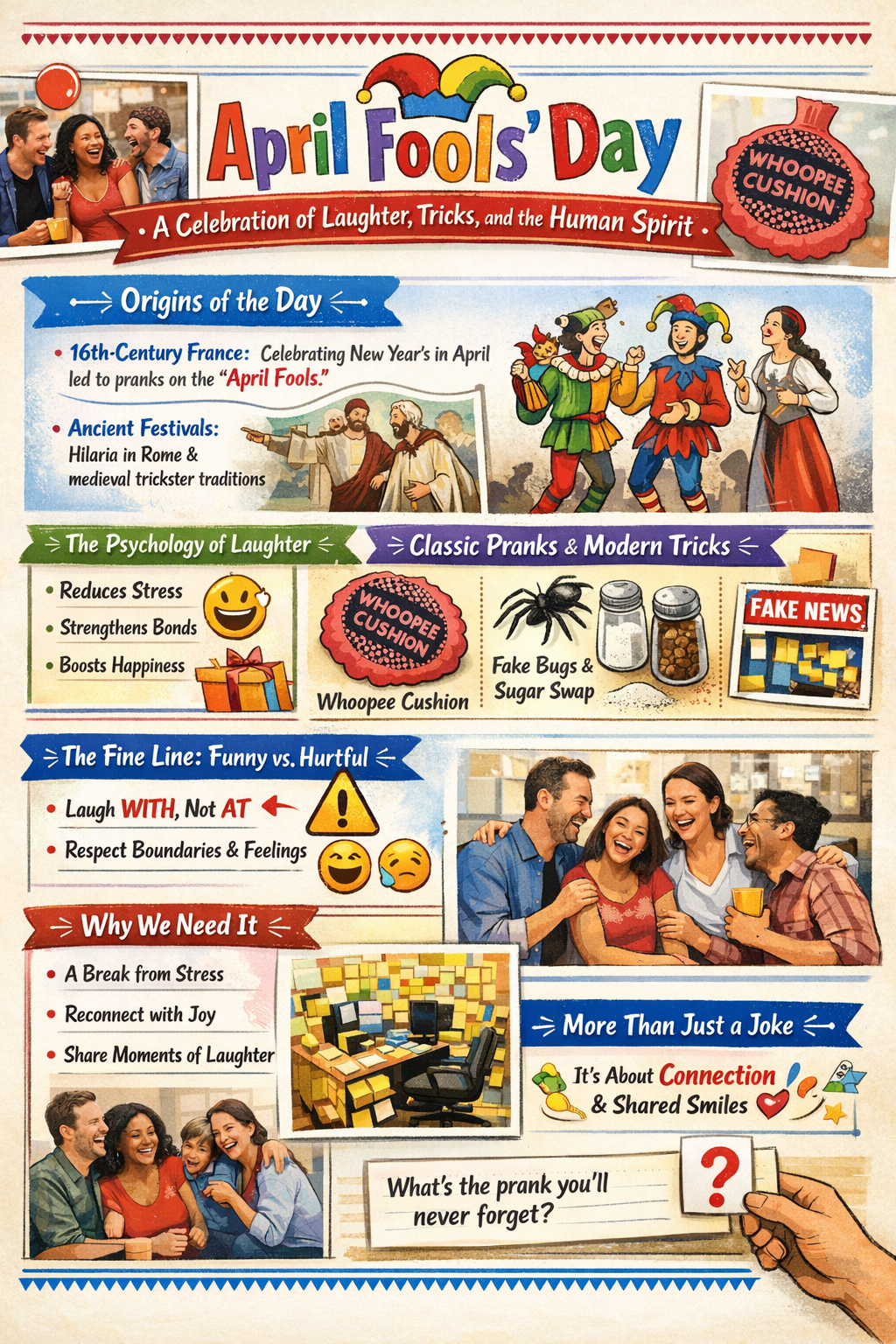
Every year on April 1st, something quietly shifts across the world. People wake up with a little more curiosity, a little more caution, and—if they’re lucky—a little more laughter waiting around the corner. April Fools’ Day isn’t just a day for jokes; it’s a reminder that even in a world filled with seriousness, there is still space for play.
It is one of the rare moments where laughter becomes expected, mischief becomes acceptable, and joy becomes contagious.
The Origins: A Story That Mirrors the Day Itself
April Fools’ Day is fittingly mysterious. Much like the pranks it celebrates, its origins are not entirely clear, and that uncertainty has become part of its identity.
One widely accepted theory traces the tradition back to 16th-century France. When the Gregorian calendar replaced the Julian calendar, New Year’s celebrations moved from late March/early April to January 1st. Those who either didn’t know about the change or chose to ignore it continued celebrating in early April—and became the targets of jokes and ridicule. They were labeled “April fools,” often having paper fish placed on their backs as a prank.
Other historians connect the day to ancient festivals like Hilaria in Rome, where people dressed in disguises and mocked one another, or to medieval celebrations that temporarily flipped social roles—allowing humor to break the structure of everyday life.
No matter its exact origin, the meaning has stayed consistent: laughter is timeless, and people have always found ways to create it.
The Psychology of a Good Laugh
There’s a reason April Fools’ Day has lasted for centuries—it taps into something deeply human.
Laughter:
Reduces stress
Strengthens relationships
Releases endorphins
Helps us cope with difficult emotions
In many ways, humor is survival. It’s how people navigate pain, loss, uncertainty, and pressure. Even a small joke can interrupt a heavy moment and remind us that we’re still here, still connected, still capable of joy.
For those carrying deeper burdens—grief, heartbreak, or stress—April Fools’ Day can feel different. But even then, a gentle laugh can become a moment of relief, not replacement. It doesn’t erase pain, but it gives it space to breathe.
The Evolution of the Prank
What once started as simple tricks has grown into an art form.
Classic pranks still hold their place:
The whoopee cushion under a chair
Plastic insects hidden in unexpected places
Swapping everyday items like sugar and salt
Fake spills or broken objects
But today’s world has taken things further.
Modern pranks include:
Fake social media announcements
Elaborate workplace setups (like covering an office in sticky notes)
Brand campaigns announcing outrageous fake products
Viral videos designed to trick viewers before revealing the joke
Companies now participate just as much as individuals, creating playful campaigns that sometimes blur the line between fiction and reality—at least for a few hours.
The Fine Line: Humor vs. Harm
While April Fools’ Day celebrates jokes, it also quietly teaches responsibility.
The best pranks share one thing in common: everyone laughs.
The worst ones:
Embarrass people publicly
Trigger fear or anxiety
Cross personal boundaries
Exploit trust in harmful ways
Humor should never come at the cost of someone else’s dignity. A good prank surprises—but it also respects.
A simple question to ask before any joke:
Will this create laughter… or regret?
Why April Fools’ Day Still Matters Today
In a fast-paced, often overwhelming world, April Fools’ Day stands as a small but meaningful pause.
It reminds us:
To not take everything so seriously
To reconnect with childlike curiosity
To share moments that don’t require perfection
To laugh—even when life feels heavy
For many people, especially those navigating loss or hardship, joy can feel distant. Days like this don’t fix that—but they can soften it, even if just for a moment.
And sometimes, a moment is enough.
More Than a Joke—A Reflection of Humanity
At its core, April Fools’ Day isn’t about tricks—it’s about connection.
It’s about:
The friend who sets up a harmless joke just to see you smile
The coworker who breaks the routine with laughter
The family moment that turns into a shared memory
These small interactions matter more than we often realize. They remind us that beneath all the seriousness of life, we are still human—still capable of joy, still capable of making each other feel something good.
A Final Thought
Not every April Fools’ Day will be filled with laughter for everyone. Some people will carry pain that humor can’t reach. But even then, the spirit of the day still offers something gentle:
A reminder that light still exists.
And sometimes, the smallest smile is the strongest kind of resilience.
Leave a Reply