Losing a parent is one of the most devastating experiences a child can endure. It is not just the loss of a person—it is the loss of safety, routine, identity, and the quiet certainty that someone will always be there. For a child, the world can suddenly feel unpredictable and fragile.
As the adult supporting them, you may feel an enormous weight: wanting to say the right thing, do the right thing, and somehow protect them from pain that cannot be taken away. The truth is, you cannot fix their grief—but you can walk beside them through it. And that presence can shape how they heal for the rest of their life.
Understanding How Children Experience Grief
Children grieve differently than adults. Their understanding of death evolves with age, and their emotions can come in waves—often unpredictable and confusing.
Young children (ages 3–6) may not fully understand permanence. They might ask when their parent is coming back or repeat the same questions over and over.
School-aged children (ages 7–12) begin to understand death is final but may struggle with fear, guilt, or “what if” thinking.
Teenagers often feel the depth of the loss intensely but may hide it behind anger, silence, or independence.
One of the most important things to remember is this:
Children “visit” their grief.
They may cry deeply one moment and laugh or play the next. This is not denial—it’s their mind protecting them from emotional overload.
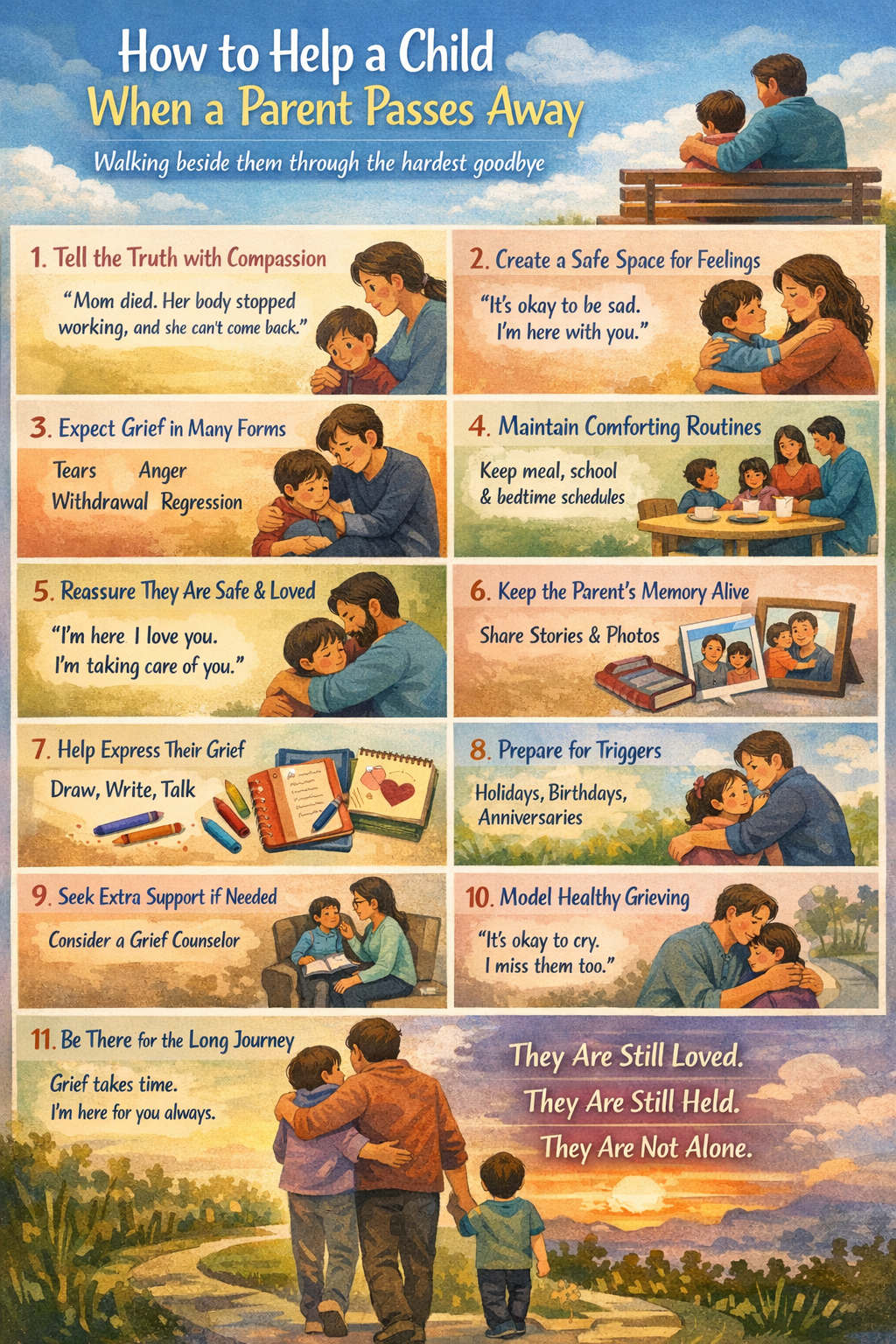
1. Tell the Truth—With Compassion and Clarity
Honesty is essential, even when the truth is painful. Avoid vague phrases like “we lost Mom” or “Dad went to sleep,” as these can confuse or frighten children.
Instead, use clear, simple language:
“Dad died. His body stopped working, and he can’t come back.”
Be prepared for repeated questions. Children process grief in layers, and asking the same question is often their way of trying to understand something that feels impossible.
Answer patiently—even if it hurts every time.
2. Create a Safe Space for Every Emotion
A child who has lost a parent may feel:
Deep sadness
Anger or frustration
Fear of losing someone else
Guilt (“Did I cause this?”)
Confusion or numbness
Sometimes, they may not feel anything at all—and that’s okay too.
Let them know:
“Whatever you’re feeling is okay. You don’t have to hide it from me.”
Avoid trying to “fix” their emotions. Instead, sit with them in it. Your calm presence tells them they are not alone in their pain.
3. Expect Grief to Show Up in Unexpected Ways
Children often express grief through behavior rather than words. You might notice:
Increased clinginess
Regression (bedwetting, needing help with tasks they once did alone)
Trouble concentrating
Acting out or becoming withdrawn
These are not signs of “bad behavior”—they are signals of a hurting heart.
Respond with patience, not punishment.
Behind every difficult behavior is a child trying to cope with something they don’t yet understand.
4. Keep Routines as Anchors in a Shaken World
When everything feels uncertain, routine becomes stability.
Try to maintain:
Regular meal times
School attendance
Bedtime routines
These everyday structures send a powerful message:
Life is still moving, and you are still safe within it.
At the same time, allow flexibility. Some days will be harder than others.
5. Reassure Them—Again and Again
After losing a parent, many children develop a deep fear of losing the people they have left.
They may ask:
“Are you going to die too?”
“Who will take care of me?”
Answer gently and honestly, while offering reassurance:
“I’m here. I love you. I’m taking care of you.”
They may need to hear this many times. Repetition builds security.
6. Keep the Parent’s Memory Alive
Grief is not about forgetting—it’s about remembering with love.
Talk about the parent often:
Share stories
Look through photos
Celebrate their birthday
Continue traditions they loved
You might say:
“Your mom loved the way you laugh. It always made her smile.”
Encourage the child to express their memories too—through drawing, writing, or simply talking.
Keeping that connection alive helps transform loss into lasting love.
7. Help Them Express Their Grief in Their Own Way
Not all children can put their feelings into words. Offer different ways for them to express themselves:
Drawing pictures
Writing letters to their parent
Creating a memory box
Playing or acting out feelings through toys
Sometimes a child will say something profound in the middle of play. Listen closely—those moments matter.
8. Prepare for “Grief Triggers”
Grief often resurfaces during:
Birthdays
Holidays
School events
Anniversaries of the death
These moments can reopen wounds.
Acknowledge them ahead of time:
“I know this birthday might feel different without Dad. We can talk about him or do something special to remember him.”
By naming the pain, you help the child feel seen rather than alone.
9. Watch for When Extra Support Is Needed
While grief has no timeline, some signs may indicate a child needs additional help:
Ongoing withdrawal or isolation
Persistent sadness that doesn’t lift
Severe anxiety or fear
Declining school performance
Expressions of hopelessness
In these cases, a grief counselor or child therapist can provide tools and support that go beyond what family alone can offer.
Seeking help is not a failure—it is an act of love.
10. Model Healthy Grieving
Children learn how to grieve by watching the adults around them.
It’s okay for them to see you cry.
It’s okay to say:
“I miss them too.”
This teaches them that grief is not something to hide—it is something we carry together.
At the same time, show them that even in grief, there is still life, love, and moments of peace.
11. Be There for the Long Journey—Not Just the Immediate Loss
Support doesn’t end after the funeral. In many ways, that’s when the real journey begins.
Grief evolves as a child grows. A loss experienced at age five will be understood differently at age ten, and again at fifteen.
They may revisit their grief over and over—and each time, they may need you in a new way.
Stay present. Stay patient. Stay available.
A Final Reflection
You cannot take away a child’s grief when a parent dies. That pain is real, deep, and lasting.
But you can give them something just as powerful:
A safe place to feel
A steady presence in the storm
A reminder that love does not end with death
And over time, that love becomes the foundation they stand on.
Because even in their deepest loss, what a child needs to know most is this:
They are still loved. They are still held. And they are not alone.
Leave a Reply