In a world that often feels fractured by misunderstanding, loss, and unresolved pain, National Reconciliation Day rises as a quiet but powerful call—to heal, to forgive, and to find our way back to one another.
This day is not just about repairing broken relationships. It is about confronting what has been left unsaid, acknowledging wounds that never fully healed, and choosing—sometimes against every instinct—to open the door to peace again.
Reconciliation is not easy. It is not quick. And it is rarely simple. But it is one of the most courageous things a human heart can do.
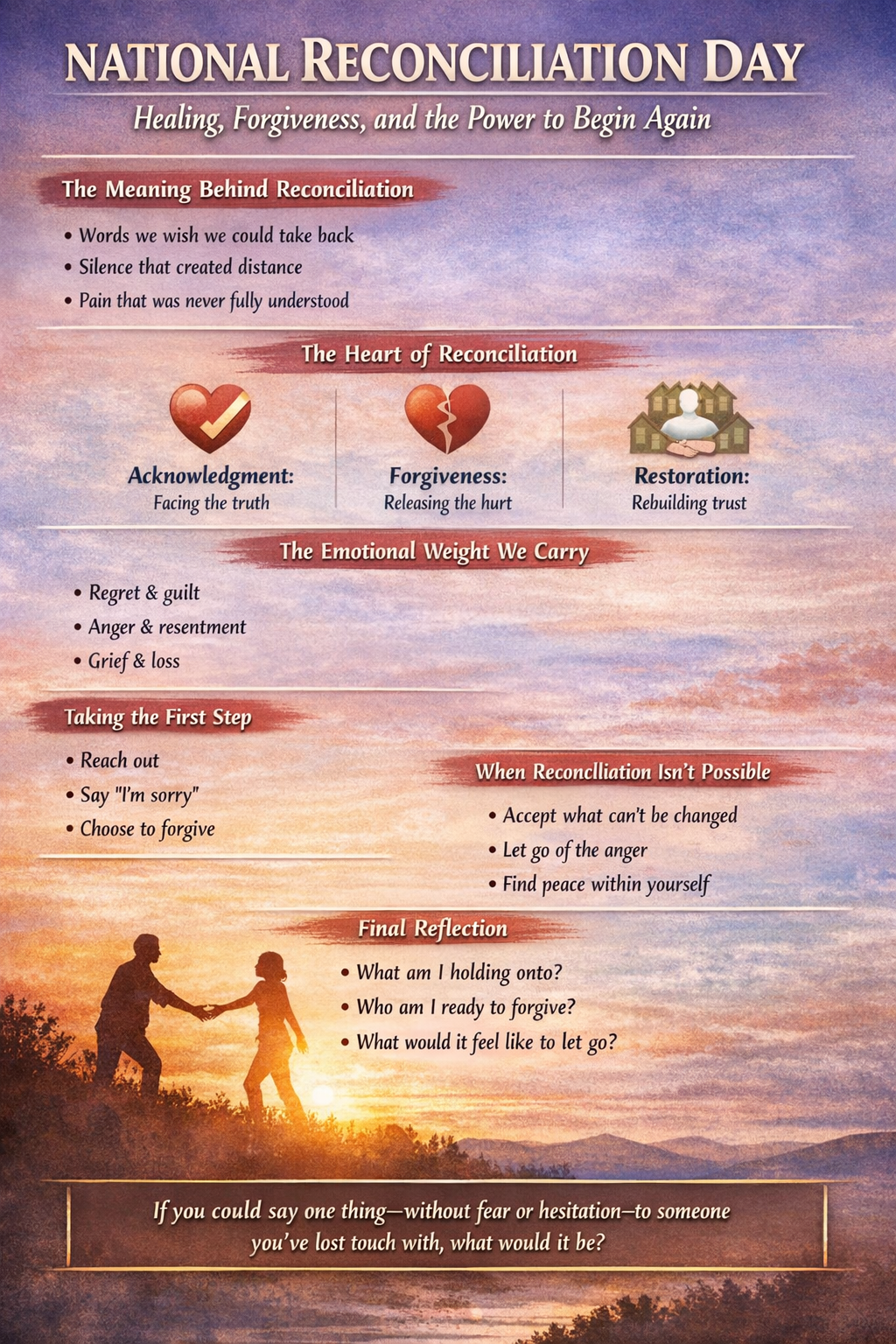
The Meaning Behind Reconciliation
At its core, reconciliation is about restoring what has been broken, even if it never returns to exactly what it once was. It is the act of bridging distance—emotional, relational, or even generational.
It asks us to face truths we may have avoided:
Words we wish we could take back
Silence that created distance
Pain that was never fully understood
Reconciliation does not erase these things. Instead, it transforms them into something new—something that can coexist with growth, understanding, and, sometimes, even deeper connection than before.
The Emotional Weight We Carry
Many people walk through life carrying invisible burdens:
Regret over things left unsaid
Anger toward someone who hurt them
Guilt for mistakes they cannot undo
Grief for relationships that faded or ended
These emotions do not disappear on their own. They settle into the heart, quietly shaping how we see the world and how we connect with others.
National Reconciliation Day reminds us that we do not have to carry that weight forever.
Sometimes, healing begins not with fixing everything—but with acknowledging that something needs to be healed at all.
The Courage to Take the First Step
Reconciliation often starts in the smallest ways:
A message that says, “I’ve been thinking about you.”
A phone call that begins with silence, then honesty
A simple “I’m sorry” or “I forgive you”
These words may seem small, but they carry immense power. They break through walls that may have stood for years.
But taking that first step requires courage—because it comes with uncertainty.
Will they respond?
Will they understand?
Will things ever be the same again?
The truth is, reconciliation does not guarantee the outcome we hope for. But it does guarantee that we have chosen growth over pride, and healing over distance.
Forgiveness: The Heart of Reconciliation
Forgiveness is often misunderstood. It is not about saying what happened was okay. It is not about forgetting the pain or pretending it didn’t matter.
Forgiveness is about releasing the hold that pain has on your life.
When we hold onto anger, resentment, or bitterness, we remain tied to the moment that hurt us. Forgiveness is the act of cutting that tie—not for them, but for ourselves.
It is one of the most freeing choices a person can make.
And yet, it is also one of the hardest.
Reconciliation Within Families
Some of the deepest wounds exist within families. These are the relationships we expect to be unbreakable—yet they are often the ones most strained by time, misunderstanding, or unresolved conflict.
National Reconciliation Day is a chance to reflect on those bonds:
The parent you haven’t spoken to
The sibling you grew apart from
The child you wish you could understand better
Family reconciliation can be especially emotional because it touches on identity, history, and love that never fully disappears—even when distance grows.
Sometimes, healing begins with simply saying:
“I miss you.”
When Reconciliation Meets Grief
For those who have lost someone—especially a child, a parent, or a loved one taken too soon—reconciliation takes on a different meaning.
It may not be about reaching out. It may be about making peace with:
Words you never got to say
Moments you wish you could relive
Love that still exists without a place to go
In these cases, reconciliation becomes deeply internal.
It is about forgiving yourself.
It is about allowing yourself to grieve without guilt.
It is about honoring love without being consumed by loss.
Sometimes, reconciliation is not with a person—but with the life that remains.
When Reconciliation Isn’t Possible
Not every relationship can be repaired. Some situations involve deep harm, broken trust, or circumstances where reconnecting is not safe or healthy.
And that’s important to acknowledge.
Reconciliation does not always mean reunion.
In those cases, it may look like:
Letting go of anger without reopening the relationship
Accepting what cannot be changed
Choosing peace over continued pain
You are allowed to heal—even if the other person is no longer part of your life.
The Ripple Effect of Reconciliation
When one person chooses reconciliation, it often creates a ripple effect.
A healed relationship can:
Restore families
Strengthen communities
Inspire others to confront their own unresolved conflicts
Even small acts of forgiveness can change the emotional landscape of an entire group of people.
Peace is contagious—just like conflict is.
A Day That Matters More Than We Realize
National Reconciliation Day is not just symbolic. It is an invitation.
An invitation to:
Reflect on who or what needs healing in your life
Release burdens you’ve carried too long
Choose understanding instead of judgment
Begin again, even if it feels uncertain
It reminds us that while we cannot control the past, we are not powerless in the present.
Final Reflection
Reconciliation is not a moment—it is a process. It unfolds slowly, often imperfectly, and sometimes painfully.
But within that process is something deeply human:
the desire to connect, to heal, and to love despite everything.
On this National Reconciliation Day, take a moment to ask yourself:
What am I holding onto?
Who am I ready to forgive?
What would it feel like to finally let go?
Because sometimes, the most powerful thing you can do…
is choose peace when holding onto pain would be easier.
Leave a Reply