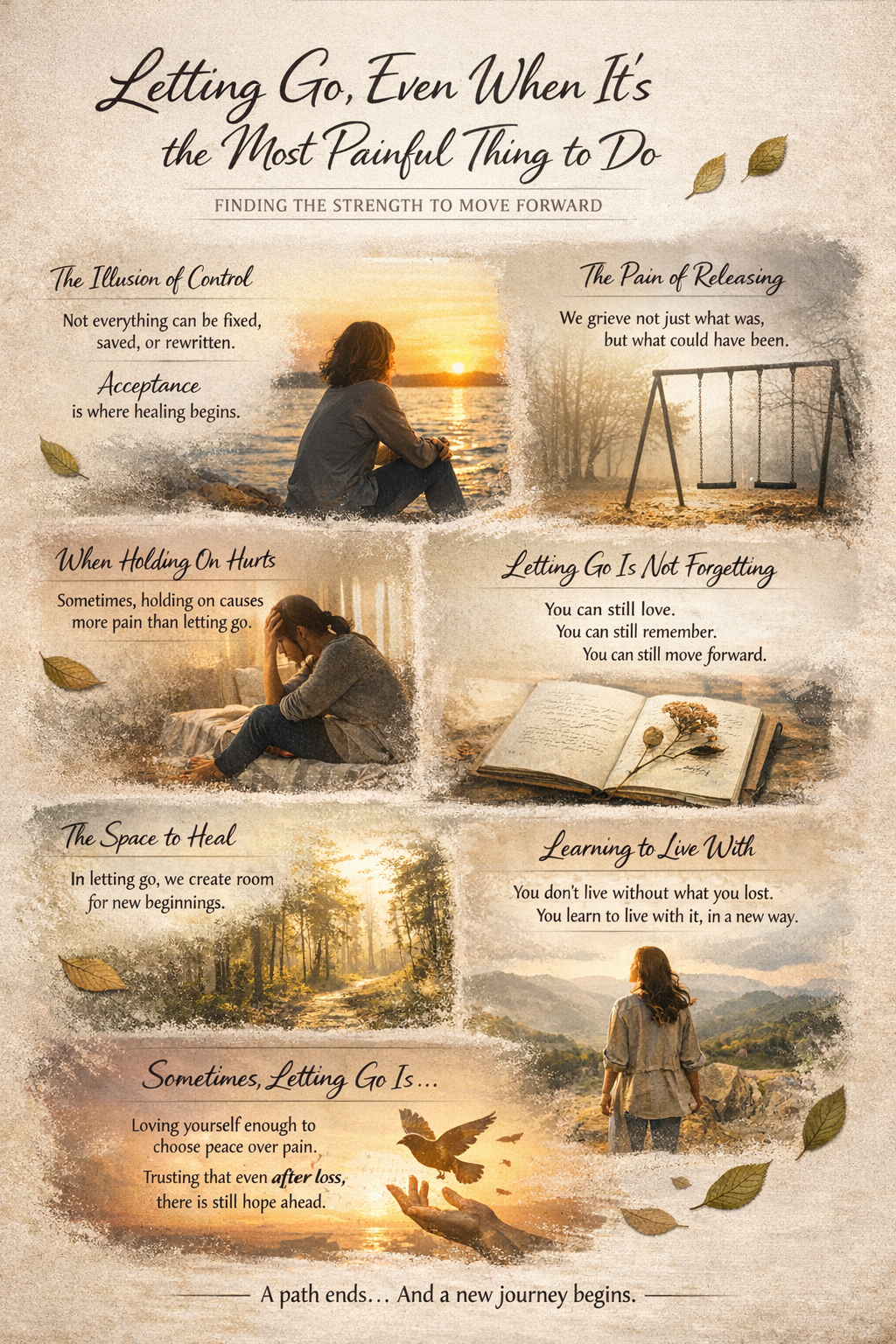
Letting go is one of the most difficult acts of courage a human being can face. It asks us to release something we once held close—something that shaped us, comforted us, or gave meaning to our lives. It challenges the very nature of our hearts, which are wired to love, to attach, and to remember.
We don’t struggle to let go because we are weak.
We struggle because what we are releasing mattered deeply.
Whether it’s the loss of a loved one, the end of a relationship, a broken dream, or even the slow realization that life has taken a different path than we imagined—letting go can feel like standing at the edge of something we are not ready to leave behind.
And yet, sometimes, it is the only way forward.
The Illusion of Control
At the heart of our pain is often the illusion that we can control outcomes if we just try hard enough. We replay conversations, revisit decisions, and imagine different endings. We ask ourselves questions that have no answers:
What if I had done things differently?
What if I had said more, loved more, stayed longer?
But life does not always bend to our will. Some things are simply beyond our control—timing, circumstances, the choices of others, and even fate itself.
Letting go begins when we accept this truth:
Not everything can be fixed, saved, or rewritten.
And while that realization can be devastating, it is also freeing. Because once we release the need to control everything, we open ourselves to something else—acceptance.
The Pain of Releasing What We Love
There is a unique kind of heartbreak that comes with letting go. It is not always loud or visible. Often, it is quiet and deeply personal.
It’s in the moments when you instinctively reach for someone who is no longer there.
It’s in the memories that surface without warning.
It’s in the spaces they once filled—now echoing with absence.
Letting go doesn’t mean the love disappears. In many ways, the love remains—just without a place to go.
That’s what makes it so painful.
We are not just letting go of a person or a situation—we are letting go of a version of life that once felt possible. We are grieving not only what was, but what could have been.
When Holding On Hurts More Than Letting Go
There comes a turning point—often subtle—when holding on becomes more painful than releasing.
It may show up as emotional exhaustion.
A constant ache that never seems to ease.
A feeling of being stuck in a moment that has already passed.
We begin to realize that holding on is no longer preserving something beautiful—it is prolonging something painful.
Letting go, then, is not giving up.
It is choosing not to suffer endlessly for something that no longer exists in the same way.
It is saying: I will not allow this pain to define the rest of my life.
Letting Go Is Not Forgetting
One of the greatest fears people have is that letting go means forgetting. That if we release something, it will somehow lose its significance.
But letting go is not about erasing memories.
It is about changing our relationship with them.
Instead of reliving the pain over and over, we begin to carry those memories with a different kind of understanding. They become part of our story—not the place where we remain stuck.
You can still love.
You can still remember.
You can still honor what was.
And at the same time, you can choose to move forward.
The Courage to Release
Letting go requires a quiet kind of bravery—the kind that doesn’t always look heroic from the outside but feels monumental on the inside.
It’s the courage to wake up each day and resist the urge to go backward.
It’s the strength to sit with your emotions instead of running from them.
It’s the willingness to accept that healing will take time.
And most importantly, it’s the decision to believe that your life still holds meaning—even after loss.
There is no timeline for letting go. No checklist to follow. It is deeply personal and often unpredictable.
Some days you will feel like you’ve made progress.
Other days, it will feel like you’re right back where you started.
Both are part of the journey.
The Space Where Healing Begins
When we finally loosen our grip on what we’ve been holding onto, something unexpected happens—we create space.
At first, that space can feel empty, even unbearable. It can feel like something is missing, because something is missing.
But slowly, that space becomes something else.
It becomes room for healing.
Room for new perspectives.
Room for rediscovering parts of yourself that were overshadowed by pain.
Letting go doesn’t mean replacing what was lost. Some things are irreplaceable.
But it does mean allowing yourself to experience life again in new and meaningful ways.
Learning to Live With, Not Without
One of the most important shifts in letting go is realizing that you are not learning to live without what you lost—you are learning to live with it, in a different way.
The love, the memories, the impact—it all remains.
But instead of carrying it as a heavy burden, you begin to carry it as something that shaped you, strengthened you, and changed you.
You don’t leave it behind.
You learn how to carry it forward differently.
A Gentle Reminder
If you are in the process of letting go, be gentle with yourself.
There is no right or wrong way to feel.
There is no “perfect” timeline for healing.
There is no expectation that you should be over it by now.
You are allowed to miss what you lost.
You are allowed to feel the weight of it.
You are allowed to take your time.
But you are also allowed to heal.
The Quiet Transformation
Letting go changes you.
It reshapes your understanding of love, loss, and resilience. It teaches you that even in the deepest pain, there is still a path forward.
One day, without even realizing it, you will notice something different.
The memories will still be there—but they won’t hurt the same way.
The longing will soften.
The heaviness will begin to lift.
And in its place, there will be something else:
Strength.
Clarity.
A deeper appreciation for life and the moments that matter.
In the End
Letting go is not the end of your story.
It is a chapter filled with pain, yes—but also growth, transformation, and eventually, peace.
It is the moment where you choose to release what you cannot change, so you can embrace what still lies ahead.
And even though it may be the most painful thing you will ever have to do…
It may also be the most freeing.
Leave a Reply