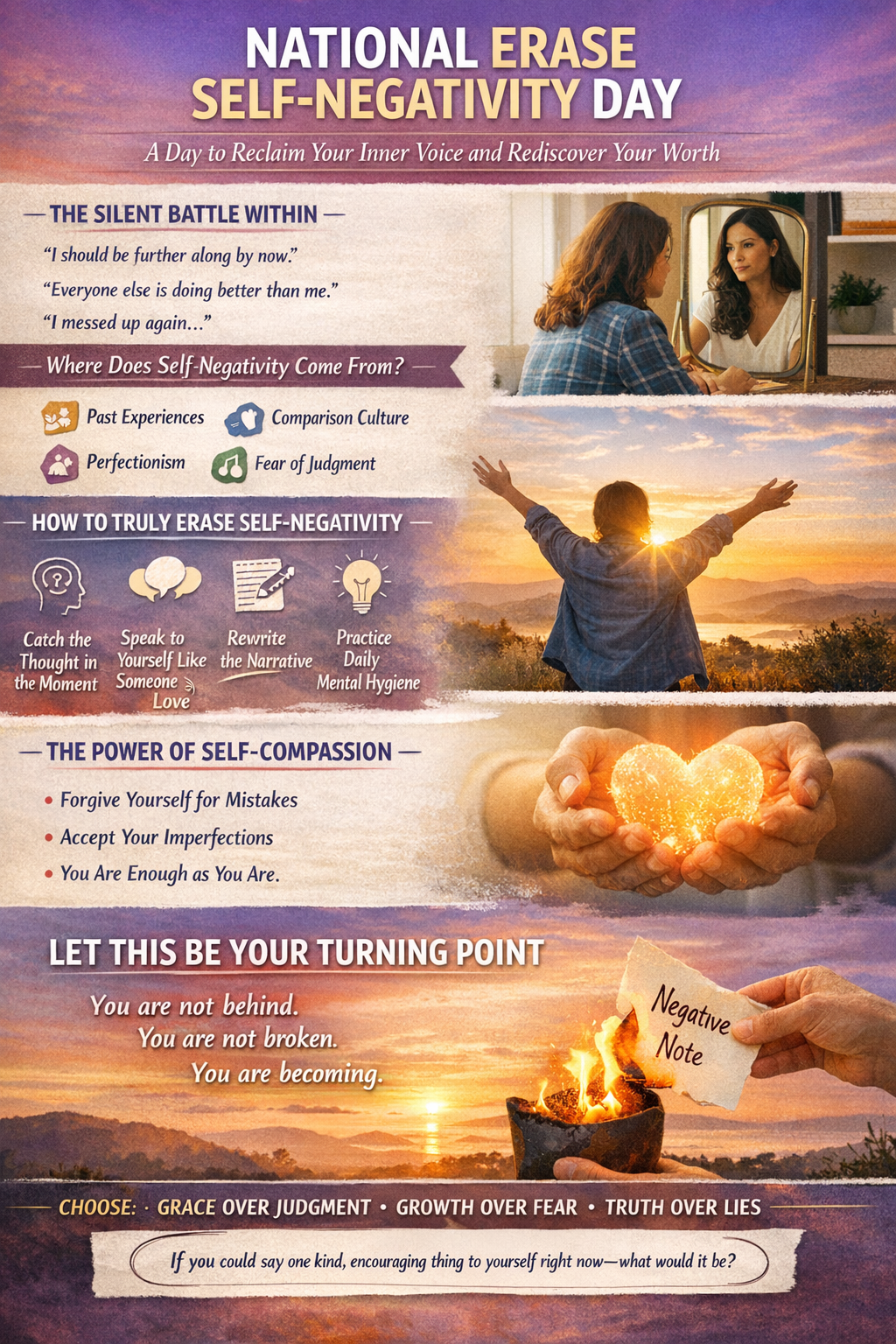
Every year, on the second Thursday of April, National Erase Self-Negativity Day offers something many of us don’t even realize we need—a chance to pause, reset, and examine the way we speak to ourselves.
Not out loud… but internally.
Because for many, the harshest words they hear don’t come from others—they come from within.
This day is a reminder that while the world can be demanding and unforgiving, we don’t have to be that way with ourselves.
The Silent Battle Within
Self-negativity doesn’t always show itself in obvious ways. It’s often subtle, woven into daily thoughts:
“I should be further along by now.”
“Everyone else is doing better than me.”
“I messed up again… what’s wrong with me?”
These thoughts may seem small, but repeated over time, they become beliefs. And beliefs shape identity.
You begin to:
Doubt your abilities
Question your worth
Hold back from opportunities
Settle for less than you deserve
The truth is, self-negativity doesn’t just affect how you feel—it affects how you live.
Where Does Self-Negativity Come From?
Understanding the root of self-negativity is a powerful step toward erasing it. It often stems from:
1. Past Experiences
Failures, rejection, or painful moments can leave lasting impressions. If you were once told you weren’t good enough, you may have carried that belief forward—even if it was never true.
2. Comparison Culture
In today’s world, it’s easy to measure your life against carefully curated versions of others. Social media highlights victories but hides struggles, creating unrealistic standards.
3. Perfectionism
The belief that you must be flawless can lead to constant disappointment. When perfection becomes the goal, anything less feels like failure.
4. Fear of Judgment
Worrying about what others think can cause you to silence your true self and replace it with self-criticism.
The Cost of Negative Self-Talk
Self-negativity is not harmless. Over time, it can:
Lower self-esteem
Increase anxiety and stress
Create feelings of hopelessness
Prevent personal and professional growth
Damage relationships (including the one you have with yourself)
It becomes a cycle: negative thoughts → negative feelings → limited actions → reinforced beliefs.
Breaking that cycle starts with awareness—and intention.
How to Truly Erase Self-Negativity
Erasing self-negativity is not about ignoring your struggles. It’s about changing your relationship with your thoughts.
1. Catch the Thought in the Moment
The next time a negative thought appears, pause. Don’t let it pass unnoticed. Awareness is the first step toward change.
Ask yourself:
“Is this thought true?”
“Is this thought helpful?”
2. Speak to Yourself Like Someone You Love
Imagine a friend came to you with the same thoughts you have about yourself. Would you criticize them—or encourage them?
Offer yourself that same kindness.
3. Rewrite the Narrative
Replace harsh thoughts with balanced, truthful ones:
“I failed” → “I learned something valuable.”
“I’m not good enough” → “I am growing and improving.”
“I’ll never succeed” → “My journey is still unfolding.”
This isn’t denial—it’s perspective.
4. Practice Daily Mental Hygiene
Just as you take care of your body, your mind needs daily care:
Journaling your thoughts
Practicing gratitude
Limiting negative influences
Feeding your mind with uplifting content
5. Give Yourself Permission to Heal
Some self-negativity runs deep. It may be tied to grief, loss, or past trauma. Healing takes time—and that’s okay.
You are allowed to grow at your own pace.
A Personal Commitment
National Erase Self-Negativity Day is not just about one day—it’s about making a commitment to yourself.
A commitment to:
Stop tearing yourself down
Start recognizing your value
Speak words of life over your mind and heart
You don’t have to become a completely different person overnight. You simply have to start treating yourself differently—one thought at a time.
The Power of Self-Compassion
Self-compassion is not weakness. It is strength.
It means:
Forgiving yourself for mistakes
Accepting your imperfections
Recognizing that you are human
When you begin to show yourself compassion, something shifts. The pressure eases. The weight lifts. And in its place, something powerful grows:
Confidence. Peace. Freedom.
Let This Be Your Turning Point
Today can be the day you choose differently.
The day you stop believing every negative thought.
The day you begin to rewrite your inner dialogue.
The day you realize that your worth has never been in question.
You are not behind.
You are not broken.
You are not unworthy.
You are becoming.
Final Reflection
Erasing self-negativity doesn’t mean you’ll never struggle again. It means you no longer let your struggles define your identity.
It means choosing:
Grace over judgment
Growth over fear
Truth over lies
And most importantly—it means choosing yourself.
Leave a Reply