Author: Brett Murphy

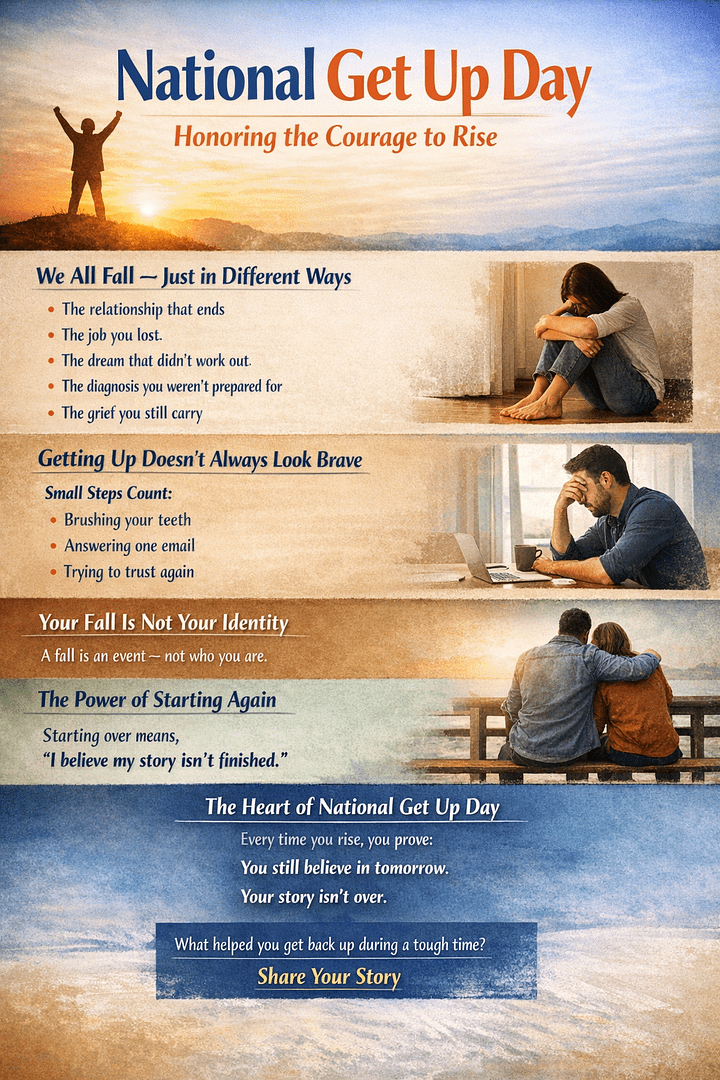
  • National Get Up Day — Honoring the Courage to Rise

    National Get Up Day — Honoring the Courage to Rise

    Advertisements

    National Get Up Day is a tribute to one of the most powerful choices a person can make: the decision to rise after life knocks them down. It’s not about pretending falls don’t hurt. It’s about recognizing that falling is part of being human — and getting back up is where strength is born.

    This day speaks to anyone who has ever faced disappointment, loss, failure, heartbreak, illness, fear, or self-doubt. It reminds us that setbacks are chapters, not conclusions.

    We All Fall — Just in Different Ways

    Falling doesn’t only mean a physical stumble. Often, the hardest falls are the invisible ones:

    • The relationship that ends when you thought it would last

    • The job you lost that shook your confidence

    • The dream that didn’t work out

    • The diagnosis you weren’t prepared for

    • The grief that changed you forever

    • The mistake you wish you could undo

    These moments can leave you feeling stuck on the ground, unsure how to stand again. National Get Up Day acknowledges that space — the pause after impact, where everything feels heavy — and honors the effort it takes to move forward.

    Getting Up Doesn’t Always Look Brave

    We often picture resilience as bold and inspiring, but real resilience is usually quiet.

    Getting up might look like:

    • Brushing your teeth when you didn’t want to leave bed

    • Answering one email after weeks of avoidance

    • Letting yourself cry instead of pretending you’re fine

    • Trying to trust again

    • Setting one boundary

    • Taking one small step toward healing

    These aren’t dramatic victories, but they are victories. Getting up is often a series of small, stubborn decisions that say, “I’m still here.”

    Your Fall Is Not Your Identity

    One of the hardest parts of failure or hardship is the story we tell ourselves afterward. We start to believe:

    “I’m not good enough.”
    “I always mess things up.”
    “I’ll never recover.”

    National Get Up Day challenges that narrative. A fall is something that happened — not who you are. The hardest seasons often build compassion, depth, wisdom, and strength that easy seasons never could.

    You are not defined by your lowest moment. You are defined by your willingness to rise from it.

    The Power of Starting Again

    Starting over can feel humiliating. You may be older, more tired, or more cautious than the last time you tried. But starting again is not a sign of failure — it’s proof of hope.

    Every fresh attempt says:

    “I believe my story isn’t finished.”
    “I deserve another chance.”
    “I can grow beyond this.”

    There is incredible dignity in trying again.

    A Day to Lift Others, Too

    National Get Up Day also reminds us that sometimes people can’t rise alone. Encouragement matters. Patience matters. Kindness matters.

    A few simple words can help someone find their footing:

    “I’m proud of you for not giving up.”
    “Take your time — you’re doing your best.”
    “You’re stronger than you think.”

    Support doesn’t erase the fall, but it can make standing possible.

    The Heart of National Get Up Day

    This day isn’t about toxic positivity or pretending pain doesn’t exist. It’s about honoring the full human experience — the fall, the struggle, the pause, and the rise.

    Because every time you get back up, even slowly, even shakily, you prove something powerful:

    You still believe in tomorrow.

    And as long as you can rise, your story is still unfolding.

    Read More Holidays & National Days

  • Just Tell Me the Truth

    Advertisements

    There’s a sentence people say when they’re bracing for impact.

    “Just tell me the truth.”

    It sounds simple. Direct. Brave, even. But underneath it is something raw:
    I can handle pain. I can’t handle confusion.
    I can survive hurt. I can’t survive guessing.

    Because the space between suspicion and certainty is where the mind does its worst work.


    The Weight of Not Knowing

    Humans are wired to search for answers. When something feels off — a shift in tone, a distance that wasn’t there before, a story that doesn’t quite line up — the mind starts filling in blanks.

    And it rarely fills them with comfort.

    Silence becomes betrayal.
    Delay becomes rejection.
    “Maybe” becomes “definitely.”

    Not knowing stretches pain out like a slow ache. Truth, even when it stings, is clean. It has edges. You can wrap your hands around it and say, “Okay. This is real. Now I deal with it.”

    But uncertainty? That’s fog. You walk into it and lose your sense of direction.


    Why Truth Feels So Hard to Give

    People avoid honesty for reasons that feel noble in the moment:

    • “I don’t want to hurt them.”

    • “It’s easier to let this fade.”

    • “They’ll take it badly.”

    But withholding truth rarely protects anyone. It only delays the impact while deepening the wound. When the truth finally surfaces — and it always does — it carries an extra sting:

    Not only did this happen…
    You let me stand in the dark while it was happening.

    That’s the part people struggle to forgive.


    The Courage on Both Sides

    Asking for the truth takes courage. You are essentially saying:

    “I’m willing to hear something that might change how I see you, us, or my future. But I’d rather face reality than live in illusion.”

    That’s strength, not weakness.

    Giving the truth takes courage too. It means choosing discomfort now over damage later. It means respecting someone enough to let them make decisions based on reality, not hope built on half-information.

    Truth says: I value you enough not to manipulate your perception.


    Pain Heals Faster Than Confusion

    Heartbreak with clarity eventually settles. You grieve. You process. You rebuild.

    But heartbreak tangled with lies or avoidance? That lingers. You replay conversations. You question your judgment. You lose trust not just in others, but in yourself.

    Clarity may hurt sharply, but it heals cleanly.
    Confusion wounds quietly and leaves scars that resurface in every future connection.


    What “Just Tell Me the Truth” Really Means

    It means:

    Don’t soften it so much that it stops being real.
    Don’t disappear instead of speaking.
    Don’t make me decode your silence.

    It means:

    “I respect myself enough to face the truth. Please respect me enough to give it.”


    Honesty doesn’t guarantee the relationship survives.
    But it guarantees dignity does.

    And sometimes, dignity is what carries us through when everything else falls apart.

    Read More Health & Wellness

  • National Hot Chocolate Day – A Cup of Comfort in Every Sip

    Advertisements

    Every year on January 31, right in the heart of winter’s chill, we celebrate something simple, sweet, and deeply comforting: National Hot Chocolate Day. It’s a holiday dedicated to one of life’s softest pleasures — a warm mug of chocolate that seems to thaw more than just cold hands.

    Hot chocolate isn’t just a beverage.
    It’s an experience. A memory. A mood.

    It’s what winter tastes like.


    The Drink That Feels Like a Hug

    Some drinks wake you up. Some cool you down.

    Hot chocolate wraps around you.

    It’s the drink you make when:

    • Snow taps against the window

    • The house feels quiet and dim

    • Your fingers are stiff from the cold

    • Your heart needs something gentle

    The warmth travels from your hands to your chest. The sweetness softens the edges of the day. Even the steam curling from the mug feels like a signal to slow down.

    Few things in life are this simple — and this comforting.


    A Taste of Childhood

    For many of us, hot chocolate is tied to our earliest memories of winter.

    It’s:

    • Sitting at the kitchen table with a mug that feels too big for your hands

    • Watching marshmallows shrink into creamy clouds

    • Blowing carefully across the top because you can’t wait

    • Ending up with a chocolate mustache and not caring

    It’s the drink after sledding, snowball fights, or coming inside with red cheeks and frozen toes. One sip, and you’re not just warming up — you’re traveling back in time.

    Hot chocolate doesn’t just warm the body.
    It warms memory.


    From Sacred Drink to Sweet Tradition

    Long before it became a winter staple, hot chocolate had a very different life.

    Ancient civilizations in Mesoamerica, including the Mayans and Aztecs, drank a form of chocolate that was:

    • Bitter

    • Spiced

    • Frothy

    • Sacred

    It was considered powerful and often reserved for ceremonies and the elite. When chocolate made its way to Europe, sugar and milk transformed it into something sweeter and creamier — closer to the drink we love today.

    Over centuries, hot chocolate evolved from ritual to comfort, from ceremony to everyday indulgence. Yet it never lost its sense of richness and luxury. Even now, it feels like a small treat — a pause in the ordinary.


    The Ritual Is Half the Magic

    Hot chocolate is one of the few drinks where the making feels as good as the drinking.

    You hear the milk warming.
    You watch cocoa dissolve into deep brown swirls.
    You stir slowly, breathing in that chocolatey scent.

    It forces a moment of stillness.

    In a world built on speed and scrolling, hot chocolate asks you to stand still at the stove. To be present. To create something warm with your own hands.

    That’s part of why it feels so grounding.


    Endless Ways to Make It Yours

    One of the best things about hot chocolate? It adapts to your mood.

    You can keep it classic or turn it into an experience.

    Comfort Classics

    • Marshmallows floating on top

    • A swirl of whipped cream

    • A sprinkle of cocoa powder

    Rich & Decadent

    • Melted dark chocolate instead of powder

    • A drizzle of chocolate syrup

    • A splash of heavy cream

    Warm & Spiced

    • Cinnamon

    • Nutmeg

    • A pinch of chili powder for subtle heat

    Fun Twists

    • Peppermint for a cool contrast

    • Salted caramel for sweet-and-savory lovers

    • A dash of vanilla or hazelnut flavor

    Modern Options

    • Oat milk for extra creaminess

    • Almond or coconut milk for dairy-free versions

    • Sugar-free alternatives without losing the warmth

    There’s no wrong way — only your way.


    Why We Keep Coming Back to It

    Hot chocolate has survived trends, diets, and decades. It doesn’t need reinvention because it already delivers what people are really craving:

    Warmth when it’s cold
    Sweetness when life feels sharp
    Comfort when things feel heavy
    Stillness when everything moves too fast

    It’s emotional, not just physical comfort.

    You don’t drink hot chocolate in a rush. You sip it. You hold it. You let it warm you from the inside out.


    A Moment, Not Just a Mug

    National Hot Chocolate Day isn’t about calories or fancy café drinks. It’s about giving yourself permission to pause. To sit under a blanket. To watch the steam rise. To breathe.

    It’s about remembering that comfort doesn’t have to be complicated.

    Sometimes, it’s just chocolate, milk, and heat — and the quiet moment you allow yourself to enjoy it.

    And honestly, that might be exactly what we all need more of.

    Read More Holidays & National Days

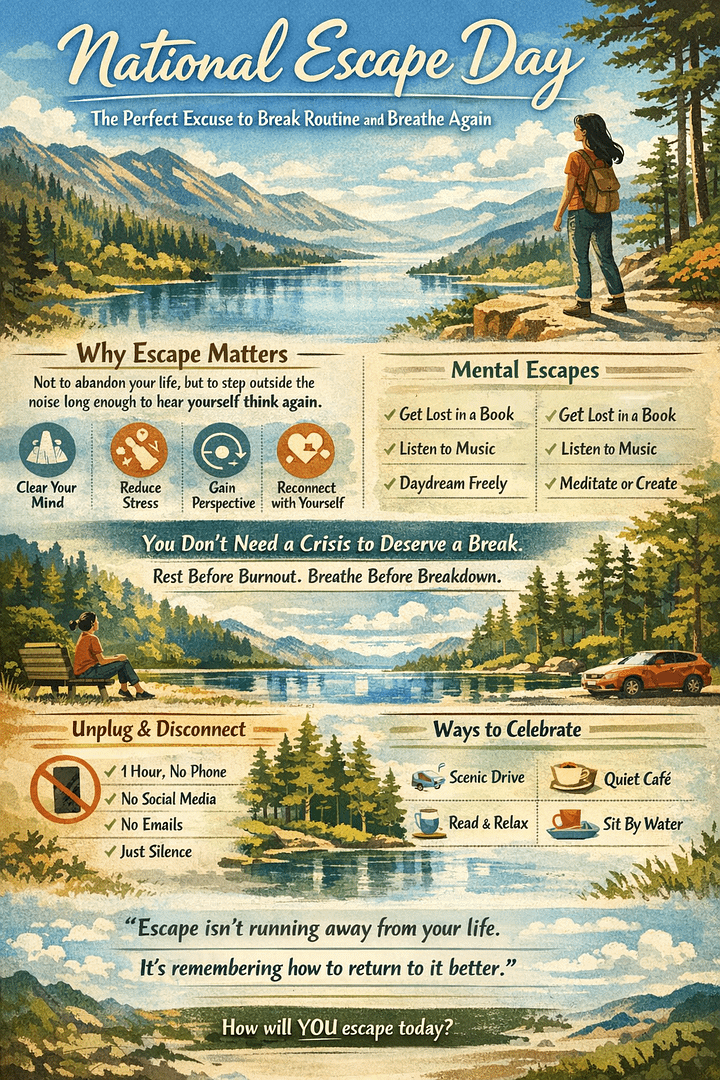
  • National Escape Day: The Perfect Excuse to Break Routine and Breathe Again

    Advertisements

    Life has a way of tightening around us.

    Schedules fill. Notifications buzz. Responsibilities stack. People need things. Decisions pile up. Even good things — family, work, goals, relationships — start to feel heavy when there’s no pause between carrying them.

    National Escape Day exists as a gentle interruption to that pressure.

    It’s not about abandoning your life.
    It’s about stepping outside the noise long enough to hear yourself think again.

    Because constant motion without moments of escape doesn’t build strength — it builds burnout.


    The Modern Life Trap: Always On, Never Off

    We live in a world where rest feels suspicious.

    If you’re not producing, posting, responding, or improving something, it can feel like you’re falling behind. Phones follow us everywhere. Work seeps into evenings. Stress rides in the passenger seat even when nothing is technically wrong.

    And here’s the sneaky part: you can feel overwhelmed even when your life looks “fine.”

    National Escape Day gives you permission to say:

    “I don’t need a crisis to deserve a break.”

    You are allowed to step away before exhaustion turns into resentment, anxiety, or emotional shutdown.


    Escape Isn’t Running Away

    There’s a difference between avoidance and renewal.

    Avoidance says, “I can’t deal with my life.”
    Escape says, “I need space so I can deal with my life better.”

    Healthy escape:

    • Clears mental clutter

    • Reduces stress hormones

    • Improves focus and creativity

    • Helps you regulate emotions

    • Brings perspective to problems that felt huge

    When you step away briefly, your nervous system shifts out of survival mode. Your thoughts slow down. Your body unclenches. Solutions appear where panic once lived.

    That’s not quitting. That’s recalibrating.


    Small Escapes Matter More Than Grand Ones

    We often imagine escape as something dramatic — vacations, road trips, disappearing into the woods.

    But the most powerful escapes are often quiet and accessible.

    A 10-minute reset can change your entire mood.

    Try:

    • Sitting in your car in silence before going inside

    • Standing outside at night and looking at the sky

    • Taking a slow walk without your phone

    • Lying on the floor and doing nothing

    • Watching rain, fire, or water move

    • Listening to one song with your eyes closed

    These tiny departures interrupt stress cycles and remind your brain that not every moment requires effort.


    Mental Escapes: Where the Mind Travels, the Body Follows

    Your brain doesn’t need plane tickets to shift states.

    Stories, music, art, prayer, meditation, and imagination all transport you. When you read a novel, get lost in a show, or create something with your hands, your stress response softens. Your breathing changes. Time loosens its grip.

    Mental escape is powerful because it:

    • Gives emotions somewhere safe to move

    • Provides relief without logistics

    • Helps you process feelings indirectly

    • Restores curiosity and wonder

    It’s not “checking out.” It’s letting your mind stretch beyond its daily cage.


    Nature: The Original Escape Room

    Something changes in us outdoors.

    The nervous system relaxes when surrounded by natural patterns — trees, water, wind, sky. Nature doesn’t rush. It doesn’t demand performance. It doesn’t care about your to-do list.

    Even brief exposure to the natural world:

    • Lowers blood pressure

    • Reduces mental fatigue

    • Improves mood

    • Grounds racing thoughts

    You don’t need a forest. A park bench, backyard, or patch of sky counts.

    Sometimes escape is just remembering you are a living being — not just a problem-solving machine.


    Digital Escape: Silence Is Medicine

    One of the most powerful modern escapes is also the simplest:

    Turning things off.

    Constant input keeps the brain in a reactive state. Every notification is a tiny demand. Every scroll invites comparison. Every headline adds emotional weight.

    A digital pause can feel uncomfortable at first — which is often a sign of how badly we need it.

    Try a one-hour digital escape:

    • No phone

    • No social media

    • No news

    • No responding

    Notice what surfaces when the noise stops. That’s where your real mental state lives.


    Why Guilt Shows Up When You Rest

    Many people struggle to escape because guilt appears immediately.

    “I should be doing something.”
    “I don’t have time for this.”
    “I haven’t earned a break.”

    But rest is not a reward.
    It’s a requirement.

    You wouldn’t expect a car to run forever without fuel. You wouldn’t expect a phone to stay on without charging. Yet we expect ourselves to operate at full capacity nonstop.

    National Escape Day challenges that belief. It reframes escape as maintenance, not indulgence.


    The Return: Why You Come Back Better

    The magic of escape isn’t just in leaving — it’s in returning.

    After stepping away:

    • Problems often feel more manageable

    • Emotions feel less intense

    • Patience increases

    • Creativity returns

    • You respond instead of react

    Nothing outside you may have changed…

    …but your internal pressure has dropped. And that changes how you experience everything.


    Ways to Celebrate National Escape Day

    You don’t need money. Just intention and permission.

    Physical escapes

    • Take a scenic drive

    • Walk somewhere new

    • Sit by water

    • Visit a quiet café alone

    Mental escapes

    • Read fiction

    • Listen to music with no multitasking

    • Watch something purely for enjoyment

    Emotional escapes

    • Journal without censoring

    • Sit with a feeling instead of solving it

    • Cry, laugh, or breathe deeply without rushing

    Digital escapes

    • Silence notifications

    • Stay offline for a set window

    • Leave your phone in another room

    The rule is simple:
    No productivity goals. No performance. No proving.

    Just space.


    The Real Meaning of Escape

    The point of escape is not to leave your life behind.

    It’s to remember that you are more than your responsibilities.
    More than your stress.
    More than your deadlines and roles.

    When you step away, even briefly, you reconnect with the part of you that isn’t exhausted — the part that notices beauty, feels curiosity, and can breathe without pressure.

    And when you return…

    you don’t just go back to your life.

    You return to it as someone with a little more air in their lungs and a little less weight on their chest.

    That’s the power of a pause.

    Read More Holidays & National Days

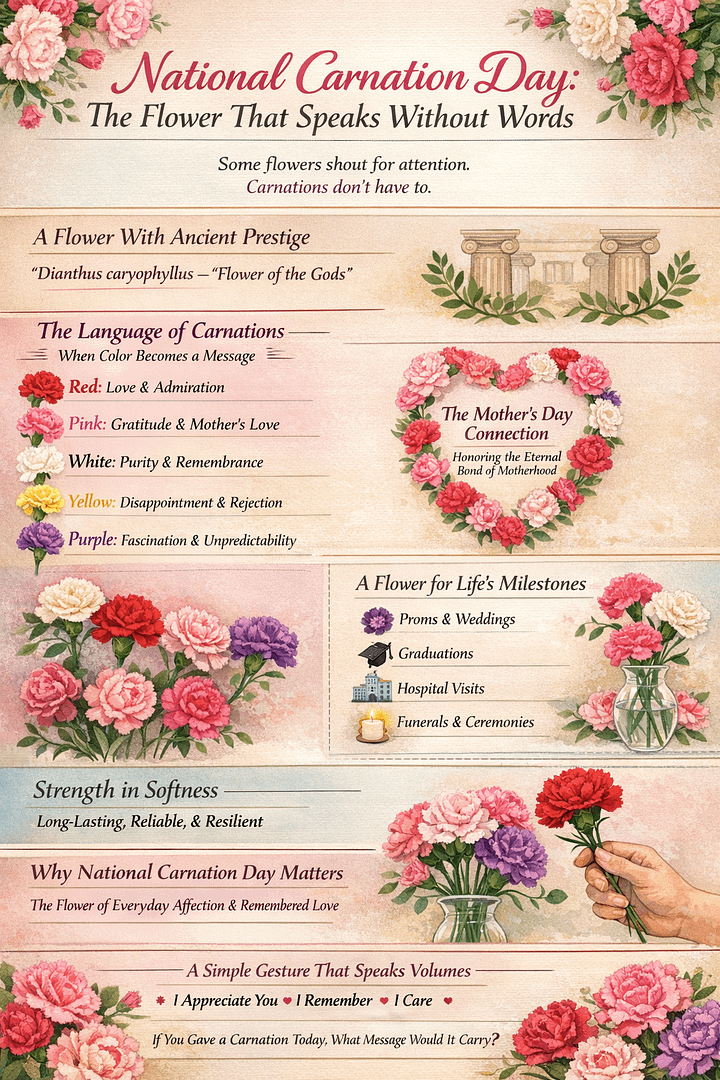
  • National Carnation Day: The Flower That Speaks Without Words

    Advertisements

    Some flowers shout for attention.
    Carnations don’t have to.

    They’ve been quietly present in the biggest moments of our lives for generations — celebrations, apologies, graduations, hospital rooms, weddings, memorials. On National Carnation Day, we pause to appreciate a flower that has been speaking for us long before we knew how to say what we felt.

    It may not always be called “luxury,” but few flowers carry as much emotional history as the carnation.


    A Flower With Ancient Prestige

    Carnations aren’t trendy newcomers. They’re botanical elders.

    Their scientific name, Dianthus caryophyllus, comes from Greek roots meaning “divine flower” or “flower of the gods.” Ancient Greek and Roman cultures used carnations in ceremonial crowns, garlands, and celebrations. They symbolized distinction, admiration, and honor — a floral badge of importance.

    Over centuries, carnations traveled through Europe and the Middle East, eventually becoming one of the most cultivated flowers in the world. They adapted, endured, and spread — much like the emotions they represent.


    The Language of Carnations: When Color Becomes a Message

    Carnations became central to floriography, the Victorian-era language of flowers. When social rules limited open emotional expression, people used blooms to send coded messages.

    Carnations turned into emotional messengers.

    Here’s what their colors traditionally say:

    • Red Carnations – Deep love, admiration, and devotion
      Not just romance — these can express respect and heartfelt appreciation.

    • Pink Carnations – Gratitude and a mother’s eternal love
      Often associated with nurturing, care, and remembrance.

    • White Carnations – Pure love, innocence, loyalty, and remembrance
      Frequently used in weddings and sympathy arrangements.

    • Yellow Carnations – Disappointment, rejection, or strained relationships
      Proof that flowers can be honest… sometimes brutally.

    • Purple Carnations – Fascination and unpredictability
      Perfect for someone who keeps life interesting.

    It’s rare to find a flower that can comfortably represent both joy and grief, but carnations move between those emotional spaces with grace.


    The Mother’s Day Connection

    Carnations are forever tied to motherhood.

    When Anna Jarvis founded Mother’s Day in the early 1900s, she chose the white carnation to honor her late mother. To her, the bloom represented the purity, faithfulness, and enduring love of a mother — a love that continues even after loss.

    That meaning still resonates. Pink and white carnations are staples in Mother’s Day bouquets because they symbolize a bond that time and distance can’t erase.

    For many people, carnations are not just decorative — they’re personal.


    A Flower for Life’s Milestones

    Carnations show up when life changes.

    • Prom corsages

    • Graduation bouquets

    • Wedding boutonnieres

    • Hospital visits

    • Sympathy arrangements

    • Religious ceremonies

    They are there at beginnings and endings, in hope and in heartbreak. Few flowers hold space for both celebration and mourning without feeling out of place.

    That emotional versatility is part of their quiet power.


    Strength in Softness

    There’s something symbolic about how durable carnations are.

    They last longer in a vase than many delicate blooms. They travel well. They’re affordable. They remain full and vibrant even after days have passed.

    They don’t wilt at the first sign of difficulty.

    In many ways, carnations represent a kind of love that isn’t flashy — the love that shows up every day, weathers storms, and stays when things get hard.

    Not dramatic.
    Not rare.
    Just reliable.

    And sometimes, that’s the most meaningful kind.


    Why National Carnation Day Matters Now

    In a culture drawn to the exotic and extravagant, carnations remind us of the beauty in the familiar.

    They are the flowers of:

    • Everyday affection

    • Quiet gratitude

    • Long-standing loyalty

    • Remembered love

    National Carnation Day isn’t about elevating a trendy bloom — it’s about recognizing a flower that has been emotionally present in human life for centuries.

    They don’t demand attention.
    They hold emotion.


    A Simple Gesture That Speaks Volumes

    Giving someone a carnation today isn’t about cost or trend. It’s about intention.

    It says:

    • I appreciate you.

    • I remember.

    • I care.

    • I’m thinking of you.

    Sometimes the simplest flower carries the deepest meaning.

    Read More Holidays & National Days

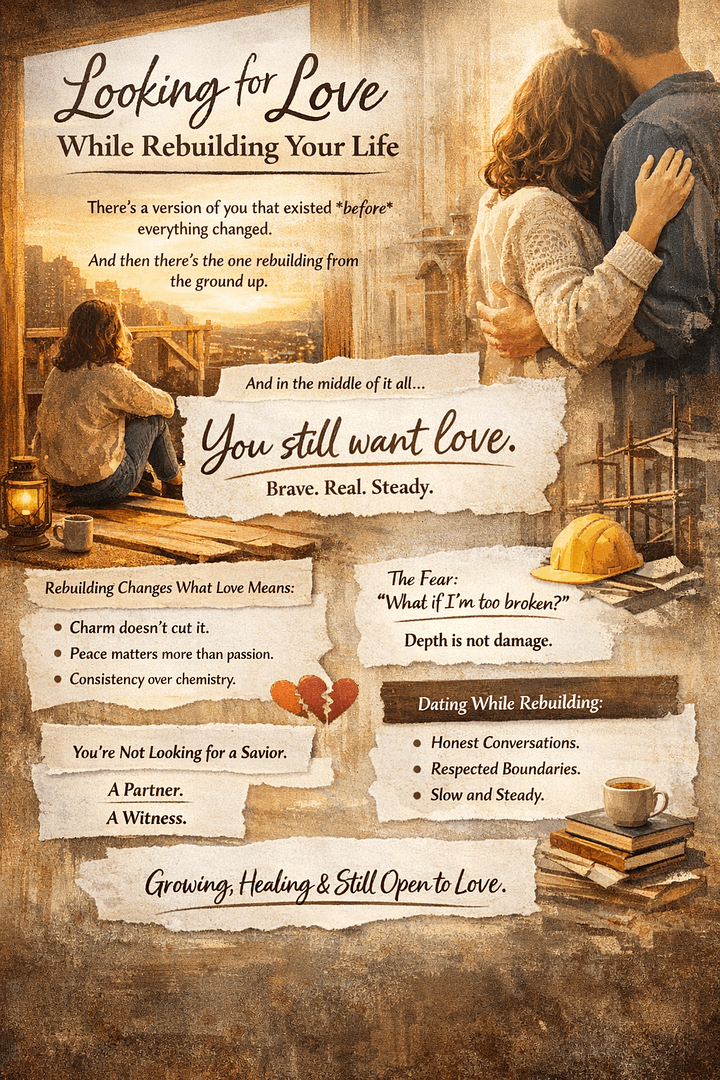
  • Looking for Love While Rebuilding Your Life

    Advertisements

    There’s a version of you that existed before everything changed.

    Before the heartbreak.
    Before the loss.
    Before the divorce, the betrayal, the collapse, the burnout, the moment you realized you couldn’t keep living the same way.

    And then there’s this version.

    The one standing in the middle of the rubble, holding pieces of a life that doesn’t look the way it used to — trying to decide what stays, what goes, and who you’re becoming now.

    It’s here, in this uncertain, half-built space, that a quiet truth often rises:

    You still want love.

    Not the fairytale version.
    Not the naive, reckless kind.
    But the real thing. The steady thing. The safe thing.

    And wanting that while you’re still rebuilding?
    That takes a kind of bravery most people don’t see.


    Rebuilding Changes What Love Means to You

    When life knocks you down, it strips illusions first.

    You stop being impressed by:

    • charm without consistency

    • attention without effort

    • chemistry without emotional safety

    • words that sound good but don’t show up in action

    Because you’ve lived enough to know:

    Butterflies can coexist with anxiety.
    Passion can hide instability.
    Intensity can be mistaken for intimacy.

    Rebuilding sharpens your vision.

    You’re no longer dating for a spark.
    You’re dating for peace.

    You want someone whose presence lowers your blood pressure, not raises your cortisol. Someone who doesn’t feel like another project, another uncertainty, another emotional risk you have to manage alone.

    That shift? It’s not boring.

    It’s evolved.


    The Loneliness of Becoming Someone New

    Rebuilding your life often means becoming unfamiliar, even to yourself.

    Your routines change.
    Your social circles shift.
    Your priorities rearrange.

    You may not go to the same places.
    You don’t laugh at the same things.
    You don’t tolerate what you used to.

    And in the middle of that transformation, there’s a specific kind of loneliness — not just being alone, but being between identities.

    You’re not who you were.
    You’re not fully who you’re becoming.

    Wanting love during this stage isn’t weakness.

    It’s the natural human desire to not walk such a massive internal shift without someone seeing it happen.

    Because rebuilding is exhausting.
    And sometimes you don’t want advice — you want someone to sit beside you and say, “I know this is hard. I’m here.”


    “What If I’m Too Broken?”

    Almost everyone rebuilding their life carries this quiet fear:

    What if I come with too much baggage now?

    You have stories. Scars. Lessons learned the hard way. A past that isn’t light or simple.

    But here’s the truth no one says enough:

    Depth is not damage.

    Yes, you’ve been through things. But those things gave you:

    • emotional intelligence

    • empathy

    • resilience

    • boundaries

    • clarity about what actually matters

    You’re not bringing chaos into a relationship.

    You’re bringing awareness.

    The right person doesn’t see your past as a liability. They see it as proof that you know how to love with intention, not fantasy.


    Dating While Rebuilding Feels Different

    You don’t rush anymore.

    You observe.

    You listen to how someone talks about:

    • their ex

    • their mistakes

    • their family

    • people who’ve hurt them

    You notice if they can apologize.
    If they can handle disagreement without shutting down or exploding.
    If they respect your pace instead of trying to override it.

    You’re not guarded because you’re cold.

    You’re careful because you’ve earned the right to protect your peace.

    And the person meant to be in your life won’t be threatened by that. They’ll be relieved by it.


    You’re Not Looking to Be Saved

    This is one of the biggest differences.

    You don’t need someone to rescue you from your life. You’re already doing the rebuilding.

    Paying the bills.
    Doing the therapy.
    Facing the grief.
    Making the hard decisions.

    You’re not searching for a hero.

    You’re looking for a partner.

    Someone who brings stability, not dependency. Someone who doesn’t need you to shrink so they can feel bigger. Someone who can say, “You handle your life, I handle mine, and we meet in the middle by choice.”

    That kind of connection is built on respect, not neediness.

    And it lasts longer.


    The Risk Is Still There — But So Are You

    Loving again after life has broken you open is terrifying.

    Because you know now:

    People leave.
    Circumstances change.
    Nothing is guaranteed.

    But you also know something else you didn’t know before:

    You can survive loss.

    You’ve already lived through days you thought you couldn’t. You’ve rebuilt once. That changes how you approach love.

    You’re not clinging.

    You’re choosing.

    And that means if things ever fall apart again — you won’t fall apart the same way.

    That’s strength, not fear.


    Love During a Rebuild Is Not a Distraction — It’s Fuel

    Sometimes people treat love like it’s a reward you get after you finish healing.

    But life doesn’t work in neat chapters.

    Sometimes:

    • a conversation helps you trust again

    • a kind partner helps you soften

    • a safe relationship helps you unlearn survival mode

    Love, when it’s healthy, doesn’t interrupt your rebuild.

    It supports it.

    It gives you a soft place to land while you’re doing hard work.


    You’re Allowed to Want Both

    You’re allowed to grow and want companionship.
    To heal and go on dates.
    To rebuild and open your heart slowly.

    You don’t have to be a finished product to be lovable.

    You just have to be real.

    Because the right person isn’t looking for perfection.

    They’re looking for someone who is doing the work, telling the truth, and brave enough to try again.

    And if that’s you?

    You’re further along than you think.

    Read More Of Love & Relationships

    Read More Of Inspiration & Motivation

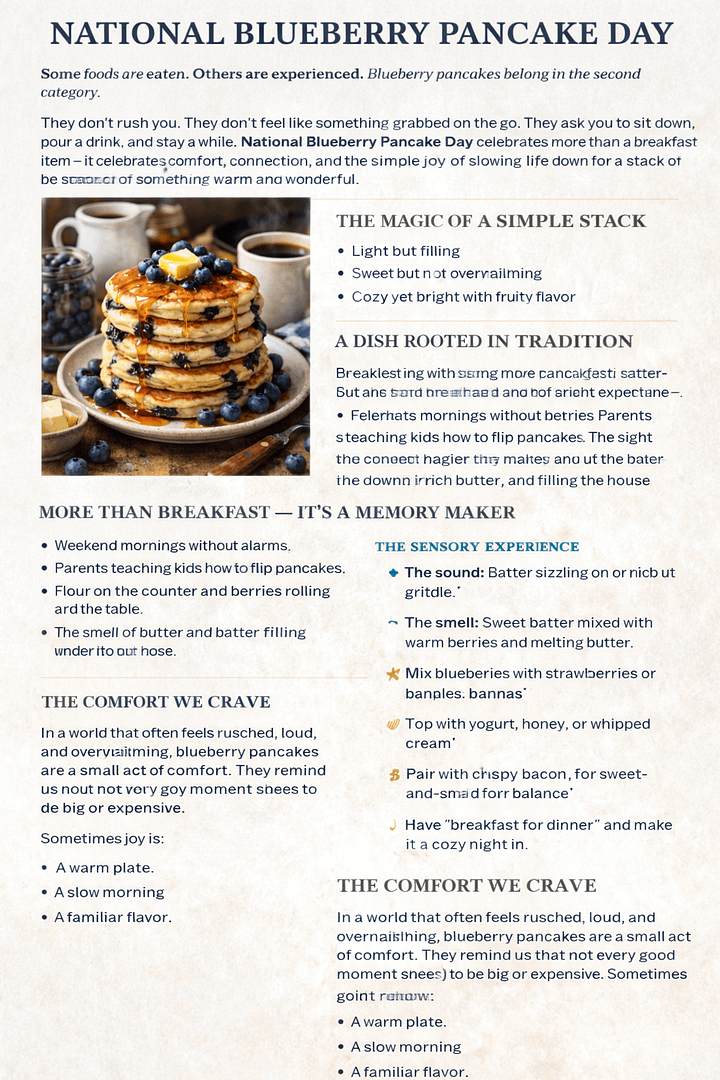
  • National Blueberry Pancake Day

    Advertisements

    Some foods are eaten. Others are experienced. Blueberry pancakes belong in the second category.

    They don’t rush you. They don’t feel like something grabbed on the go. They ask you to sit down, pour a drink, and stay awhile. National Blueberry Pancake Day celebrates more than a breakfast item — it celebrates comfort, connection, and the simple joy of slowing life down for a stack of something warm and wonderful.


    The Magic of a Simple Stack

    At first glance, blueberry pancakes seem humble: flour, eggs, milk, a handful of berries. But when they hit a hot griddle, something special happens. The batter rises into soft, golden pillows while the blueberries burst into little pockets of sweet-tart goodness.

    It’s the balance that makes them unforgettable:

    • Light but filling

    • Sweet but not overwhelming

    • Cozy yet bright with fruity flavor

    They’re indulgent without feeling heavy — the kind of meal that feels like a treat, even when it’s made in your own kitchen.


    A Dish Rooted in Tradition

    Pancakes, in some form, have been made for centuries across cultures — from French crêpes to Russian blini. But the fluffy American-style pancake became a staple in homes and diners alike, especially when blueberries entered the picture.

    Blueberries are native to North America, and their natural sweetness made them a perfect addition to morning recipes. Over time, blueberry pancakes became a breakfast classic, showing up everywhere from camping trips to holiday mornings.

    They’re one of those rare foods that feel equally at home:

    • In a small-town diner booth

    • Around a crowded family table

    • On a quiet solo morning with coffee and a book


    More Than Breakfast — It’s a Memory Maker

    Blueberry pancakes often carry emotional weight. They’re tied to moments that linger long after the plates are cleared.

    For many people, they mean:

    • Weekend mornings without alarms

    • Parents teaching kids how to flip pancakes

    • Flour on the counter and berries rolling across the table

    • The smell of butter and batter filling the house

    They’re the kind of meal that invites conversation, laughter, and second helpings. Nobody grabs pancakes and runs out the door — they encourage staying, talking, and being present.


    The Sensory Experience

    Part of the love for blueberry pancakes comes from how they engage all the senses.

    The sound: Batter sizzling on a hot griddle.
    The smell: Sweet batter mixed with warm berries and melting butter.
    The sight: Golden pancakes with deep blue-purple bursts inside.
    The touch: Soft, fluffy texture that almost melts under your fork.
    The taste: A perfect dance between sweet syrup, rich butter, and bright blueberries.

    It’s comfort you can see, smell, and taste all at once.


    Why Blueberries Make the Difference

    Blueberries aren’t just delicious — they elevate the whole dish.

    They add:

    • Natural sweetness

    • A slight tang that balances syrup

    • A juicy texture inside the fluffy pancake

    • Antioxidants, vitamins, and fiber

    They turn an ordinary stack into something colorful, flavorful, and just a little bit special.


    Creative Ways to Celebrate

    National Blueberry Pancake Day is the perfect excuse to make breakfast an event.

    Fun ideas to try:

    🫐 Add lemon zest or vanilla to the batter
    🥞 Make mini silver-dollar pancakes for kids
    🍓 Mix blueberries with strawberries or bananas
    🍯 Top with yogurt, honey, or whipped cream
    🥓 Pair with crispy bacon for sweet-and-savory balance
    🌙 Have “breakfast for dinner” and make it a cozy night in

    You can keep it classic or get creative — blueberry pancakes are incredibly forgiving and fun to experiment with.


    The Comfort We Crave

    In a world that often feels rushed, loud, and overwhelming, blueberry pancakes are a small act of comfort. They remind us that not every good moment needs to be big or expensive. Sometimes joy is:

    A warm plate.
    A slow morning.
    A familiar flavor.

    They represent care — the kind that says, “Sit down. Eat. Stay a while.”


    A Celebration of Simple Happiness

    National Blueberry Pancake Day isn’t about elaborate plans. It’s about pausing to enjoy something warm, sweet, and familiar. It’s about tradition, nostalgia, and making new memories at the same time.

    That stack on your plate isn’t just breakfast.

    It’s comfort.
    It’s connection.
    It’s a little reminder that life’s sweetest moments are often the simplest.

    Read More Holidays & National Days
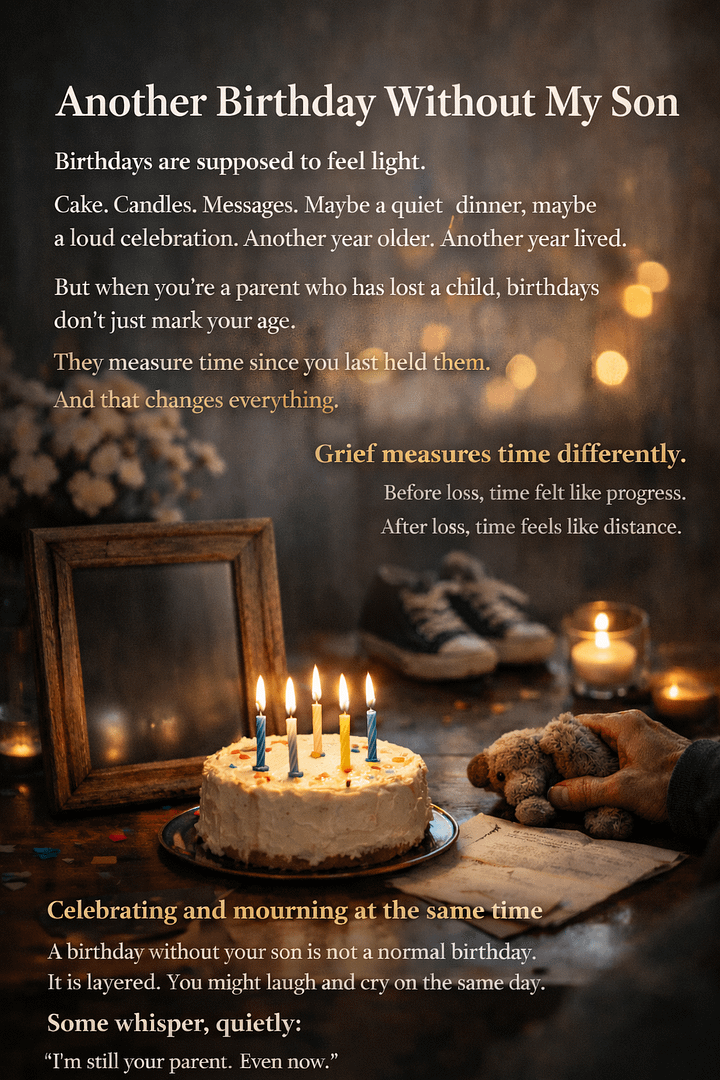
  • Another Birthday Without My Son

    Advertisements

    Birthdays are supposed to feel light.

    Cake. Candles. Messages. Maybe a quiet dinner, maybe a loud celebration. Another year older. Another year lived.

    But when you’re a parent who has lost a child, birthdays don’t just mark your age.

    They measure time since you last held them.

    And that changes everything.

    The Birthday That No Longer Fits

    There’s something disorienting about celebrating your own life when part of your heart is missing. People say, “Happy Birthday!” with genuine kindness, and you smile back — because you know they mean well — but the words land differently now.

    It isn’t that you aren’t grateful to be alive.
    It’s that life feels incomplete in a way that can’t be explained in a party setting.

    A birthday used to mean:

    • Another year of memories

    • Watching your child grow

    • Hearing their voice say, “Happy Birthday, Dad”

    Now it’s a quiet awareness:

    They should be here for this.


    Grief Measures Time Differently

    Before loss, time felt like progress.

    After loss, time feels like distance.

    Another birthday means another year you’ve lived without hearing their laugh. Another year since you’ve seen their face light up. Another year of carrying memories instead of moments.

    And yet, strangely, you carry them into every birthday.

    They are in:

    • The silence between well-wishes

    • The extra chair that exists only in memory

    • The thought that crosses your mind when you make a wish before blowing out candles

    Not for presents.
    Not for success.
    Just for one more moment.


    The Guilt of Being the One Still Here

    Birthdays after losing a child can carry a weight few talk about — survivor’s guilt.

    You wonder things you’d never say out loud:

    • Why do I get more years?

    • Why did their time stop and mine keep going?

    There’s no logic that fixes this. No explanation that makes it sit neatly in the heart.

    But here’s a truth that grief slowly teaches:

    Your continuing life does not betray them.
    It carries them.

    Every year you live is another year their story lives through you.


    Celebrating and Mourning at the Same Time

    A birthday without your son is not a normal birthday.
    It is layered.

    You might laugh and cry on the same day. You might feel okay in the morning and wrecked by evening. You might want company — or none at all.

    All of it is allowed.

    There is no rulebook for how a grieving parent “should” spend their birthday. Some people visit a special place. Some light a candle. Some look through photos. Some avoid the day entirely.

    Some whisper, quietly:

    “I’m still your parent. Even now.”

    Because you don’t stop being a parent when a child dies.
    You just become a parent whose love has nowhere physical to land — so it lives in memory, ritual, and the quiet corners of the heart.


    They Are Part of Every Year You Turn

    Your age is not just a number anymore.

    It’s a timeline of love.

    Every year added to your life is another year you’ve carried them with you. Another year you’ve gotten out of bed, breathed through the ache, and continued — not because the pain is gone, but because love doesn’t end when a life does.

    You are not “moving on.”
    You are moving forward with them inside you.

    And that is one of the hardest, bravest things a person can do.


    If Today Is Your Birthday

    If today feels heavy instead of happy, you are not doing it wrong.

    If you miss your son so fiercely it feels physical, that’s love — still alive.

    If you smile at one moment and cry the next, that’s not weakness. That’s a heart big enough to hold grief and gratitude in the same breath.

    Blow out the candles if you can.
    Or don’t.

    But know this:

    The love between you and your son did not end. It changed form.
    And it still walks with you into every year ahead.

    A Father’s Guide to Surviving the Loss of a Child

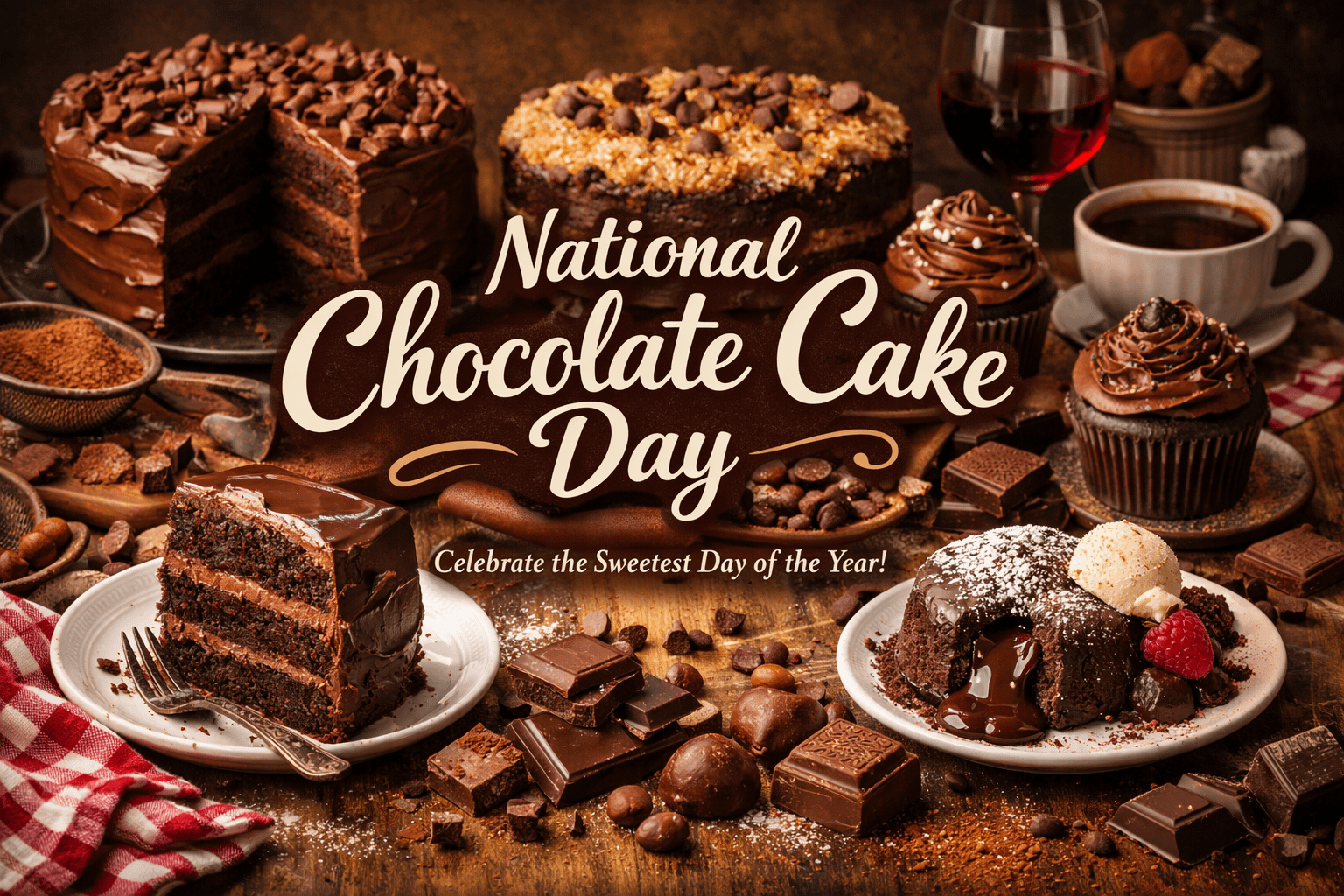
  • National Chocolate Cake Day: A Celebration of the World’s Most Loved Dessert

    Advertisements

    There are desserts… and then there’s chocolate cake. And National Chocolate Cake Day is the official permission slip to stop pretending you’ll “just have a bite” and fully commit to the slice.

    This isn’t just about sugar and cocoa. Chocolate cake is tied to memory, emotion, comfort, and celebration in a way few foods are. It shows up for the milestones, the heartbreaks, the quiet nights, and the loud parties. It’s the dessert equivalent of a best friend who always shows up.


    🍫 From Luxury to Everyday Love

    Chocolate wasn’t always something you could whip into a cake on a random Tuesday. For centuries, it was consumed mainly as a drink and often reserved for the wealthy. Once cocoa powder became widely available in the 1800s, bakers began experimenting — and the dessert world has never been the same.

    Early chocolate cakes were denser and less sweet than modern versions. As baking powder, refined sugar, and better ovens became common, recipes evolved into the fluffy, moist, deeply chocolatey creations we know today. By the early 20th century, chocolate cake had gone from novelty to necessity.

    Now? It’s the backbone of birthdays, weddings, office parties, and “I just need a win today” moments.


    🎂 Why Chocolate Cake Hits Different

    There’s a reason chocolate cake feels less like a dessert and more like an emotional experience.

    It’s tied to:

    • Childhood birthday parties with frosting-covered smiles

    • Grandma’s kitchen and handwritten recipe cards

    • First celebrations after big life wins

    • Comfort during tough seasons

    Chocolate cake doesn’t judge your reason for eating it. Celebration? Great. Breakup? Also great. Tuesday? Absolutely.

    Chocolate itself contains compounds that can support mood and relaxation, which might explain why that first bite feels like your shoulders dropping an inch. But honestly, the real magic is memory. Taste is one of the strongest triggers of nostalgia, and chocolate cake is often tied to moments that matter.


    🍰 The Many Faces of Chocolate Cake

    One of the best parts of National Chocolate Cake Day is realizing there’s no “one” chocolate cake. It’s a whole universe.

    The Classics

    • Devil’s Food Cake – Dark, rich, and intensely chocolatey

    • Chocolate Fudge Cake – Dense, moist, and deeply indulgent

    • German Chocolate Cake – Layers with coconut-pecan frosting

    The Indulgent Ones

    • Molten Lava Cake – That dramatic, gooey center

    • Chocolate Ganache Cake – Smooth, glossy, and elegant

    • Triple Chocolate Cake – Because moderation is optional today

    The Modern Twists

    • Vegan chocolate cake that’s shockingly rich

    • Gluten-free versions that don’t sacrifice texture

    • Chocolate zucchini cake (trust the process)

    • Espresso-infused cakes that deepen the flavor

    There’s a chocolate cake for every personality — dramatic, classic, low-key, or extra.


    ❤️ More Than a Dessert — It’s a Ritual

    Think about how often cake is part of life’s important events. We literally mark time with it. Candles. Wishes. Gathered people. Photos before anyone takes a slice.

    Chocolate cake especially carries warmth. It’s often the flavor chosen when someone wants to make others happy. Bringing a chocolate cake somewhere feels like bringing comfort in edible form.

    And then there are the quiet rituals:

    • Sneaking a forkful straight from the fridge

    • Eating the corner piece because of the extra frosting

    • Pairing it with coffee after everyone’s gone to bed

    Those little moments count too.


    🏠 Ways to Celebrate National Chocolate Cake Day

    You don’t need a bakery case or a fancy party. This day can be simple, cozy, and personal.

    Ideas to make it sweet:

    • Bake from scratch and let the kitchen smell like heaven

    • Try a local bakery’s signature chocolate cake

    • Turn it into a cake-and-movie night

    • Host a mini taste-test with different chocolate cake styles

    • Share slices with neighbors, coworkers, or family

    • Teach a kid how to bake their first cake

    Food tastes better when it’s connected to people. Chocolate cake is practically designed for sharing.


    ☕ The Perfect Pairings

    Want to level it up? Pair your slice with:

    • A hot cup of coffee (classic for a reason)

    • Cold milk for that nostalgic vibe

    • Vanilla ice cream melting into warm cake

    • A bold red wine for a more grown-up twist

    The contrast of bitter and sweet makes chocolate flavors shine even more.


    🎉 A Little Joy on a Plate

    National Chocolate Cake Day isn’t really about overindulging — it’s about allowing joy without guilt. Life is full of responsibilities, stress, and schedules. A slice of cake is a tiny rebellion against all that seriousness.

    It’s permission to pause. To savor. To remember that pleasure doesn’t always have to be earned.

    Because sometimes, the most meaningful celebrations are the simple ones — a fork, a plate, and a slice of something made with love.

    Read More Holidays & National Days
  • Three Pieces of Advice That Quietly Change Your Life

    Advertisements

    Don’t talk — act.
    Don’t say — show.
    Don’t promise — prove.

    These aren’t just catchy lines. They’re a blueprint for maturity, healing, leadership, love, and self-respect. They draw a hard line between intention and integrity — and most of us, at some point, have lived more on the intention side.

    We don’t struggle because we don’t know what to do.
    We struggle because doing it requires discomfort, humility, and consistency.

    This advice challenges the part of us that wants credit before the work is done.


    The Comfort of Words vs. The Discomfort of Action

    Talking, saying, and promising all live in the same emotional neighborhood: they relieve pressure without requiring change.

    They help us:

    • Feel better about ourselves

    • Calm other people down

    • Avoid consequences (for a moment)

    • Postpone hard work

    But relief is not the same as resolution.

    Action, showing, and proving?
    That’s where the discomfort lives:

    • Discipline when motivation is gone

    • Accountability when ego is bruised

    • Effort when nobody is watching

    • Patience when results are slow

    One path soothes your feelings.
    The other transforms your life.


    1. Don’t Talk — Act

    Talking about change can become a hidden form of procrastination.

    We talk when we are:

    • Excited

    • Inspired

    • Emotional

    • Tired of our situation

    But inspiration fades. Emotion cools. And then we’re left with the part we were secretly avoiding: the daily behavior required.

    Real change is deeply unglamorous.

    It’s:

    • Drinking water instead of soda

    • Going to the gym when you’re embarrassed to be there

    • Saving money when you want instant comfort

    • Sitting with grief instead of numbing it

    • Staying single instead of running back to what’s familiar

    No one applauds these moments. No one posts them. But these are the exact moments your future is built.

    There’s another reason to act more and talk less: talking creates social pressure. Once you announce a goal, your brain gets a small reward as if progress has already been made. It tricks you into feeling accomplished before you’ve earned it.

    Action flips that script.

    When you move quietly, you:

    • Build discipline

    • Develop internal confidence

    • Stop needing validation

    • Surprise people with results instead of excuses

    Silence paired with action is power.


    2. Don’t Say — Show

    Words describe intentions.
    Behavior reveals priorities.

    You don’t really see someone’s heart during easy times. You see it when:

    • They’re tired

    • They’re stressed

    • They’re not getting their way

    Anyone can say they care.
    But care looks like:

    • Respecting boundaries you don’t like

    • Being gentle with someone’s insecurities

    • Staying consistent when the “honeymoon” feeling fades

    Anyone can say they’ve changed.
    But change looks like:

    • Reacting differently in the same old situation

    • Owning mistakes without defensiveness

    • Doing emotional work without being forced

    People don’t leave relationships because of one wrong sentence. They leave because the pattern doesn’t match the promise.

    Your actions are always telling the truth, even when your mouth isn’t.

    And this isn’t just about others — it’s about yourself too.

    If you tell yourself:
    “I’m working on myself,”
    but your habits stay the same…

    Your brain stops trusting you.

    Self-respect grows when your behavior matches your words — especially the words you speak privately.


    3. Don’t Promise — Prove

    Promises are emotional currency. They’re often used during damage control.

    “I swear I’ll do better.”
    “This time is different.”
    “I won’t hurt you again.”

    Most of the time, people mean it when they say it. But meaning something in pain is not the same as maintaining it in peace.

    A promise is made in a moment.
    Proof is built over months.

    Trust doesn’t rebuild when someone feels bad. It rebuilds when someone behaves differently long after the crisis has passed.

    Proof looks like:

    • Changed patterns, not changed speeches

    • Effort that continues after forgiveness

    • Responsibility without reminders

    • Growth that sticks when it’s inconvenient

    That’s why proof is rare. It requires identity change, not emotional reaction.

    You can promise with feelings.
    You can only prove with discipline.


    The Deeper Truth Behind All Three

    This advice is really about one thing:

    Stop trying to manage perception. Start building substance.

    Talking, saying, and promising are often about being seen a certain way:

    • As motivated

    • As loving

    • As changed

    • As good

    But acting, showing, and proving are about becoming someone — whether anyone notices or not.

    And here’s the irony:

    When you stop trying to convince people and start becoming solid in your actions, you don’t have to defend yourself nearly as much. Your reputation starts building itself.

    People trust what they consistently experience.


    Why This Is So Hard

    Because it forces us to confront:

    • Our laziness

    • Our fear

    • Our need for approval

    • Our discomfort with slow progress

    It asks us to give up the spotlight and work in the dark.

    But that’s where real confidence is born — not from praise, but from private integrity.

    You begin to know, deeply:

    “I don’t just talk about who I want to be. I show up as them.”

    That’s a different kind of self-worth. It’s quieter. But it’s unshakeable.


    When You Start Living This Way

    Something powerful happens:

    • You argue less, because your behavior speaks

    • You promise less, because your consistency reassures

    • You explain less, because your results are visible

    Your life becomes your statement.

    And the people who belong in your life?
    They won’t need speeches to believe you.

    They’ll already see it.

    Read More Of Inspiration & Motivation

Exit mobile version