Author: Brett Murphy

  • Silent Strength: The Power of Moving Differently

    Silent Strength: The Power of Moving Differently

    Advertisements

    In a world that celebrates constant noise—where success is broadcast, opinions are shared instantly, and validation is often measured in likes and attention—there is a quiet revolution happening. It’s the choice to move differently. To grow privately. To become stronger without needing the world to witness every step.

    The mindset behind these five statements isn’t about arrogance or detachment. It’s about evolution. It’s about becoming grounded in who you are, what you’ve been through, and where you’re going—without needing permission, applause, or understanding from others.

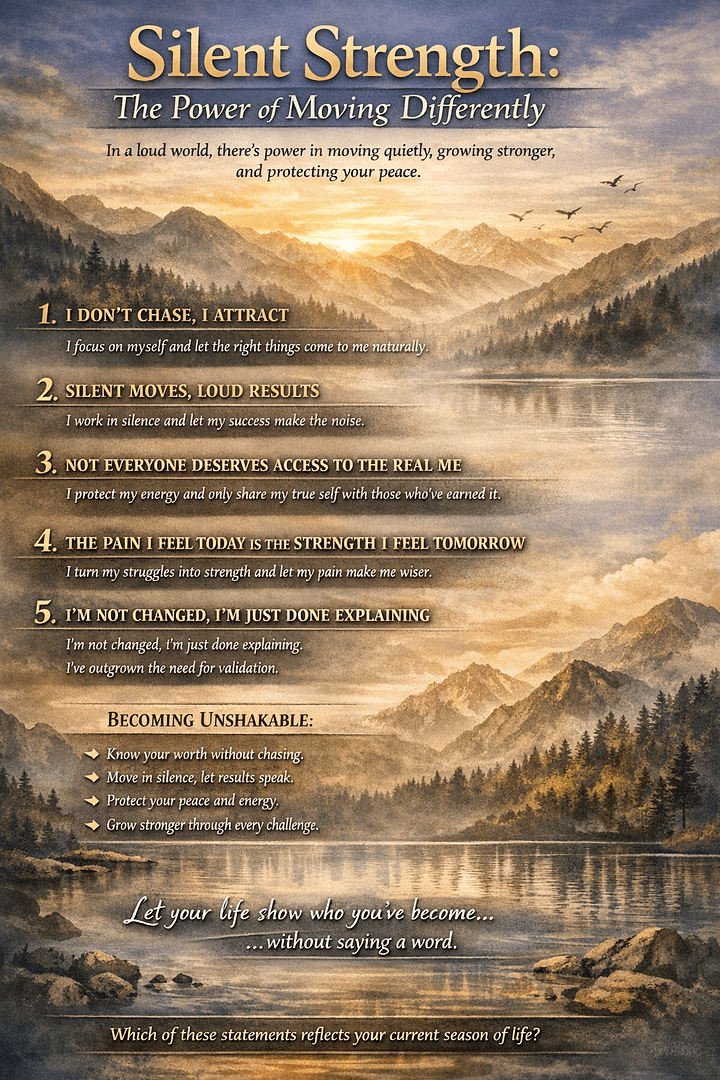
    1. I Don’t Chase, I Attract

    There is a deep shift that happens when you stop chasing.

    Chasing often comes from a place of lack—feeling like you have to prove your worth, earn someone’s attention, or force opportunities to happen. It’s exhausting. It drains your energy and often leads you toward things that were never meant for you in the first place.

    Attraction, on the other hand, comes from alignment.

    When you invest in yourself—your mindset, your discipline, your healing, your purpose—you naturally begin to draw in what matches that energy. You no longer need to convince people to stay, to care, or to see your value. The right people and opportunities recognize it without explanation.

    This doesn’t mean you stop working hard or putting yourself out there. It means you stop forcing what doesn’t flow. You begin to trust that what is meant for you will not require you to lose yourself to obtain it.

    2. Silent Moves, Loud Results

    We live in a time where people feel pressured to share everything—their plans, their goals, their next moves. But there is a different kind of power in silence.

    When you move quietly, you eliminate distractions. You’re no longer influenced by outside opinions, doubts, or unnecessary comparisons. You get to focus fully on the work, the process, and the discipline it takes to grow.

    Silent moves also build resilience. You learn to rely on your own validation instead of seeking it from others. You develop a deeper connection with your purpose because you’re not performing for an audience—you’re building for yourself.

    And when the results finally come, they don’t need explanation. They don’t need hype. They speak for themselves.

    The transformation becomes undeniable—not because you announced it, but because you became it.

    3. Not Everyone Deserves Access to the Real Me

    One of the hardest lessons in life is realizing that access is a privilege, not a right.

    As you grow, you begin to understand the importance of protecting your energy, your peace, and your inner world. Not everyone will understand your journey. Not everyone will respect your boundaries. And not everyone is meant to walk with you through every season of your life.

    There is a difference between being kind and being accessible to everyone. You can still be a good person while choosing to limit who gets to see your vulnerabilities, your struggles, and your dreams.

    The “real you” is layered. It’s built from your experiences, your pain, your hopes, and your growth. And it should be shared with people who honor that—not people who take it lightly or misuse it.

    Learning to say “no,” to step back, and to create emotional distance when needed isn’t cold—it’s wise.

    4. The Pain I Feel Today Is the Strength I Feel Tomorrow

    Pain is one of life’s greatest teachers, even though it’s the one we try hardest to avoid.

    Every hardship carries a lesson. Every loss reshapes your perspective. Every moment of deep pain forces you to confront parts of yourself you may have never explored otherwise.

    The truth is, strength is not built in comfort. It is built in the moments when you feel like giving up—but don’t. When you feel broken—but keep going. When you feel lost—but continue searching.

    Pain has a way of stripping away illusions. It shows you what truly matters. It reveals your resilience. It forces growth in ways that nothing else can.

    And while you may not see it in the moment, one day you’ll look back and realize that the very thing that hurt you… also built you.

    It gave you strength you didn’t know you had.
    It gave you perspective you couldn’t have learned otherwise.
    It gave you a deeper understanding of yourself and the world around you.

    5. I’m Not Changed, I’m Just Done Explaining

    Growth often comes with misunderstanding.

    People who knew you before may not recognize who you’re becoming. They may say you’ve changed—but what they’re really noticing is that you’ve set boundaries, raised your standards, and stopped tolerating what once drained you.

    And the truth is—you don’t owe anyone an explanation for that.

    You don’t have to explain why you’ve become quieter.
    You don’t have to explain why you’ve distanced yourself.
    You don’t have to explain why you’ve chosen peace over chaos.

    Growth is personal. It’s not always visible. And it’s not always understood by others.

    Being “done explaining” doesn’t mean you’ve become closed off—it means you’ve become secure. You no longer feel the need to justify your decisions or seek approval for your evolution.

    You’ve learned that your peace is more important than being understood.

    The Bigger Picture: Becoming Unshakable

    When you bring all of these ideas together, they form a mindset that is deeply rooted in self-awareness and strength.

    It’s about:

    Knowing your worth without needing validation
    Moving with purpose instead of pressure
    Protecting your energy without guilt
    Growing through pain instead of being defined by it
    Choosing peace over constant explanation

    This isn’t about perfection. It’s about progress. It’s about becoming more intentional with how you live, who you allow into your life, and what you give your energy to.

    It’s about becoming unshakable—not because life stops being hard, but because you become stronger.

    Final Thoughts

    You don’t need to announce your growth.
    You don’t need to prove your worth.
    You don’t need to explain your journey.

    The most powerful transformations happen quietly.

    They happen in the moments no one sees.
    In the decisions no one hears about.
    In the strength you build when no one is watching.

    And one day, without saying a word…
    your life will show exactly who you’ve become.

    Read More Of Inspiration & Motivation

  • 🍺 National Beer Day: A Toast to History, Craft, and Community

    Advertisements

    Every year on April 7th, Americans come together to celebrate National Beer Day—a tribute to one of the world’s oldest and most beloved beverages. But this day is more than just an excuse to enjoy a cold drink. It’s a celebration rooted in history, shaped by resilience, and carried forward by a culture that values craftsmanship, community, and connection.

    Whether you’re raising a glass at a neighborhood brewery, enjoying a quiet drink at home, or simply reflecting on the past, National Beer Day invites us to pause and appreciate the journey that brought beer back into American life.

    📜 A Turning Point in American History

    To truly understand the significance of National Beer Day, we have to go back to one of the most restrictive periods in U.S. history—Prohibition.

    From 1920 to 1933, the 18th Amendment made the production, sale, and transportation of alcoholic beverages illegal. What followed was a time marked by underground speakeasies, bootlegging, and a nationwide struggle between law enforcement and those who resisted the ban.

    But change was coming.

    In 1933, President Franklin D. Roosevelt signed the Cullen–Harrison Act, allowing the legal sale of beer and wine with low alcohol content. His famous remark, “I think this would be a good time for a beer,” captured the spirit of a nation ready to reclaim a simple pleasure.

    At 12:01 a.m. on April 7, 1933, breweries reopened, taps began to flow, and millions of Americans celebrated in the streets and bars. It wasn’t just about beer—it was about freedom, relief, and the return of a shared cultural experience.

    🍺 Beer Through the Ages

    Beer’s story stretches back thousands of years, long before modern civilization as we know it.

    Ancient Mesopotamians were brewing beer as early as 5,000 B.C.
    The Egyptians considered it a daily staple, often safer to drink than water
    Medieval monks refined brewing techniques and preserved recipes
    European immigrants brought their brewing traditions to America

    Beer has always been more than just a drink—it has been a source of nourishment, a social bond, and even a form of currency in ancient societies.

    Over time, brewing evolved into both a science and an art, blending precision with creativity to produce the wide range of styles we enjoy today.

    🍻 The Craft Beer Revolution

    While beer never disappeared after Prohibition, its diversity was limited for decades. Large-scale breweries dominated the market, offering mostly similar styles.

    That began to change in the late 20th century with the rise of the craft beer movement.

    Small, independent brewers started experimenting again—reviving old recipes, introducing bold flavors, and redefining what beer could be. Today, the craft beer scene is thriving, with thousands of breweries across the country offering unique and innovative creations.

    From hoppy IPAs to rich stouts, from sour ales to crisp pilsners, there is truly a beer for every taste.

    Even more importantly, craft breweries have become community hubs—places where people gather, connect, and support local businesses.

    🌎 Beer as a Cultural Connector

    Beer has a unique ability to bring people together across backgrounds, beliefs, and borders.

    Think about it:

    Friends meeting after a long day
    Families celebrating milestones
    Strangers bonding over a shared table
    Communities gathering for festivals and events

    Across the world, beer plays a central role in traditions—whether it’s Germany’s Oktoberfest, Ireland’s pub culture, or backyard barbecues in America.

    In a fast-paced world, beer often slows things down—encouraging conversation, laughter, and genuine connection.

    🍽️ Pairing Beer with Life’s Simple Pleasures

    One of the joys of beer is how well it pairs with everyday moments.

    A cold lager on a warm afternoon
    A dark stout by the fire on a quiet evening
    A refreshing wheat beer alongside a summer meal
    A bold IPA shared during a game with friends

    Beer enhances not just food, but experiences. It becomes part of the memory—something you associate with a place, a moment, or a person.

    🎉 Ways to Celebrate National Beer Day

    There’s no right or wrong way to celebrate—just make it meaningful and enjoyable:

    Visit a local brewery and support small businesses
    Try a new style you’ve never had before
    Host a tasting night with friends or family
    Learn the brewing process and deepen your appreciation
    Share your favorite beer stories with others

    For some, it’s a lively gathering. For others, it’s a quiet moment of reflection. Both are equally valid.

    ⚠️ Celebrate with Responsibility

    While the day is about enjoyment, it also comes with a reminder: drink responsibly.

    Know your limits, make safe choices, and look out for those around you. The best celebrations are the ones everyone remembers for the right reasons.

    🍻 More Than a Drink—A Symbol

    National Beer Day represents more than hops and barley. It stands as a symbol of:

    Resilience – overcoming restriction and hardship
    Freedom – reclaiming personal choice
    Creativity – the artistry of brewing
    Connection – the bonds formed over shared moments

    It reminds us that even something as simple as a glass of beer can carry deep meaning—connecting us to history, to each other, and to the present moment.

    ✨ Final Thoughts

    In a world that often moves too fast, National Beer Day invites us to slow down.

    To raise a glass.
    To share a story.
    To remember where we’ve been—and appreciate where we are.

    So whether your beer is poured fresh from a tap or cracked open at home, take a moment to enjoy it—not just for the taste, but for everything it represents.

    Read More Holidays & National Days

  • National Sorry Charlie Day: A Reminder That Rejection Isn’t the End

    Advertisements

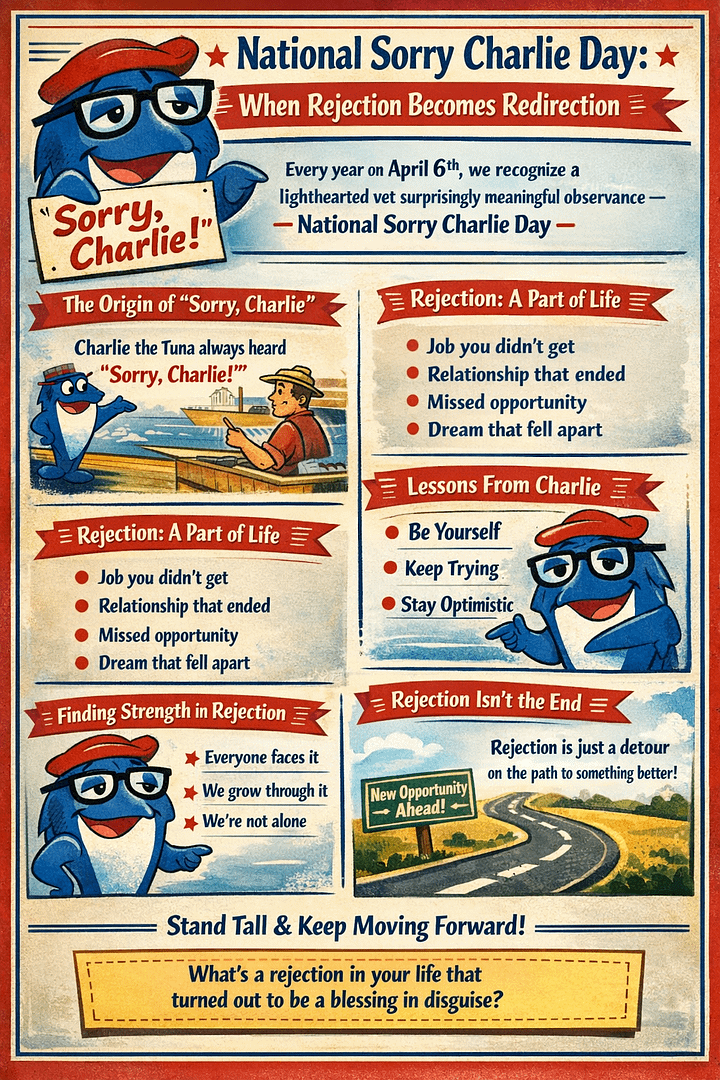
    Every year on April 6th, we recognize a lighthearted yet surprisingly meaningful observance—National Sorry Charlie Day. What began as a catchy advertising phrase has grown into a powerful reminder of something we all face but rarely celebrate: rejection.

    At first glance, the phrase “Sorry Charlie” may sound dismissive or even humorous—but beneath it lies a universal truth. Life doesn’t always go our way. Doors close. Opportunities pass us by. Plans fall apart. And yet, somehow, those very moments often shape who we become.

    The Origin: A Tuna Who Just Wasn’t Picked

    The phrase “Sorry Charlie” originated from a popular mid-20th-century ad campaign by StarKist. The commercials featured Charlie the Tuna, a charming cartoon fish who proudly believed he had refined taste. Ironically, that’s exactly why he wasn’t chosen.

    The fishermen weren’t looking for tuna with good taste—they wanted tuna that tasted good. And so, time after time, Charlie was passed over with the now-famous line:

    “Sorry, Charlie.”

    While meant to be humorous, the message stuck. It became shorthand for rejection—sometimes gentle, sometimes blunt, but always final.

    Why We Need a Day Like This

    Rejection is one of the most common human experiences—and one of the most difficult to handle. It touches every part of life:

    Careers and missed opportunities
    Relationships that don’t last
    Dreams that don’t unfold as planned
    Efforts that go unnoticed or unappreciated

    Yet, despite how universal rejection is, we often treat it as something to hide, avoid, or be ashamed of.

    National Sorry Charlie Day flips that perspective.
    It invites us to acknowledge rejection openly—and even find strength in it.

    The Emotional Weight of “No”

    Let’s be honest—rejection hurts.

    It can feel personal, even when it isn’t. It can make you question your worth, your abilities, or your direction. In some cases, it can leave a lasting mark that shapes how you approach future opportunities.

    But here’s the truth:
    Rejection doesn’t define you—how you respond to it does.

    Every “no” carries within it a choice:

    You can let it stop you
    Or you can let it shape you
    Rejection as a Turning Point

    Many of life’s greatest stories are built on rejection.

    The job you didn’t get leads you to a better career path
    The relationship that ended opens space for deeper connection later
    The closed door forces you to create your own

    Rejection has a way of redirecting us—often toward something we couldn’t see at the time.

    Think of it like this:
    Rejection isn’t the end of the road—it’s a detour.

    And sometimes, that detour leads exactly where you were meant to go.

    Lessons We Can Learn From Charlie

    Charlie the Tuna never stopped believing in himself. Despite constant rejection, he remained confident, optimistic, and unapologetically himself.

    That’s the real takeaway.

    On National Sorry Charlie Day, we’re reminded to:

    Stay true to who you are, even when others don’t see your value
    Keep showing up, even after disappointment
    Maintain your sense of humor, because sometimes laughter is healing

    Charlie wasn’t chosen—but he was unforgettable.

    Finding Strength in Shared Experience

    One of the most powerful aspects of rejection is realizing you’re not alone.

    Everyone—no matter how successful—has faced rejection:

    Writers whose work was turned down
    Athletes who didn’t make the team
    Entrepreneurs whose ideas were dismissed

    Behind every success story is a series of “Sorry Charlie” moments.

    When we share those experiences, something shifts:

    Shame turns into connection
    Failure turns into growth
    Isolation turns into understanding
    A Day to Reflect, Reset, and Rise

    National Sorry Charlie Day is more than a novelty—it’s an opportunity.

    A chance to:

    Reflect on past disappointments
    Recognize how far you’ve come
    Release the weight of rejection
    Recommit to your path forward

    It’s a day to remind yourself that setbacks are not stop signs—they are stepping stones.

    A Deeper Perspective: What Rejection Teaches Us

    Rejection teaches resilience.

    It teaches patience.

    It teaches humility.

    But most importantly, it teaches perspective.

    Not everything that feels like a loss actually is one. Sometimes, what we perceive as rejection is simply life protecting us, guiding us, or preparing us for something greater.

    Final Thoughts

    National Sorry Charlie Day may have started with a cartoon tuna, but its message carries real depth:

    You will face rejection in life—but rejection is not the end of your story.

    It’s a chapter. A turning point. A moment that asks you:

    Will you stop here… or will you keep going?

    So the next time life tells you “Sorry, Charlie,”
    stand tall, take a breath, and keep moving forward.

    Because somewhere ahead…
    there’s a “yes” waiting for you.

    Read More Holidays & National Days

  • 🍻 New Beer’s Eve: A Toast to Second Chances and American Spirit

    Advertisements

    Every year on April 6th, a unique and often overlooked celebration quietly comes to life across the United States. Known as New Beer’s Eve, this unofficial holiday honors a powerful moment in American history—when a nation stepped out from the shadow of restriction and raised a glass to freedom once more.

    But New Beer’s Eve is more than just a prelude to a drink. It is a story of perseverance, cultural identity, economic revival, and the undeniable human desire for connection.

    📜 The Long Dry Road to Celebration

    To truly understand New Beer’s Eve, we have to go back to one of the most controversial chapters in American history: Prohibition.

    In 1920, the ratification of the 18th Amendment made the production, sale, and transportation of alcohol illegal across the country. What began as a movement rooted in temperance and moral reform quickly turned into a nationwide experiment with unintended consequences.

    Instead of eliminating alcohol consumption, Prohibition drove it underground.

    Speakeasies—hidden, illegal bars—began popping up in cities and small towns alike
    Bootleggers and organized crime networks thrived
    Law enforcement struggled to contain the widespread disregard for the law

    For many Americans, Prohibition felt less like protection and more like restriction.

    ⏳ A Nation Ready for Change

    By the early 1930s, the country was in the grips of the Great Depression. Jobs were scarce, businesses were failing, and government revenue had plummeted. The idea of legalizing alcohol once again began to gain traction—not just as a cultural shift, but as an economic necessity.

    Enter President Franklin D. Roosevelt.

    Shortly after taking office in 1933, Roosevelt signed the Cullen-Harrison Act, allowing the sale of beer and wine with low alcohol content (3.2%). It wasn’t full repeal—but it was a monumental first step.

    And Americans were ready.

    🍺 Midnight, April 7, 1933: The First Legal Pour

    As April 6 turned into April 7, anticipation filled the air. Across the country, people lined up outside bars, taverns, and breweries—some waiting for hours just to be part of history.

    When midnight struck, it wasn’t just beer that flowed—it was relief, excitement, and a sense of reclaiming something deeply human.

    Newspapers at the time reported:

    Millions of barrels of beer were prepared in advance
    Cities saw massive crowds celebrating into the early morning hours
    Breweries that had been dormant roared back to life almost overnight

    For many, that first sip wasn’t just refreshing—it was symbolic.

    🇺🇸 The Beginning of the End of Prohibition

    New Beer’s Eve marked the turning point, but the journey wasn’t complete until December 1933, when the 21st Amendment officially repealed Prohibition.

    This made history in a profound way:

    It remains the only amendment ever passed to repeal another
    It restored control over alcohol laws back to individual states
    It acknowledged that public policy must sometimes adapt to reality

    The repeal was not just a legal shift—it was a cultural reset.

    💼 Economic Revival: Beer as a Lifeline

    The return of legal beer played a surprising but vital role in helping the U.S. economy recover during the Great Depression.

    Breweries reopened, and with them came:

    Thousands of jobs in brewing, distribution, and hospitality
    Increased demand for agriculture (barley, hops, corn)
    Tax revenue that helped fund public programs

    Beer, in many ways, became more than a beverage—it became part of America’s recovery story.

    🍻 The Evolution of American Beer Culture

    Fast forward to today, and the American beer scene has evolved into something incredibly diverse and creative.

    From large-scale breweries to independent craft operations, beer has become an art form:

    IPAs bursting with bold hop flavors
    Smooth lagers and crisp pilsners
    Rich stouts and porters with notes of coffee and chocolate
    Seasonal and experimental brews pushing the boundaries of flavor

    New Beer’s Eve now serves as both a celebration of history and a tribute to how far brewing has come.

    🎉 How New Beer’s Eve Is Celebrated Today

    While not an official holiday, New Beer’s Eve continues to grow in popularity—especially among history buffs and beer enthusiasts.

    Common ways people celebrate include:

    Visiting local breweries and supporting small businesses
    Hosting beer tastings with friends and family
    Learning about Prohibition-era history and stories
    Counting down to midnight with a toast to freedom

    Some bars and breweries even host themed events, recreating the spirit of 1933 with vintage décor and classic brews.

    ❤️ More Than Beer: A Celebration of Freedom and Connection

    At its core, New Beer’s Eve is not just about alcohol—it’s about what that moment represented.

    It reminds us:

    That people value freedom and personal choice
    That communities thrive when they can gather and connect
    That even difficult chapters in history can lead to meaningful change

    It’s about sitting across from someone, sharing a drink, telling stories, and feeling—if only for a moment—that everything is okay.

    🍺 Raise a Glass to History

    New Beer’s Eve is a celebration of second chances—a reminder that even after years of restriction, joy can return.

    So whether you’re enjoying a cold beer, reflecting on history, or simply appreciating the freedoms you have today, take a moment on April 6th to pause and reflect.

    Because sometimes, the smallest things—like a simple glass of beer—can carry the weight of an entire nation’s story.

    Cheers to resilience. Cheers to freedom. And cheers to the night America got its beer back.

    Read More Holidays & National Days

  • Easter: A Celebration of Hope, Renewal, and Life

    Advertisements

    Easter stands as one of the most meaningful and widely celebrated days in the world—a day that carries both deep spiritual significance and a universal message that reaches far beyond tradition. It is a time when faith, family, and the quiet beauty of renewal come together, reminding us that even after the darkest nights, light still finds a way to rise.

    The Heart of Easter

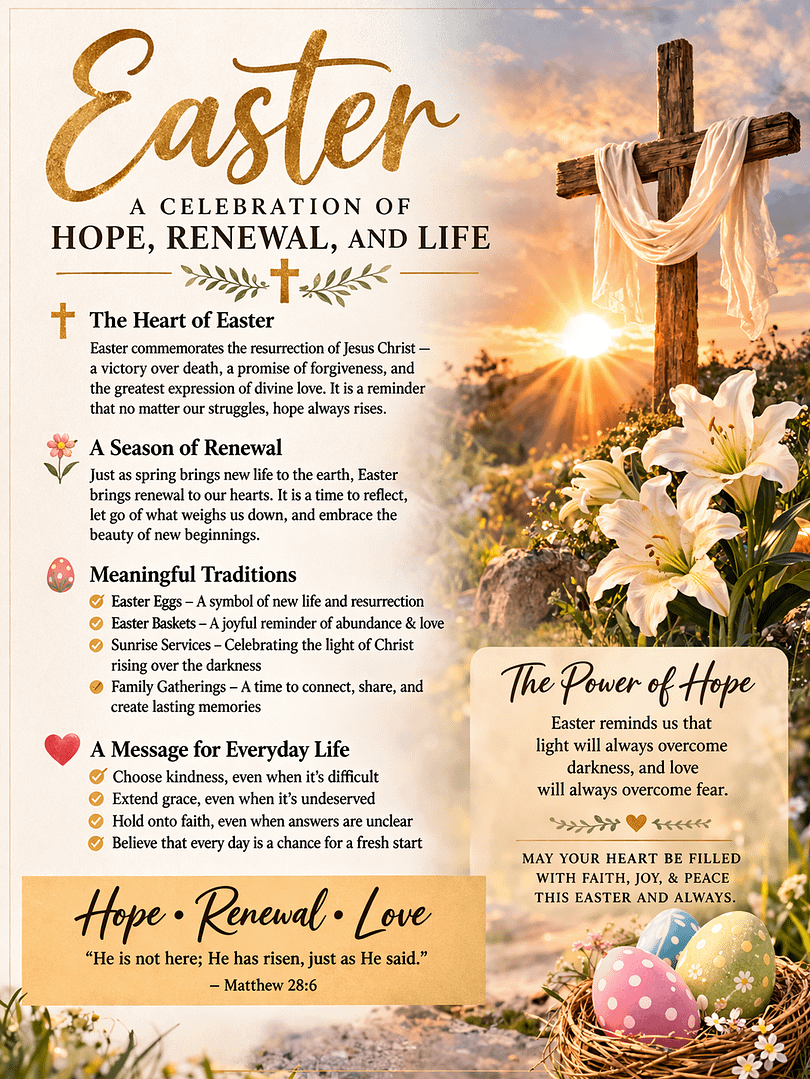
    At its core, Easter commemorates the resurrection of Jesus Christ—a moment that changed the course of history and continues to shape lives today. It is the cornerstone of Christian faith, symbolizing victory over death, forgiveness over sin, and hope over despair.

    The story of Easter is not just about what happened—it’s about what it means. It tells us that endings are not always final, that brokenness can be restored, and that love is stronger than anything we may face.

    For believers, Easter is a sacred reminder that God’s promises are real. For others, it still carries a powerful message: no matter how heavy life becomes, renewal is always possible.

    A Season of Renewal

    Easter arrives in the spring, and that timing feels anything but accidental. Nature itself begins to echo the message of the season. Trees that once stood bare begin to bud again. Flowers push through the soil. The air feels lighter, warmer—alive.

    This transformation mirrors what Easter represents within us:

    The renewal of hope after hardship
    The healing that follows loss
    The strength that grows through struggle

    Spring doesn’t rush its way into existence—it unfolds gradually. And in the same way, Easter reminds us that healing and renewal take time. It’s okay to grow slowly. It’s okay to still be in the middle of your journey.

    Traditions That Carry Meaning

    While Easter is rich in spiritual depth, it is also filled with traditions that bring joy and connection.

    Easter eggs, often brightly colored and decorated, symbolize new life and resurrection. The simple act of an egg hunt, especially for children, becomes a celebration of discovery and excitement.

    Easter baskets filled with treats represent abundance and joy—a reminder that life still holds sweetness even after sorrow.

    Church services, especially sunrise services, hold a special significance. As the sun rises, it reflects the moment of resurrection, offering a powerful visual reminder that light always returns.

    Family gatherings and meals bring people together, strengthening bonds and creating memories that last far beyond the day itself.

    Each tradition, whether deeply spiritual or simply joyful, carries a thread of the same message: life is meant to be shared, celebrated, and cherished.

    Easter and the Journey Through Grief

    For those who carry loss—especially the loss of a child or loved one—Easter can feel complicated. A day that speaks of joy and resurrection can also highlight the absence that is deeply felt.

    But Easter does not ignore grief. In fact, it meets it.

    Before the resurrection came the pain of Good Friday. Before the empty tomb came sorrow, confusion, and heartbreak. Easter acknowledges that suffering exists—but it also declares that suffering is not the end of the story.

    For those grieving, Easter gently offers this truth:

    Your love has not ended
    Your connection still exists
    Your story is still unfolding

    It does not rush healing or demand happiness. Instead, it invites you to hold both grief and hope in the same space.

    A Message for Everyday Life

    Easter is more than a moment—it is a mindset. It encourages us to carry its message into our daily lives.

    It asks us to:

    Choose kindness, even when it’s difficult
    Extend grace, even when it’s undeserved
    Hold onto faith, even when answers don’t come easily

    Easter reminds us that every day holds the potential for a fresh start. No matter what yesterday looked like, today offers another chance—to love better, to live fuller, to believe again.

    The Power of Hope

    If there is one word that defines Easter, it is hope.

    Hope that:

    Light will break through darkness
    Healing will come in time
    Love will never truly be lost

    Hope doesn’t always arrive loudly. Sometimes it comes quietly—in a sunrise, in a memory, in a moment of peace you didn’t expect. Easter teaches us to recognize those moments and hold onto them.

    Because even the smallest glimpse of hope can carry us forward.

    Living the Spirit of Easter

    Easter is not meant to stay within a single day. It is something to live out in how we treat others, how we face challenges, and how we carry ourselves through life.

    It lives in:

    A kind word to someone who is struggling
    A moment of patience when you feel overwhelmed
    A decision to keep going, even when it’s hard

    Easter lives in resilience. It lives in compassion. It lives in the quiet strength it takes to believe that better days are ahead.

    Read More Holidays & National Days

  • Grief Does Not Define You: Finding Yourself After the Loss of a Loved One

    Advertisements

    Grief is one of the most powerful forces a human heart can endure. It does not ask for permission. It does not follow rules. It does not arrive gently and leave quietly. Instead, it crashes into your life, reshaping everything you thought you knew—about love, about life, and even about yourself.

    When someone you love dies, it can feel as though the person you once were disappeared with them. The world continues to move, but you are left standing still, trying to understand how everything changed so quickly.

    In those moments, it is easy to believe that grief has become your identity.

    But even in the deepest sorrow, there is a truth that remains:

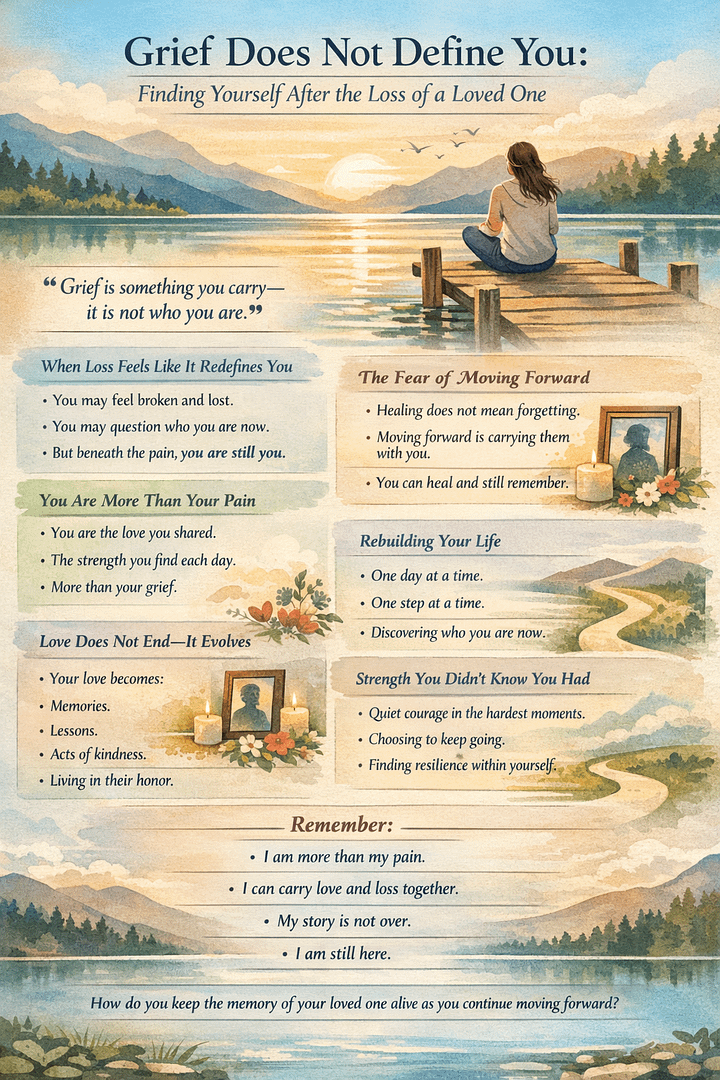
    Grief is something you carry—it is not who you are.

    When Loss Feels Like It Redefines You

    After losing a loved one, your sense of self can feel shattered. The roles you once held—parent, partner, child, friend—may feel incomplete or painfully altered. You may look in the mirror and not recognize the person staring back at you.

    Grief has a way of whispering lies:

    You are broken beyond repair.
    You will never feel whole again.
    This pain is all you are now.

    And on the hardest days, those lies can feel like truth.

    You may withdraw from others.
    You may feel disconnected from the world around you.
    You may struggle to find joy in things that once made you feel alive.

    All of this is part of grief—but none of it defines your identity.

    Because beneath the pain, you are still there.

    The Invisible Weight You Carry

    Grief is often misunderstood by the outside world. People may expect you to “move on” or “be strong,” not realizing that grief is not something you leave behind—it is something you learn to live with.

    It is the quiet ache that shows up in ordinary moments:

    An empty chair at the table
    A song that suddenly brings tears
    A birthday, a holiday, or an anniversary that feels incomplete

    It is the conversations you wish you could still have.
    The laughter you wish you could hear again.
    The presence you feel is missing in every room.

    This weight is real. It is heavy. And it is valid.

    But even as you carry it, it does not define the entirety of who you are.

    You Are Still You—Even Now

    Grief may change you, but it does not erase you.

    You are still:

    The person who loved deeply
    The one who showed up, cared, and gave your heart fully
    The individual with dreams, values, and purpose
    The soul capable of connection, growth, and meaning

    Grief adds layers to your life—it does not replace it.

    You are not just “someone who lost someone.”
    You are a person who has lived, loved, and continues to exist beyond that loss.

    Love Does Not End—It Evolves

    At the center of grief is love.

    What you feel is not just pain—it is love that no longer has a physical place to go. That love doesn’t disappear when someone dies. It transforms.

    It becomes:

    Memories you carry with you
    Stories you tell to keep them alive
    Lessons they taught you that shape your life
    The quiet moments where you still feel connected to them

    Love evolves into something deeper—something unseen, but still very real.

    And that love becomes part of who you are in a way that no loss can take away.

    The Fear of Moving Forward

    One of the most painful struggles in grief is the fear that healing means forgetting.

    You may find yourself thinking:

    If I laugh again, am I dishonoring them?
    If I move forward, am I leaving them behind?
    If I begin to heal, does that mean they mattered less?

    These fears are common—and they are rooted in love.

    But healing does not erase love.
    Moving forward does not mean moving on without them.

    It means learning to carry them with you in a new way.

    You don’t leave them behind—you bring them with you, in your heart, in your choices, in the way you live your life.

    Rebuilding a Life That Feels Different

    Life after loss is not about returning to who you were before—it’s about discovering who you are now.

    And that can feel overwhelming.

    You may feel like you are starting over in a world that no longer feels familiar. The things that once mattered may no longer hold the same importance. Your priorities may shift. Your perspective may deepen.

    This is not a sign that you are losing yourself.

    It is a sign that you are growing through something incredibly difficult.

    Rebuilding doesn’t happen all at once. It happens slowly:

    One breath at a time
    One day at a time
    One small step forward, even when it feels impossible

    And in that process, you begin to see that your life still holds meaning—even if it looks different than it once did.

    Strength You Didn’t Know You Had

    Grief reveals a kind of strength that is often quiet and unseen.

    It is not the loud, triumphant strength people talk about.
    It is the quiet courage of continuing to live when your heart is broken.

    It is:

    Getting out of bed on days when you don’t want to
    Facing memories that bring both comfort and pain
    Choosing to keep going, even when you feel like giving up

    This strength is not something you chose—but it is something you possess.

    And it is part of who you are.

    You Are Allowed to Feel Everything

    There is no “right way” to grieve.

    Some days you may feel numb.
    Some days you may feel overwhelmed.
    Some days you may even feel moments of peace or joy—and then feel guilty for it.

    All of these emotions are valid.

    Grief is not linear. It does not follow a predictable path. It moves in waves—sometimes gentle, sometimes overwhelming.

    Allow yourself to feel without judgment.

    You are not weak for grieving.
    You are human.

    Finding Meaning Again

    One of the hardest questions after loss is: What now?

    How do you continue living when someone so important is no longer here?

    The answer is not simple. And it does not come all at once.

    But over time, many people find ways to create meaning again:

    Honoring their loved one through acts of kindness
    Supporting others who are grieving
    Living in a way that reflects the love they shared
    Finding purpose in the pain, without letting it consume them

    Meaning does not erase grief—but it can coexist with it.

    Grief Walks Beside You—It Does Not Lead You

    Grief does not disappear. It becomes part of your story.

    But it does not get to be the whole story.

    You are still the author of your life.

    You still have choices.
    You still have a voice.
    You still have the ability to create moments of connection, purpose, and even joy.

    Grief may walk beside you—but it does not define the direction you take.

    A Gentle Reminder

    On the days when grief feels overwhelming, remind yourself:

    I am more than my pain
    I am allowed to heal
    I can carry love and loss at the same time
    My story is not over

    You are still here.

    And that matters more than you may realize.

    Final Reflection

    Grief does not define you—it reveals the depth of your love, the strength of your spirit, and the resilience of your heart.

    You are not just someone who has lost.

    You are someone who has loved deeply…
    who continues to endure…
    and who is still finding a way forward, one step at a time.

    And that is something powerful.

    A Father’s Guide to Surviving the Loss of a Child

  • National Love Our Children Day: A Celebration of What Matters Most

    Advertisements

    Every year, National Love Our Children Day arrives as more than just a symbolic observance—it is a heartfelt reminder of the responsibility, privilege, and profound blessing of loving a child. In a world that often feels rushed, distracted, and uncertain, this day calls us to slow down and refocus on what truly matters: the lives entrusted to us.

    Children are not just part of our lives—they are our legacy. They carry our stories forward, shaped by the love, guidance, and presence we give them today.

    The True Meaning of Loving a Child

    Loving a child goes far beyond meeting their basic needs. It’s not measured by the clothes they wear, the toys they have, or the opportunities we can provide. Real love is found in the quiet, everyday moments that often go unnoticed.

    It’s:

    Sitting beside them when they’re hurting and not rushing their tears
    Listening to their stories, even when they seem small
    Being patient when they test boundaries
    Showing up—again and again—no matter how tired you are

    Love is consistency. It’s choosing them, even on the hard days.

    When a child feels deeply loved, it becomes the foundation of their confidence, their resilience, and their ability to love others. It shapes how they see themselves and the world around them.

    The Emotional Safety Every Child Deserves

    One of the greatest gifts we can give a child is emotional safety.

    A safe child is one who knows:

    They can make mistakes without losing your love
    Their voice matters
    Their feelings are valid
    They are accepted for who they are

    In a world that can sometimes be harsh, home should be a place of refuge. A place where a child doesn’t have to earn love—it is freely given.

    This kind of environment doesn’t just build stronger children—it builds stronger adults.

    The Reality of a Busy World

    Today’s world is filled with constant noise—notifications, obligations, responsibilities pulling us in every direction. It’s easy to believe we’re too busy, that there will be more time later.

    But childhood doesn’t wait.

    The bedtime stories, the car ride conversations, the laughter at the dinner table—these moments pass quietly, and once they’re gone, they don’t return.

    National Love Our Children Day is a wake-up call:
    Not everything that demands your attention deserves it.

    Sometimes, the most important thing you can do is stop, sit down, and simply be present.

    For the Parents Carrying Invisible Grief

    For some, this day is not just about celebration—it’s about remembrance.

    For parents who have lost a child, love does not end with loss. It changes form, but it remains just as powerful—if not more.

    It lives in:

    The memories you replay in quiet moments
    The milestones that still come, even when they’re not here to celebrate them
    The love you continue to carry, even when your arms feel empty

    There is a unique kind of strength in loving a child who is no longer physically present. It is a love that defies time, distance, and even death.

    On this day, loving your child may look different:

    Speaking their name out loud
    Sharing their story
    Lighting a candle in their honor
    Helping others in their memory

    Your love still matters. Their life still matters. And the bond you share can never be broken.

    Small Moments, Lasting Impact

    We often think love needs to be shown through big gestures—but children remember the small things.

    They remember:

    The way you looked at them when they were proud of something
    The hug that lasted a little longer than usual
    The times you chose them over everything else

    You don’t need perfection. You need intention.

    A few simple ways to make this day meaningful:

    Put your phone away and give them your full attention
    Tell them specifically what you love about them
    Ask them how they feel—and truly listen
    Create a simple tradition, like a shared meal or evening walk
    Write them a note they can keep forever

    These are the moments that stay with them long after childhood ends.

    A Message to Every Parent, Grandparent, and Caregiver

    You are shaping a life.

    Not through perfection, but through presence. Not through having all the answers, but through showing up with love, patience, and grace.

    There will be days when you feel like you’re not doing enough. Days when you question yourself. Days when exhaustion takes over.

    But if your child feels loved—truly loved—you are doing more than enough.

    Carrying the Spirit Beyond One Day

    National Love Our Children Day is not meant to be a single moment of reflection—it’s meant to inspire a lifelong commitment.

    Let it be a reset.
    A reminder.
    A turning point.

    Hold them a little closer.
    Speak a little kinder.
    Listen a little longer.

    Because one day, the house will be quieter. The toys will be gone. The routines will change.

    But what will remain is how deeply they knew they were loved.

    A Final Reflection

    At the end of the day, children won’t measure our love by what we gave them—but by how we made them feel.

    Did they feel safe?
    Did they feel seen?
    Did they feel valued?

    That is the legacy of love.

    And that is what National Love Our Children Day is truly about.

    Read More Holidays & National Days

  • Carrying the Cross of Child Loss: A Good Friday Reflection

    Advertisements

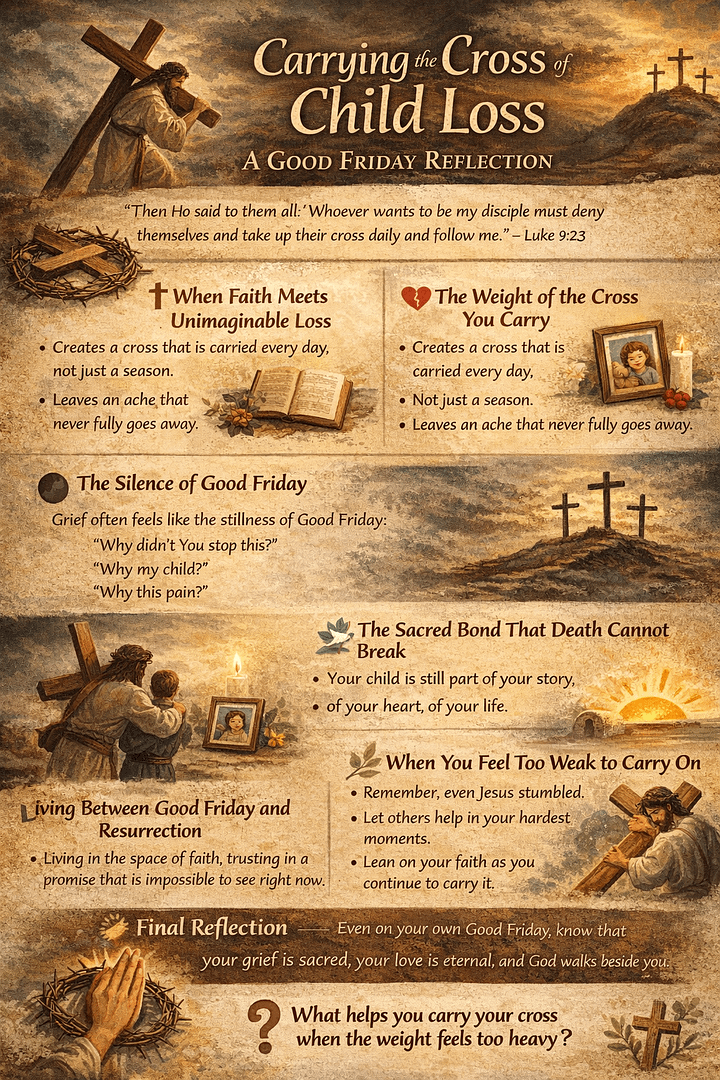
    “Then He said to them all: ‘Whoever wants to be my disciple must deny themselves and take up their cross daily and follow me.’” – Luke 9:23

    Good Friday is one of the most sacred and solemn days in the Christian faith. It is a day marked by suffering, sacrifice, and a love so profound that it chose the cross. It is a day where the world pauses to remember the pain Jesus endured—the weight of the cross, the betrayal, the suffering, and the ultimate surrender of His life.

    But for those who have lost a child, Good Friday is not just something remembered.

    It is something lived.

    ✝️ When Faith Meets Unimaginable Loss

    Faith often speaks of trust, hope, and surrender. But when a parent loses a child, those words can feel distant—almost unreachable.

    Because child loss shakes the very foundation of everything you once believed:

    The belief that life follows a natural order
    The belief that your child would outlive you
    The belief that you could protect them

    In a single moment, everything changes.

    And suddenly, faith is no longer about certainty—it becomes about survival.

    It becomes about whispering prayers through tears.
    About holding on to God, even when you don’t understand Him.
    About choosing to believe—even when your heart is broken.

    💔 The Weight of the Cross You Carry

    The cross of child loss is not something you carry for a season. It is not temporary. It does not fade with time.

    It becomes part of who you are.

    It shows up in:

    Birthdays that feel incomplete
    Holidays that carry an empty space
    Photos that hold both joy and sorrow
    Everyday moments when you instinctively think of them

    It is the quiet ache that never fully leaves.
    The longing that cannot be fulfilled.
    The love that has nowhere to go—and yet never stops flowing.

    And like Jesus on the road to Calvary, there are moments when the weight feels too much to bear.

    Moments when you feel like you might fall under it.

    But somehow… you keep going.

    🌑 The Silence of Good Friday

    One of the most profound aspects of Good Friday is its silence.

    After the suffering… after the final breath… there is a stillness.

    No celebration.
    No answers.
    No immediate relief.

    Just silence.

    Grief often feels the same way.

    After the calls stop.
    After the meals stop coming.
    After the world returns to normal…

    You are left in a quiet space where your pain still echoes.

    It is in this silence that many grieving parents wrestle with God.

    “Why didn’t You stop this?”
    “Why my child?”
    “Why this pain?”

    These questions are not a lack of faith—they are a reflection of deep love and deep loss.

    Even Jesus cried out in His suffering.
    Even He felt the weight of abandonment.

    And still—He was not alone.

    🕊️ The Sacred Bond That Death Cannot Break

    Death changes many things—but it does not break love.

    The love you have for your child is not confined to time. It does not end with their last breath. It continues—deep, unyielding, and eternal.

    It lives in:

    The way you say their name
    The memories you revisit
    The values they carried
    The impact they had on others
    The person you have become because of them

    Your child is still part of your story.
    Still part of your heart.
    Still part of your life.

    And in a way that is hard to explain, love becomes both the source of your pain—and the reason you keep going.

    🌅 Living Between Good Friday and Resurrection

    Good Friday is not the end of the story.

    But on that day… it feels like it is.

    There is no visible hope. No sign of what is to come. Only grief, loss, and waiting.

    For many parents, life after child loss feels like living in that space—between Good Friday and resurrection.

    A place where:

    You believe in something more, but struggle to feel it
    You hope for healing, but still carry deep wounds
    You trust in God, but still ask difficult questions

    This in-between space is sacred, even when it feels unbearable.

    Because it is here—in the waiting, in the pain, in the not knowing—that faith becomes real.

    Not perfect.
    Not polished.
    But real.

    🌿 When You Feel Too Weak to Carry On

    There will be days when the weight of your cross feels unbearable.

    Days when getting out of bed feels like a mountain.
    Days when the memories hit harder than usual.
    Days when the silence feels louder than anything else.

    On those days, remember this:

    Jesus stumbled under the weight of His cross too.

    He fell.
    He struggled.
    He needed help.

    And help came.

    Simon of Cyrene was called to carry the cross alongside Him—a powerful reminder that we are not meant to carry our burdens alone.

    If you are grieving:

    Let someone sit with you
    Let someone listen
    Let someone help carry the weight, even if just for a moment

    There is no strength in isolation.
    There is strength in allowing yourself to be supported.

    💫 Finding Meaning Without Answers

    One of the hardest parts of child loss is the absence of answers.

    There is no explanation that makes it okay.
    No reasoning that makes it fair.

    And yet, many grieving parents find themselves searching for meaning—not to justify the loss, but to survive it.

    Meaning can be found in:

    Helping others who are grieving
    Sharing your child’s story
    Living in a way that honors their life
    Choosing kindness, even in pain
    Holding on to love when everything else feels uncertain

    You may never understand why this happened.

    But you can choose how you carry it.

    🌈 The Quiet Courage of Continuing

    There is a kind of courage that the world rarely sees.

    It is not loud.
    It is not celebrated.

    It is the courage of:

    Waking up when you don’t want to
    Smiling when your heart is breaking
    Showing up for others while carrying your own pain
    Continuing to live, even when a part of you feels missing

    This is the courage of the cross.

    And if you are carrying the loss of a child, you are living that courage every single day.

    💬 Final Reflection

    Good Friday teaches us that love is not proven in comfort—it is proven in sacrifice.

    It shows us that even in the darkest moments, there is a story still unfolding.

    If you are carrying the cross of child loss, know this:

    Your grief is sacred.
    Your love is eternal.
    Your strength is seen.

    And just as the cross was not the end of Christ’s story, your pain is not the end of yours.

    Even here… in the sorrow… in the silence… in the weight of it all…

    There is still love.
    There is still purpose.
    And somehow, even now—there is still a path forward.

    🙏 Closing Prayer

    Heavenly Father,
    On this Good Friday, we bring before You hearts that are heavy with grief.
    For every parent carrying the loss of a child, we ask for Your presence to be felt in a real and comforting way.

    When the weight feels too much, be their strength.
    When the silence feels overwhelming, be their peace.
    When hope feels distant, be their light.

    Remind them that they are not alone in their suffering.
    That You walk beside them in every step, every tear, every moment.

    Hold their child in Your eternal care, and hold them in Your everlasting love.

    Amen.

    A Father’s Guide to Surviving the Loss of a Child

  • National Inspiring Joy Day: A Celebration of Light in Everyday Life

    Advertisements

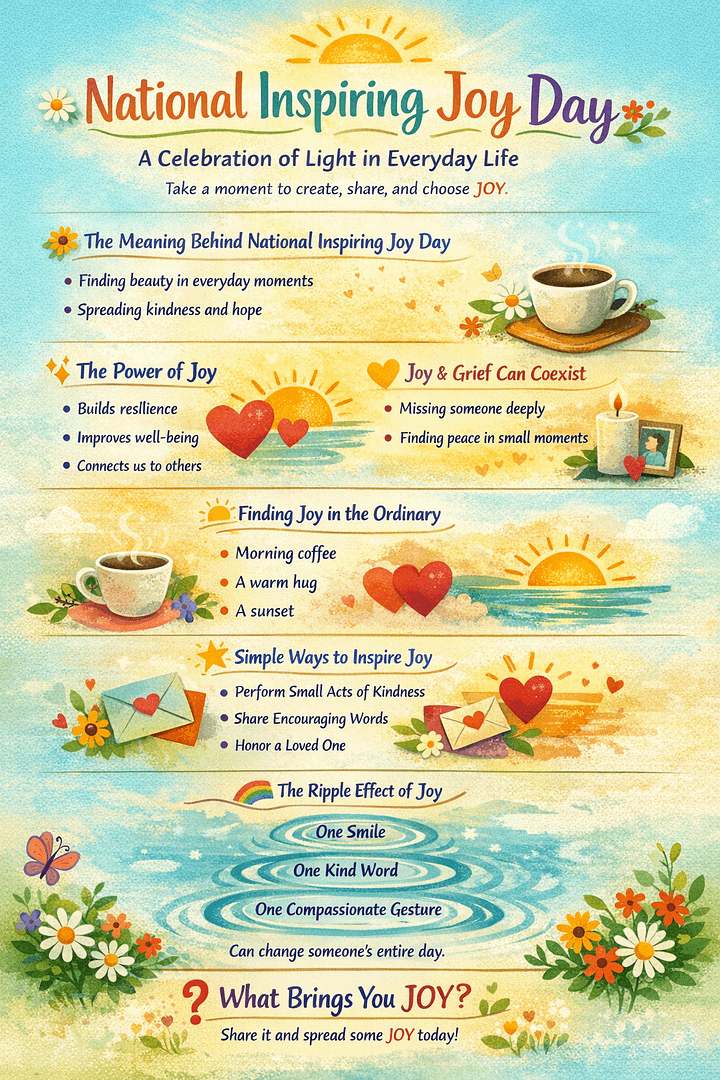
    In a world that often feels fast, overwhelming, and uncertain, National Inspiring Joy Day stands as a gentle invitation—to slow down, to notice, and to choose joy. Not the kind of joy that depends on everything going right, but the kind that quietly lives in the background of our everyday lives, waiting to be discovered.

    This day is not about pretending life is perfect. It’s about recognizing that even in imperfect moments, there is still beauty. There is still light. And there is still the opportunity to inspire joy—not only within ourselves, but in the hearts of others.

    🌼 The Meaning Behind National Inspiring Joy Day

    National Inspiring Joy Day is more than just a date on the calendar. It’s a mindset. A movement. A reminder that joy is not something we stumble upon by chance—it’s something we can intentionally create.

    This day encourages us to:

    Look for the good in the present moment
    Share kindness without expecting anything in return
    Uplift others who may be struggling silently
    Rediscover what makes our own hearts feel alive

    Joy is often misunderstood as something loud, exciting, or extraordinary. But in truth, the deepest joy is often found in the simplest things—a quiet morning, a heartfelt conversation, a shared laugh.

    ✨ The Power of Joy in Our Lives

    Joy is not just an emotion—it’s a form of strength. It has the power to reshape how we experience life, especially during difficult seasons.

    When we allow joy into our lives:

    We become more resilient, able to face challenges without losing hope
    We connect more deeply with others, creating meaningful relationships
    We shift our perspective, focusing less on what’s missing and more on what remains
    We nurture our mental health, giving our minds a break from constant stress

    Even science supports what many already feel—joy can lower stress levels, improve overall well-being, and even strengthen the immune system. But beyond the science, joy gives us something even more valuable: a reason to keep going.

    💛 Joy and Grief: Can They Coexist?

    For those who have experienced deep loss—especially the loss of a child, a loved one, or a piece of their identity—joy can feel distant, even impossible. There can be guilt in smiling again. In laughing. In feeling something other than pain.

    But the truth is this: joy and grief are not enemies. They can exist side by side.

    Grief is love that has nowhere to go. Joy is love that still finds a way to live.

    You can miss someone deeply and still feel warmth in a memory.
    You can carry pain and still find peace in a quiet moment.
    You can honor someone you’ve lost by continuing to live—and even by allowing yourself to feel joy again.

    On National Inspiring Joy Day, it’s okay if your joy looks different. Maybe it’s softer. Maybe it’s quieter. But it still counts.

    🌅 Where Joy Is Found

    Joy is not always found in big milestones or life-changing events. More often, it’s hidden in the ordinary moments we overlook.

    It lives in:

    The first sip of coffee in the morning
    The sound of rain tapping against the window
    A hug that lingers just a little longer
    A memory that makes you smile unexpectedly
    The feeling of sunlight on your face
    A message from someone who thought of you

    When we begin to notice these moments, we realize something powerful—joy has been there all along.

    🌟 Simple Ways to Inspire Joy in Others

    One of the most beautiful things about joy is that it multiplies when shared. You don’t need money, status, or a perfect life to inspire joy. All you need is intention.

    Here are meaningful ways to spread it:

    1. Be Present
    Sometimes the greatest gift you can give someone is your full attention. Listen without distraction. Show them they matter.

    2. Speak Life Into Others
    Your words have power. Encourage someone. Tell them you believe in them. Let them know they are not alone.

    3. Perform Small Acts of Kindness
    Hold the door open. Pay for someone’s coffee. Leave a kind note. These small gestures can leave lasting impressions.

    4. Share Your Story
    Your journey—your struggles and your strength—can inspire someone who feels lost.

    5. Create and Give
    Whether it’s writing, art, music, or a home-cooked meal, creating something from the heart can bring joy to others.

    6. Honor Loved Ones
    If you’ve lost someone, keep their memory alive. Speak their name. Share their story. Do something in their honor.

    🌻 Choosing Joy Every Day

    Joy is not something reserved for holidays or special occasions. It’s something we can choose—daily, intentionally, and sometimes even courageously.

    Choosing joy doesn’t mean ignoring pain. It means refusing to let pain define your entire story.

    It means:

    Getting out of bed when it’s hard
    Finding something to be grateful for, even on difficult days
    Smiling, even if it feels unfamiliar
    Believing that better moments are still ahead

    Joy is a quiet act of defiance against despair.

    🌈 The Ripple Effect of Joy

    One act of joy can create a ripple that reaches far beyond what we can see.

    A kind word might stay with someone for years.
    A simple gesture might change the course of someone’s day—or even their life.
    A moment of connection might remind someone that they are not alone.

    You may never fully know the impact of the joy you inspire—but that doesn’t make it any less powerful.

    💬 Final Reflection

    National Inspiring Joy Day is a reminder that joy is not something we have to chase—it’s something we can create.

    It lives in the small moments.
    It grows when it’s shared.
    And it becomes stronger when we choose it, even in the face of hardship.

    No matter where you are in your journey—whether you’re celebrating, healing, grieving, or simply getting through the day—there is still space for joy in your life.

    And sometimes, the greatest act of courage is allowing yourself to feel it.

    Read More Holidays & National Days

  • How to Help a Child When a Parent Passes Away

    Advertisements

    Losing a parent is one of the most devastating experiences a child can endure. It is not just the loss of a person—it is the loss of safety, routine, identity, and the quiet certainty that someone will always be there. For a child, the world can suddenly feel unpredictable and fragile.

    As the adult supporting them, you may feel an enormous weight: wanting to say the right thing, do the right thing, and somehow protect them from pain that cannot be taken away. The truth is, you cannot fix their grief—but you can walk beside them through it. And that presence can shape how they heal for the rest of their life.

    Understanding How Children Experience Grief

    Children grieve differently than adults. Their understanding of death evolves with age, and their emotions can come in waves—often unpredictable and confusing.

    Young children (ages 3–6) may not fully understand permanence. They might ask when their parent is coming back or repeat the same questions over and over.
    School-aged children (ages 7–12) begin to understand death is final but may struggle with fear, guilt, or “what if” thinking.
    Teenagers often feel the depth of the loss intensely but may hide it behind anger, silence, or independence.

    One of the most important things to remember is this:
    Children “visit” their grief.
    They may cry deeply one moment and laugh or play the next. This is not denial—it’s their mind protecting them from emotional overload.

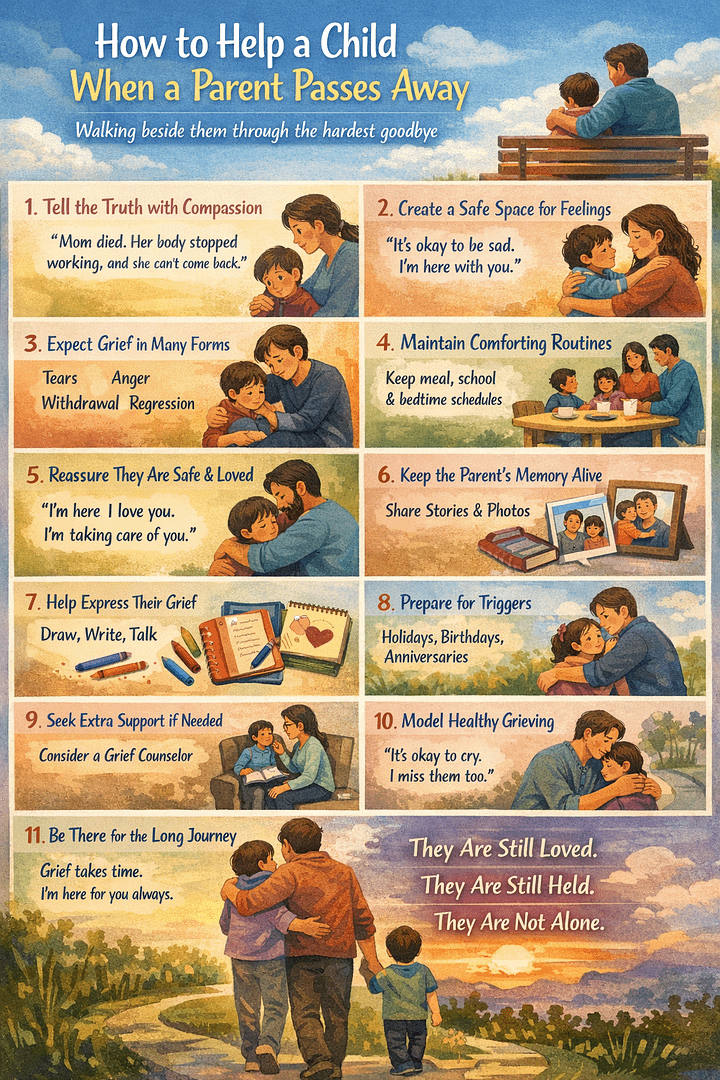
    1. Tell the Truth—With Compassion and Clarity

    Honesty is essential, even when the truth is painful. Avoid vague phrases like “we lost Mom” or “Dad went to sleep,” as these can confuse or frighten children.

    Instead, use clear, simple language:
    “Dad died. His body stopped working, and he can’t come back.”

    Be prepared for repeated questions. Children process grief in layers, and asking the same question is often their way of trying to understand something that feels impossible.

    Answer patiently—even if it hurts every time.

    2. Create a Safe Space for Every Emotion

    A child who has lost a parent may feel:

    Deep sadness
    Anger or frustration
    Fear of losing someone else
    Guilt (“Did I cause this?”)
    Confusion or numbness

    Sometimes, they may not feel anything at all—and that’s okay too.

    Let them know:
    “Whatever you’re feeling is okay. You don’t have to hide it from me.”

    Avoid trying to “fix” their emotions. Instead, sit with them in it. Your calm presence tells them they are not alone in their pain.

    3. Expect Grief to Show Up in Unexpected Ways

    Children often express grief through behavior rather than words. You might notice:

    Increased clinginess
    Regression (bedwetting, needing help with tasks they once did alone)
    Trouble concentrating
    Acting out or becoming withdrawn

    These are not signs of “bad behavior”—they are signals of a hurting heart.

    Respond with patience, not punishment.
    Behind every difficult behavior is a child trying to cope with something they don’t yet understand.

    4. Keep Routines as Anchors in a Shaken World

    When everything feels uncertain, routine becomes stability.

    Try to maintain:

    Regular meal times
    School attendance
    Bedtime routines

    These everyday structures send a powerful message:
    Life is still moving, and you are still safe within it.

    At the same time, allow flexibility. Some days will be harder than others.

    5. Reassure Them—Again and Again

    After losing a parent, many children develop a deep fear of losing the people they have left.

    They may ask:

    “Are you going to die too?”
    “Who will take care of me?”

    Answer gently and honestly, while offering reassurance:
    “I’m here. I love you. I’m taking care of you.”

    They may need to hear this many times. Repetition builds security.

    6. Keep the Parent’s Memory Alive

    Grief is not about forgetting—it’s about remembering with love.

    Talk about the parent often:

    Share stories
    Look through photos
    Celebrate their birthday
    Continue traditions they loved

    You might say:
    “Your mom loved the way you laugh. It always made her smile.”

    Encourage the child to express their memories too—through drawing, writing, or simply talking.

    Keeping that connection alive helps transform loss into lasting love.

    7. Help Them Express Their Grief in Their Own Way

    Not all children can put their feelings into words. Offer different ways for them to express themselves:

    Drawing pictures
    Writing letters to their parent
    Creating a memory box
    Playing or acting out feelings through toys

    Sometimes a child will say something profound in the middle of play. Listen closely—those moments matter.

    8. Prepare for “Grief Triggers”

    Grief often resurfaces during:

    Birthdays
    Holidays
    School events
    Anniversaries of the death

    These moments can reopen wounds.

    Acknowledge them ahead of time:
    “I know this birthday might feel different without Dad. We can talk about him or do something special to remember him.”

    By naming the pain, you help the child feel seen rather than alone.

    9. Watch for When Extra Support Is Needed

    While grief has no timeline, some signs may indicate a child needs additional help:

    Ongoing withdrawal or isolation
    Persistent sadness that doesn’t lift
    Severe anxiety or fear
    Declining school performance
    Expressions of hopelessness

    In these cases, a grief counselor or child therapist can provide tools and support that go beyond what family alone can offer.

    Seeking help is not a failure—it is an act of love.

    10. Model Healthy Grieving

    Children learn how to grieve by watching the adults around them.

    It’s okay for them to see you cry.
    It’s okay to say:
    “I miss them too.”

    This teaches them that grief is not something to hide—it is something we carry together.

    At the same time, show them that even in grief, there is still life, love, and moments of peace.

    11. Be There for the Long Journey—Not Just the Immediate Loss

    Support doesn’t end after the funeral. In many ways, that’s when the real journey begins.

    Grief evolves as a child grows. A loss experienced at age five will be understood differently at age ten, and again at fifteen.

    They may revisit their grief over and over—and each time, they may need you in a new way.

    Stay present. Stay patient. Stay available.

    A Final Reflection

    You cannot take away a child’s grief when a parent dies. That pain is real, deep, and lasting.

    But you can give them something just as powerful:

    A safe place to feel
    A steady presence in the storm
    A reminder that love does not end with death

    And over time, that love becomes the foundation they stand on.

    Because even in their deepest loss, what a child needs to know most is this:

    They are still loved. They are still held. And they are not alone.

    A Father’s Guide to Surviving the Loss of a Child

Exit mobile version