Author: Brett Murphy

  • 🍪 Chocolate Chip Cookie Week: Celebrating America’s Favorite Sweet Treat

    🍪 Chocolate Chip Cookie Week: Celebrating America’s Favorite Sweet Treat

    Few desserts bring the same feeling of comfort and nostalgia as a warm chocolate chip cookie. Soft in the middle, slightly crisp on the edges, and filled with rich chocolate pieces, this beloved treat has become a staple in kitchens across the world. Chocolate Chip Cookie Week is the perfect time to celebrate this iconic dessert and the happiness it has delivered for generations.

    From family kitchens to professional bakeries, chocolate chip cookies have earned a special place in our hearts. The smell alone—warm butter, vanilla, sugar, and melting chocolate—can instantly transport people back to childhood memories of baking with parents or grandparents. This simple dessert carries with it a sense of comfort that few foods can match.

    The Sweet History Behind the Cookie

    The story of the chocolate chip cookie begins in the late 1930s with Ruth Wakefield, owner of the Toll House Inn in Whitman, Massachusetts. While preparing a batch of butter cookies for guests, Wakefield added chopped pieces of semi-sweet chocolate into the dough, expecting them to melt throughout the batter.

    Instead, the chocolate softened but held its shape, creating small pockets of chocolate inside each cookie. The result was a delicious surprise that quickly became popular with guests at the inn.

    Soon, the recipe was published in newspapers and cookbooks across the country. The cookie became so popular that the chocolate company Nestlé struck a deal with Wakefield to print the recipe on its chocolate bar packaging. In return, she received a lifetime supply of chocolate.

    From that moment forward, chocolate chip cookies became an American baking tradition.

    Why Chocolate Chip Cookies Became So Popular

    Chocolate chip cookies stand out because they are incredibly simple to make, yet endlessly satisfying. The basic recipe contains only a handful of ingredients: butter, sugar, eggs, flour, vanilla, baking soda, and chocolate chips.

    Despite this simplicity, small changes can create completely different cookie experiences.

    Some bakers prefer soft and chewy cookies with a slightly underbaked center. Others love thin, crispy cookies with golden edges and a caramelized flavor. There are also thick bakery-style cookies loaded with chocolate chunks that have become popular in modern bakeries.

    Chocolate chip cookies are also incredibly adaptable. Bakers often add ingredients like:

    Chopped walnuts or pecans

    Dark chocolate or white chocolate chips

    Sea salt sprinkled on top

    Peanut butter or caramel swirls

    Oats or coconut flakes

    Each variation offers a new twist on the classic recipe, proving that chocolate chip cookies can evolve while still keeping their timeless charm.

    The Science of the Perfect Cookie

    Part of the magic of baking cookies lies in the science behind them. Small adjustments in ingredients and baking techniques can dramatically change the texture and flavor.

    For example:

    Butter temperature matters.
    Melted butter tends to produce denser cookies, while softened butter helps create lighter, fluffier dough.

    Brown sugar vs. white sugar.
    Brown sugar contains molasses, which adds moisture and chewiness to cookies.

    Chilling the dough.
    Many bakers chill their cookie dough before baking, allowing flavors to develop and preventing cookies from spreading too thin.

    Baking time.
    A difference of just one or two minutes in the oven can determine whether a cookie is soft and gooey or crisp and crunchy.

    These little details allow bakers to create cookies exactly the way they like them.

    Fun Ways to Celebrate Chocolate Chip Cookie Week

    Chocolate Chip Cookie Week is the perfect excuse to enjoy this classic treat and share it with others. Whether you are an experienced baker or someone who simply loves cookies, there are plenty of fun ways to celebrate.

    Bake a classic batch
    Sometimes the best way to celebrate is the simplest—bake a traditional chocolate chip cookie recipe and enjoy them fresh from the oven.

    Try a new recipe
    Experiment with gourmet ingredients like dark chocolate chunks, sea salt, espresso powder, or even stuffed cookie centers.

    Host a cookie swap
    Invite friends or coworkers to bake their favorite cookie recipes and exchange them with one another. Everyone gets to try something new.

    Visit local bakeries
    Many bakeries create specialty chocolate chip cookies, from oversized bakery-style treats to stuffed cookies filled with marshmallow or Nutella.

    Bake with family
    Chocolate chip cookies are one of the easiest recipes for children to help with, making them perfect for family baking days.

    A Cookie That Connects Generations

    Chocolate chip cookies have a special way of bringing people together. They appear at birthday parties, school bake sales, holiday gatherings, and quiet nights at home. For many families, baking cookies is a tradition passed down from one generation to the next.

    Grandparents share recipes with grandchildren. Parents teach kids how to measure flour and stir dough. Friends bond over late-night baking sessions and trays of cookies fresh from the oven.

    These moments turn a simple dessert into something meaningful.

    The Timeless Joy of Chocolate Chip Cookies

    In a world that often moves too fast, chocolate chip cookies remind us to slow down and enjoy simple pleasures. A glass of milk, a warm cookie, and a few minutes to savor the moment can make an ordinary day feel special.

    Chocolate Chip Cookie Week celebrates more than just a dessert—it celebrates comfort, tradition, creativity, and the small moments that bring joy into everyday life.

    So whether you bake your own batch, buy one from your favorite bakery, or share cookies with friends and family, take a moment this week to enjoy one of the sweetest traditions ever created.

    Because sometimes happiness really is as simple as a warm chocolate chip cookie.

    Read More Holidays & National Days
  • When All You Want Is to Talk to That Special Someone

    When All You Want Is to Talk to That Special Someone

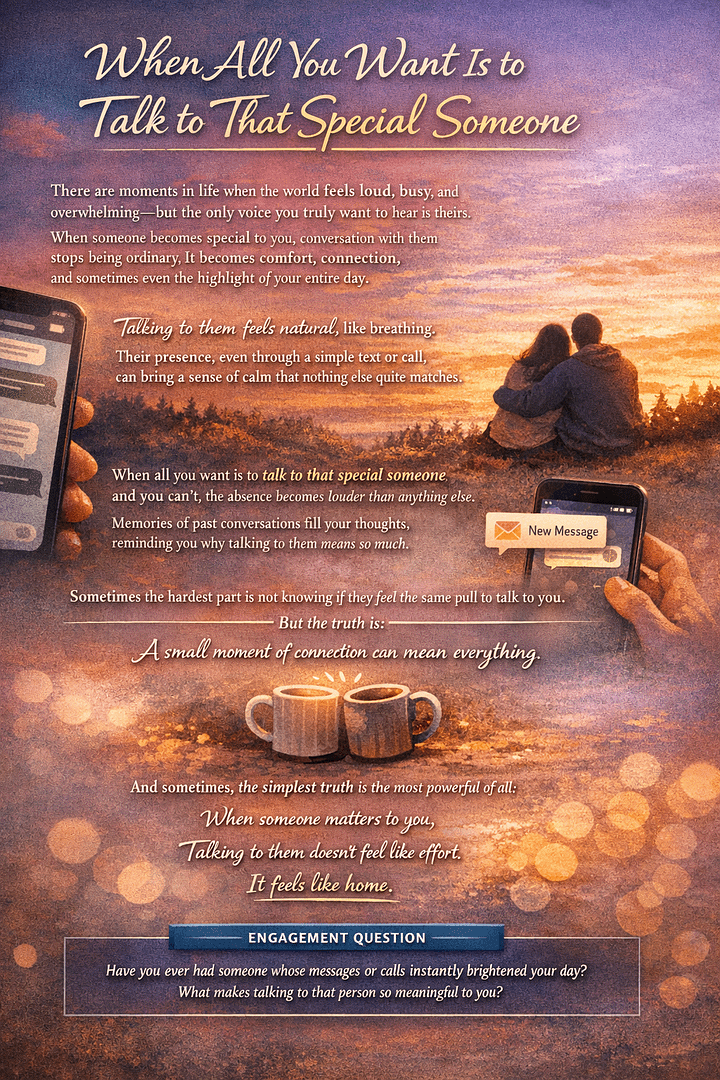
    There are moments in life when the world feels loud, busy, and overwhelming—but the only voice you truly want to hear is theirs. When someone becomes special to you, conversation with them stops being ordinary. It becomes comfort, connection, and sometimes even the highlight of your entire day.

    It’s not always about having something important to say. In fact, most of the time it isn’t. It might be about the little things—how the day went, a funny moment at work, a song that reminded you of them, or even the random thoughts that cross your mind throughout the day. When someone matters to you, talking to them feels natural, like breathing. Their presence, even through a simple text or phone call, can bring a sense of calm that nothing else quite matches.

    For many people, these conversations become a safe place. Life can be complicated, and sometimes we carry things inside that we don’t share with anyone else. But with that one special person, it feels different. You don’t have to pretend to be stronger than you are. You don’t have to filter every thought. You can simply be yourself. In a world that often expects us to wear masks, that kind of connection is rare and deeply meaningful.

    Talking to someone special also creates a rhythm in your life. You begin to look forward to those moments without even realizing it. Maybe it’s a good morning message that starts your day on a brighter note. Maybe it’s a conversation late at night when the rest of the world is quiet and honest thoughts tend to surface. Those moments begin to feel like small traditions—tiny threads that slowly weave two lives together.

    But there is also a quiet ache that can come with it. When all you want is to talk to that special someone and you can’t, the absence becomes louder than anything else. You find yourself checking your phone more often than usual, hoping their name appears on the screen. Even the smallest notification can make your heart skip for a moment, wondering if it might be them.

    In those moments, memories of past conversations tend to surface. You remember the jokes you shared, the late-night talks that seemed to last forever, or the moments when they said exactly what you needed to hear. Those memories remind you why talking to them means so much in the first place.

    Sometimes the hardest part is not knowing if they feel the same pull to talk to you. You might hold back from reaching out, not wanting to seem like you’re bothering them or appearing too eager. Pride, fear, and uncertainty can quietly stand in the way of the simple act of saying, “I miss talking to you.”

    Yet the truth is that human connection is built through these small moments. A quick message. A thoughtful question. A shared laugh. None of it seems extraordinary on the surface, but together they create something powerful. Over time, these conversations form a bond that words alone can’t fully explain.

    Talking to someone special isn’t just about exchanging words—it’s about feeling understood. It’s about knowing that somewhere out there is a person who listens to your thoughts, values your feelings, and genuinely cares about what’s happening in your world.

    Sometimes those conversations are deep and meaningful, touching on dreams, fears, and hopes for the future. Other times they are simple and lighthearted, filled with jokes, stories, or playful teasing. But regardless of the topic, the feeling remains the same: their presence makes the moment better.

    There is also something beautifully human about wanting to share life with someone in real time. When something funny happens, they are the first person you want to tell. When something difficult happens, they are the voice you want to hear. It’s not because they can fix everything, but because their presence makes things feel a little less heavy.

    And sometimes, the truth is simple.
    You don’t need a long conversation.
    You don’t need perfect words.
    You don’t even need a reason to reach out.

    All you need is that small moment of connection.

    Because when someone truly holds a place in your heart, even a short “Hi” can brighten your entire day. Even a few minutes of conversation can remind you that you are not alone.

    In the end, wanting to talk to someone special is one of the purest forms of affection. It means they have become a part of your everyday thoughts. It means their voice, their words, and their presence bring something meaningful into your life.

    And sometimes, the simplest truth is the most powerful of all:

    When someone matters to you, talking to them doesn’t feel like effort.

    It feels like home.

    Read More Of Love & Relationships

  • You Do Not Have to Grieve Alone

    You Do Not Have to Grieve Alone

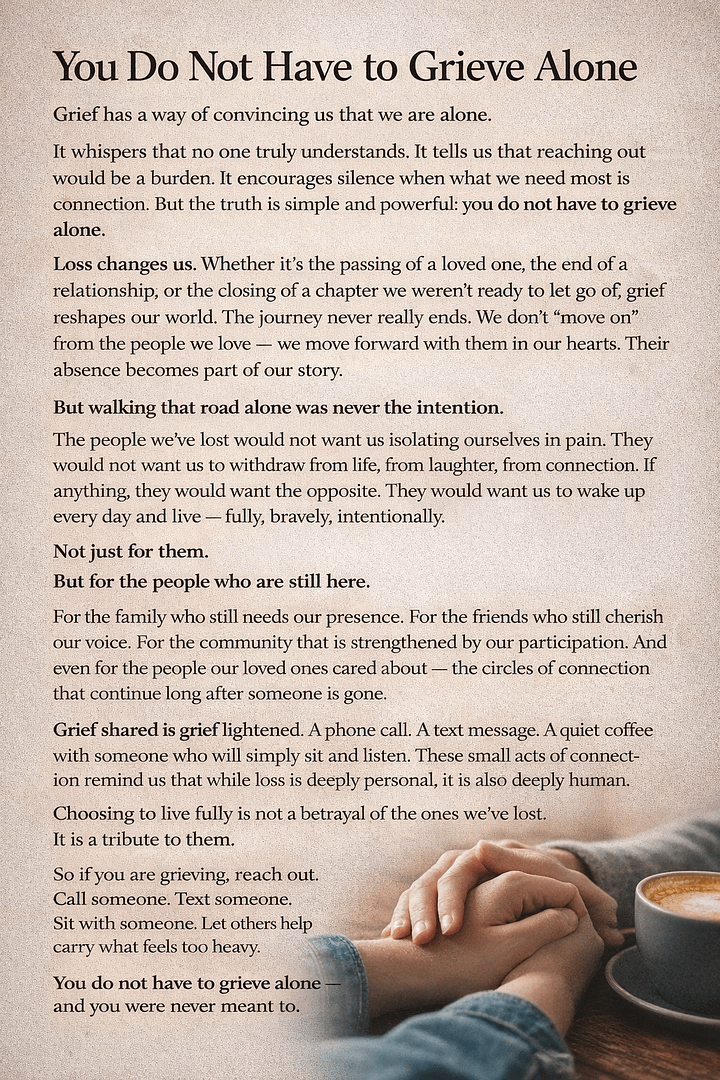
    Grief has a way of convincing us that we are alone.

    It whispers that no one truly understands. It tells us that reaching out would be a burden. It encourages silence when what we need most is connection. But the truth is simple and powerful: you do not have to grieve alone.

    Loss changes us. Whether it’s the passing of a loved one, the end of a relationship, or the closing of a chapter we weren’t ready to let go of, grief reshapes our world. The journey never really ends. We don’t “move on” from the people we love — we move forward with them in our hearts. Their absence becomes part of our story.

    But walking that road alone was never the intention.

    The people we’ve lost would not want us isolating ourselves in pain. They would not want us to withdraw from life, from laughter, from connection. If anything, they would want the opposite. They would want us to wake up every day and live — fully, bravely, intentionally.

    Not just for them.

    But for the people who are still here.

    For the family who still needs our presence. For the friends who still cherish our voice. For the community that is strengthened by our participation. And even for the people our loved ones cared about — the circles of connection that continue long after someone is gone.

    Grief shared is grief lightened. A phone call. A text message. A quiet coffee with someone who will simply sit and listen. These small acts of connection remind us that while loss is deeply personal, it is also deeply human. We were not created to carry sorrow by ourselves.

    There is strength in vulnerability. There is courage in saying, “I’m not okay today.” And there is healing in allowing others to stand beside us in the storm.

    The journey of grief may never end, but it does evolve. The sharp edges soften. The memories become less painful and more precious. And slowly, life begins to feel like life again — not as it was, but as it is now.

    Choosing to live fully is not a betrayal of the ones we’ve lost. It is a tribute to them.

    So if you are grieving, reach out. Call someone. Text someone. Sit with someone. Let others help carry what feels too heavy.

    You do not have to grieve alone — and you were never meant to.

    A Father’s Guide to Surviving the Loss of a Child

  • Honoring Paul Murphy on National Sons Day

    Honoring Paul Murphy on National Sons Day

    “Honoring Paul Murphy” is more than a tribute—it is a testament to how a life, though heartbreakingly brief, can leave a lasting and meaningful imprint on the world.

    Paul Murphy passed away at the tender age of 21, yet his influence far exceeds the years he was given. This tribute speaks of a young man known not for loud accomplishments or public praise, but for something far more powerful: quiet compassion. Paul was the kind of person who noticed when someone needed help and stepped in without hesitation, without expectation, and without seeking recognition.

    He led a life of example. Paul’s selflessness, generosity, and deep care for family, friends, and even strangers defined who he was. He consistently put others before himself, embodying empathy in its purest form. In a world that often celebrates visibility and applause, Paul’s story reminds us that the most meaningful acts are often the ones done quietly, seen only by those whose lives are changed by them.

    Though Paul’s time on earth was short, his spirit continues to inspire empathy, courage, and generosity in those who read his story. His life serves as a gentle but powerful reminder: even small acts of kindness can leave a permanent mark. Paul Murphy’s legacy lives on—not only in memory, but in the hearts and actions of those encouraged to live a little more like him.

    For me, honoring my son means waking up each day with a heart that is both shattered and shining. It means carrying him not in my arms, but in every corner of my spirit. It means understanding that although his life ended, his impact never will.

    He Is the Strength Behind My Steps

    Grief is heavy, but love—his love—is stronger still.
    I used to believe grief was love with nowhere to go. Now I know better.
    My love for him goes everywhere I go. It shows up in my choices, in my resilience, in the moments when I whisper, “I’m doing this for you.”

    His memory pushes me forward on days I want to collapse.
    His light reaches into the darkest hours and gives me just enough strength to try again.
    And every time I choose courage over despair, I am honoring him.

    Living Is the Legacy

    There was a time when laughter felt wrong, when joy felt like betrayal, when moving forward felt like leaving him behind. But grief taught me something profound:

    Living does not erase the love.
    Living does not silence the memories.
    Living does not dishonor the loss.

    Living is how I keep him with me.
    It’s how I carry the story of who he was, and who he made me, into a world that still needs the beauty he inspired.

    Every act of kindness, every moment of gratitude, every breath of hope—these are the gifts I offer in his name.
    His life, though shorter than I ever wanted, continues through the way I choose to shape mine.

    Healing Means Carrying Him Forward

    People say healing means “moving on.” But I refuse that idea.
    I am not moving on—I am moving with him.

    He is woven into the fabric of my days.
    Into my courage.
    Into my resilience.
    Into the quiet moments when I miss him so deeply I can hardly speak.

    Some days I stand tall.
    Some days I barely stand at all.
    But both are sacred. Both count. Both honor a love big enough to survive anything—even loss.

    Finding Him in the Everyday Moments

    Honoring my son isn’t something I do once a year or on special dates.
    I honor him in the small things:

    When I let myself smile, even through tears

    When I choose to believe in tomorrow

    When I help someone else carry their pain

    When I speak his name, without fear, without apology

    When I reflect on the way his presence shaped the best parts of me

    He is there in the sunrise, in the quiet car rides, in the moments when life surprises me with joy I never thought I’d feel again.

    A Promise of Love That Endures

    Losing him changed me forever. But loving him changed me too—and that part will never fade.

    My promise to my son is this:
    I will live a life worthy of the love we shared.

    I will carry him with grace.
    I will seek meaning, even in the brokenness.
    I will choose hope, even when hope feels fragile.
    I will keep going—not because the pain is gone, but because his light deserves a life that continues.

    Every step forward is a tribute.
    Every breath is a testament.
    Every moment of courage is a way of saying,
    “Your life mattered. Your love is still here. And because of you, I will keep living.”

    This day encourages us to re-center on what truly matters—love, family, memory. For those of us who have lost children, it offers a gentle invitation to honor not just loss, but the enduring bonds that remain.

    Although my son is no longer with us, I find solace and strength in helping others and in giving words to my love for him—because family means everything, even across different realms of existence. I hope this tribute encourages anyone reading—who has also known the ache of loss—to find your own meaningful way to remember, honor, and spread light in your loved one’s name.

    A Father’s Guide to Surviving the Loss of a Child

  • NATIONAL SONS DAY – A celebration of love, growth, and the men we are raising

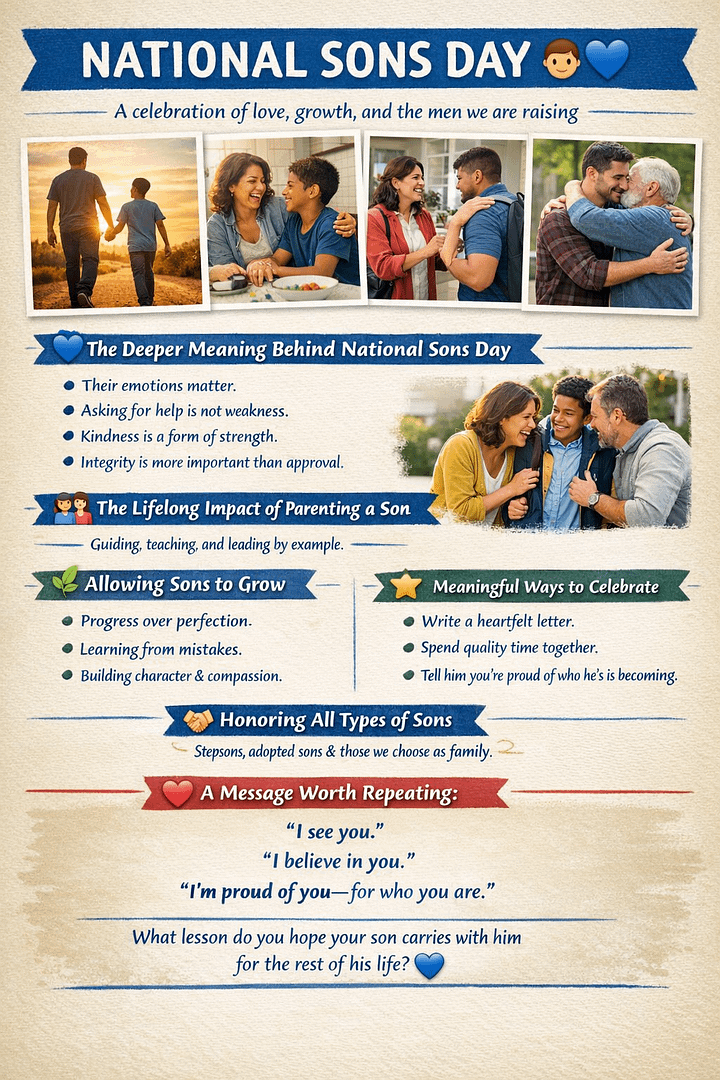
    NATIONAL SONS DAY – A celebration of love, growth, and the men we are raising

    National Sons Day is a meaningful reminder to pause, reflect, and celebrate the sons who shape our lives in ways both quiet and profound. Observed each year on March 4 (with another widely recognized observance on September 28), this day honors sons of every age — from the little boys who still reach for our hands to the grown men who carry our values forward into the world.

    At its heart, National Sons Day is about appreciation, intention, and connection.

    💙 The Deeper Meaning Behind National Sons Day

    Raising a son is about more than guiding him through childhood milestones. It’s about shaping character, teaching emotional intelligence, and helping him understand his place in a complex world. Sons are often taught how to perform strength, but National Sons Day invites us to teach them how to live with strength — rooted in empathy, respect, and accountability.

    This day encourages families to remind sons that:

    Their emotions matter

    Asking for help is not weakness

    Kindness is a form of strength

    Integrity is more important than approval

    When sons feel safe to be fully themselves, they grow into men who are confident without being hardened.

    👨‍👩‍👦 The Lifelong Impact of Parenting a Son

    From scraped knees to broken hearts, sons look to their parents and caregivers for guidance — even when they pretend they don’t. Every conversation, boundary, and example leaves an imprint.

    Fathers and father figures often shape how sons understand responsibility, leadership, and self-respect. Sons learn not just from what is said, but from what is consistently shown.

    Mothers and maternal figures often teach sons empathy, communication, and how to treat others with dignity and care.

    Together, these influences help sons build a moral compass that guides them long after they leave home.

    🌱 Allowing Sons to Grow — Not Just Succeed

    In a world focused on achievement, it’s easy to measure success by grades, trophies, or career paths. National Sons Day reminds us that growth matters just as much as accomplishment.

    Celebrate your son for:

    Trying again after failure

    Standing up for what is right

    Showing compassion to others

    Learning from mistakes

    Becoming more self-aware

    Progress deserves recognition, even when perfection is out of reach.

    🌟 Meaningful Ways to Celebrate National Sons Day

    Celebration doesn’t need to be loud or expensive to be impactful. What matters most is intention.

    Consider:

    Writing a letter he can keep forever

    Sharing a lesson you’ve learned and wish you knew earlier

    Spending uninterrupted time doing something he loves

    Publicly acknowledging his growth and character

    Privately reminding him he is enough — just as he is

    For adult sons, a thoughtful message or shared memory can strengthen bonds that sometimes get lost in busy lives.

    🤝 Honoring All Types of Sons

    National Sons Day extends beyond biology. It honors:

    Adopted sons

    Step-sons

    Foster sons

    Godsons

    Chosen sons — the young men who found guidance and belonging through mentorship and love

    Being a son is not defined by DNA alone, but by connection, trust, and care.

    ❤️ A Message Worth Repeating

    Sons are navigating expectations, pressures, and identities in a rapidly changing world. What they need most is reassurance — that they are supported not only when they succeed, but when they struggle.

    Let today be a reminder to say the words that matter:

    I see you.

    I believe in you.

    I’m proud of you — not just for what you do, but for who you are.

    Because one day, the way we love our sons will echo in the way they love others.

    Read More Holidays & National Days
  • When You’re in Love With Someone Who Doesn’t Feel the Same

    When You’re in Love With Someone Who Doesn’t Feel the Same

    There’s a specific kind of heartbreak that doesn’t come from betrayal, lies, or dramatic endings. It comes from loving someone who simply doesn’t love you back the same way.

    No explosion.
    No villain.
    Just imbalance.

    And somehow, that makes it even harder.

    Because when someone hurts you intentionally, anger can help you detach. But when they’re kind, honest, and simply don’t feel what you feel? There’s nothing to fight. Nothing to blame. Just a quiet ache you carry every time you’re around them.

    When Feelings Are One-Sided

    Unrequited love isn’t about being foolish or delusional. It’s about emotional investment landing in a place where it can’t grow.

    You see them differently.
    You feel deeply when they speak.
    You imagine a future they’ve never pictured.

    And the hardest part? They may genuinely care about you — just not in the way your heart longs for.

    That gray area is brutal.

    They might:

    Call you when they need support

    Laugh with you effortlessly

    Confide in you

    Say, “You’re so important to me”

    But they don’t reach for you romantically.
    They don’t choose you exclusively.
    They don’t look at you the way you look at them.

    You’re close — but not close enough.

    The Agony of Being Around Them

    Being around someone you love who doesn’t reciprocate can feel like emotional whiplash.

    One moment, you feel connected.
    The next, you’re reminded that you’re alone in your feelings.

    You might sit across from them at dinner, smiling on the outside while your heart silently breaks. You may watch them talk about someone they’re interested in. You might see them give their attention, affection, or effort to someone else — and have to pretend it doesn’t crush you.

    Even small moments become loaded:

    A hug that lingers too long in your mind

    A compliment that feels like hope

    A delayed text that feels like rejection

    You try to act natural. You tell yourself you can handle it. But inside, you’re constantly adjusting your expectations to survive the interaction.

    It’s exhausting.

    The Inner Conflict

    Loving someone who doesn’t feel the same creates a painful inner split.

    Part of you wants to stay — because being near them feels better than not having them at all.

    Another part of you knows staying keeps you stuck.

    You tell yourself:

    “I can manage my feelings.”

    “I’ll get over it eventually.”

    “Maybe they’ll change their mind.”

    But healing rarely happens while you’re still emotionally entangled.

    When you’re around them often, your brain keeps reinforcing attachment. You don’t get the space needed to let your heart recalibrate. Instead, you stay in a loop of hope, disappointment, and self-questioning.

    How It Affects Your Self-Worth

    Over time, unreciprocated love can quietly damage how you see yourself.

    You may start asking:

    What does the other person have that I don’t?

    Why am I not enough?

    If I love this deeply, why can’t they?

    But attraction and emotional connection aren’t merit-based systems. You can be kind, attractive, loyal, emotionally available — and still not be the right match for someone.

    It’s not a reflection of your value.

    It’s a reflection of compatibility.

    Still, when you’re constantly exposed to someone who doesn’t choose you, it can feel personal. You might shrink yourself. Lower your standards. Accept crumbs of attention because they feel better than nothing.

    That’s when love becomes self-abandonment.

    The Illusion of “Just Friends”

    Many people try to transition into friendship too quickly.

    On the surface, it sounds mature. Healthy. Evolved.

    But if your heart is still hoping for more, friendship can feel like slow torture.

    You celebrate their wins while secretly wishing you were their partner.
    You give advice about their dating life while swallowing your own feelings.
    You show up for them emotionally while denying your own unmet needs.

    True friendship requires emotional neutrality. And you can’t force neutrality.

    It has to grow — often after distance.

    Creating Space Without Bitterness

    Distance doesn’t have to be dramatic. It doesn’t have to come with accusations or slammed doors.

    Sometimes it’s as simple as saying:

    “I care about you, but I need some space to sort through my feelings.”

    That’s not weakness. That’s emotional maturity.

    Creating space allows:

    Your nervous system to calm down

    Your expectations to reset

    Your identity to expand beyond them

    You start remembering who you are outside of longing.

    And something surprising happens when you pull back: clarity replaces obsession. The fantasy loses some of its shine. You begin seeing the full picture instead of just the parts your heart romanticized.

    Grieving What Never Was

    One of the most painful aspects of unrequited love is grieving a relationship that never officially existed.

    There are no anniversaries.
    No breakup speech.
    No clear “end.”

    You’re mourning potential. Possibility. Imagined futures.

    And that grief is valid.

    Allow yourself to feel it without judgment. Cry if you need to. Journal. Talk to someone you trust. Acknowledge that your heart invested in something meaningful — even if it wasn’t mutual.

    Healing begins when you stop minimizing your own pain.

    Opening the Door to Something Better

    Letting go of someone who doesn’t feel the same isn’t giving up on love. It’s making space for love that flows both ways.

    The right connection won’t feel like a constant question mark. It won’t leave you analyzing every interaction. It won’t require you to convince someone to see your worth.

    It will feel steady. Safe. Mutual.

    And when that kind of love arrives, you’ll understand why this one had to end — even if it never truly began.

    A Final Truth

    You can’t force someone to feel what they don’t feel.

    But you can choose how long you stay in a situation that hurts you.

    Loving someone who doesn’t love you back doesn’t make you foolish. It means you have depth. It means your heart is capable of commitment and vulnerability.

    Just make sure that depth is eventually given to someone who meets you there.

    Because you deserve more than proximity.

    You deserve reciprocity.

    Read More Of Love & Relationships

  • 🍷 National Mulled Wine Day – A Toast to Warmth, History, and Heart

    🍷 National Mulled Wine Day – A Toast to Warmth, History, and Heart

    Every year on March 3rd, we raise a glass to one of winter’s most comforting traditions — National Mulled Wine Day. It’s a celebration of warmth, spice, and centuries-old customs that have brought people together during the coldest months of the year.

    More than just a seasonal beverage, mulled wine represents hospitality, community, and the simple joy of slowing down. In a world that often feels rushed, this day invites us to pause, savor the moment, and enjoy the rich aroma of spices drifting through the air.

    🍇 The Ancient Roots of Mulled Wine

    Mulled wine’s story stretches back over 2,000 years. The ancient Romans were among the first to heat wine and blend it with spices. As their empire expanded across Europe, they brought this warming practice with them.

    In medieval Europe, spiced wine became a symbol of wealth and status. Spices like cinnamon and cloves were rare and expensive, often traded along the Silk Road. Serving mulled wine wasn’t just about warmth — it was a display of prosperity and refinement.

    Over time, what began as a luxury evolved into a beloved winter staple, especially during Christmas and holiday markets. Today, it remains a cherished seasonal ritual around the world.

    🌍 Mulled Wine Around the World

    Though the ingredients may vary slightly, the essence remains universal: warmth, spice, and togetherness.

    Germany – Glühwein is a holiday market staple, often served in collectible mugs.

    Sweden – Glögg is traditionally richer, sometimes including raisins and almonds.

    France – Vin Chaud is commonly enjoyed at ski resorts and winter festivals.

    United Kingdom – A Christmas classic often infused with citrus and nutmeg.

    United States – Popular at winter gatherings and increasingly embraced beyond the holiday season.

    Each culture adds its own touch, but the heart of the drink stays the same — it brings people together.

    🔥 The Sensory Experience

    Mulled wine isn’t just tasted — it’s experienced.

    The aroma of cinnamon and orange fills the room.

    The steam rising from the mug warms your face.

    The first sip delivers sweetness, spice, and gentle heat.

    It creates an atmosphere as much as it quenches thirst. Few drinks are as closely tied to feeling and memory as mulled wine.

    🏡 How to Celebrate National Mulled Wine Day
    1. Craft a Traditional Batch

    Start with a dry red wine like Merlot, Cabernet Sauvignon, or Zinfandel. Add:

    2–3 cinnamon sticks

    4–6 whole cloves

    2 star anise

    Orange slices

    2–3 tablespoons honey or sugar

    Heat gently over low heat for 15–20 minutes. Avoid boiling — this preserves flavor and balance.

    2. Host a Mulled Wine Bar

    Set out small bowls of spices, citrus slices, cranberries, and optional add-ins like brandy. Let guests customize their cups for a fun and interactive experience.

    3. Pair It With Comfort Foods

    Mulled wine pairs beautifully with:

    Sharp cheeses

    Roasted nuts

    Gingerbread cookies

    Dark chocolate desserts

    The spice notes complement sweet and savory flavors alike.

    4. Try a White or Non-Alcoholic Version

    Use white wine with apple slices and lighter spices for a brighter twist.

    Substitute grape juice or apple cider for a family-friendly alternative.

    🍷 Why This Day Matters

    National Mulled Wine Day is about more than enjoying a drink. It reminds us that traditions endure because they nourish something deeper — connection.

    In colder months, we instinctively gather closer. We light candles. We cook hearty meals. We share stories. Mulled wine fits perfectly into that rhythm of comfort.

    It encourages:

    Slower evenings

    Meaningful conversations

    Intentional hospitality

    And perhaps most importantly, gratitude for the warmth we create in each other’s lives.

    🌟 A Toast to Togetherness

    Whether you’re celebrating with friends, family, or enjoying a quiet evening alone, National Mulled Wine Day is an invitation to savor life’s simple pleasures.

    Let the spices simmer.
    Let the conversations linger.
    Let the warmth settle in.

    Raise your glass on March 3rd and toast to tradition, comfort, and the timeless joy of mulled wine.

    Cheers to National Mulled Wine Day! 🍷

    Read More Holidays & National Days

  • Irish Whiskey Day 🥃 – Celebrating Ireland’s Most Famous Spirit

    Irish Whiskey Day 🥃 – Celebrating Ireland’s Most Famous Spirit

    Every year on March 3rd, whiskey lovers around the world celebrate Irish Whiskey Day—a tribute to one of Ireland’s most treasured exports and one of the smoothest spirits ever poured into a glass.

    But Irish Whiskey Day is about more than simply raising a dram. It’s about celebrating resilience, heritage, craftsmanship, and the revival of an industry that once dominated the world.

    The Origins: “Uisce Beatha” — The Water of Life

    The word “whiskey” comes from the Irish phrase uisce beatha, meaning “water of life.” Early Irish monks are believed to have adapted distillation techniques brought from mainland Europe around the 12th century. What began as medicinal alcohol eventually evolved into a refined and beloved spirit.

    By the 18th and 19th centuries, Ireland had become the global leader in whiskey production. Irish whiskey was exported widely and was considered superior by many drinkers of the era.

    Then came a difficult chapter. Political unrest, trade conflicts with Britain, the Irish War of Independence, and most significantly, Prohibition in the United States devastated the industry. By the mid-20th century, only a handful of distilleries remained.

    Yet Irish whiskey endured.

    The Great Comeback

    Today, Irish whiskey is experiencing a historic renaissance. What once dwindled to just a few producers has grown into a booming industry with dozens of operating distilleries.

    Iconic brands like Jameson helped lead the revival by expanding internationally and introducing new audiences to Irish whiskey’s smooth character. Historic names such as Bushmills—one of the oldest licensed distilleries in the world—remain pillars of tradition. Meanwhile, brands like Tullamore D.E.W. continue blending heritage with innovation.

    Ireland now produces a wide range of styles:

    Single Malt Irish Whiskey

    Single Pot Still Whiskey (a uniquely Irish style)

    Blended Irish Whiskey

    Grain Whiskey

    Each bottle reflects both centuries-old tradition and modern creativity.

    What Makes Irish Whiskey Different?

    Irish whiskey is typically known for its:

    Triple distillation, which often results in a smoother, lighter body

    Minimal peat influence (unlike many Scotch whiskies)

    Soft fruit, honey, vanilla, and floral notes

    Clean, approachable finish

    To legally qualify as Irish whiskey, it must:

    Be distilled and matured in Ireland

    Be aged at least three years in wooden casks

    Contain no additives other than water and caramel coloring

    The result is a spirit that’s welcoming to newcomers yet complex enough for seasoned enthusiasts.

    Exploring the Styles of Irish Whiskey
    🥃 Single Pot Still

    Unique to Ireland, this style combines malted and unmalted barley in the mash bill, creating a spicy, creamy texture.

    🥃 Single Malt

    Made entirely from malted barley at one distillery, offering elegant fruit and oak characteristics.

    🥃 Blended Whiskey

    A combination of malt, grain, and pot still whiskeys—smooth, balanced, and widely popular.

    🥃 Cask-Finished Varieties

    Many modern distilleries experiment with aging whiskey in sherry, port, rum, or wine barrels to add unique flavor dimensions.

    How to Celebrate Irish Whiskey Day

    Irish Whiskey Day is meant to be savored. Here are a few ways to mark the occasion:

    1. Sip It Neat

    Pour a small measure into a proper whiskey glass. Take time to observe the color, inhale the aroma, and let the flavors unfold slowly.

    2. Host a Tasting Night

    Invite friends over and sample different styles side by side. Compare pot still, blended, and single malt varieties.

    3. Enjoy a Classic Cocktail

    Irish whiskey shines in timeless drinks like:

    Irish Coffee

    Whiskey Ginger

    The Emerald

    Old Fashioned (Irish style)

    4. Support Local or Independent Brands

    Explore smaller distilleries and discover how innovation is shaping the future of Irish whiskey.

    The Culture Behind the Glass

    Irish whiskey isn’t just about flavor—it’s about connection.

    It’s poured at weddings and wakes. It’s shared in laughter at the pub and sipped during quiet reflection. It tells stories of family, heritage, migration, struggle, and celebration.

    Much like Ireland itself, Irish whiskey carries a history of resilience. It has survived collapse, reinvented itself, and risen again stronger than ever.

    Irish Whiskey Day reminds us that tradition is not just preserved—it evolves.

    A Global Phenomenon

    Today, Irish whiskey is one of the fastest-growing spirit categories in the world. From Dublin to New York, Tokyo to Sydney, bottles bearing Irish labels line shelves and back bars.

    The revival reflects a global appreciation for authenticity. Consumers are increasingly drawn to spirits with real history, craftsmanship, and storytelling—and Irish whiskey delivers all three.

    Raising a Glass

    On March 3rd, whether you’re in Ireland or thousands of miles away, Irish Whiskey Day offers an opportunity to slow down and savor something meaningful.

    Pour a glass. Appreciate the craftsmanship. Share it with someone you care about. Or simply enjoy a quiet moment alone with a spirit that has traveled centuries to meet you.

    Because sometimes, the smoothest stories are the ones poured gently.

    Sláinte! 🍀🥃

    Read More Holidays & National Days

  • The Pain of Opening Up After Years — And Getting Hurt

    The Pain of Opening Up After Years — And Getting Hurt

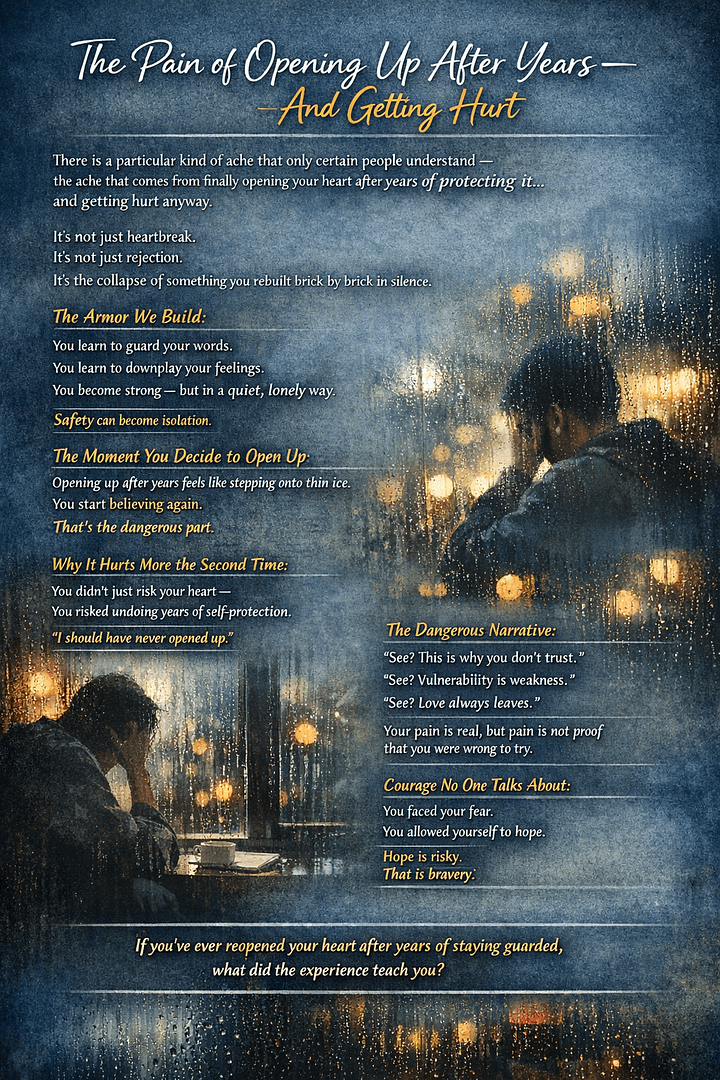
    There is a particular kind of ache that only certain people understand — the ache that comes from finally opening your heart after years of protecting it… and getting hurt anyway.

    It’s not just heartbreak.

    It’s not just rejection.

    It’s the collapse of something you rebuilt brick by brick in silence.

    The Armor We Build

    When someone goes years without truly opening up, it’s rarely because they don’t long for connection. It’s because they once gave too much of themselves to someone who didn’t know how to hold it.

    Maybe it was betrayal that blindsided you.
    Maybe it was being replaced.
    Maybe it was loving someone who promised forever but delivered distance.
    Maybe it was giving loyalty to someone who gave you uncertainty.

    Whatever the story, the result is the same: you learn.

    You learn to guard your words.
    You learn to downplay your feelings.
    You learn to laugh things off instead of letting them in.

    You become strong — but in a quiet, lonely way.

    And over time, you convince yourself:
    “I don’t need anyone.”
    “I’m better off alone.”
    “It’s safer this way.”

    Safety becomes your comfort zone.

    But safety can also become isolation.

    The Fear Behind the Smile

    People who have been hurt deeply often look fine on the outside. They show up. They work. They laugh. They function.

    But internally, they are careful.

    They measure how much they say.
    They hold back the most tender parts of themselves.
    They avoid talking about what still aches.

    Because vulnerability feels like standing in the open during a storm.

    So when someone who has lived like that for years decides to try again, it’s not casual. It’s monumental.

    The Moment You Decide to Open Up

    It usually doesn’t happen all at once.

    It starts small.

    A longer conversation.
    A deeper question.
    A shared story that you normally would have kept to yourself.

    Then one night you find yourself saying something real — something that exposes the soft part of you.

    And you wait.

    You wait to see how they’ll respond.
    You wait to see if they’ll pull away.
    You wait to see if you just made a mistake.

    Opening up after years feels like stepping onto thin ice.

    You want connection.
    But you also know how easily it can break.

    And when they respond well — when they listen, when they reassure, when they make you feel seen — something inside you begins to thaw.

    You start believing again.

    That’s the dangerous part.

    Why It Hurts More the Second Time

    When it doesn’t work out — when they withdraw, lose interest, choose someone else, or simply can’t meet you where you stand — the pain cuts deeper than it used to.

    Not because you’re weaker.

    But because you risked more.

    You didn’t just risk your heart.
    You risked your healing.
    You risked undoing years of self-protection.

    You thought:
    “Maybe I was wrong about love.”
    “Maybe this time it will stay.”
    “Maybe I can finally stop bracing myself.”

    So when it falls apart, it feels like confirmation of your worst fear:

    “I should have never opened up.”

    That thought is heavy.

    It tempts you to retreat permanently.

    The Dangerous Narrative

    After being hurt again, your mind tries to protect you by rewriting the story.

    It says:
    “See? This is why you don’t trust.”
    “See? Vulnerability is weakness.”
    “See? Love always leaves.”

    But those thoughts aren’t truth.

    They are trauma trying to keep you safe.

    There is a difference.

    Your pain is real.
    Your disappointment is valid.
    Your fear makes sense.

    But pain does not equal proof that you were wrong to try.

    The Courage No One Talks About

    Opening up after years of emotional distance is not weakness — it’s one of the strongest acts a human can make.

    You faced your fear.
    You confronted your history.
    You allowed yourself to hope.

    Hope is risky.

    Especially when you know exactly how much losing can hurt.

    Many people choose numbness because it’s easier.
    They detach.
    They avoid.
    They never fully invest.

    You didn’t do that.

    You stepped forward knowing the odds.

    That is bravery.

    What Getting Hurt Again Doesn’t Mean

    It doesn’t mean:

    You are too intense.

    You are too emotional.

    You expect too much.

    You are unworthy of consistency.

    It doesn’t mean you should shrink yourself next time.

    It doesn’t mean you should love halfway.

    It simply means that this particular connection wasn’t aligned.

    Sometimes timing is off.
    Sometimes emotional maturity doesn’t match.
    Sometimes two good people just aren’t good together.

    And sometimes, people enjoy the warmth of your vulnerability but aren’t prepared to carry its responsibility.

    That’s not a flaw in you.

    The Aftermath

    The hardest part isn’t just losing them.

    It’s losing the version of yourself that started to believe again.

    You might feel embarrassed for caring.
    Ashamed for hoping.
    Angry at yourself for ignoring red flags.

    You might withdraw.
    You might go quiet again.
    You might rebuild your walls thicker than before.

    That’s human.

    But here’s the important part:

    Do not confuse healing with hardening.

    Healing allows you to grow.
    Hardening makes you smaller.

    Choosing Not to Close Forever

    After getting hurt again, you have a choice.

    You can decide:
    “Never again.”
    “No one gets this close.”
    “I’m done.”

    Or you can decide:
    “That hurt. But I’m still capable of love.”
    “That didn’t work. But I won’t let it define me.”
    “I can protect myself without shutting down completely.”

    That second path is harder.

    It requires balance.
    It requires boundaries.
    It requires discernment instead of walls.

    But it keeps your heart alive.

    And a living heart — even one with scars — is far more powerful than a protected one that never feels anything at all.

    A Deeper Truth

    If you opened up after years and got hurt, it doesn’t mean you failed.

    It means you healed enough to try.

    That alone is progress.

    You were not foolish.
    You were hopeful.

    You were not naive.
    You were courageous.

    And courage sometimes comes with bruises.

    A Gentle Reminder for You

    If you’re reading this and your chest feels heavy right now, remember:

    You are not weak for wanting connection.
    You are not dramatic for feeling deeply.
    You are not broken because it didn’t last.

    You are human.

    And the fact that you opened your heart after everything it has endured proves something incredible:

    It still believes in love.

    And one day, someone will meet that belief with the steadiness it deserves.

    Until then, don’t punish yourself for having the courage to feel.

    That courage is rare.

    And it is beautiful.

    Read More Of Love & Relationships

  • Irish American History Month: Celebrating Heritage, Resilience, and Cultural Influence

    Irish American History Month: Celebrating Heritage, Resilience, and Cultural Influence

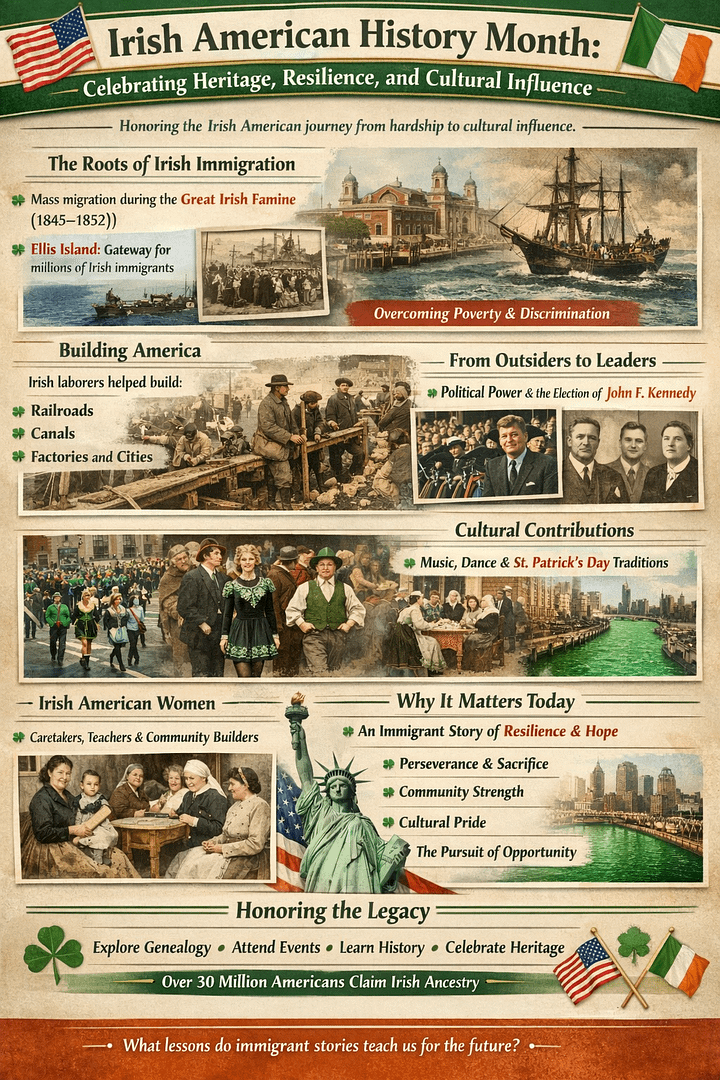
    Every March, the United States observes Irish American History Month, a national recognition of the generations of Irish immigrants and Irish Americans whose courage, labor, and cultural influence helped shape the country. While green clothing, festive parades, and celebrations often define public perception of the month, its true purpose is historical reflection — honoring a story of hardship, determination, and transformation that mirrors the broader American immigrant experience.

    Irish American History Month invites Americans not only to celebrate heritage but also to understand how identity, struggle, and opportunity intertwine in the building of a nation.

    Irish migration to America stretches back to the colonial era, but the most significant wave occurred during the Great Irish Famine (1845–1852). A devastating potato blight destroyed Ireland’s primary food source, leading to mass starvation, disease, and economic collapse. Families faced impossible choices — remain and risk death or leave everything behind for uncertain survival abroad.

    Over one million Irish immigrants crossed the Atlantic during this period. Many arrived through Ellis Island, exhausted from long, dangerous journeys aboard overcrowded ships sometimes called “coffin ships” due to high mortality rates.

    Upon arrival, the promise of America quickly met harsh reality. Irish immigrants often settled in crowded urban neighborhoods where poverty, disease, and limited employment opportunities were common. Anti-Irish sentiment was widespread, fueled by religious prejudice against Catholics and fears that immigrants would take jobs from native-born workers.

    Despite discrimination, Irish communities formed strong support networks centered around churches, neighborhoods, and extended families. These communities became the foundation for future generations’ success.

    Faith, Community, and Identity

    Religion played a central role in Irish American life. Catholic parishes were more than places of worship — they functioned as social centers, schools, employment networks, and sources of stability in unfamiliar cities.

    Irish clergy and religious sisters established hospitals, orphanages, and educational institutions that served both immigrant families and broader communities. Catholic schools helped preserve cultural identity while offering pathways to upward mobility through education.

    The parish system also gave Irish Americans a sense of belonging at a time when mainstream society often excluded them. Through shared traditions, music, storytelling, and faith, Irish immigrants maintained connections to their homeland while building a new American identity.

    Building America: Labor, Industry, and Sacrifice

    Irish Americans were instrumental in building America’s infrastructure during the 19th century. Many took physically demanding and dangerous jobs that others refused, including:

    Railroad construction

    Canal digging

    Mining operations

    Factory labor

    Urban sanitation and public works

    Irish workers helped construct canals such as the Erie Canal and contributed significantly to railroad expansion, including segments tied to the nation’s westward growth.

    Working conditions were often brutal. Long hours, unsafe environments, and low wages were common realities. Yet Irish laborers became pioneers of organized labor movements, advocating for fair treatment and workplace protections.

    Their activism laid groundwork for labor reforms that later benefited workers across all industries and backgrounds.

    Military Service and Patriotism

    Irish Americans also demonstrated deep commitment to their adopted country through military service. During the American Civil War, thousands joined both Union and Confederate armies, though Irish brigades fighting for the Union became especially famous for their bravery.

    Military service helped Irish immigrants gain acceptance within American society. Participation in national defense reinforced their identity not only as immigrants but as Americans willing to sacrifice for shared ideals.

    Irish Americans have continued this tradition through service in every major U.S. conflict, strengthening their legacy of patriotism and civic responsibility.

    From Marginalization to Political Power

    As Irish communities grew, political engagement became a pathway to opportunity and influence. Urban political organizations helped immigrants navigate employment, housing, and social services.

    Cities like Boston, New York, and Chicago saw the rise of Irish American political leadership. Over time, Irish Americans transitioned from a marginalized group into a powerful voting bloc.

    The election of John F. Kennedy in 1960 marked a historic milestone. As the first Irish Catholic president, Kennedy symbolized the full integration of Irish Americans into national leadership and public life. His presidency represented not only political success but also cultural acceptance.

    Cultural Contributions That Shaped America

    Irish culture has profoundly influenced American traditions in ways both visible and subtle.

    Music and Arts

    Irish folk traditions influenced American bluegrass, country, and folk music. Instruments like the fiddle became central to American musical identity, blending Irish melodies with other cultural sounds.

    Literature and Storytelling

    Irish storytelling traditions enriched American literature and journalism. Humor, poetry, and narrative storytelling styles carried across generations, helping shape American creative expression.

    Celebrations and Public Culture

    St. Patrick’s Day transformed from a religious feast day into a nationwide celebration of cultural pride. Parades, festivals, and community gatherings now highlight Irish heritage while celebrating multicultural unity across America.

    Irish American Women: Unsung Builders of Community

    Irish American women played critical yet often overlooked roles in shaping society. Many worked as domestic workers, nurses, and teachers, sending money home to support relatives while establishing economic stability in America.

    Religious sisters founded schools and hospitals that served immigrant populations regardless of background. Their contributions expanded education and healthcare access across growing American cities.

    These women were not only caretakers but also community builders who helped families transition into American life.

    The Evolution of Irish American Identity

    Over generations, Irish Americans transitioned from immigrant outsiders to fully integrated participants in American society. Intermarriage, education, and economic advancement broadened opportunities, while cultural traditions remained strong.

    Today, Irish American identity reflects both heritage and adaptation — honoring Irish roots while embracing the diversity of modern America.

    More than 30 million Americans claim Irish ancestry, demonstrating how a once-struggling immigrant group became a central thread in the American cultural fabric.

    Why Irish American History Month Matters Today

    Irish American History Month serves as a reminder that the American story is fundamentally an immigrant story. The challenges faced by Irish immigrants — discrimination, economic hardship, cultural misunderstanding — echo experiences still faced by newcomers today.

    By studying Irish American history, we gain perspective on:

    The importance of inclusion

    The power of community support

    The value of cultural preservation

    The resilience required to build a better future

    It encourages empathy and understanding while celebrating progress.

    Honoring the Legacy Today

    People celebrate Irish American History Month in many ways:

    Attending cultural festivals and parades

    Exploring genealogy and family history

    Reading Irish American literature

    Supporting Irish arts and music

    Teaching younger generations about heritage and history

    Whether through education or celebration, the month invites Americans to recognize how diverse cultures strengthen the nation.

    Irish American history is ultimately a story of hope — proof that perseverance, faith, and community can transform adversity into lasting contribution.

    Read More Holidays & National Days