Category: Love

  • Admitting Your Feelings to That Special Someone

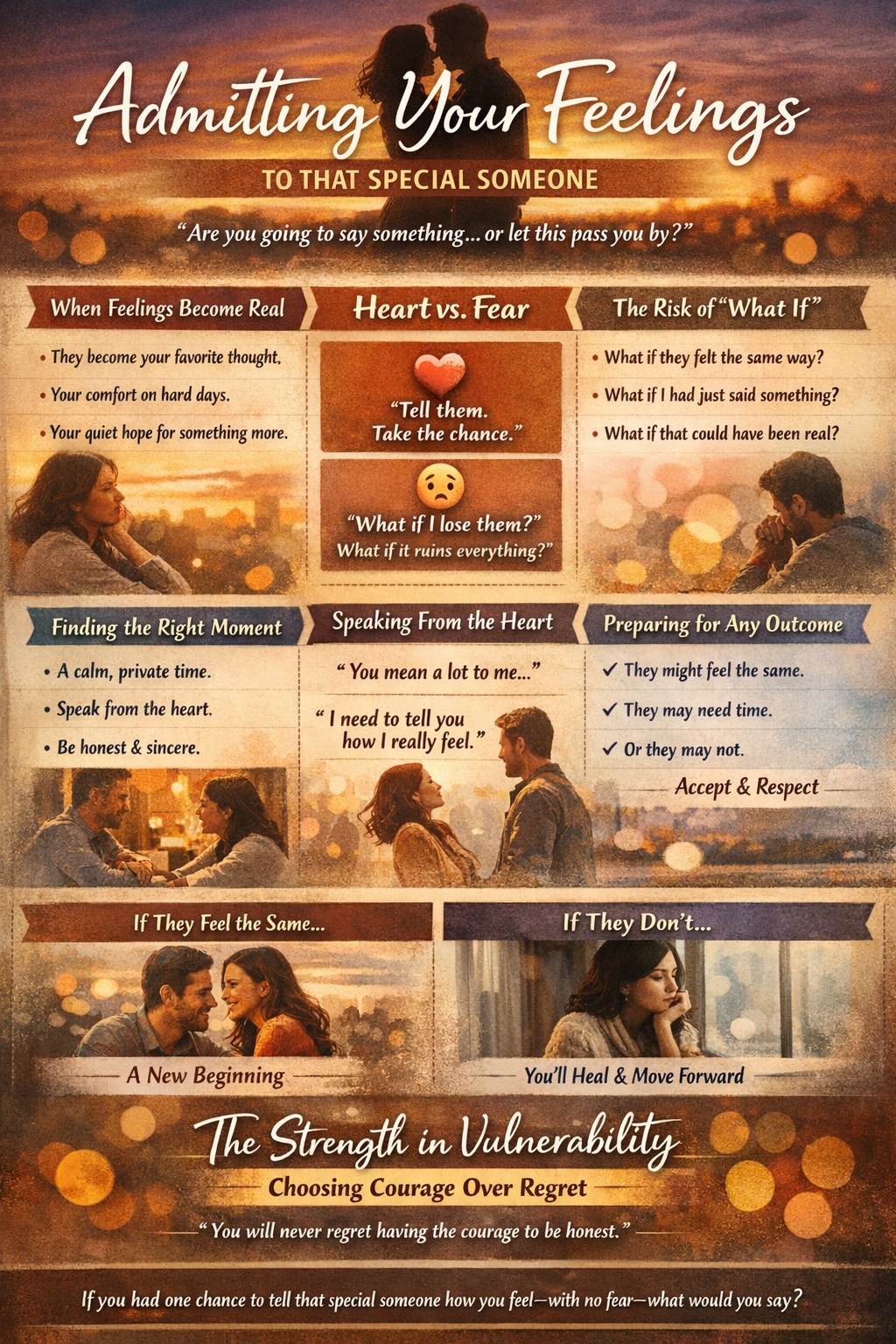
    Admitting Your Feelings to That Special Someone

    There comes a moment in life when silence becomes heavier than words. When what you feel inside grows too strong to ignore. It shows up in the quietest ways—in how your day feels incomplete without hearing from them, in how their smile stays with you long after they’re gone, in how your heart reacts before your mind can catch up.

    You try to convince yourself it’s nothing. Just a phase. Just a passing feeling.

    But deep down, you know the truth.

    And that truth keeps asking one question:
    “Are you going to say something… or let this pass you by?”

    When Feelings Become Real

    At first, it’s subtle.

    A little excitement when their name pops up on your phone.
    A little extra attention when they’re talking.
    A little longer thinking about them before you fall asleep.

    But over time, it becomes undeniable.

    They become your favorite thought.
    Your comfort on hard days.
    Your quiet hope for something more.

    And that’s when things begin to shift.

    Because once your feelings become real, pretending they don’t exist becomes exhausting.

    The Battle Between Heart and Fear

    Admitting your feelings is rarely just about love—it’s about courage versus fear.

    Your heart says:
    “Tell them. Be honest. Take the chance.”

    Your mind says:
    “What if you lose them? What if it ruins everything?”

    So you stay in the middle.

    Not moving forward.
    Not letting go.
    Just existing in uncertainty.

    And that space—between what you feel and what you say—is where doubt grows.

    You start questioning everything:
    Do they feel it too?
    Am I imagining this?
    Should I wait?
    What if I say something and regret it?

    But here’s the truth most people don’t say out loud:

    Waiting doesn’t always protect you—it often prolongs the risk.

    Because the longer you wait, the deeper your feelings grow. And the deeper they grow, the harder it becomes to speak.

    The Risk of “What If”

    One of the greatest emotional burdens we carry in life is unfinished truth.

    The things we didn’t say.
    The chances we didn’t take.
    The moments we let pass because fear was louder than courage.

    “What if they felt the same way?”
    “What if I had just said something?”
    “What if that could have been something real?”

    These questions don’t fade easily. They linger.

    And sometimes, the pain of never knowing lasts longer than the sting of rejection ever would.

    Why Honesty Matters More Than Outcome

    When you admit your feelings, you’re not just chasing a result—you’re honoring yourself.

    You’re saying:
    “My feelings are real, and they deserve to be expressed.”

    That alone is powerful.

    Because too often, people shrink themselves to avoid discomfort. They stay quiet to avoid rejection. They hide parts of who they are to protect what they might lose.

    But love—real love—doesn’t grow in silence.

    It grows in honesty.
    In vulnerability.
    In the willingness to be seen without guarantees.

    And even if the outcome isn’t what you hoped for, you walk away with something just as valuable:

    Self-respect.

    Finding the Right Moment

    There is no perfect timing.

    No flawless setting where everything aligns and guarantees the outcome you want.

    But there are better moments—moments where you can be genuine, present, and clear.

    Choose a time when:

    You’re both calm and not distracted
    You can speak without rushing
    You feel grounded enough to express yourself honestly

    And most importantly—choose a moment when you’re ready to accept whatever comes.

    Because timing isn’t about perfection. It’s about intention.

    Speaking From the Heart

    You don’t need rehearsed lines or dramatic confessions.

    In fact, the more real and simple you are, the more powerful your words become.

    It might sound like:

    “I’ve been thinking about this for a while, and I just want to be honest with you…”
    “You mean a lot to me, and my feelings have grown into something more…”
    “I don’t expect anything—I just didn’t want to keep this to myself anymore.”

    The key is not perfection—it’s authenticity.

    People don’t connect to perfect words.
    They connect to real ones.

    Preparing for Any Outcome

    This is where true strength shows.

    Because when you open your heart, you’re stepping into the unknown.

    They may smile and say they feel the same way.
    They may need time to process.
    Or they may gently tell you they don’t feel that way.

    And while rejection hurts—it does not define you.

    It doesn’t mean you misread everything.
    It doesn’t mean your feelings were wrong.
    It simply means the connection wasn’t mutual in the way you hoped.

    And that’s okay.

    Because the right connection—the one meant for you—won’t require you to hide how you feel.

    If They Feel the Same

    If your feelings are returned, something beautiful begins.

    Not because everything becomes perfect—but because it begins with truth.

    A relationship built on honesty starts stronger.
    It grows deeper.
    It carries a level of openness that many relationships never reach.

    Because you didn’t start with guessing—you started with clarity.

    If They Don’t

    This is the part people fear the most—but it’s also where growth happens.

    Yes, it will hurt.
    Yes, it may feel awkward for a while.
    Yes, things might change.

    But you will heal.

    And more importantly—you will move forward without regret.

    You won’t spend months or years wondering what could have been.

    You’ll know.

    And knowing—even when it’s not what you wanted—is a form of peace.

    The Strength in Vulnerability

    Admitting your feelings is not weakness—it’s emotional bravery.

    It takes strength to:

    Risk rejection
    Face uncertainty
    Be open in a world that often encourages people to hide

    Most people never say how they truly feel.

    They play it safe.
    They stay guarded.
    They let opportunities pass them by.

    But you? You chose differently.

    You chose truth over comfort.
    Courage over fear.
    Growth over regret.

    And that matters.

    Final Reflection

    At the end of the day, life is not measured by how perfectly we protected our hearts—but by how honestly we lived.

    Love isn’t guaranteed.
    But neither is tomorrow.

    So if there’s someone who has been on your mind… someone your heart keeps coming back to… someone who makes you wonder “what if”…

    Maybe it’s time to stop wondering.

    Maybe it’s time to speak.

    Because the right person won’t punish you for being real.
    They’ll respect you for it.

    And whether it leads to love… or closure… or a new beginning—

    you will never regret having the courage to be honest.

  • Dear Paul, My Son, My Hero

    Dear Paul, My Son, My Hero

    Dear Paul,

    I know you are looking down at me while I am writing this. Smiling and laughing that I am doing the one thing we both know that I rarely do. Opening up and letting my feelings out.

    In life and death, you are not just my son, you are also my hero.

    In life you led by example. You were a loving, caring, mature 21-year-old with an old soul. You cared about others and would help someone in any way you could. Not once did you ever say look what I did, you would say, Dad there was someone who needed help, and I helped them without letting others know so they wouldn’t be embarrassed. You would donate time, items, and other resources to help those in need. Just like your old man.

    You took care of me when I was having medical issues years ago. You would get up, make sure I took my medicine, cook breakfast, go to school, come home and make sure I had dinner and taking care of me all at the tender age of 15.

    I remember how you kept taking care of me all the way up until your death.

    It was just the two of us.

    You would never let me give up. You always knew what to say when things were not good or when you could tell I was not doing good. I miss those pep talk speeches.

    I remember there was times when you would use a speech from a movie and turn it to your own speech. Whatever I needed to hear, you had a knack to find out what was going on and knew what to say.

    I miss the meals you would cook. You always knew what meal would be good for us. Especially what meal would be good for me after a long day or a long night.

    I miss the conversations we would have about anything and everything. It was just not father-son conversations, but the best friends conversations that we would have.

    If it was not for you in life, I would not be here writing this letter to you.

    Thank you for taking care of me and pushing me to live and be better.

    In death, you are not just my son, my hero, but you are also my guardian angel.

    When I found out you had passed away, it broke me into a billion pieces. I could not talk, I could not move, I could not breath.

    I remember that the only thing I needed was you. I ended up going to the bar and numbing the pain of losing of you. I ended up back at home and was up all night and right before I slept for thirty minutes, the last thing I saw was you with wings.

    Ever since, you are the voice that guides me, the spirit that pushes me when I want to give up and the reason why I help people.

    When things get bad or I don’t know what to do, I look up for your guidance. Even in death, you know what to say to me.

    You know how much a pain in the rear you are and I know you are laughing and smiling right now. You know how much I do not like being pushed to do things. But if there is anyone who could get through to me, its you. Your guidance has helped me more than you know.

    I know it took me years to even think of living. Well, with your help, I am trying to live son. Not as much as you want for me, but at least I am trying.

    I know what you are saying to the other angels right now. You are saying,

    “You see how stubborn my old man is, he thinks he is living. He thinks that he tries something new a few times, asks someone out once or twice, writes some articles and helps people do what he needs to do is living. What he needs to do is fully open up to that person he opened up to once, stop hiding and live life, stop being scared of the unknown and get back up and fight to win like he did when I was there with him.”

    I know son. I felt that smack upside my head.

    I will do better. I will be better. I will lead by example. I will get that life you want for me.

    Thank you for taking care of me and pushing me to live and be better.

    Paul, I love you and I miss you every second. You always have been and will be forever my guardian angel.
    Forever my rock, forever my hero, forever my guardian angel, Forever my son.

    Paul, I miss you and I Love you. Till we meet again.

  • When You Feel Like Nobody’s First Choice

    When You Feel Like Nobody’s First Choice

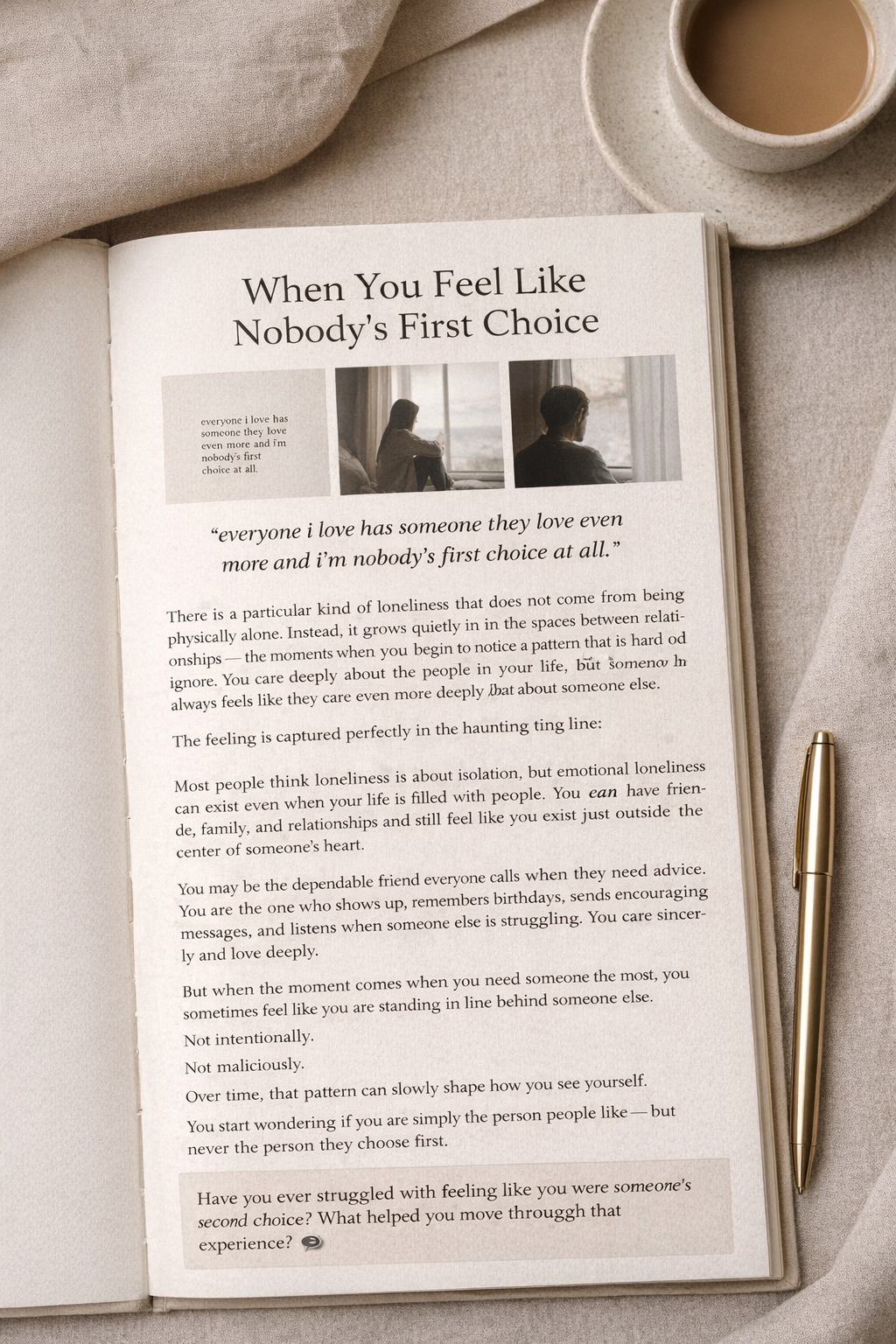
    There is a particular kind of loneliness that does not come from being physically alone. Instead, it grows quietly in the spaces between relationships—the moments when you begin to notice a pattern that is hard to ignore. You care deeply about the people in your life, but somehow it always feels like they care even more deeply about someone else.

    The feeling is captured perfectly in the haunting line:

    “everyone i love has someone they love even more and i’m nobody’s first choice at all.”

    It is a thought that many people carry privately, often afraid to admit it out loud. Because once you say it, you are acknowledging a fear that touches something very vulnerable: the fear of not being chosen.

    The Quiet Weight of Emotional Second Place

    Most people think loneliness is about isolation, but emotional loneliness can exist even when your life is filled with people. You can have friends, family, and relationships and still feel like you exist just outside the center of someone’s heart.

    You may be the dependable friend everyone calls when they need advice. You are the one who shows up, remembers birthdays, sends encouraging messages, and listens when someone else is struggling. You care sincerely and love deeply.

    But when the moment comes when you need someone the most, you sometimes feel like you are standing in line behind someone else.

    Not intentionally.
    Not maliciously.
    But consistently.

    Over time, that pattern can slowly shape how you see yourself.

    You start wondering if you are simply the person people like—but never the person they choose first.

    Loving Deeply in a World of Hesitation

    People who experience this feeling are often the same people who love the hardest. They are emotionally attentive and deeply empathetic. They notice small changes in someone’s voice, the slight shift in someone’s mood, or the unspoken sadness behind a smile.

    They give their energy generously because caring comes naturally to them.

    However, this emotional openness can also make them vulnerable. When you invest your heart so fully in others, every imbalance becomes more noticeable. Every time someone chooses someone else first, it feels like confirmation of a painful narrative forming inside your mind.

    You begin asking quiet questions:

    What am I missing?
    Why am I never the one people choose first?
    Is there something wrong with me?

    These questions can linger for years, even when there are no simple answers.

    When Comparison Becomes a Silent Enemy

    Social media and modern communication can amplify these feelings. Every photo, every public declaration of love, every visible friendship dynamic can create the illusion that everyone else is someone’s priority.

    Meanwhile, you may feel like you are always supporting roles in other people’s stories.

    The danger of this mindset is that it often leads to comparison. You begin measuring your worth against the relationships of others. You look at couples, close friendships, or tight family bonds and assume that you somehow fall short.

    But relationships are complex. What we see on the surface rarely tells the full story.

    Still, the emotional impact of comparison can be powerful. It can convince someone that they are destined to always be “almost enough” but never truly chosen.

    The Emotional Cost of Always Being Strong

    Another hidden aspect of this experience is the role you may have unintentionally taken on: the strong one.

    People who appear emotionally resilient often become the support systems for everyone around them. Because they seem capable, others lean on them during difficult times. Because they seem stable, others assume they do not need the same level of care.

    But strength can sometimes become a mask.

    Behind that dependable presence may be someone who quietly longs for a moment when someone else says, “You matter to me most.”

    Not as an afterthought.
    Not as a backup.
    But as a priority.

    The Truth About Being Chosen

    The painful belief that you are nobody’s first choice often has less to do with your worth and more to do with timing, circumstance, and emotional compatibility.

    People enter our lives at different stages of their own emotional journeys. Some are not ready for deep connection. Some are healing from past wounds. Others may already be attached to relationships that shape their priorities.

    This does not diminish the value of the love you offer.

    In fact, the ability to love deeply is one of the rarest and most meaningful qualities a person can have.

    The challenge is learning to give that love without losing yourself in the process.

    Becoming Your Own First Choice

    One of the most transformative shifts someone can make is learning to choose themselves first.

    This does not mean becoming selfish or closing yourself off emotionally. Instead, it means recognizing that your value should not be determined by who prioritizes you.

    When you begin to respect your own worth, several things start to change.

    You stop chasing validation from people who cannot give it.

    You stop investing emotional energy in relationships that consistently place you second.

    And most importantly, you begin creating space in your life for the people who will truly see you.

    The Love That Feels Different

    When the right connection enters your life, it does not feel like competition. It does not require constant questioning or quiet insecurity.

    It feels steady.

    You do not have to wonder where you stand because the other person makes it clear. They include you in their life without hesitation. They choose you not because you asked for it, but because their heart naturally gravitates toward you.

    In those moments, the old fear begins to fade.

    You realize that you were never unworthy of being someone’s first choice.

    You were simply waiting for someone who recognized your value.

    A Different Ending to the Story

    The feeling that “everyone you love loves someone else more” can be incredibly painful. But it does not define your future or the relationships you will eventually experience.

    Sometimes the people who feel overlooked are the very people who will one day be cherished the most. Their empathy, loyalty, and emotional depth become the foundation of powerful connections when they finally meet someone capable of appreciating them fully.

    The truth is simple, even if it takes time to believe:

    You are not meant to be everyone’s first choice.

    You are meant to be the right person’s first choice.

    And when that happens, it will not feel like you are competing for someone’s heart.

    It will feel like you finally came home.

  • When All You Want Is to Talk to That Special Someone

    When All You Want Is to Talk to That Special Someone

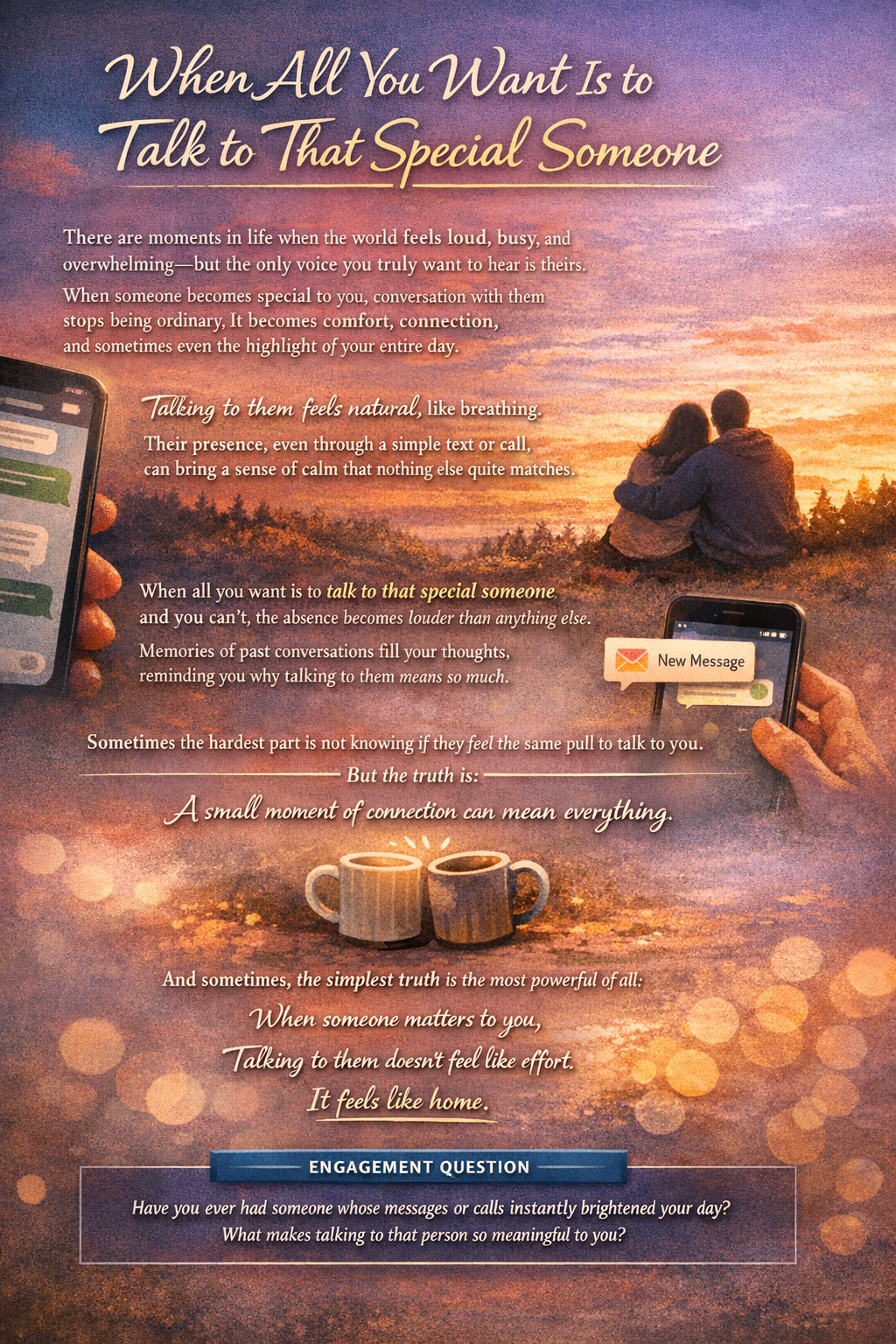
    There are moments in life when the world feels loud, busy, and overwhelming—but the only voice you truly want to hear is theirs. When someone becomes special to you, conversation with them stops being ordinary. It becomes comfort, connection, and sometimes even the highlight of your entire day.

    It’s not always about having something important to say. In fact, most of the time it isn’t. It might be about the little things—how the day went, a funny moment at work, a song that reminded you of them, or even the random thoughts that cross your mind throughout the day. When someone matters to you, talking to them feels natural, like breathing. Their presence, even through a simple text or phone call, can bring a sense of calm that nothing else quite matches.

    For many people, these conversations become a safe place. Life can be complicated, and sometimes we carry things inside that we don’t share with anyone else. But with that one special person, it feels different. You don’t have to pretend to be stronger than you are. You don’t have to filter every thought. You can simply be yourself. In a world that often expects us to wear masks, that kind of connection is rare and deeply meaningful.

    Talking to someone special also creates a rhythm in your life. You begin to look forward to those moments without even realizing it. Maybe it’s a good morning message that starts your day on a brighter note. Maybe it’s a conversation late at night when the rest of the world is quiet and honest thoughts tend to surface. Those moments begin to feel like small traditions—tiny threads that slowly weave two lives together.

    But there is also a quiet ache that can come with it. When all you want is to talk to that special someone and you can’t, the absence becomes louder than anything else. You find yourself checking your phone more often than usual, hoping their name appears on the screen. Even the smallest notification can make your heart skip for a moment, wondering if it might be them.

    In those moments, memories of past conversations tend to surface. You remember the jokes you shared, the late-night talks that seemed to last forever, or the moments when they said exactly what you needed to hear. Those memories remind you why talking to them means so much in the first place.

    Sometimes the hardest part is not knowing if they feel the same pull to talk to you. You might hold back from reaching out, not wanting to seem like you’re bothering them or appearing too eager. Pride, fear, and uncertainty can quietly stand in the way of the simple act of saying, “I miss talking to you.”

    Yet the truth is that human connection is built through these small moments. A quick message. A thoughtful question. A shared laugh. None of it seems extraordinary on the surface, but together they create something powerful. Over time, these conversations form a bond that words alone can’t fully explain.

    Talking to someone special isn’t just about exchanging words—it’s about feeling understood. It’s about knowing that somewhere out there is a person who listens to your thoughts, values your feelings, and genuinely cares about what’s happening in your world.

    Sometimes those conversations are deep and meaningful, touching on dreams, fears, and hopes for the future. Other times they are simple and lighthearted, filled with jokes, stories, or playful teasing. But regardless of the topic, the feeling remains the same: their presence makes the moment better.

    There is also something beautifully human about wanting to share life with someone in real time. When something funny happens, they are the first person you want to tell. When something difficult happens, they are the voice you want to hear. It’s not because they can fix everything, but because their presence makes things feel a little less heavy.

    And sometimes, the truth is simple.
    You don’t need a long conversation.
    You don’t need perfect words.
    You don’t even need a reason to reach out.

    All you need is that small moment of connection.

    Because when someone truly holds a place in your heart, even a short “Hi” can brighten your entire day. Even a few minutes of conversation can remind you that you are not alone.

    In the end, wanting to talk to someone special is one of the purest forms of affection. It means they have become a part of your everyday thoughts. It means their voice, their words, and their presence bring something meaningful into your life.

    And sometimes, the simplest truth is the most powerful of all:

    When someone matters to you, talking to them doesn’t feel like effort.

    It feels like home.

  • Honoring Paul Murphy on National Sons Day

    Honoring Paul Murphy on National Sons Day

    “Honoring Paul Murphy” is more than a tribute—it is a testament to how a life, though heartbreakingly brief, can leave a lasting and meaningful imprint on the world.

    Paul Murphy passed away at the tender age of 21, yet his influence far exceeds the years he was given. This tribute speaks of a young man known not for loud accomplishments or public praise, but for something far more powerful: quiet compassion. Paul was the kind of person who noticed when someone needed help and stepped in without hesitation, without expectation, and without seeking recognition.

    He led a life of example. Paul’s selflessness, generosity, and deep care for family, friends, and even strangers defined who he was. He consistently put others before himself, embodying empathy in its purest form. In a world that often celebrates visibility and applause, Paul’s story reminds us that the most meaningful acts are often the ones done quietly, seen only by those whose lives are changed by them.

    Though Paul’s time on earth was short, his spirit continues to inspire empathy, courage, and generosity in those who read his story. His life serves as a gentle but powerful reminder: even small acts of kindness can leave a permanent mark. Paul Murphy’s legacy lives on—not only in memory, but in the hearts and actions of those encouraged to live a little more like him.

    For me, honoring my son means waking up each day with a heart that is both shattered and shining. It means carrying him not in my arms, but in every corner of my spirit. It means understanding that although his life ended, his impact never will.

    He Is the Strength Behind My Steps

    Grief is heavy, but love—his love—is stronger still.
    I used to believe grief was love with nowhere to go. Now I know better.
    My love for him goes everywhere I go. It shows up in my choices, in my resilience, in the moments when I whisper, “I’m doing this for you.”

    His memory pushes me forward on days I want to collapse.
    His light reaches into the darkest hours and gives me just enough strength to try again.
    And every time I choose courage over despair, I am honoring him.

    Living Is the Legacy

    There was a time when laughter felt wrong, when joy felt like betrayal, when moving forward felt like leaving him behind. But grief taught me something profound:

    Living does not erase the love.
    Living does not silence the memories.
    Living does not dishonor the loss.

    Living is how I keep him with me.
    It’s how I carry the story of who he was, and who he made me, into a world that still needs the beauty he inspired.

    Every act of kindness, every moment of gratitude, every breath of hope—these are the gifts I offer in his name.
    His life, though shorter than I ever wanted, continues through the way I choose to shape mine.

    Healing Means Carrying Him Forward

    People say healing means “moving on.” But I refuse that idea.
    I am not moving on—I am moving with him.

    He is woven into the fabric of my days.
    Into my courage.
    Into my resilience.
    Into the quiet moments when I miss him so deeply I can hardly speak.

    Some days I stand tall.
    Some days I barely stand at all.
    But both are sacred. Both count. Both honor a love big enough to survive anything—even loss.

    Finding Him in the Everyday Moments

    Honoring my son isn’t something I do once a year or on special dates.
    I honor him in the small things:

    When I let myself smile, even through tears

    When I choose to believe in tomorrow

    When I help someone else carry their pain

    When I speak his name, without fear, without apology

    When I reflect on the way his presence shaped the best parts of me

    He is there in the sunrise, in the quiet car rides, in the moments when life surprises me with joy I never thought I’d feel again.

    A Promise of Love That Endures

    Losing him changed me forever. But loving him changed me too—and that part will never fade.

    My promise to my son is this:
    I will live a life worthy of the love we shared.

    I will carry him with grace.
    I will seek meaning, even in the brokenness.
    I will choose hope, even when hope feels fragile.
    I will keep going—not because the pain is gone, but because his light deserves a life that continues.

    Every step forward is a tribute.
    Every breath is a testament.
    Every moment of courage is a way of saying,
    “Your life mattered. Your love is still here. And because of you, I will keep living.”

    This day encourages us to re-center on what truly matters—love, family, memory. For those of us who have lost children, it offers a gentle invitation to honor not just loss, but the enduring bonds that remain.

    Although my son is no longer with us, I find solace and strength in helping others and in giving words to my love for him—because family means everything, even across different realms of existence. I hope this tribute encourages anyone reading—who has also known the ache of loss—to find your own meaningful way to remember, honor, and spread light in your loved one’s name.

  • When You’re in Love With Someone Who Doesn’t Feel the Same

    When You’re in Love With Someone Who Doesn’t Feel the Same

    There’s a specific kind of heartbreak that doesn’t come from betrayal, lies, or dramatic endings. It comes from loving someone who simply doesn’t love you back the same way.

    No explosion.
    No villain.
    Just imbalance.

    And somehow, that makes it even harder.

    Because when someone hurts you intentionally, anger can help you detach. But when they’re kind, honest, and simply don’t feel what you feel? There’s nothing to fight. Nothing to blame. Just a quiet ache you carry every time you’re around them.

    When Feelings Are One-Sided

    Unrequited love isn’t about being foolish or delusional. It’s about emotional investment landing in a place where it can’t grow.

    You see them differently.
    You feel deeply when they speak.
    You imagine a future they’ve never pictured.

    And the hardest part? They may genuinely care about you — just not in the way your heart longs for.

    That gray area is brutal.

    They might:

    Call you when they need support

    Laugh with you effortlessly

    Confide in you

    Say, “You’re so important to me”

    But they don’t reach for you romantically.
    They don’t choose you exclusively.
    They don’t look at you the way you look at them.

    You’re close — but not close enough.

    The Agony of Being Around Them

    Being around someone you love who doesn’t reciprocate can feel like emotional whiplash.

    One moment, you feel connected.
    The next, you’re reminded that you’re alone in your feelings.

    You might sit across from them at dinner, smiling on the outside while your heart silently breaks. You may watch them talk about someone they’re interested in. You might see them give their attention, affection, or effort to someone else — and have to pretend it doesn’t crush you.

    Even small moments become loaded:

    A hug that lingers too long in your mind

    A compliment that feels like hope

    A delayed text that feels like rejection

    You try to act natural. You tell yourself you can handle it. But inside, you’re constantly adjusting your expectations to survive the interaction.

    It’s exhausting.

    The Inner Conflict

    Loving someone who doesn’t feel the same creates a painful inner split.

    Part of you wants to stay — because being near them feels better than not having them at all.

    Another part of you knows staying keeps you stuck.

    You tell yourself:

    “I can manage my feelings.”

    “I’ll get over it eventually.”

    “Maybe they’ll change their mind.”

    But healing rarely happens while you’re still emotionally entangled.

    When you’re around them often, your brain keeps reinforcing attachment. You don’t get the space needed to let your heart recalibrate. Instead, you stay in a loop of hope, disappointment, and self-questioning.

    How It Affects Your Self-Worth

    Over time, unreciprocated love can quietly damage how you see yourself.

    You may start asking:

    What does the other person have that I don’t?

    Why am I not enough?

    If I love this deeply, why can’t they?

    But attraction and emotional connection aren’t merit-based systems. You can be kind, attractive, loyal, emotionally available — and still not be the right match for someone.

    It’s not a reflection of your value.

    It’s a reflection of compatibility.

    Still, when you’re constantly exposed to someone who doesn’t choose you, it can feel personal. You might shrink yourself. Lower your standards. Accept crumbs of attention because they feel better than nothing.

    That’s when love becomes self-abandonment.

    The Illusion of “Just Friends”

    Many people try to transition into friendship too quickly.

    On the surface, it sounds mature. Healthy. Evolved.

    But if your heart is still hoping for more, friendship can feel like slow torture.

    You celebrate their wins while secretly wishing you were their partner.
    You give advice about their dating life while swallowing your own feelings.
    You show up for them emotionally while denying your own unmet needs.

    True friendship requires emotional neutrality. And you can’t force neutrality.

    It has to grow — often after distance.

    Creating Space Without Bitterness

    Distance doesn’t have to be dramatic. It doesn’t have to come with accusations or slammed doors.

    Sometimes it’s as simple as saying:

    “I care about you, but I need some space to sort through my feelings.”

    That’s not weakness. That’s emotional maturity.

    Creating space allows:

    Your nervous system to calm down

    Your expectations to reset

    Your identity to expand beyond them

    You start remembering who you are outside of longing.

    And something surprising happens when you pull back: clarity replaces obsession. The fantasy loses some of its shine. You begin seeing the full picture instead of just the parts your heart romanticized.

    Grieving What Never Was

    One of the most painful aspects of unrequited love is grieving a relationship that never officially existed.

    There are no anniversaries.
    No breakup speech.
    No clear “end.”

    You’re mourning potential. Possibility. Imagined futures.

    And that grief is valid.

    Allow yourself to feel it without judgment. Cry if you need to. Journal. Talk to someone you trust. Acknowledge that your heart invested in something meaningful — even if it wasn’t mutual.

    Healing begins when you stop minimizing your own pain.

    Opening the Door to Something Better

    Letting go of someone who doesn’t feel the same isn’t giving up on love. It’s making space for love that flows both ways.

    The right connection won’t feel like a constant question mark. It won’t leave you analyzing every interaction. It won’t require you to convince someone to see your worth.

    It will feel steady. Safe. Mutual.

    And when that kind of love arrives, you’ll understand why this one had to end — even if it never truly began.

    A Final Truth

    You can’t force someone to feel what they don’t feel.

    But you can choose how long you stay in a situation that hurts you.

    Loving someone who doesn’t love you back doesn’t make you foolish. It means you have depth. It means your heart is capable of commitment and vulnerability.

    Just make sure that depth is eventually given to someone who meets you there.

    Because you deserve more than proximity.

    You deserve reciprocity.

  • The Pain of Opening Up After Years — And Getting Hurt

    The Pain of Opening Up After Years — And Getting Hurt

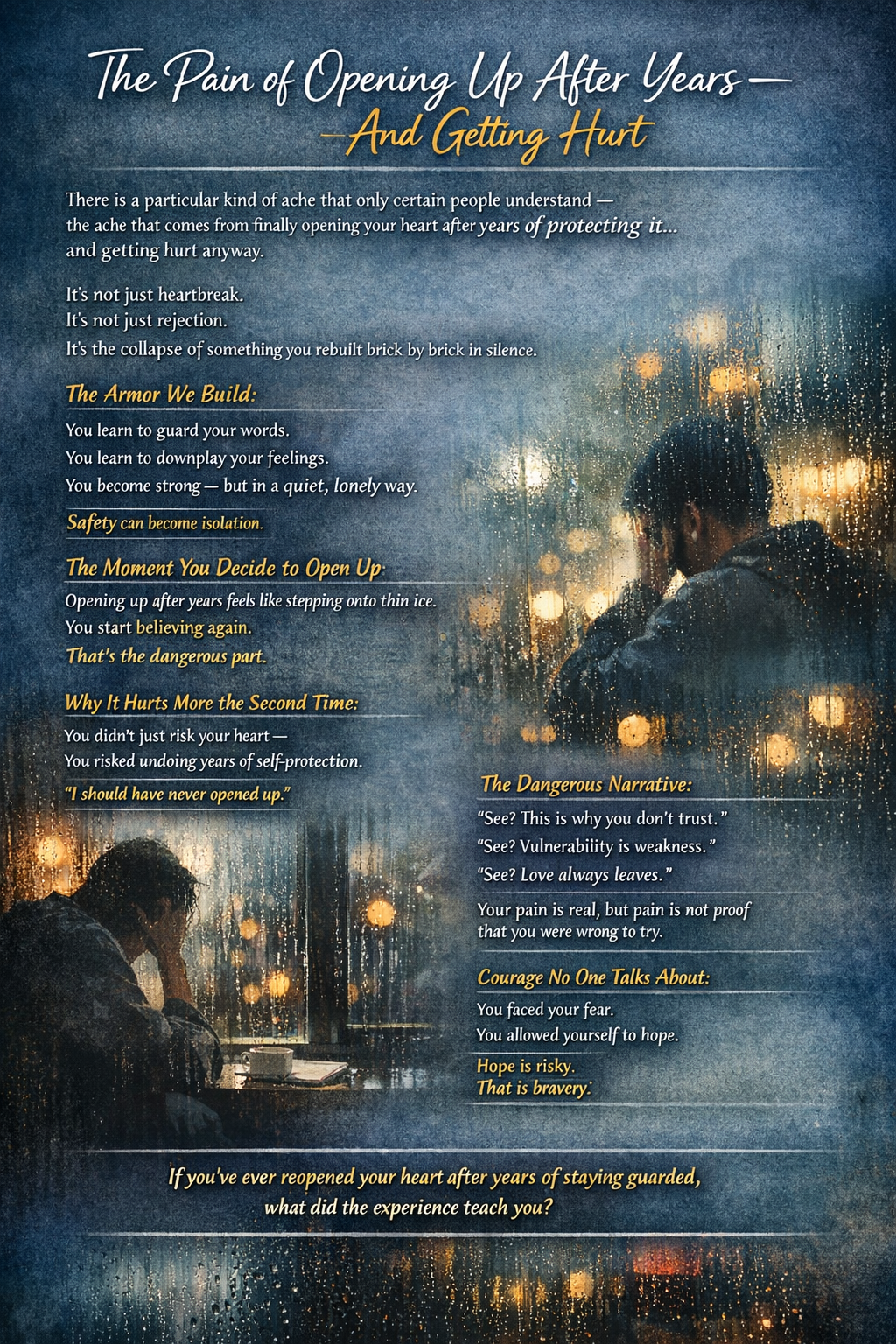
    There is a particular kind of ache that only certain people understand — the ache that comes from finally opening your heart after years of protecting it… and getting hurt anyway.

    It’s not just heartbreak.

    It’s not just rejection.

    It’s the collapse of something you rebuilt brick by brick in silence.

    The Armor We Build

    When someone goes years without truly opening up, it’s rarely because they don’t long for connection. It’s because they once gave too much of themselves to someone who didn’t know how to hold it.

    Maybe it was betrayal that blindsided you.
    Maybe it was being replaced.
    Maybe it was loving someone who promised forever but delivered distance.
    Maybe it was giving loyalty to someone who gave you uncertainty.

    Whatever the story, the result is the same: you learn.

    You learn to guard your words.
    You learn to downplay your feelings.
    You learn to laugh things off instead of letting them in.

    You become strong — but in a quiet, lonely way.

    And over time, you convince yourself:
    “I don’t need anyone.”
    “I’m better off alone.”
    “It’s safer this way.”

    Safety becomes your comfort zone.

    But safety can also become isolation.

    The Fear Behind the Smile

    People who have been hurt deeply often look fine on the outside. They show up. They work. They laugh. They function.

    But internally, they are careful.

    They measure how much they say.
    They hold back the most tender parts of themselves.
    They avoid talking about what still aches.

    Because vulnerability feels like standing in the open during a storm.

    So when someone who has lived like that for years decides to try again, it’s not casual. It’s monumental.

    The Moment You Decide to Open Up

    It usually doesn’t happen all at once.

    It starts small.

    A longer conversation.
    A deeper question.
    A shared story that you normally would have kept to yourself.

    Then one night you find yourself saying something real — something that exposes the soft part of you.

    And you wait.

    You wait to see how they’ll respond.
    You wait to see if they’ll pull away.
    You wait to see if you just made a mistake.

    Opening up after years feels like stepping onto thin ice.

    You want connection.
    But you also know how easily it can break.

    And when they respond well — when they listen, when they reassure, when they make you feel seen — something inside you begins to thaw.

    You start believing again.

    That’s the dangerous part.

    Why It Hurts More the Second Time

    When it doesn’t work out — when they withdraw, lose interest, choose someone else, or simply can’t meet you where you stand — the pain cuts deeper than it used to.

    Not because you’re weaker.

    But because you risked more.

    You didn’t just risk your heart.
    You risked your healing.
    You risked undoing years of self-protection.

    You thought:
    “Maybe I was wrong about love.”
    “Maybe this time it will stay.”
    “Maybe I can finally stop bracing myself.”

    So when it falls apart, it feels like confirmation of your worst fear:

    “I should have never opened up.”

    That thought is heavy.

    It tempts you to retreat permanently.

    The Dangerous Narrative

    After being hurt again, your mind tries to protect you by rewriting the story.

    It says:
    “See? This is why you don’t trust.”
    “See? Vulnerability is weakness.”
    “See? Love always leaves.”

    But those thoughts aren’t truth.

    They are trauma trying to keep you safe.

    There is a difference.

    Your pain is real.
    Your disappointment is valid.
    Your fear makes sense.

    But pain does not equal proof that you were wrong to try.

    The Courage No One Talks About

    Opening up after years of emotional distance is not weakness — it’s one of the strongest acts a human can make.

    You faced your fear.
    You confronted your history.
    You allowed yourself to hope.

    Hope is risky.

    Especially when you know exactly how much losing can hurt.

    Many people choose numbness because it’s easier.
    They detach.
    They avoid.
    They never fully invest.

    You didn’t do that.

    You stepped forward knowing the odds.

    That is bravery.

    What Getting Hurt Again Doesn’t Mean

    It doesn’t mean:

    You are too intense.

    You are too emotional.

    You expect too much.

    You are unworthy of consistency.

    It doesn’t mean you should shrink yourself next time.

    It doesn’t mean you should love halfway.

    It simply means that this particular connection wasn’t aligned.

    Sometimes timing is off.
    Sometimes emotional maturity doesn’t match.
    Sometimes two good people just aren’t good together.

    And sometimes, people enjoy the warmth of your vulnerability but aren’t prepared to carry its responsibility.

    That’s not a flaw in you.

    The Aftermath

    The hardest part isn’t just losing them.

    It’s losing the version of yourself that started to believe again.

    You might feel embarrassed for caring.
    Ashamed for hoping.
    Angry at yourself for ignoring red flags.

    You might withdraw.
    You might go quiet again.
    You might rebuild your walls thicker than before.

    That’s human.

    But here’s the important part:

    Do not confuse healing with hardening.

    Healing allows you to grow.
    Hardening makes you smaller.

    Choosing Not to Close Forever

    After getting hurt again, you have a choice.

    You can decide:
    “Never again.”
    “No one gets this close.”
    “I’m done.”

    Or you can decide:
    “That hurt. But I’m still capable of love.”
    “That didn’t work. But I won’t let it define me.”
    “I can protect myself without shutting down completely.”

    That second path is harder.

    It requires balance.
    It requires boundaries.
    It requires discernment instead of walls.

    But it keeps your heart alive.

    And a living heart — even one with scars — is far more powerful than a protected one that never feels anything at all.

    A Deeper Truth

    If you opened up after years and got hurt, it doesn’t mean you failed.

    It means you healed enough to try.

    That alone is progress.

    You were not foolish.
    You were hopeful.

    You were not naive.
    You were courageous.

    And courage sometimes comes with bruises.

    A Gentle Reminder for You

    If you’re reading this and your chest feels heavy right now, remember:

    You are not weak for wanting connection.
    You are not dramatic for feeling deeply.
    You are not broken because it didn’t last.

    You are human.

    And the fact that you opened your heart after everything it has endured proves something incredible:

    It still believes in love.

    And one day, someone will meet that belief with the steadiness it deserves.

    Until then, don’t punish yourself for having the courage to feel.

    That courage is rare.

    And it is beautiful.

  • I Do Care About You: The Quiet Strength of Genuine Care in a Loud World

    I Do Care About You: The Quiet Strength of Genuine Care in a Loud World

    In a world that moves faster every day, genuine care has become one of the most powerful — and sometimes overlooked — forms of human connection. We live surrounded by notifications, quick replies, and conversations that often skim the surface of who we truly are. Yet beneath all the noise, people are longing for something simple and deeply human: to feel seen, valued, and understood.

    The words “I do care about you” may sound ordinary, but their meaning reaches far beyond language. They represent attention, emotional presence, and a willingness to stand beside someone not only during joyful moments but also through uncertainty, struggle, and vulnerability.

    Real care is not proven by grand declarations. It is revealed through consistency — through small, repeated acts that quietly say, you matter to me.

    Caring About Someone’s Problems

    Everyone carries invisible battles. Some struggles are spoken openly, while others remain hidden behind smiles and routine conversations. When you genuinely care about someone’s problems, you offer more than advice — you offer understanding.

    Caring does not always mean solving issues. Often, the most meaningful support comes from simply listening without judgment. Sitting with someone in their discomfort sends a powerful message: Your pain is not inconvenient to me.

    In a culture that often encourages people to “fix” emotions quickly, patience becomes an act of love. Allowing someone space to feel heard can be more healing than any solution.

    Caring About Health — Seen and Unseen

    True care recognizes that well-being goes beyond physical health. Emotional exhaustion, anxiety, and silent stress can weigh just as heavily as physical illness. When someone checks on your health, they are acknowledging that your life matters beyond productivity or appearances.

    It may look like reminding someone to rest, encouraging healthier choices, or noticing when their energy changes. Sometimes it is asking the simplest yet most meaningful question: “How are you really doing?”

    These moments remind us that care is rooted in awareness — paying attention to what others may not openly express.

    Supporting Goals and Dreams

    One of the deepest ways to care for someone is to believe in their potential. Caring about someone’s goals means investing emotionally in their future. It means celebrating victories, encouraging perseverance during setbacks, and reminding them of their strength when self-doubt appears.

    Support does not require complete understanding of another person’s dream. It only requires respect for what matters to them.

    When someone stands behind your ambitions, they become part of your journey. Their belief can become the motivation that keeps you moving forward when confidence fades.

    The Meaning Behind Everyday Conversations

    Asking how someone’s day went may seem small, but it carries profound emotional significance. These daily check-ins create connection through routine. They communicate interest, reliability, and emotional availability.

    Relationships are rarely strengthened by extraordinary moments alone. Instead, they grow through ordinary interactions repeated over time — shared laughter, small updates, and consistent presence.

    Care lives in these everyday exchanges.

    Being Present Through Communication

    In modern relationships, communication has taken new forms through calls, texts, and messages. Responding, reaching out, and maintaining connection may appear simple, yet they signal priority.

    When someone makes time to communicate, they are offering attention — one of the most valuable resources we possess. Attention cannot be faked for long; it reflects genuine interest.

    Consistent communication reassures people that they are not forgotten, ignored, or alone in their experiences.

    Valuing Opinions and Feelings

    To care about someone is to respect their inner world — their thoughts, perspectives, and emotions. This requires empathy, humility, and openness.

    Listening does not mean agreeing with everything. It means acknowledging that another person’s feelings are valid and worthy of consideration.

    When people feel emotionally safe enough to share openly, trust deepens. And trust is the foundation upon which meaningful relationships are built.

    Understanding What Bothers Someone

    Care also involves awareness of emotional boundaries — knowing what hurts someone, what comforts them, and what brings them peace. This understanding develops over time through attention and compassion.

    It requires remembering details, recognizing patterns, and adjusting behavior out of respect rather than obligation.

    This kind of attentiveness communicates something powerful: I see you as an individual, not just a presence in my life.

    The Courage to Care

    Caring deeply requires vulnerability. It means risking disappointment, misunderstanding, or emotional pain. Many people hesitate to show care openly because it exposes their hearts.

    Yet choosing to care is an act of courage. It means deciding that connection is worth the risk.

    When we allow ourselves to care fully, we create spaces where authenticity can exist — spaces where people feel safe enough to be themselves without fear of rejection.

    Why Caring Matters More Than Ever

    Loneliness has become increasingly common despite constant digital connection. Many people communicate daily yet still feel emotionally unseen. Genuine care breaks through this isolation.

    It reminds us that relationships are not measured by frequency of interaction but by depth of understanding.

    A single person who truly cares can change how someone experiences the world. They can restore hope, rebuild confidence, and remind another human being of their worth.

    The Simple Truth

    At its heart, caring is not complicated. It is choosing presence over distraction, empathy over indifference, and patience over convenience.

    It is caring about someone’s problems, health, goals, feelings, and daily experiences. It is noticing what troubles them and celebrating what brings them joy.

    And ultimately, it is saying — through both words and actions:

    I do care about you.

    Because sometimes the most life-changing thing a person can hear is not advice or solutions, but the reassurance that they matter deeply to someone else.

  • When Will I Be Loved?

    When Will I Be Loved?

    There comes a quiet moment in many lives when the question finally rises to the surface — not loudly, not dramatically, but softly and persistently:

    “When will I be loved?”

    It is a question whispered during sleepless nights, asked after another failed connection, or felt while watching others experience the companionship we deeply desire. It is not simply about romance; it is about belonging, being chosen, and feeling seen in a world that can sometimes feel emotionally distant.

    This question lives inside people of every age, background, and story. And while it may feel lonely, it is one of the most human questions we can ask.

    The Silent Ache of Wanting to Be Chosen

    At its core, the longing to be loved is not about needing someone to complete us. It is about wanting to share life with someone who recognizes our worth without hesitation.

    Many people know the experience of giving love freely — supporting others, showing kindness, being emotionally present — while secretly wondering why that same energy has not returned to them in the way they hope.

    You may become the strong one.
    The listener.
    The dependable heart everyone leans on.

    Yet when the day ends, you sit with a quiet thought:

    Who chooses me?

    This ache is rarely visible to others. From the outside, you may appear confident, independent, or fulfilled. But internally, there is a space reserved for connection — a space that remains patiently open.

    The Misunderstanding of Timing

    We often believe love operates on fairness: good people should find love quickly, loyal hearts should be rewarded, and genuine intentions should naturally attract the right person.

    But love does not move according to fairness or logic.

    Timing in love is influenced by countless invisible factors:

    emotional maturity,

    personal healing,

    life circumstances,

    readiness to receive rather than just give.

    Sometimes two people meet too early — before growth has taken place. Sometimes love passes close by but cannot stay because one or both hearts are still learning lessons they cannot yet see.

    What feels like delay may actually be alignment happening slowly behind the scenes.

    The Fear That Grows While Waiting

    Waiting for love can slowly create dangerous beliefs:

    Maybe I’m too much.

    Maybe I’m not enough.

    Maybe love isn’t meant for me.

    These thoughts are understandable, but they are not truths — they are wounds speaking.

    The longer we wait, the easier it becomes to measure our worth by relationship status. Social media, movies, and cultural expectations amplify this pressure, presenting love as something everyone else has already figured out.

    But love is not a race with winners and losers. It is a deeply personal journey shaped by individual growth.

    Your timeline is not broken simply because it looks different.

    Learning the Difference Between Loneliness and Solitude

    One of the hidden gifts of waiting is discovering yourself outside of partnership.

    Loneliness says:
    I am incomplete alone.

    Solitude says:
    I am whole, but I still desire connection.

    This transformation is powerful. When you learn to enjoy your own company — your thoughts, passions, and peace — you stop seeking love out of desperation and begin seeking it from intention.

    Healthy love grows best in two complete lives choosing to walk together, not in two people trying to escape emptiness.

    Why Some Hearts Take Longer to Find Love

    People who feel deeply often take longer to find lasting love. Not because they are difficult to love, but because they are unwilling to settle for something shallow.

    They want:

    emotional safety,

    honesty,

    consistency,

    connection beyond surface attraction.

    And those qualities require emotional readiness from both people involved.

    Sometimes the delay exists because your heart recognizes what it deserves — even when your loneliness tries to convince you otherwise.

    Becoming Ready Without Realizing It

    While asking “When will I be loved?”, something important is happening quietly:

    You are evolving.

    Every disappointment teaches discernment.
    Every heartbreak strengthens boundaries.
    Every period alone builds self-awareness.

    You learn:

    how you want to be treated,

    what you will no longer tolerate,

    how to communicate your needs,

    and how to protect your peace.

    One day, you may look back and realize the waiting period was shaping you into someone capable of receiving a deeper, healthier kind of love.

    Love Often Arrives Differently Than Expected

    Many imagine love arriving dramatically — instant chemistry, overwhelming passion, undeniable certainty.

    But lasting love often feels different.

    It feels calm.
    Safe.
    Consistent.

    It may begin as friendship. It may grow slowly. It may not resemble the intense stories we were taught to expect.

    Real love frequently replaces anxiety with peace. Instead of wondering where you stand, you simply know.

    And sometimes that quiet certainty is what makes it real.

    The Moment the Question Changes

    There is a turning point that happens subtly.

    You stop asking, “When will I be loved?” and begin living fully regardless of the answer.

    You pursue passions.
    You build friendships.
    You invest in personal growth.

    And ironically, it is often during this stage — when love is no longer the center of your identity — that connection finds its way into your life.

    Not because you stopped wanting love, but because you stopped believing you were incomplete without it.

    A Gentle Truth to Hold Onto

    If you are still waiting for love, consider this:

    Your capacity to love is evidence that love belongs in your life. The desire itself is not random; it reflects something real within you.

    You are not late.
    You are not overlooked.
    You are not unworthy.

    You are simply living a chapter that has not yet reached its introduction to the person who will understand your heart.

    And when love finally arrives, it will not erase the waiting — it will make sense of it.

    Final Reflection

    “When will I be loved?” is ultimately a question about hope.

    It is proof that despite disappointment, your heart still believes in connection. And that belief is powerful. It means you have not allowed cynicism to replace your humanity.

    Love is not always immediate, but it is often meaningful precisely because it takes time to find.

    Until that day comes, remember:

    You are already becoming someone worth loving — including by yourself.

  • Saying It Plainly: The Courage of Honest Love

    Saying It Plainly: The Courage of Honest Love

    An Expanded Reflection on Vulnerability, Truth, and Emotional Integrity

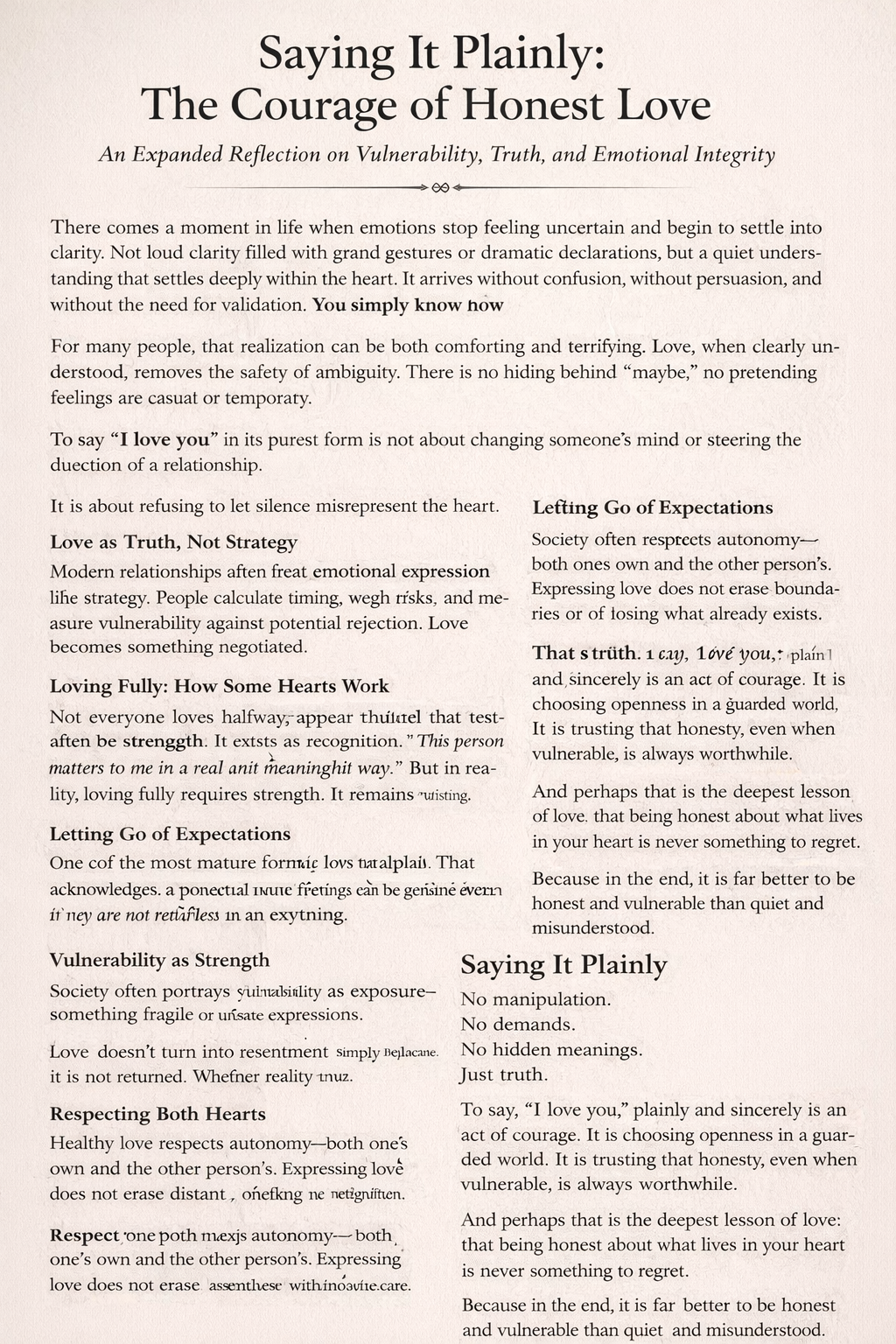
    There comes a moment in life when emotions stop feeling uncertain and begin to settle into clarity. Not loud clarity filled with grand gestures or dramatic declarations, but a quiet understanding that settles deeply within the heart. It arrives without confusion, without persuasion, and without the need for validation. You simply know how you feel.

    For many people, that realization can be both comforting and terrifying. Love, when clearly understood, removes the safety of ambiguity. There is no hiding behind “maybe,” no pretending feelings are casual or temporary. There is only truth—and truth asks to be spoken.

    To say “I love you” in its purest form is not about changing someone’s mind or steering the direction of a relationship. It is about refusing to let silence misrepresent the heart.

    Love as Truth, Not Strategy

    Modern relationships often treat emotional expression like strategy. People calculate timing, weigh risks, and measure vulnerability against potential rejection. Love becomes something negotiated rather than felt.

    But authentic love is not strategic. It does not emerge as a tool to secure commitment or control outcomes. Instead, it exists as recognition: This person matters to me in a real and meaningful way.

    When love is spoken from this place, it carries no hidden agenda. It does not demand reciprocity or emotional repayment. It simply communicates honesty.

    There is a quiet dignity in saying, “I’m not telling you this to change you—I’m telling you because it’s true.” That distinction transforms love from pressure into freedom. It allows the other person to receive the feeling without fear of obligation while allowing the speaker to live authentically.

    The Fear Behind Silence

    Many people remain silent about love not because their feelings are weak, but because they are strong. Silence often grows from fear—the fear of rejection, of altering a relationship, or of losing what already exists.

    Yet silence carries its own risks.

    Unspoken emotions can slowly reshape perception. Care may be mistaken for casualness. Devotion may appear distant. The absence of words can unintentionally communicate indifference, even when the heart feels anything but indifferent.

    Over time, silence becomes heavier than vulnerability. Regret begins to whisper questions: What if I had just been honest? What if they never knew how deeply I cared?

    Choosing honesty interrupts that cycle. It replaces uncertainty with clarity, even if the outcome remains unknown.

    Loving Fully: How Some Hearts Work

    Not everyone loves halfway. Some people are naturally wired to care deeply once emotional connection forms. When they love, it shows in consistent presence—checking in, remembering details, offering emotional support, and holding space even from afar.

    This kind of love is often misunderstood in a culture that praises emotional detachment. Deep care can be mistaken for intensity or vulnerability mistaken for weakness. But in reality, loving fully requires strength. It demands emotional awareness and the willingness to remain open despite risk.

    To hold space for someone when they are absent is one of love’s quietest expressions. It means wishing them well without needing recognition. It means carrying respect and affection into everyday moments where no one else can see.

    That is not dependency. That is emotional sincerity.

    Letting Go of Expectations

    One of the most mature forms of love is love without entitlement. It acknowledges a powerful truth: feelings can be genuine even if they are not shared equally.

    This perspective shifts love away from outcome and toward integrity. Instead of asking, “Will they choose me?” the focus becomes, “Am I being honest with who I am?”

    Acceptance plays a crucial role here. If the other person meets the feeling, gratitude follows. If they do not, respect remains. Love does not turn into resentment simply because it is not returned.

    This does not mean rejection is painless. Vulnerability always carries emotional risk. But acceptance allows pain to exist without bitterness. It protects the heart from becoming hardened by unmet expectations.

    Vulnerability as Strength

    Society often portrays vulnerability as exposure—something fragile or unsafe. Yet emotional openness is one of the strongest acts a person can make. It requires self-awareness, courage, and emotional responsibility.

    Being vulnerable means standing in your truth without guarantees. It means understanding that authenticity matters more than emotional protection. It means choosing to be known rather than merely perceived.

    When someone says plainly, “I love you,” they are not surrendering power. They are reclaiming it. They are choosing honesty over fear and clarity over confusion.

    And regardless of response, vulnerability creates peace. There is comfort in knowing nothing meaningful was hidden or left unsaid.

    Respecting Both Hearts

    Healthy love respects autonomy—both one’s own and the other person’s. Expressing love does not erase boundaries or individuality. Instead, it acknowledges that two emotional realities can coexist.

    One person may feel ready; the other may not. One may move forward; the other may step back. Neither reality invalidates the sincerity of the moment.

    Respect allows love to remain compassionate even when paths diverge. It recognizes that caring deeply for someone also includes honoring their freedom to choose differently.

    This understanding transforms love from possession into appreciation.

    The Peace of Emotional Honesty

    There is a unique calm that follows honest expression. Even when uncertainty remains, clarity replaces internal conflict. The heart no longer carries the burden of secrecy.

    Emotional honesty aligns actions with feelings. It allows a person to live without pretending indifference or minimizing genuine care. And in doing so, it nurtures self-respect.

    Because sometimes the most important outcome is not whether love is returned—it is whether it was expressed truthfully.

    Saying It Plainly

    At the center of all meaningful connection lies simplicity. Love, stripped of fear and expectation, becomes clear and direct.

    No manipulation.
    No demands.
    No hidden meanings.

    Just truth.

    To say, “I love you,” plainly and sincerely is an act of courage. It is choosing openness in a guarded world. It is trusting that honesty, even when vulnerable, is always worthwhile.

    And perhaps that is the deepest lesson of love: that being honest about what lives in your heart is never something to regret.

    Because in the end, it is far better to be honest and vulnerable than quiet and misunderstood.