
Grief changes everything.
Whether your loss happened recently or years ago, grief has a way of showing up when you least expect it. Some days it arrives quietly, like a distant ache. Other days it crashes into your life without warning, making even the simplest tasks feel impossible.
Many people believe healing from grief means finding a way to leave it behind. The truth is quite different. Healing isn’t about forgetting your loved one or moving on from them. Healing is about learning how to carry your loss while continuing to live your life.
The small choices you make each day can have a profound impact on your emotional well-being. While no daily routine can erase the pain of loss, healthy habits can provide stability, comfort, and moments of peace during difficult seasons.
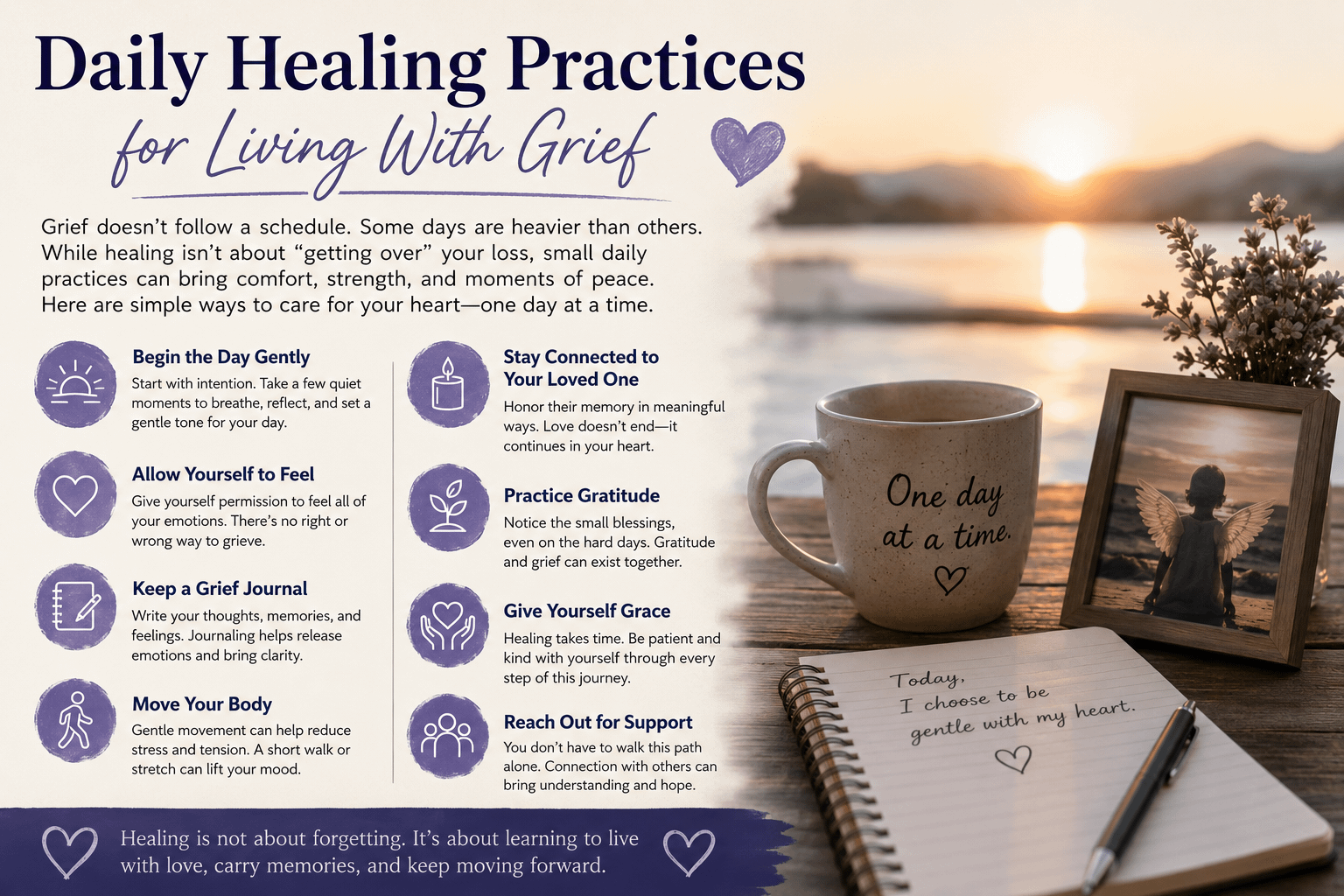
Here are several daily healing practices that can help you navigate your grief journey one day at a time.
Begin the Day Gently
For many grieving people, mornings can be the hardest part of the day.
There is often a painful moment immediately after waking when reality returns. The loss becomes real all over again, and the weight of another day can feel overwhelming.
Creating a gentle morning routine can help ease that transition.
Instead of immediately reaching for your phone or rushing into responsibilities, take a few moments to simply breathe. Sit quietly with a cup of coffee or tea. Watch the sunrise. Read a favorite scripture, devotional, or inspirational quote.
You might choose to light a candle in memory of your loved one or spend a few moments reflecting on a favorite memory.
The goal is not to force happiness. The goal is to begin the day with intention rather than allowing grief to immediately take control.
Allow Yourself to Feel
One of the biggest mistakes people make is trying to avoid grief.
We live in a culture that often encourages us to stay busy, stay strong, and push through our emotions. Unfortunately, buried grief rarely stays buried. It often resurfaces later through anxiety, depression, anger, or emotional exhaustion.
Give yourself permission to feel whatever emotions arise.
Some days you may feel sadness.
Some days you may feel anger.
Some days you may even feel moments of joy followed by guilt.
All of these emotions are normal.
Healing begins when we stop judging our feelings and start acknowledging them.
Keep a Grief Journal
Writing can be one of the most powerful tools for emotional healing.
A journal provides a safe place to express thoughts that may be difficult to share with others. It allows you to release emotions rather than carrying them inside.
You don’t have to be a writer to benefit from journaling.
Simply write about:
- What you’re feeling today
- What you miss most
- Memories that came to mind
- Things you wish you could say
- Lessons you’ve learned through loss
Many grieving parents find comfort in writing letters to their child. Others write daily reflections or prayers.
There is no right or wrong way to journal. The purpose is simply to give your grief a voice.
Move Your Body
Grief affects more than your emotions.
It impacts your body as well.
Many people experience fatigue, muscle tension, headaches, disrupted sleep, and physical exhaustion after a significant loss.
Gentle movement can help release some of that emotional and physical tension.
This doesn’t mean you need an intense workout.
Consider:
- Taking a short walk
- Stretching for ten minutes
- Practicing yoga
- Riding a bicycle
- Working in the garden
- Spending time outdoors
Movement reminds your body that it is still alive, still capable, and still deserving of care.
Even five or ten minutes can make a difference.
Stay Connected to Your Loved One
One of the greatest fears after a loss is the fear of forgetting.
Many people worry that as time passes, memories will fade.
Creating a daily remembrance practice can help maintain a healthy connection with your loved one.
You might:
- Display photos
- Light a candle
- Visit a special place
- Wear a meaningful piece of jewelry
- Listen to their favorite music
- Prepare a favorite meal
- Share stories about them
Love does not end when someone dies.
Continuing to honor their memory allows that love to remain part of your life.
Practice Gratitude Without Ignoring Pain
Gratitude and grief can exist together.
Being grateful does not mean you’re no longer hurting.
It simply means you’re allowing yourself to notice moments of goodness alongside the pain.
At the end of each day, try identifying one thing for which you’re grateful.
It might be:
- A supportive friend
- A comforting conversation
- A beautiful sunset
- A warm meal
- A peaceful moment
On particularly difficult days, your gratitude might simply be:
“I made it through today.”
And sometimes, that’s enough.
Give Yourself Grace
Grief is not a straight path.
There will be good days.
There will be difficult days.
There will be setbacks, emotional triggers, anniversaries, birthdays, holidays, and unexpected reminders.
None of these moments mean you’re failing.
Healing is not measured by how little you cry or how quickly you recover.
Healing is measured by your willingness to keep going despite the pain.
Be patient with yourself.
Speak to yourself with the same kindness you would offer a close friend facing the same loss.
Reach Out When You Need Support
Grief can feel incredibly isolating.
Many people around you may not understand what you’re experiencing. Some may even expect you to “move on” long before you’re ready.
You do not have to carry this burden alone.
Consider connecting with:
- A grief support group
- A counselor or therapist
- Trusted friends
- Family members
- Faith communities
- Online grief communities
Sometimes healing begins simply by realizing someone else understands.
Final Thoughts
There is no timetable for grief.
There is no finish line.
There is no moment when you suddenly stop missing the person you love.
What healing offers is something different. It offers the ability to carry your grief with greater strength, greater compassion, and greater hope.
The small choices you make each day matter.
A walk.
A prayer.
A journal entry.
A memory.
A moment of gratitude.
These simple practices won’t erase your loss, but they can help you build a life that honors both your loved one and your own journey forward.
One day at a time.
One step at a time.
One breath at a time.
A Father’s Guide to Surviving the Loss of a Child
Leave a ReplyCancel reply