
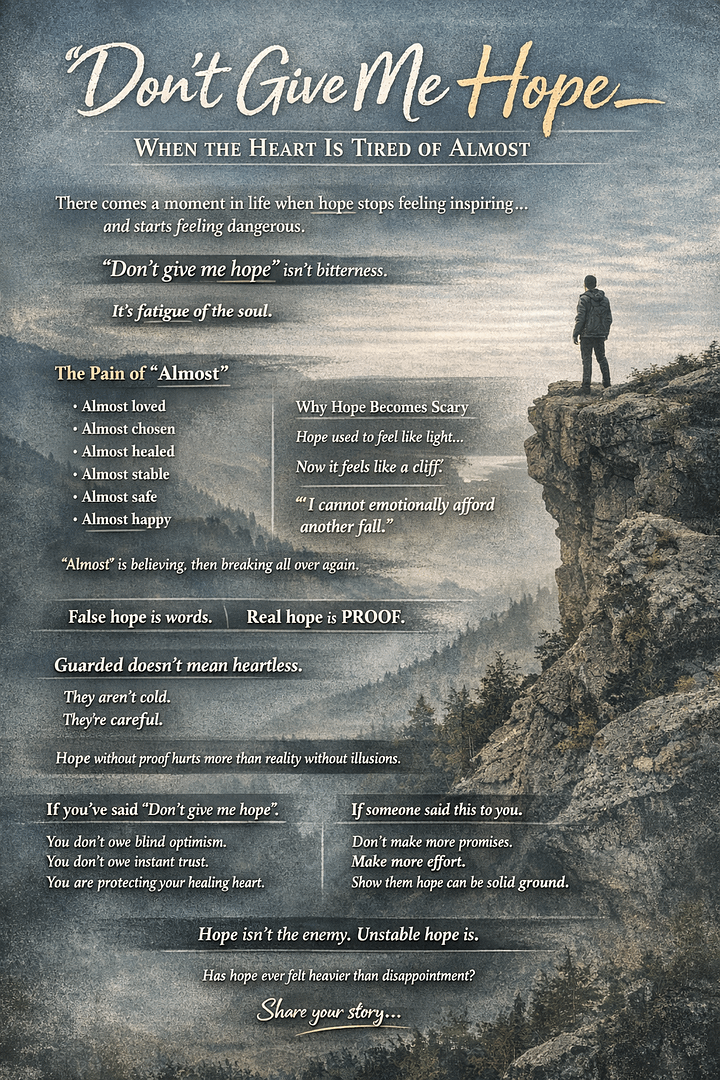
There comes a moment in life when hope stops feeling inspiring… and starts feeling dangerous.
We grow up being told hope is everything. Hope keeps us going. Hope heals. Hope is strength. But no one talks about what happens when hope has been broken too many times. When believing starts to feel like volunteering to be hurt again.
“Don’t give me hope” isn’t bitterness.
It’s fatigue of the soul.
It’s what someone says when they’ve stood at the doorway of something good — love, healing, opportunity, reconciliation, change — and watched it slip away at the last second. Not once. Not twice. But enough times that their heart now flinches at possibility.
The Pain of “Almost”
Clear endings hurt, but they heal.
“Almost” lingers.
Almost loved
Almost chosen
Almost healed
Almost stable
Almost safe
Almost happy
“Almost” is the slowest kind of heartbreak. There’s no closure, no clean ending, no clear line between what was real and what wasn’t. Just a thousand “what ifs” echoing in the mind.
Hope is what makes “almost” hurt so deeply. Because for a moment, you believed.
And belief makes the fall longer.
Why Hope Becomes Scary
Hope asks you to open your heart.
But opening your heart means removing the armor you worked so hard to build. It means saying, “Maybe this time will be different,” even when your past whispers, It never is.
Every disappointment doesn’t just hurt — it rewires you.
After enough emotional drops, your nervous system stops reacting to hope as excitement and starts reacting to it as a threat. Your body remembers the crash. So when someone offers promises, affection, reassurance, or “good news,” your instinct isn’t relief.
It’s caution.
That’s when the phrase appears:
“Don’t give me hope.”
What it really means is:
“I cannot emotionally afford another fall.”
False Hope vs. Real Hope
There’s a difference between hope built on words and hope built on evidence.
False hope sounds like:
“I promise things will change.”
“Trust me this time.”
“It’s going to work out.”
“I’ll do better.”
These phrases aren’t evil. But when they’ve been repeated without follow-through, they become emotional landmines.
False hope lifts someone emotionally… then drops them from a height they didn’t choose.
Real hope feels different.
It’s quieter. Less dramatic. Less flashy.
It’s:
Actions matching words
Time proving patterns
Effort that continues when no one is watching
Consistency when it’s inconvenient
Real hope doesn’t rush in loudly.
It rebuilds trust one brick at a time.
Guarded Doesn’t Mean Heartless
People who say “don’t give me hope” are often the ones who once loved the hardest, believed the deepest, and trusted the most.
They are not cold.
They are careful.
Carefulness is what happens when a warm heart learns the cost of blind optimism. It’s not negativity — it’s emotional intelligence shaped by experience.
They’ve learned:
Hope without proof hurts more than reality without illusions.
So they choose grounded expectations over emotional freefall.
The Exhaustion No One Sees
There’s a special kind of tired that comes from emotional whiplash.
Getting excited.
Letting your guard down.
Imagining the future.
Feeling safe for a moment.
Then… losing it.
Again.
After enough cycles, even good news feels suspicious. Compliments feel temporary. Promises feel hollow. Opportunities feel fragile.
That’s not cynicism.
That’s self-protection.
Hope becomes something you ration — not something you live on.
How Hope Comes Back (The Right Way)
Hope cannot be forced. It cannot be argued into someone. It cannot be demanded.
It must be earned.
Not through grand gestures.
Not through emotional speeches.
Not through “just believe.”
But through reliability.
Hope returns when:
Someone does what they said they would
Patterns stay stable
Effort doesn’t disappear
Words don’t change with moods
Presence doesn’t vanish during hard moments
That kind of hope feels different. It doesn’t give you butterflies.
It gives you peace.
And peace is safer than excitement.
If You’ve Said “Don’t Give Me Hope”
It means your heart is still alive — just cautious.
You’re not refusing joy.
You’re refusing illusions.
You’re not incapable of believing.
You’re waiting for something real enough to believe in.
That’s strength, not weakness.
You don’t owe anyone instant trust.
You don’t owe blind optimism.
You don’t owe emotional risk without evidence.
You are allowed to protect your heart while it heals.
If Someone Said This To You
Don’t try to talk them out of it.
Don’t drown them in reassurance.
And definitely don’t take it as rejection.
They are not saying, “I don’t care.”
They are saying, “I care too much to be hurt like that again.”
The most powerful response isn’t more words.
It’s time. Consistency. Follow-through.
It’s proving that this time, hope won’t be a cliff — it will be solid ground.
Because Here’s the Truth
Hope isn’t the enemy.
Unstable hope is.
And people who are afraid of hope are usually people who once believed in it with their whole heart.
They’re not asking for miracles.
They’re asking for something they can stand on without falling.
Leave a ReplyCancel reply