
Grief has a way of hiding in plain sight.
On ordinary days, it may sit quietly in the background—manageable, familiar, almost folded neatly into daily life. Then a date appears on the calendar, and suddenly the weight returns. Death anniversaries, birthdays, and holidays don’t just mark time; they reopen memories, emotions, and questions we thought we had already faced.
For many people, these moments can feel more painful than the loss itself. And when they do, it can be confusing, frustrating, and isolating.
The Calendar as a Trigger
Special dates are emotional landmarks. They don’t simply remind us of who we lost—they remind us of who we were before the loss and who we are now.
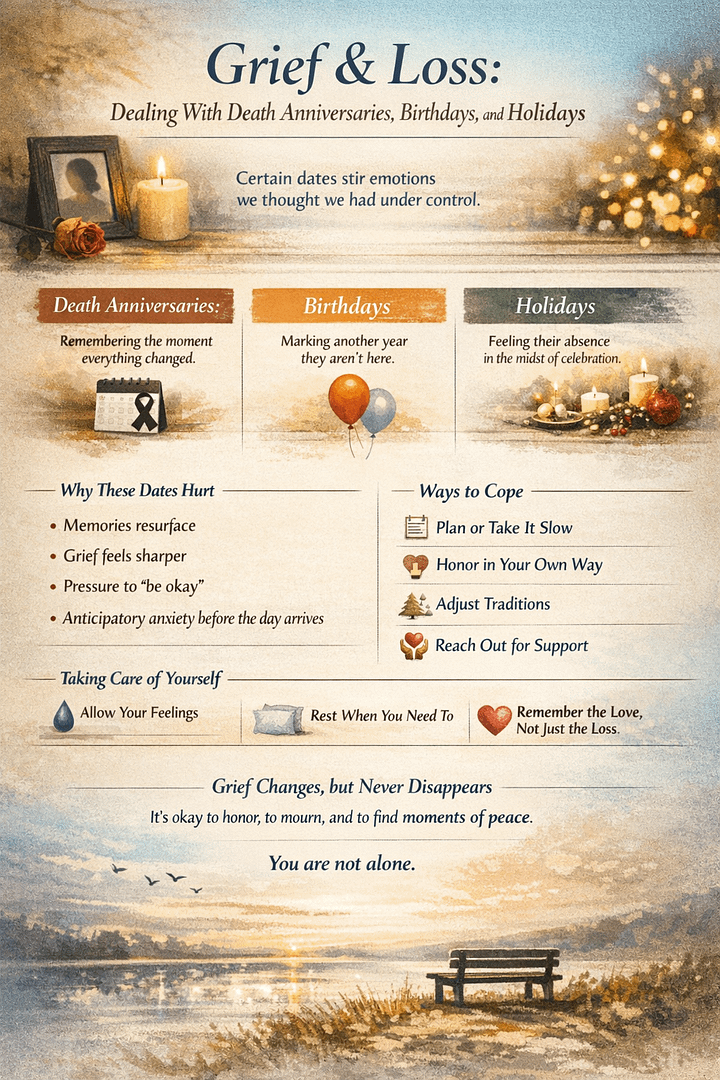
A death anniversary often brings the mind back to the moment everything changed: the phone call, the hospital room, the silence afterward. Birthdays remind us that time continues to pass without them—another year they don’t get to live, another candle that won’t be lit. Holidays, meant to symbolize joy and togetherness, can amplify absence in a room full of people.
Grief becomes louder when the world expects celebration.
Why These Days Can Feel Worse Than “Random” Days
Many people are surprised to find that grief intensifies years after a loss, particularly around significant dates. This isn’t a sign of regression—it’s a natural response.
Our bodies and minds store emotional memory. Even if we don’t consciously remember the date, our nervous system often does. This can show up as:
-
Increased anxiety or irritability
-
Fatigue or brain fog
-
Sudden waves of sadness or anger
-
Trouble sleeping or concentrating
-
A sense of dread with no clear explanation
This phenomenon, sometimes called anniversary reactions, is deeply human. The body remembers before the mind catches up.
Anticipatory Grief: The Quiet Build-Up
Often, the most difficult part isn’t the day itself—it’s the lead-up.
Days or even weeks before an anniversary or holiday, grief may begin to surface quietly. You might feel emotionally off-balance, distracted, or unusually sensitive. This is known as anticipatory grief, and it can make the days feel long and heavy.
Naming it matters. Saying to yourself, “This makes sense—this date is coming,” can soften the internal tension. Awareness doesn’t remove the pain, but it gives it context.
The Pressure to Be ‘Okay’
One of the most painful aspects of grieving these milestones is the expectation to perform normalcy.
Early after a loss, grief is acknowledged. Over time, support often fades—not because people don’t care, but because discomfort grows. Society prefers grief to have an expiration date.
Holidays come with expectations:
-
Be grateful
-
Be joyful
-
Be social
-
Be positive
When grief doesn’t cooperate, many mourners feel guilt on top of sadness—guilt for not enjoying the moment, guilt for changing traditions, guilt for still hurting.
But grief doesn’t disappear because the calendar says it should.
Death Anniversaries: Revisiting the Moment of Loss
Death anniversaries often bring a replay of details: sights, sounds, conversations, regrets. Even when years have passed, the body remembers the shock.
Some people find comfort in marking the day with intention—lighting a candle, visiting a grave, journaling, or spending time alone. Others prefer to avoid the date entirely.
There is no correct response.
What matters is giving yourself permission to experience the day in a way that feels authentic—not performative.
Birthdays: Celebrating Absence
Birthdays can be uniquely painful because they center on life—growth, milestones, and future possibility. When someone is gone, their birthday becomes a reminder of everything they didn’t get to experience.
Some people choose to celebrate anyway—sharing stories, cooking their favorite meal, donating or volunteering in their name. Others find birthdays too raw and choose quiet reflection instead.
Both approaches honor love.
Remembering a birthday doesn’t mean you’re stuck in grief. It means the person mattered—and still does.
Holidays: Grief in a World That Keeps Celebrating
Holidays can feel unbearable because they magnify contrast. The world insists on cheer while grief demands honesty.
Family gatherings highlight empty chairs. Traditions once shared feel incomplete. Even familiar music, scents, or foods can trigger unexpected waves of emotion.
It’s okay to change traditions. It’s okay to skip gatherings. It’s okay to create something new or simplify everything.
You’re not betraying the past—you’re adapting to the present.
Ways to Care for Yourself Through These Dates
Grief doesn’t need fixing, but it does need care. Some gentle ways to support yourself include:
Plan with flexibility. Decide ahead of time what you might do, knowing you can change your mind.
Lower expectations. Productivity, cheerfulness, and social engagement are optional.
Create a ritual. Even small acts—writing a note, lighting a candle, sitting quietly—can provide grounding.
Communicate boundaries. Let others know what you need, even if it’s space.
Stay connected safely. One supportive person can make a difference. You don’t need a crowd.
Rest intentionally. Grief is exhausting. Fatigue is not weakness—it’s a response.
How Grief Evolves Over Time
Grief doesn’t shrink—it changes shape.
What once felt sharp may become deep and quiet. Some anniversaries may pass gently, others may surprise you with intensity. This unpredictability doesn’t mean healing has failed.
It means love remains.
Over time, many people discover they can hold both grief and joy simultaneously. They laugh, love again, build meaning—while still carrying loss.
This isn’t moving on. It’s moving forward with grief.
A Gentle Reminder
If you are approaching a difficult anniversary, birthday, or holiday, know this:
You are not weak.
You are not behind.
You are not doing grief wrong.
You are responding to loss in the most human way possible.
If all you manage to do on that day is breathe and survive it, that is enough. And if you find moments of peace—or even joy—that is not betrayal. It is resilience.
Grief doesn’t end. But neither does love.
A Father’s Guide to Surviving the Loss of a Child
Leave a ReplyCancel reply