
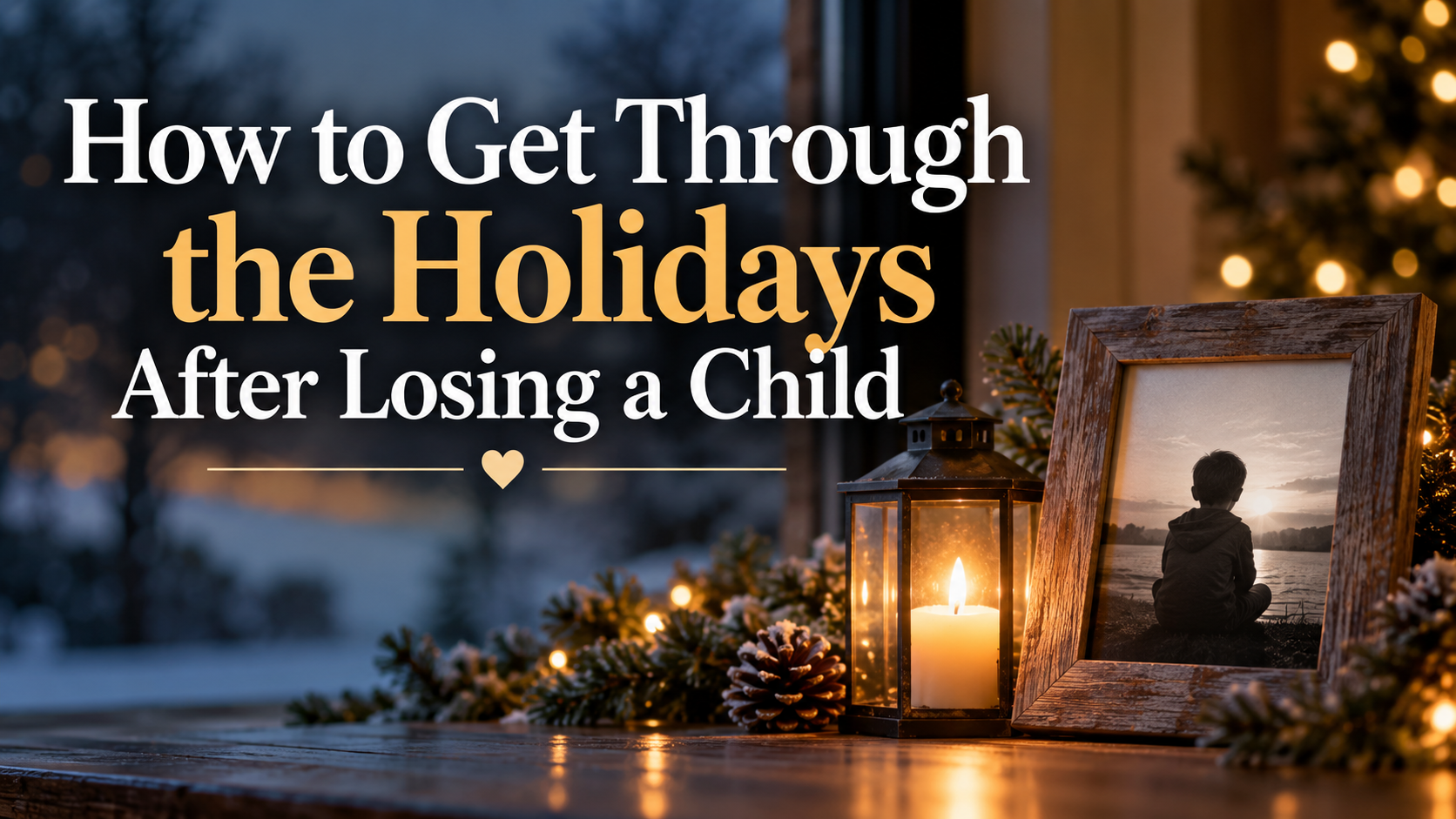
The holidays are supposed to be filled with happiness.
Families gather around tables. Christmas lights glow from houses. Familiar songs play everywhere you go. People exchange gifts, share meals, take photographs, tell stories, and talk about everything they are thankful for.
But when your child has died, the holidays can feel completely different.
Instead of excitement, you may feel dread.
Instead of looking forward to traditions, you may find yourself wondering how you are supposed to participate in them without your child.
There is an empty place at the table.
There is one less name on the gift list.
There is one less voice in the room.
And no matter how many people surround you, your heart knows exactly who is missing.
After losing my son, Paul, I learned that grief does not disappear simply because the calendar says it is time to celebrate. In many ways, holidays can magnify grief because they remind us of the traditions, memories, and moments we once shared with our children.
If you are facing Thanksgiving, Christmas, New Year’s, a family celebration, or another important holiday after losing your child, you do not have to pretend that everything is okay.
You are allowed to grieve.
You are allowed to remember.
And you are allowed to experience the holidays differently than you did before.
Why Holidays Can Be So Painful After Losing a Child
Grief is difficult every day, but holidays have a way of bringing memories to the surface.
You may remember your child’s favorite Christmas movie.
You may remember what they always ate at Thanksgiving dinner.
You may remember them opening presents on Christmas morning.
You may remember decorating the tree together, driving around looking at Christmas lights, baking cookies, attending church, watching football, or simply sitting together at home.
Even small traditions can suddenly become enormous reminders of what has been lost.
Sometimes the anticipation is worse than the holiday itself.
Weeks beforehand, you may start thinking:
How am I going to get through this?
You see advertisements showing happy families.
You hear Christmas music.
People begin discussing their holiday plans.
Stores fill with decorations.
Everyone seems excited.
Meanwhile, you may simply be trying to survive another day without your child.
That difference between what the world expects you to feel and what you actually feel can make grief incredibly lonely.
Give Yourself Permission to Feel Whatever You Feel
There is no correct emotional response to the holidays after losing a child.
You may cry.
You may feel angry.
You may feel numb.
You may laugh at something and then feel guilty for laughing.
You may want to spend time with family.
You may want to stay home.
You may feel relatively strong in the morning and completely overwhelmed a few hours later.
All of those reactions can happen during grief.
You do not have to force yourself into a holiday mood simply because other people are celebrating.
Grief does not follow the calendar.
Your love for your child does not suddenly become easier because it is Thanksgiving or Christmas.
Allow yourself to experience the emotions that come.
Some moments may hurt terribly.
Others may surprise you with warmth or even happiness.
You can miss your child deeply and still experience moments of joy.
One feeling does not erase the other.
Understand That the Holidays May Never Be the Same
One of the hardest things about losing a child is realizing that life has been divided into two parts:
Before they died and after they died.
The holidays are part of that change.
You may try to recreate Christmas exactly as it used to be, only to discover that it feels painfully different.
That does not mean you have failed.
The family has changed.
You have changed.
It is okay for your traditions to change too.
Some traditions may eventually become comforting.
Others may become too painful.
You might decide to keep certain traditions because they make you feel connected to your child while letting others go entirely.
There is no rule saying the holidays must look exactly as they did before.
Decide What You Can Handle
Before the holidays arrive, think about what you realistically have the emotional energy to do.
You do not have to attend every gathering.
You do not have to host dinner.
You do not have to decorate your entire house.
You do not have to participate in every tradition.
You do not have to send Christmas cards.
You do not have to stay at a party for five hours because everyone else does.
Grief can be exhausting.
Sometimes simply getting out of bed takes more energy than people realize.
Protecting your emotional strength is not selfish.
If a large gathering feels overwhelming, perhaps attend for an hour.
If traveling feels impossible, stay home.
If you normally host the family holiday dinner but cannot imagine doing it this year, allow someone else to take over.
Give yourself permission to change plans.
Have an Exit Plan
One thing that can make holiday gatherings easier is knowing you can leave.
Grief can hit without warning.
You may be sitting at dinner when someone tells a story that reminds you of your child.
A song may begin playing.
Someone may mention your child’s name.
You may notice the empty chair.
Suddenly, staying in the room becomes difficult.
If possible, drive yourself to gatherings or arrange transportation that allows you to leave when you need to.
You can also tell someone you trust beforehand:
“If I become overwhelmed, I may need to leave early.”
You do not owe anyone a lengthy explanation.
Sometimes knowing that you have permission to leave makes it easier to attend in the first place.
Say Your Child’s Name
One of the painful experiences bereaved parents sometimes face during holidays is feeling as though everyone is afraid to mention their child.
People may think mentioning your child’s name will upset you.
What they may not understand is that you are already thinking about your child.
Their name does not create the grief.
Their absence does.
For many grieving parents, hearing their child’s name can actually be comforting.
Tell stories.
Share memories.
Talk about funny things they did.
Remember their personality.
Speak about the things they loved.
Your child was part of your family.
Death does not erase that.
You should not have to pretend they never existed just to make other people more comfortable.
Create a Holiday Tradition in Your Child’s Memory
One way to make the holidays more meaningful is to create a tradition specifically honoring your child.
It does not have to be elaborate.
You might light a candle at dinner.
Hang a special ornament on the Christmas tree.
Prepare your child’s favorite food.
Play their favorite song.
Visit their resting place.
Display a favorite photograph.
Donate to a charity in their name.
Help a family in need.
Buy a gift for a child who otherwise might not receive one.
Write your child a letter.
Say a prayer.
Share a favorite memory before dinner.
These traditions give your love somewhere to go.
They acknowledge something important:
Your child is still part of your family story.
Keep Their Place in Your Family
Some parents find comfort in creating a physical reminder of their child during holiday gatherings.
Perhaps you place their photograph somewhere visible.
Maybe you light a candle beside it.
Some families place an empty chair at the table.
Others find an empty chair too painful and choose something more subtle.
There is no right approach.
Do whatever brings you comfort.
The purpose is not to make everyone sad.
It is to recognize that someone deeply loved is missing.
Your child’s physical presence may be gone, but their place within your family remains.
Do Something Kind in Their Honor
Grief leaves us carrying an enormous amount of love with nowhere obvious to put it.
One meaningful way to carry that love forward is through kindness.
During the holidays, consider doing something for someone else in your child’s memory.
Donate toys.
Feed someone who is hungry.
Help a struggling family.
Support a cause your child cared about.
Pay for someone’s meal.
Give a gift anonymously.
Volunteer.
Help another grieving parent.
Then quietly say:
This is for you.
Acts of kindness cannot replace your child.
Nothing can.
But they can transform part of your pain into something that brings goodness into another person’s life.
Be Prepared for Unexpected Grief Triggers
You can prepare yourself for obvious moments, but grief often appears when you least expect it.
You might walk through a store and see something you would have bought your child.
You may hear their favorite Christmas song.
You might see another father shopping with his son.
You may watch families taking holiday photographs.
A memory can appear suddenly.
And sometimes it can feel as though you have been transported right back to the beginning of your grief.
When that happens, try not to judge yourself.
Step outside.
Sit somewhere quiet.
Cry if you need to.
Call someone you trust.
Take a drive.
Say your child’s name.
Allow the moment to pass naturally rather than fighting it.
Grief comes in waves.
Some are small.
Others knock you down.
But waves eventually move through.
Do Not Compare Your Grief to Someone Else’s
Every parent experiences child loss differently.
One grieving parent may decorate the entire house.
Another cannot look at a Christmas tree.
One may attend every family gathering.
Another may spend Christmas quietly at home.
One parent may talk constantly about their child.
Another may struggle to speak about them at all.
None of these approaches determines how much someone loved their child.
Grief is personal.
Do what helps you survive the season.
Let People Help You
Grief often makes us withdraw.
Sometimes we do not want to burden other people.
Sometimes we become tired of explaining how we feel.
Sometimes people have disappointed us so many times that isolation feels easier.
But the holidays can be particularly difficult to face alone.
If someone trustworthy offers help, consider accepting it.
Maybe they can cook dinner.
Maybe they can handle shopping.
Maybe they can decorate.
Maybe they can simply sit with you.
You do not always need advice.
Sometimes you simply need someone willing to be present while you miss your child.
Take Care of Your Body Too
Grief affects more than emotions.
It can affect sleep, appetite, concentration, energy, and motivation.
During the holidays, routines often become even more disrupted.
Try to remember basic needs.
Eat regular meals when possible.
Drink enough water.
Rest.
Take a walk.
Step outside for fresh air.
Limit commitments when you are exhausted.
Grief already places tremendous stress on the body. You do not need to push yourself beyond your limits simply to meet holiday expectations.
It Is Okay to Laugh
One of the strange things about grief is that happiness can sometimes create guilt.
You may catch yourself laughing during Christmas dinner and suddenly think:
How can I laugh when my child is gone?
But loving your child does not require you to remain miserable every second of your life.
Laughter does not mean you have forgotten.
Enjoying a meal does not mean you have moved on from your child.
Having a good day does not diminish your love.
You carry your child with you whether you are crying or smiling.
Both can exist.
You can experience joy and grief in the same moment.
Talk to Your Child
Some bereaved parents continue talking to their children after they die.
You may speak aloud.
You may speak silently.
You may write letters.
You may talk while visiting their resting place.
You may simply say:
“Merry Christmas. I miss you.”
There is nothing unusual about wanting to continue expressing love toward someone who remains deeply important to you.
The relationship changes after death, but love does not simply disappear.
Sometimes saying the words we wish our children could hear helps us carry the weight of everything left unsaid.
Make Space for Faith If Faith Is Important to You
For people of faith, holidays can bring complicated emotions.
You may find comfort in prayer and Scripture.
You may also have questions.
You may feel angry.
You may wonder why this happened.
You may struggle to understand God’s plan.
Faith and grief do not always exist neatly together.
Sometimes faith means having answers.
Sometimes it simply means continuing to reach toward God while admitting that you do not understand.
You can pray honestly.
You can say:
God, I miss my child. I don’t understand why this happened. Please give me enough strength to make it through today.
Sometimes “today” is all we can handle.
And that is enough.
Do Not Worry About What the Holidays Are “Supposed” to Look Like
There is tremendous pressure surrounding the holidays.
Everything is supposed to be magical.
Everyone is supposed to be happy.
Families are supposed to gather.
Traditions are supposed to continue.
But bereaved parents live in a different reality.
Your Christmas does not have to look like anyone else’s Christmas.
Your Thanksgiving does not have to resemble previous years.
Maybe you order food instead of cooking.
Maybe you travel somewhere new.
Maybe you spend the morning at the cemetery.
Maybe you stay home watching movies.
Maybe you volunteer.
Maybe you attend church.
Maybe you spend time alone.
Maybe you gather with family and tell stories about your child.
Create the holiday you can emotionally handle—not the holiday other people expect from you.
The First Holiday May Not Be the Hardest
People often assume the first Christmas or Thanksgiving after a child’s death will automatically be the hardest.
Sometimes it is.
Sometimes it isn’t.
The second holiday may hurt more because the shock has worn off.
The fifth may unexpectedly break your heart.
A particular Christmas song may suddenly affect you ten years later.
Grief does not move in a straight line.
There is no deadline when holidays are supposed to become easy again.
You may always feel your child’s absence during special occasions.
That does not mean you are grieving incorrectly.
It means your child mattered.
Your Child Is Still Part of the Holidays
When someone we love dies, there can be pressure to focus only on the people who are physically present.
But our children remain part of us.
Their stories remain.
Their laughter remains in our memories.
The lessons they taught us remain.
The love remains.
The holidays can become an opportunity not only to mourn their absence but also to remember their life.
Tell their stories.
Cook their favorite meal.
Hang their ornament.
Share photographs.
Speak their name.
Remember the years you were fortunate enough to have together.
There may be tears.
There may also eventually be smiles.
Sometimes both happen at once.
When Everyone Else Goes Home
One of the hardest parts of a holiday may come after the celebration ends.
The guests leave.
The dishes are put away.
The house becomes quiet.
And suddenly the grief becomes louder.
Prepare yourself for that moment.
Have something comforting available.
A favorite movie.
Music.
Prayer.
A phone call with someone you trust.
A journal.
Photographs.
A quiet walk.
Sometimes surviving grief means anticipating the difficult moments and creating a small place of safety for ourselves when they arrive.
You Only Have to Get Through One Moment at a Time
When a holiday approaches, thinking about the entire day can feel overwhelming.
So make the day smaller.
Do not worry about getting through Christmas.
Get through breakfast.
Then get through the next hour.
Then dinner.
Then the evening.
Sometimes grief requires us to reduce life to the smallest manageable pieces.
One hour.
One minute.
One breath.
You do not have to figure out the rest of your life today.
You only need enough strength for the moment in front of you.
The Holidays After Losing My Son
The holidays remind me that grief and love are connected.
I miss my son because I love my son.
That love did not end when his life ended.
There are days when memories hurt deeply because I wish I could experience those moments again.
I wish there could be another holiday.
Another conversation.
Another laugh.
Another ordinary day together.
But I have also learned that remembering Paul is part of how I continue carrying him with me.
I cannot change what happened.
I cannot bring my son back.
But I can continue saying his name.
I can tell his story.
I can honor his life.
I can help other grieving parents feel less alone.
And I can keep loving my son for as long as I live.
You Do Not Have to “Move On” During the Holidays
People sometimes talk about moving on after loss.
I prefer to think about moving forward.
Moving forward does not mean leaving your child behind.
It means learning how to carry their memory into the life that remains.
That may be especially important during the holidays.
Your child can remain part of your traditions.
Part of your stories.
Part of your prayers.
Part of your family.
Part of your heart.
You are not betraying your child by continuing to live.
And you are not failing at grief because you still cry years later.
Love does not operate according to a timetable.
Final Thoughts: Surviving the Holidays One Day at a Time
If you are approaching the holidays after losing your child, please remember that you do not have to make the season perfect.
You do not even have to make it happy.
Your goal may simply be to get through it.
And sometimes that is enough.
Change traditions if you need to.
Cancel plans.
Leave gatherings early.
Cry.
Laugh.
Pray.
Rest.
Say your child’s name.
Light a candle.
Tell their stories.
Help someone in their honor.
Remember the love you shared.
There will always be an empty space because someone irreplaceable is missing.
But that empty space also tells a story.
It tells the story of a child who was here.
A child who was loved.
A child who mattered.
And a child who will never be forgotten.
The holidays after losing a child may never look exactly the way they once did.
But over time, you may discover a different way of experiencing them—one that makes room for both grief and gratitude, tears and memories, sorrow and love.
You do not have to leave your child behind to continue living.
You carry them with you.
Through every Thanksgiving.
Every Christmas.
Every New Year.
Every family gathering.
Every quiet night.
Every sunrise.
And every holiday still to come.
What is one holiday tradition, memory, food, song, or activity that always makes you think about your child?




Leave a ReplyCancel reply