Category: Grief & Child Loss

  • 🌸 Bereaved Mother’s Day: Honoring Love That Never Ends

    🌸 Bereaved Mother’s Day: Honoring Love That Never Ends

    Advertisements

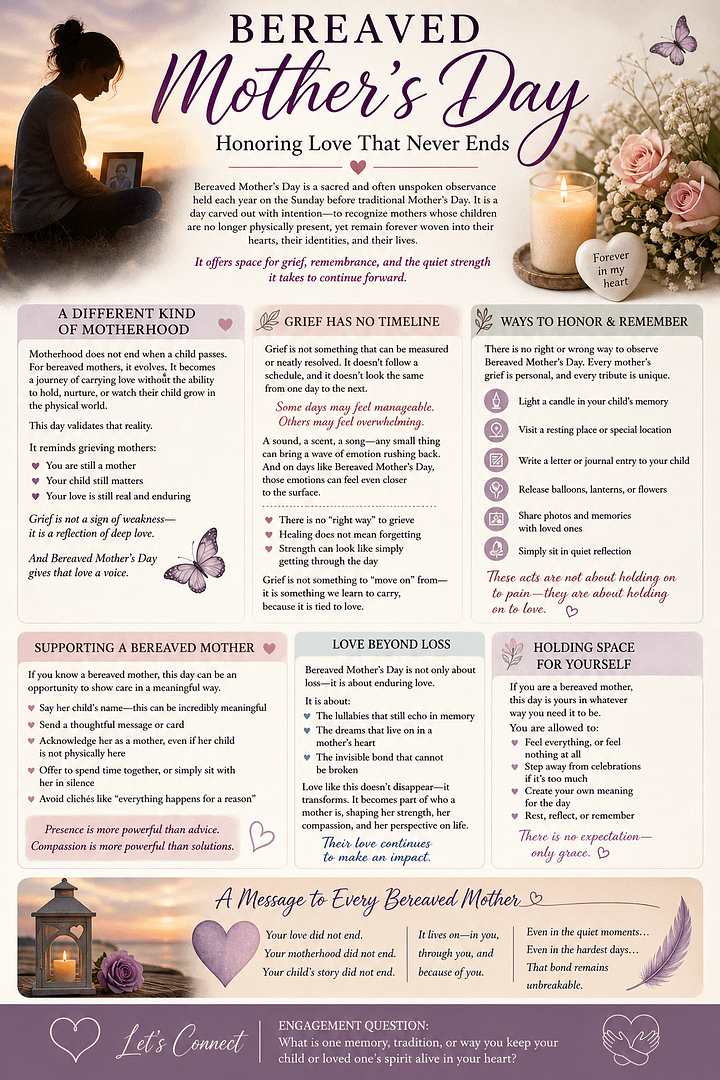
    Bereaved Mother’s Day is a sacred and often unspoken observance held each year on the Sunday before traditional Mother’s Day. It is a day carved out with intention—to recognize mothers whose children are no longer physically present, yet remain forever woven into their hearts, their identities, and their lives.

    While the world prepares for flowers, cards, and celebrations, this day gently acknowledges a different reality—one where love remains, but the arms ache with absence. It offers space for grief, remembrance, and the quiet strength it takes to continue forward.

    💔 The Depth of a Mother’s Love

    There is no loss quite like the loss of a child. It reshapes everything—how time feels, how memories are held, how the future is imagined.

    For a bereaved mother:

    Every milestone becomes a reminder
    Every holiday carries both light and heaviness
    Every “what could have been” lingers in the heart

    And yet, through all of it, one thing never changes: she is still a mother.

    Motherhood is not defined by presence alone—it is defined by love. And that love does not end. It stretches beyond what we can see, beyond what we can hold, and into something eternal.

    🕊️ Grief Has No Timeline

    Grief is not something that can be measured or neatly resolved. It doesn’t follow a schedule, and it doesn’t look the same from one day to the next.

    Some days may feel manageable. Others may feel overwhelming.

    A sound, a scent, a song—any small thing can bring a wave of emotion rushing back. And on days like Bereaved Mother’s Day, those emotions can feel even closer to the surface.

    It’s important to remember:

    There is no “right way” to grieve
    Healing does not mean forgetting
    Strength can look like simply getting through the day

    Grief is not something to “move on” from—it is something we learn to carry, because it is tied to love.

    🌷 Creating Space for Remembrance

    Bereaved Mother’s Day is not about grand gestures—it’s about meaningful ones. It’s about allowing yourself to feel, to remember, and to honor your child in a way that feels true to you.

    Some mothers find comfort in tradition, while others create new rituals each year.

    You might choose to:

    Light a candle and sit in quiet reflection
    Write your child a letter, saying the things still in your heart
    Visit a place that holds special meaning
    Cook a favorite meal or play a song that brings memories alive
    Look through photos and speak their name out loud
    Release something symbolic—like a balloon or flower—into the sky or water

    These acts are not about holding on to pain—they are about holding on to love.

    🤍 The Power of Being Seen

    One of the most painful parts of child loss can be the silence that follows. The world keeps moving, while a mother’s heart remains tethered to someone who is no longer visible to others.

    Bereaved Mother’s Day helps break that silence.

    It says:

    Your child mattered
    Your motherhood matters
    Your grief deserves acknowledgment

    Sometimes, the most healing thing is simply being seen and understood.

    🌼 Supporting a Bereaved Mother with Compassion

    If you know a bereaved mother, this day can be an opportunity to show care in a meaningful way. You don’t need perfect words—you just need a willing heart.

    Here are gentle ways to support:

    Say her child’s name—this can be incredibly meaningful
    Send a message letting her know you’re thinking of her
    Acknowledge her as a mother, even if her child is not physically here
    Offer to spend time together, or simply sit with her in silence
    Avoid clichés like “everything happens for a reason”

    Presence is more powerful than advice. Compassion is more powerful than solutions.

    🌅 Love That Transcends Time

    Bereaved Mother’s Day is not only about loss—it is about enduring love.

    It is about:

    The lullabies that still echo in memory
    The dreams that live on in a mother’s heart
    The invisible bond that cannot be broken

    Love like this doesn’t disappear—it transforms. It becomes part of who a mother is, shaping her strength, her compassion, and her perspective on life.

    Many bereaved mothers go on to honor their children in powerful ways—through acts of kindness, advocacy, creativity, or simply by living with deeper intention.

    Their love continues to make an impact.

    🌹 Holding Space for Yourself

    If you are a bereaved mother, this day is yours in whatever way you need it to be.

    You are allowed to:

    Feel everything, or feel nothing at all
    Step away from celebrations if it’s too much
    Create your own meaning for the day
    Rest, reflect, or remember

    There is no expectation—only grace.

    ✨ A Message to Every Bereaved Mother

    Your love did not end.
    Your motherhood did not end.
    Your child’s story did not end.

    It lives on—in you, through you, and because of you.

    Even in the quiet moments…
    Even in the hardest days…
    That bond remains unbreakable

    A Father’s Guide to Surviving the Loss of a Child
    Grief & Child Loss


  • Missing You, Son

    Advertisements

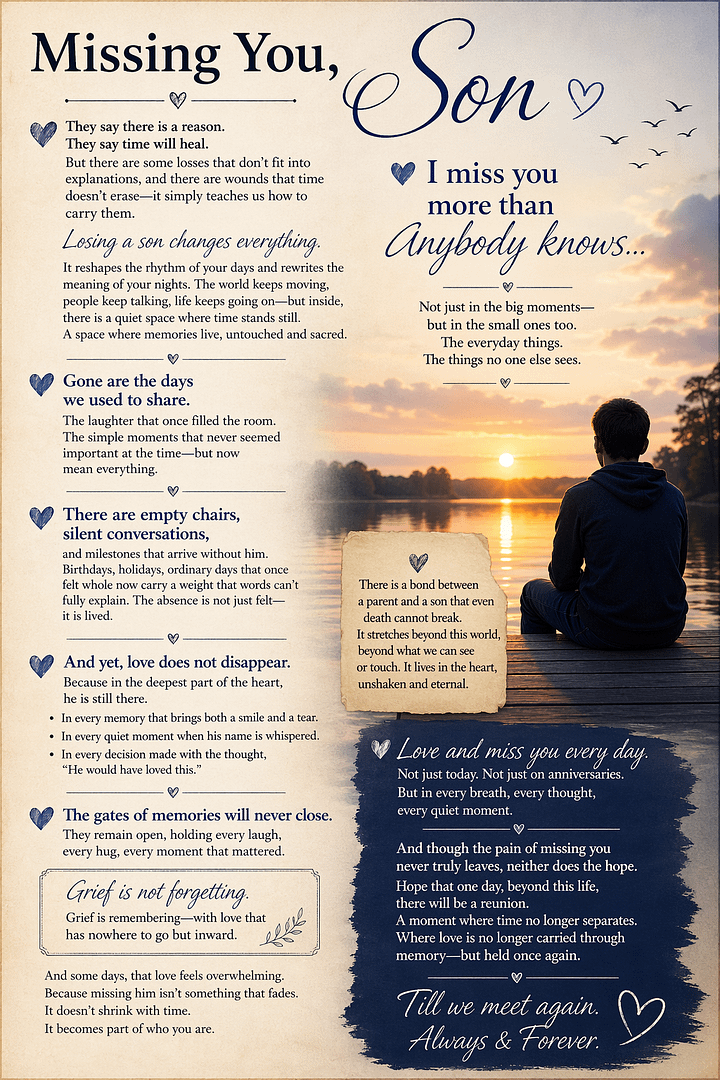
    They say there is a reason.
    They say time will heal.
    But there are some losses that don’t fit into explanations, and there are wounds that time doesn’t erase—it simply teaches us how to carry them.

    Losing a son changes everything.

    It reshapes the rhythm of your days and rewrites the meaning of your nights. The world keeps moving, people keep talking, life keeps going on—but inside, there is a quiet space where time stands still. A space where memories live, untouched and sacred.

    Gone are the days we used to share.
    The laughter that once filled the room.
    The simple moments that never seemed important at the time—but now mean everything.

    There are empty chairs, silent conversations, and milestones that arrive without him. Birthdays, holidays, ordinary days that once felt whole now carry a weight that words can’t fully explain. The absence is not just felt—it is lived.

    And yet, love does not disappear.

    Because in the deepest part of the heart, he is still there.

    In every memory that brings both a smile and a tear.
    In every quiet moment when his name is whispered.
    In every decision made with the thought, “He would have loved this.”

    The gates of memories will never close.
    They remain open, holding every laugh, every hug, every moment that mattered.

    Grief is not forgetting.
    Grief is remembering—with love that has nowhere to go but inward.

    And some days, that love feels overwhelming.
    Because missing him isn’t something that fades. It doesn’t shrink with time. It becomes part of who you are.

    I miss you more than anybody knows.

    Not just in the big moments—but in the small ones too.
    The everyday things.
    The things no one else sees.

    There is a bond between a parent and a son that even death cannot break. It stretches beyond this world, beyond what we can see or touch. It lives in the heart, unshaken and eternal.

    Love and miss you every day.
    Not just today. Not just on anniversaries.
    But in every breath, every thought, every quiet moment.

    And though the pain of missing you never truly leaves, neither does the hope.

    Hope that one day, beyond this life, there will be a reunion.
    A moment where time no longer separates.
    Where love is no longer carried through memory—but held once again.

    Till we meet again.

    Always and forever.

    A Father’s Guide to Surviving the Loss of a Child

    Grief & Child Loss


  • There’s No Way Around It: Walking Through Grief and Loss

    Advertisements

    There’s a quiet truth about grief that most people don’t want to hear—because it asks something of us we don’t feel ready to give.

    There’s no way around it.

    No shortcut. No detour. No way to outrun something that lives in your heart.

    You can dodge it for a while. You can stay busy, fill your days, keep the noise going so there’s no room for silence. You can tell yourself you’re fine, convince others you’re strong, and maybe even believe it for a moment. But grief doesn’t operate on denial. It doesn’t fade just because we refuse to look at it.

    It waits.

    Patiently. Quietly. Faithfully.

    And sooner or later, it asks you to come back and face it.

    The World That Changed Overnight

    Grief begins the moment something—or someone—you love is taken from your world.

    And in that instant, everything shifts.

    The world keeps moving. People keep talking. Life goes on like nothing happened. But for you, everything has changed. The familiar becomes unfamiliar. The normal becomes distant. Even the smallest routines can feel unbearable, because they remind you of what used to be.

    You don’t just lose a person—you lose the version of life that existed with them in it.

    You lose conversations that will never happen.
    Moments that will never be shared.
    A future that will never unfold the way you imagined.

    And there’s no preparing for that.

    No manual on how to carry something so heavy and invisible at the same time.

    The Illusion of Avoidance

    In the early days—or even months or years—many people try to avoid grief.

    It’s not weakness. It’s survival.

    You do what you have to do to get through the day. You put one foot in front of the other. You show up where you’re needed. You learn how to function, even when everything inside you feels broken.

    Some people bury themselves in work.
    Some isolate themselves from the world.
    Some try to stay strong for everyone else.
    Some numb the pain in ways that only delay it.

    And for a while, it might seem like it’s working.

    But grief is not something you can outwork, outthink, or outlast.

    Because grief is tied to love.

    And love doesn’t disappear just because we’re not ready to feel it.

    Going Into It

    There comes a moment—different for everyone—when the distractions stop working.

    It might be triggered by something small. A song. A smell. A memory. A random Tuesday that feels heavier than it should. Or it might come crashing in all at once, without warning, without mercy.

    That’s when you realize:

    You can’t go around this.

    You have to go through it.

    Going through grief doesn’t mean you understand it. It doesn’t mean you accept it. It doesn’t even mean you’re ready.

    It simply means you allow yourself to feel it.

    The sadness.
    The anger.
    The confusion.
    The guilt.
    The longing.

    All of it.

    It means sitting in the quiet when the world gets too loud. It means letting tears fall without trying to stop them. It means acknowledging the depth of your loss instead of minimizing it.

    And that’s not easy.

    Because going into grief feels like stepping into something endless.

    Like you might never find your way back out.

    The Weight of Love

    One of the hardest realizations in grief is this:

    The pain you feel is a reflection of how deeply you loved.

    Grief is not a sign of weakness.

    It’s proof of connection.

    It’s what remains when love has nowhere to go.

    And that’s why it hurts so much.

    Because the love is still there.

    Still present.
    Still alive.
    Still searching for a place to land.

    You don’t stop loving someone just because they’re gone.

    And so, you carry it.

    In your memories.
    In your thoughts.
    In the quiet moments no one else sees.

    Learning to Carry It

    As time passes, something begins to shift—not in a way that erases the pain, but in a way that changes your relationship with it.

    You start to learn how to carry your grief.

    Not perfectly. Not consistently. But gradually.

    At first, it feels like it’s carrying you.

    Every step is heavy. Every day feels like a mountain. The weight of it presses down on everything—your thoughts, your energy, your ability to move forward.

    But slowly, you find small ways to hold it.

    You learn what helps, even just a little.
    You learn when to rest.
    You learn when to let yourself feel and when to step back.

    And over time, the grief that once consumed every part of you begins to settle into something you carry alongside you.

    It’s still there.

    But it doesn’t define every moment.

    The Days That Still Break You

    Even as you begin to move forward, grief doesn’t follow a straight line.

    There will be days that feel okay.

    And then there will be days that feel like the beginning all over again.

    Anniversaries.
    Birthdays.
    Holidays.

    Or sometimes nothing at all—just a random moment that hits you out of nowhere.

    A memory surfaces.
    A feeling returns.
    A wave of emotion you didn’t expect crashes in.

    And suddenly, you’re right back in it.

    That doesn’t mean you’re not healing.

    It means you’re human.

    Grief doesn’t disappear—it evolves.

    The Other Side of Grief

    When people talk about “coming out the other side,” it can sound misleading.

    Because there’s no finish line.

    No moment where grief is completely gone.

    But there is a shift.

    A quiet transformation.

    One day, you notice that the pain doesn’t feel as sharp.
    That your breathing feels a little easier.
    That you can remember without completely falling apart.

    You begin to experience moments of peace.

    Moments of gratitude.
    Moments of connection.
    Moments where you feel something other than loss.

    And those moments matter.

    Because they remind you that life still exists—even after everything you’ve been through.

    A Different World

    When you come through grief, you don’t return to the same world you left.

    That world is gone.

    And so is the version of you that lived in it.

    But what emerges is someone who has walked through something deep and life-changing.

    Someone who understands the fragility of life.
    The value of time.
    The importance of presence.

    You may find yourself softer.

    More compassionate.
    More aware of others who are hurting.

    And at the same time, stronger.

    More grounded.
    More resilient.
    More capable than you ever thought possible.

    Still Capable of Love

    One of the greatest fears in grief is the idea that you’ll never feel whole again.

    That the loss has taken something from you that can never be replaced.

    And in some ways, that’s true.

    There are parts of your life that will never be the same.

    But grief doesn’t take away your ability to love.

    If anything, it deepens it.

    It reminds you how precious it is.

    How important it is to show up, to speak, to hold on to the moments you have.

    You don’t stop loving.

    You learn to love differently.

    With more intention.
    More awareness.
    More heart.

    Step by Step

    If you’re in the middle of grief right now, standing at the edge of something you don’t want to face, hear this:

    You don’t have to do it all at once.

    You don’t have to be strong every day.

    You don’t have to have the answers.

    All you have to do is take the next step.

    And then the next.

    Some days that step might be getting out of bed.
    Some days it might be letting yourself cry.
    Some days it might be finding a moment of peace in the middle of the chaos.

    Every step counts.

    Every breath matters.

    The Quiet Strength of Survival

    There’s a kind of strength that only comes from walking through grief.

    It’s not loud.
    It’s not obvious.
    It doesn’t look like what people usually think strength looks like.

    It’s quiet.

    It’s the strength to keep going when everything in you wants to stop.
    The strength to feel when it would be easier to shut down.
    The strength to carry love and loss at the same time.

    And if you’re here—if you’re still moving, still breathing, still trying—then you already have it.

    Because the truth is this:

    There’s no way around grief and loss.

    But there is a way through.

    And while the world you find on the other side will never be the same as the one you left…

    You will still be here.

    Stronger than you know.

    Still standing.

    Still loving.

    Still becoming someone who carries both the weight of loss and the beauty of what remains.

    A Father’s Guide to Surviving the Loss of a Child

    Grief & Child Loss


  • It’s Been a Week Since Deleting My Son’s Number and Last Text Message

    Advertisements

    It’s been seven days.

    Seven days since I did something I never thought I would have the strength—or the heartbreak—to do. I deleted my son’s phone number. I erased the last text message he ever sent me.

    And somehow, the world kept turning.

    But inside… something shifted.

    For a long time, I held onto that number like it was still a lifeline. Like somehow, if I just didn’t let go, there would still be a connection. His name sitting there in my contacts felt like proof that he existed—not just in memory, but in something tangible. Something I could see, scroll to, and almost… reach.

    And that last text message.

    I read it more times than I could count.

    Sometimes I’d open it just to feel close to him again. Other times, I’d stare at it, wishing I had answered differently… said more… said better. You don’t realize how much weight a few simple words can carry until they’re all you have left.

    Deleting it wasn’t just pressing a button.

    It felt like standing at the edge of something permanent.

    My finger hovered longer than I’d like to admit. Because deep down, I knew this wasn’t really about clearing space on a phone. This was about facing a truth I’ve been trying to live with every single day…

    He’s not coming back.

    People might not understand that.

    They might think, “It’s just a number. Just a message.”

    But it wasn’t.

    It was the last place where our conversations still existed in real time. The last thread where it felt like he could text me again… even though I knew he wouldn’t.

    Letting that go felt like closing a door I never wanted to shut.

    This past week has been quiet in a different way.

    There’s no more scrolling back. No more rereading those words. No more holding onto that digital piece of him like it could somehow bring comfort.

    And I’ll be honest…

    It hurt.

    It still hurts.

    Because grief doesn’t get smaller when you let go of things. It just changes shape.

    But something else happened too.

    In the silence, I started realizing something I hadn’t fully allowed myself to see before…

    He was never in that phone.

    Not really.

    He’s in the memories that play without warning.
    He’s in the lessons he left behind.
    He’s in the way I try to live now… trying to honor him in the smallest, everyday moments.

    Deleting his number didn’t erase him.

    It just forced me to find him somewhere deeper.

    There’s a different kind of connection now.

    Not one I can hold in my hand.

    But one I carry in my heart… every second of every day.

    And maybe that’s the hardest part of grief—learning to let go of what you can touch, while holding on to what you can’t.

    It’s been a week.

    Some moments feel heavier than others. Some days, I still reach for my phone without thinking. Muscle memory doesn’t disappear overnight.

    But I’m still here.

    Still breathing.
    Still remembering.
    Still loving him in a way that doesn’t need a contact name or a message thread.

    If you’re walking this road too—holding onto the last pieces, the last words, the last connection—you’re not alone.

    There’s no right time to let go.

    And there’s no right way to grieve.

    All we can do is take it one step at a time… carrying them with us, not in our phones—but in the way we live, the way we love, and the way we refuse to forget.

    Because love like that doesn’t disappear.
    It just finds a new place to live.

    A Father’s Guide to Surviving the Loss of a Child

    Grief & Child Loss


  • Being in the Bereavement Parent Club: A Membership No One Chooses

    Advertisements

    There are no invitations.
    No sign-up sheets.
    No orientation.

    Yet somehow, without warning or consent, some parents find themselves part of a club they never knew existed—the bereavement parent club. And it is a club that no one, not a single soul, ever wants to belong to.

    The Unspoken Bond

    Those who are part of this club recognize each other without words. There’s a quiet understanding, a shared language of loss that doesn’t need explanation. It lives in the eyes, in the pauses between sentences, in the way a name is spoken—or sometimes avoided.

    This bond is not one formed out of joy or shared interests. It is forged in heartbreak. It is built on memories that should still be in the making, on dreams that were never given the chance to unfold.

    And yet, within this unchosen community, there is a deep and powerful connection. Because only another bereaved parent truly understands the weight of:

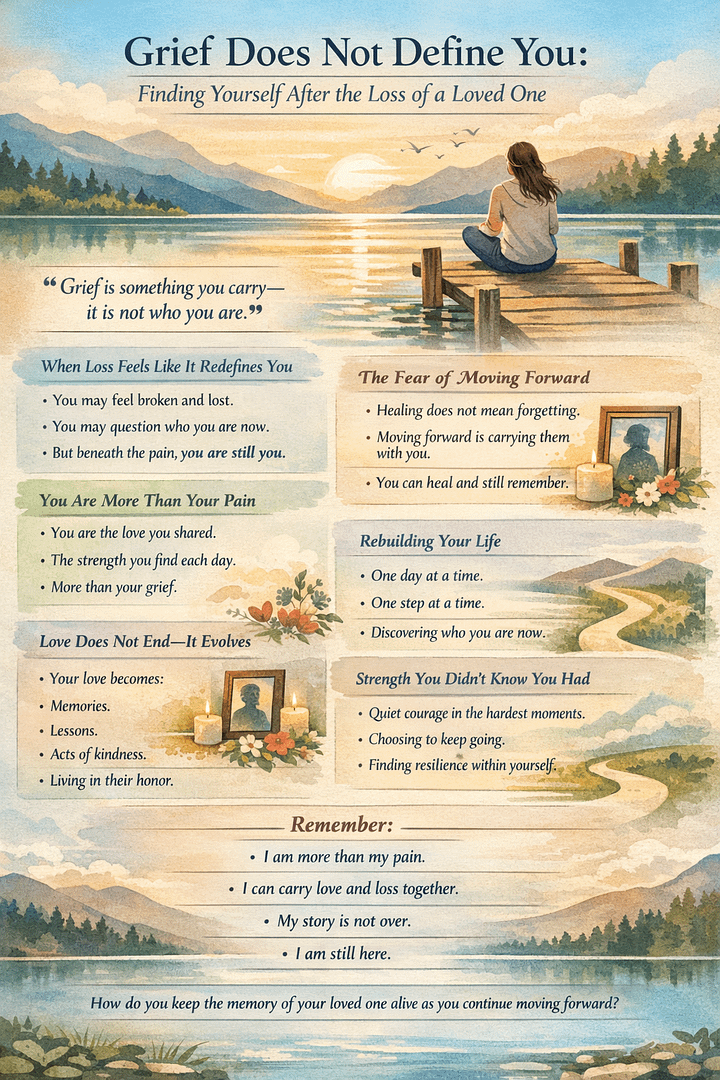
    An empty seat at the table
    A birthday that comes and goes in silence
    A future that looks nothing like it once did
    A Pain That Changes Everything

    Losing a child is not something you “get over.” It is something that becomes a part of you—woven into your identity, reshaping your world forever.

    Grief, in this form, is not linear. It doesn’t follow rules or timelines. One moment you may find yourself functioning, even smiling… and the next, you are pulled under by a wave of sorrow so strong it takes your breath away.

    It changes how you see everything:

    Time feels different
    Priorities shift
    The small things matter more, yet the big things sometimes feel meaningless

    You learn quickly that life continues around you—but it never continues the same within you.

    The Loneliness Within the Crowd

    One of the hardest parts of this journey is the isolation. Even when surrounded by people who care, there can be a deep sense of being alone.

    Friends and family may not know what to say. Some may try to offer comfort but unintentionally say the wrong things. Others may drift away, unsure of how to handle such profound grief.

    And so, many bereaved parents carry their pain quietly.

    They learn to:

    Smile when expected
    Change the subject when it gets too heavy
    Hold back tears in public spaces

    But inside, the grief remains—constant, present, and deeply personal.

    Love Never Dies

    What makes this kind of grief so powerful is love. The love for a child does not end when their life does. It continues—fierce, unbreakable, and eternal.

    That love shows up in different ways:

    Speaking their child’s name
    Honoring anniversaries and birthdays
    Keeping traditions alive
    Finding small ways to carry their memory forward

    Grief is not just sorrow—it is love with nowhere to go. And so, it finds its way into everything.

    Finding Strength You Never Asked For

    There is a quiet strength in bereaved parents. Not the kind that boasts or shines loudly—but the kind that endures.

    They wake up each day and keep going, even when it feels impossible.
    They carry both love and loss in the same heart.
    They learn to live in a world that no longer feels whole.

    And in time—though the pain never disappears—they find ways to breathe again. To live again. Not in the same way as before, but in a way that honors both their child and their journey.

    A Club Built on Compassion

    If there is anything this unwanted club offers, it is compassion.

    Bereaved parents often become:

    More understanding of others’ pain
    More present in moments that matter
    More aware of how fragile and precious life truly is

    They become a source of comfort for others walking similar paths—offering a kind of support that can only come from someone who truly knows.

    Closing Thoughts

    No one chooses this path. No one signs up for this kind of heartbreak.

    But for those who find themselves here, know this:

    You are not alone.
    Your child matters.
    Your grief is valid.
    And your love—your endless, unwavering love—will always be a part of your story.

    Even in the deepest pain, that love remains.

    A Father’s Guide to Surviving the Loss of a Child

    Grief & Child Loss


  • Letting Go, Even When It’s the Most Painful Thing to Do

    Advertisements

    Letting go is one of the most difficult acts of courage a human being can face. It asks us to release something we once held close—something that shaped us, comforted us, or gave meaning to our lives. It challenges the very nature of our hearts, which are wired to love, to attach, and to remember.

    We don’t struggle to let go because we are weak.
    We struggle because what we are releasing mattered deeply.

    Whether it’s the loss of a loved one, the end of a relationship, a broken dream, or even the slow realization that life has taken a different path than we imagined—letting go can feel like standing at the edge of something we are not ready to leave behind.

    And yet, sometimes, it is the only way forward.

    The Illusion of Control

    At the heart of our pain is often the illusion that we can control outcomes if we just try hard enough. We replay conversations, revisit decisions, and imagine different endings. We ask ourselves questions that have no answers:

    What if I had done things differently?
    What if I had said more, loved more, stayed longer?

    But life does not always bend to our will. Some things are simply beyond our control—timing, circumstances, the choices of others, and even fate itself.

    Letting go begins when we accept this truth:
    Not everything can be fixed, saved, or rewritten.

    And while that realization can be devastating, it is also freeing. Because once we release the need to control everything, we open ourselves to something else—acceptance.

    The Pain of Releasing What We Love

    There is a unique kind of heartbreak that comes with letting go. It is not always loud or visible. Often, it is quiet and deeply personal.

    It’s in the moments when you instinctively reach for someone who is no longer there.
    It’s in the memories that surface without warning.
    It’s in the spaces they once filled—now echoing with absence.

    Letting go doesn’t mean the love disappears. In many ways, the love remains—just without a place to go.

    That’s what makes it so painful.

    We are not just letting go of a person or a situation—we are letting go of a version of life that once felt possible. We are grieving not only what was, but what could have been.

    When Holding On Hurts More Than Letting Go

    There comes a turning point—often subtle—when holding on becomes more painful than releasing.

    It may show up as emotional exhaustion.
    A constant ache that never seems to ease.
    A feeling of being stuck in a moment that has already passed.

    We begin to realize that holding on is no longer preserving something beautiful—it is prolonging something painful.

    Letting go, then, is not giving up.
    It is choosing not to suffer endlessly for something that no longer exists in the same way.

    It is saying: I will not allow this pain to define the rest of my life.

    Letting Go Is Not Forgetting

    One of the greatest fears people have is that letting go means forgetting. That if we release something, it will somehow lose its significance.

    But letting go is not about erasing memories.

    It is about changing our relationship with them.

    Instead of reliving the pain over and over, we begin to carry those memories with a different kind of understanding. They become part of our story—not the place where we remain stuck.

    You can still love.
    You can still remember.
    You can still honor what was.

    And at the same time, you can choose to move forward.

    The Courage to Release

    Letting go requires a quiet kind of bravery—the kind that doesn’t always look heroic from the outside but feels monumental on the inside.

    It’s the courage to wake up each day and resist the urge to go backward.
    It’s the strength to sit with your emotions instead of running from them.
    It’s the willingness to accept that healing will take time.

    And most importantly, it’s the decision to believe that your life still holds meaning—even after loss.

    There is no timeline for letting go. No checklist to follow. It is deeply personal and often unpredictable.

    Some days you will feel like you’ve made progress.
    Other days, it will feel like you’re right back where you started.

    Both are part of the journey.

    The Space Where Healing Begins

    When we finally loosen our grip on what we’ve been holding onto, something unexpected happens—we create space.

    At first, that space can feel empty, even unbearable. It can feel like something is missing, because something is missing.

    But slowly, that space becomes something else.

    It becomes room for healing.
    Room for new perspectives.
    Room for rediscovering parts of yourself that were overshadowed by pain.

    Letting go doesn’t mean replacing what was lost. Some things are irreplaceable.

    But it does mean allowing yourself to experience life again in new and meaningful ways.

    Learning to Live With, Not Without

    One of the most important shifts in letting go is realizing that you are not learning to live without what you lost—you are learning to live with it, in a different way.

    The love, the memories, the impact—it all remains.

    But instead of carrying it as a heavy burden, you begin to carry it as something that shaped you, strengthened you, and changed you.

    You don’t leave it behind.
    You learn how to carry it forward differently.

    A Gentle Reminder

    If you are in the process of letting go, be gentle with yourself.

    There is no right or wrong way to feel.
    There is no “perfect” timeline for healing.
    There is no expectation that you should be over it by now.

    You are allowed to miss what you lost.
    You are allowed to feel the weight of it.
    You are allowed to take your time.

    But you are also allowed to heal.

    The Quiet Transformation

    Letting go changes you.

    It reshapes your understanding of love, loss, and resilience. It teaches you that even in the deepest pain, there is still a path forward.

    One day, without even realizing it, you will notice something different.

    The memories will still be there—but they won’t hurt the same way.
    The longing will soften.
    The heaviness will begin to lift.

    And in its place, there will be something else:

    Strength.
    Clarity.
    A deeper appreciation for life and the moments that matter.

    In the End

    Letting go is not the end of your story.

    It is a chapter filled with pain, yes—but also growth, transformation, and eventually, peace.

    It is the moment where you choose to release what you cannot change, so you can embrace what still lies ahead.

    And even though it may be the most painful thing you will ever have to do…

    It may also be the most freeing.

    A Father’s Guide to Surviving the Loss of a Child
  • Grief Does Not Define You: Finding Yourself After the Loss of a Loved One

    Advertisements

    Grief is one of the most powerful forces a human heart can endure. It does not ask for permission. It does not follow rules. It does not arrive gently and leave quietly. Instead, it crashes into your life, reshaping everything you thought you knew—about love, about life, and even about yourself.

    When someone you love dies, it can feel as though the person you once were disappeared with them. The world continues to move, but you are left standing still, trying to understand how everything changed so quickly.

    In those moments, it is easy to believe that grief has become your identity.

    But even in the deepest sorrow, there is a truth that remains:

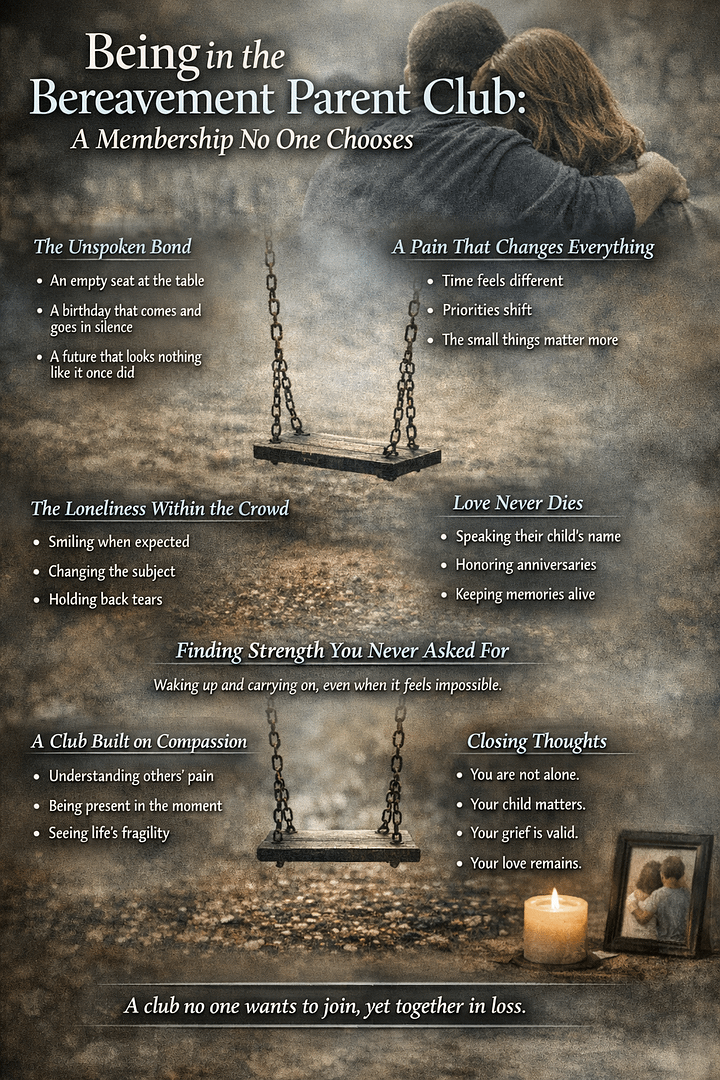
    Grief is something you carry—it is not who you are.

    When Loss Feels Like It Redefines You

    After losing a loved one, your sense of self can feel shattered. The roles you once held—parent, partner, child, friend—may feel incomplete or painfully altered. You may look in the mirror and not recognize the person staring back at you.

    Grief has a way of whispering lies:

    You are broken beyond repair.
    You will never feel whole again.
    This pain is all you are now.

    And on the hardest days, those lies can feel like truth.

    You may withdraw from others.
    You may feel disconnected from the world around you.
    You may struggle to find joy in things that once made you feel alive.

    All of this is part of grief—but none of it defines your identity.

    Because beneath the pain, you are still there.

    The Invisible Weight You Carry

    Grief is often misunderstood by the outside world. People may expect you to “move on” or “be strong,” not realizing that grief is not something you leave behind—it is something you learn to live with.

    It is the quiet ache that shows up in ordinary moments:

    An empty chair at the table
    A song that suddenly brings tears
    A birthday, a holiday, or an anniversary that feels incomplete

    It is the conversations you wish you could still have.
    The laughter you wish you could hear again.
    The presence you feel is missing in every room.

    This weight is real. It is heavy. And it is valid.

    But even as you carry it, it does not define the entirety of who you are.

    You Are Still You—Even Now

    Grief may change you, but it does not erase you.

    You are still:

    The person who loved deeply
    The one who showed up, cared, and gave your heart fully
    The individual with dreams, values, and purpose
    The soul capable of connection, growth, and meaning

    Grief adds layers to your life—it does not replace it.

    You are not just “someone who lost someone.”
    You are a person who has lived, loved, and continues to exist beyond that loss.

    Love Does Not End—It Evolves

    At the center of grief is love.

    What you feel is not just pain—it is love that no longer has a physical place to go. That love doesn’t disappear when someone dies. It transforms.

    It becomes:

    Memories you carry with you
    Stories you tell to keep them alive
    Lessons they taught you that shape your life
    The quiet moments where you still feel connected to them

    Love evolves into something deeper—something unseen, but still very real.

    And that love becomes part of who you are in a way that no loss can take away.

    The Fear of Moving Forward

    One of the most painful struggles in grief is the fear that healing means forgetting.

    You may find yourself thinking:

    If I laugh again, am I dishonoring them?
    If I move forward, am I leaving them behind?
    If I begin to heal, does that mean they mattered less?

    These fears are common—and they are rooted in love.

    But healing does not erase love.
    Moving forward does not mean moving on without them.

    It means learning to carry them with you in a new way.

    You don’t leave them behind—you bring them with you, in your heart, in your choices, in the way you live your life.

    Rebuilding a Life That Feels Different

    Life after loss is not about returning to who you were before—it’s about discovering who you are now.

    And that can feel overwhelming.

    You may feel like you are starting over in a world that no longer feels familiar. The things that once mattered may no longer hold the same importance. Your priorities may shift. Your perspective may deepen.

    This is not a sign that you are losing yourself.

    It is a sign that you are growing through something incredibly difficult.

    Rebuilding doesn’t happen all at once. It happens slowly:

    One breath at a time
    One day at a time
    One small step forward, even when it feels impossible

    And in that process, you begin to see that your life still holds meaning—even if it looks different than it once did.

    Strength You Didn’t Know You Had

    Grief reveals a kind of strength that is often quiet and unseen.

    It is not the loud, triumphant strength people talk about.
    It is the quiet courage of continuing to live when your heart is broken.

    It is:

    Getting out of bed on days when you don’t want to
    Facing memories that bring both comfort and pain
    Choosing to keep going, even when you feel like giving up

    This strength is not something you chose—but it is something you possess.

    And it is part of who you are.

    You Are Allowed to Feel Everything

    There is no “right way” to grieve.

    Some days you may feel numb.
    Some days you may feel overwhelmed.
    Some days you may even feel moments of peace or joy—and then feel guilty for it.

    All of these emotions are valid.

    Grief is not linear. It does not follow a predictable path. It moves in waves—sometimes gentle, sometimes overwhelming.

    Allow yourself to feel without judgment.

    You are not weak for grieving.
    You are human.

    Finding Meaning Again

    One of the hardest questions after loss is: What now?

    How do you continue living when someone so important is no longer here?

    The answer is not simple. And it does not come all at once.

    But over time, many people find ways to create meaning again:

    Honoring their loved one through acts of kindness
    Supporting others who are grieving
    Living in a way that reflects the love they shared
    Finding purpose in the pain, without letting it consume them

    Meaning does not erase grief—but it can coexist with it.

    Grief Walks Beside You—It Does Not Lead You

    Grief does not disappear. It becomes part of your story.

    But it does not get to be the whole story.

    You are still the author of your life.

    You still have choices.
    You still have a voice.
    You still have the ability to create moments of connection, purpose, and even joy.

    Grief may walk beside you—but it does not define the direction you take.

    A Gentle Reminder

    On the days when grief feels overwhelming, remind yourself:

    I am more than my pain
    I am allowed to heal
    I can carry love and loss at the same time
    My story is not over

    You are still here.

    And that matters more than you may realize.

    Final Reflection

    Grief does not define you—it reveals the depth of your love, the strength of your spirit, and the resilience of your heart.

    You are not just someone who has lost.

    You are someone who has loved deeply…
    who continues to endure…
    and who is still finding a way forward, one step at a time.

    And that is something powerful.

    A Father’s Guide to Surviving the Loss of a Child

  • Carrying the Cross of Child Loss: A Good Friday Reflection

    Advertisements

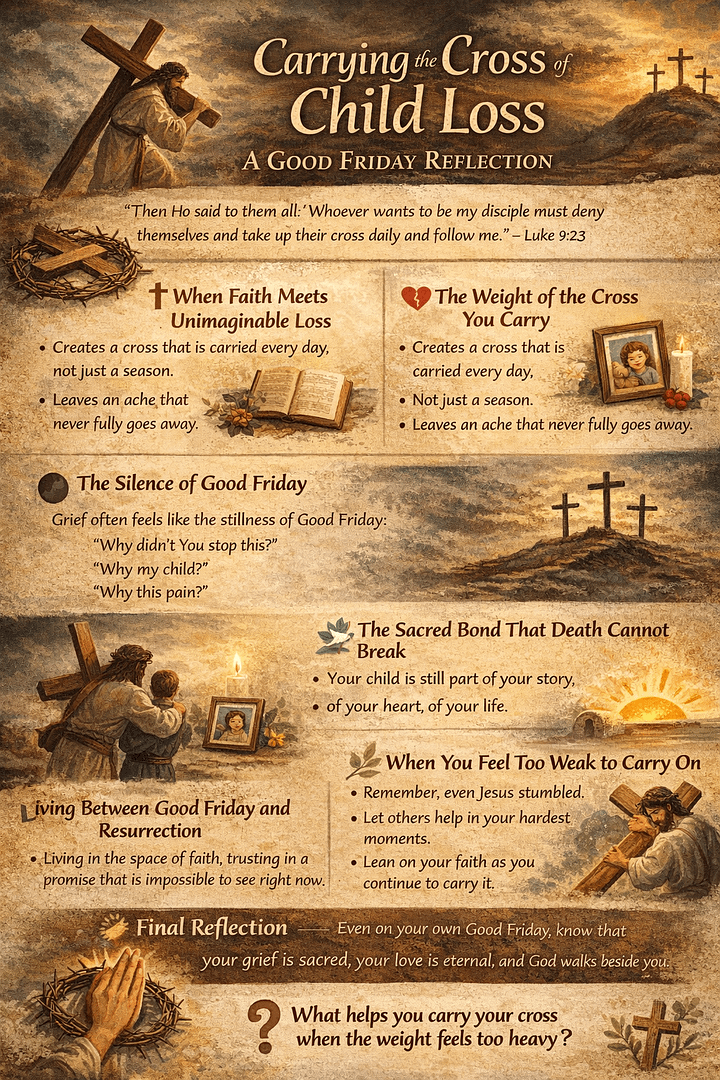
    “Then He said to them all: ‘Whoever wants to be my disciple must deny themselves and take up their cross daily and follow me.’” – Luke 9:23

    Good Friday is one of the most sacred and solemn days in the Christian faith. It is a day marked by suffering, sacrifice, and a love so profound that it chose the cross. It is a day where the world pauses to remember the pain Jesus endured—the weight of the cross, the betrayal, the suffering, and the ultimate surrender of His life.

    But for those who have lost a child, Good Friday is not just something remembered.

    It is something lived.

    ✝️ When Faith Meets Unimaginable Loss

    Faith often speaks of trust, hope, and surrender. But when a parent loses a child, those words can feel distant—almost unreachable.

    Because child loss shakes the very foundation of everything you once believed:

    The belief that life follows a natural order
    The belief that your child would outlive you
    The belief that you could protect them

    In a single moment, everything changes.

    And suddenly, faith is no longer about certainty—it becomes about survival.

    It becomes about whispering prayers through tears.
    About holding on to God, even when you don’t understand Him.
    About choosing to believe—even when your heart is broken.

    💔 The Weight of the Cross You Carry

    The cross of child loss is not something you carry for a season. It is not temporary. It does not fade with time.

    It becomes part of who you are.

    It shows up in:

    Birthdays that feel incomplete
    Holidays that carry an empty space
    Photos that hold both joy and sorrow
    Everyday moments when you instinctively think of them

    It is the quiet ache that never fully leaves.
    The longing that cannot be fulfilled.
    The love that has nowhere to go—and yet never stops flowing.

    And like Jesus on the road to Calvary, there are moments when the weight feels too much to bear.

    Moments when you feel like you might fall under it.

    But somehow… you keep going.

    🌑 The Silence of Good Friday

    One of the most profound aspects of Good Friday is its silence.

    After the suffering… after the final breath… there is a stillness.

    No celebration.
    No answers.
    No immediate relief.

    Just silence.

    Grief often feels the same way.

    After the calls stop.
    After the meals stop coming.
    After the world returns to normal…

    You are left in a quiet space where your pain still echoes.

    It is in this silence that many grieving parents wrestle with God.

    “Why didn’t You stop this?”
    “Why my child?”
    “Why this pain?”

    These questions are not a lack of faith—they are a reflection of deep love and deep loss.

    Even Jesus cried out in His suffering.
    Even He felt the weight of abandonment.

    And still—He was not alone.

    🕊️ The Sacred Bond That Death Cannot Break

    Death changes many things—but it does not break love.

    The love you have for your child is not confined to time. It does not end with their last breath. It continues—deep, unyielding, and eternal.

    It lives in:

    The way you say their name
    The memories you revisit
    The values they carried
    The impact they had on others
    The person you have become because of them

    Your child is still part of your story.
    Still part of your heart.
    Still part of your life.

    And in a way that is hard to explain, love becomes both the source of your pain—and the reason you keep going.

    🌅 Living Between Good Friday and Resurrection

    Good Friday is not the end of the story.

    But on that day… it feels like it is.

    There is no visible hope. No sign of what is to come. Only grief, loss, and waiting.

    For many parents, life after child loss feels like living in that space—between Good Friday and resurrection.

    A place where:

    You believe in something more, but struggle to feel it
    You hope for healing, but still carry deep wounds
    You trust in God, but still ask difficult questions

    This in-between space is sacred, even when it feels unbearable.

    Because it is here—in the waiting, in the pain, in the not knowing—that faith becomes real.

    Not perfect.
    Not polished.
    But real.

    🌿 When You Feel Too Weak to Carry On

    There will be days when the weight of your cross feels unbearable.

    Days when getting out of bed feels like a mountain.
    Days when the memories hit harder than usual.
    Days when the silence feels louder than anything else.

    On those days, remember this:

    Jesus stumbled under the weight of His cross too.

    He fell.
    He struggled.
    He needed help.

    And help came.

    Simon of Cyrene was called to carry the cross alongside Him—a powerful reminder that we are not meant to carry our burdens alone.

    If you are grieving:

    Let someone sit with you
    Let someone listen
    Let someone help carry the weight, even if just for a moment

    There is no strength in isolation.
    There is strength in allowing yourself to be supported.

    💫 Finding Meaning Without Answers

    One of the hardest parts of child loss is the absence of answers.

    There is no explanation that makes it okay.
    No reasoning that makes it fair.

    And yet, many grieving parents find themselves searching for meaning—not to justify the loss, but to survive it.

    Meaning can be found in:

    Helping others who are grieving
    Sharing your child’s story
    Living in a way that honors their life
    Choosing kindness, even in pain
    Holding on to love when everything else feels uncertain

    You may never understand why this happened.

    But you can choose how you carry it.

    🌈 The Quiet Courage of Continuing

    There is a kind of courage that the world rarely sees.

    It is not loud.
    It is not celebrated.

    It is the courage of:

    Waking up when you don’t want to
    Smiling when your heart is breaking
    Showing up for others while carrying your own pain
    Continuing to live, even when a part of you feels missing

    This is the courage of the cross.

    And if you are carrying the loss of a child, you are living that courage every single day.

    💬 Final Reflection

    Good Friday teaches us that love is not proven in comfort—it is proven in sacrifice.

    It shows us that even in the darkest moments, there is a story still unfolding.

    If you are carrying the cross of child loss, know this:

    Your grief is sacred.
    Your love is eternal.
    Your strength is seen.

    And just as the cross was not the end of Christ’s story, your pain is not the end of yours.

    Even here… in the sorrow… in the silence… in the weight of it all…

    There is still love.
    There is still purpose.
    And somehow, even now—there is still a path forward.

    🙏 Closing Prayer

    Heavenly Father,
    On this Good Friday, we bring before You hearts that are heavy with grief.
    For every parent carrying the loss of a child, we ask for Your presence to be felt in a real and comforting way.

    When the weight feels too much, be their strength.
    When the silence feels overwhelming, be their peace.
    When hope feels distant, be their light.

    Remind them that they are not alone in their suffering.
    That You walk beside them in every step, every tear, every moment.

    Hold their child in Your eternal care, and hold them in Your everlasting love.

    Amen.

    A Father’s Guide to Surviving the Loss of a Child
  • How to Help a Child When a Parent Passes Away

    Advertisements

    Losing a parent is one of the most devastating experiences a child can endure. It is not just the loss of a person—it is the loss of safety, routine, identity, and the quiet certainty that someone will always be there. For a child, the world can suddenly feel unpredictable and fragile.

    As the adult supporting them, you may feel an enormous weight: wanting to say the right thing, do the right thing, and somehow protect them from pain that cannot be taken away. The truth is, you cannot fix their grief—but you can walk beside them through it. And that presence can shape how they heal for the rest of their life.

    Understanding How Children Experience Grief

    Children grieve differently than adults. Their understanding of death evolves with age, and their emotions can come in waves—often unpredictable and confusing.

    Young children (ages 3–6) may not fully understand permanence. They might ask when their parent is coming back or repeat the same questions over and over.
    School-aged children (ages 7–12) begin to understand death is final but may struggle with fear, guilt, or “what if” thinking.
    Teenagers often feel the depth of the loss intensely but may hide it behind anger, silence, or independence.

    One of the most important things to remember is this:
    Children “visit” their grief.
    They may cry deeply one moment and laugh or play the next. This is not denial—it’s their mind protecting them from emotional overload.

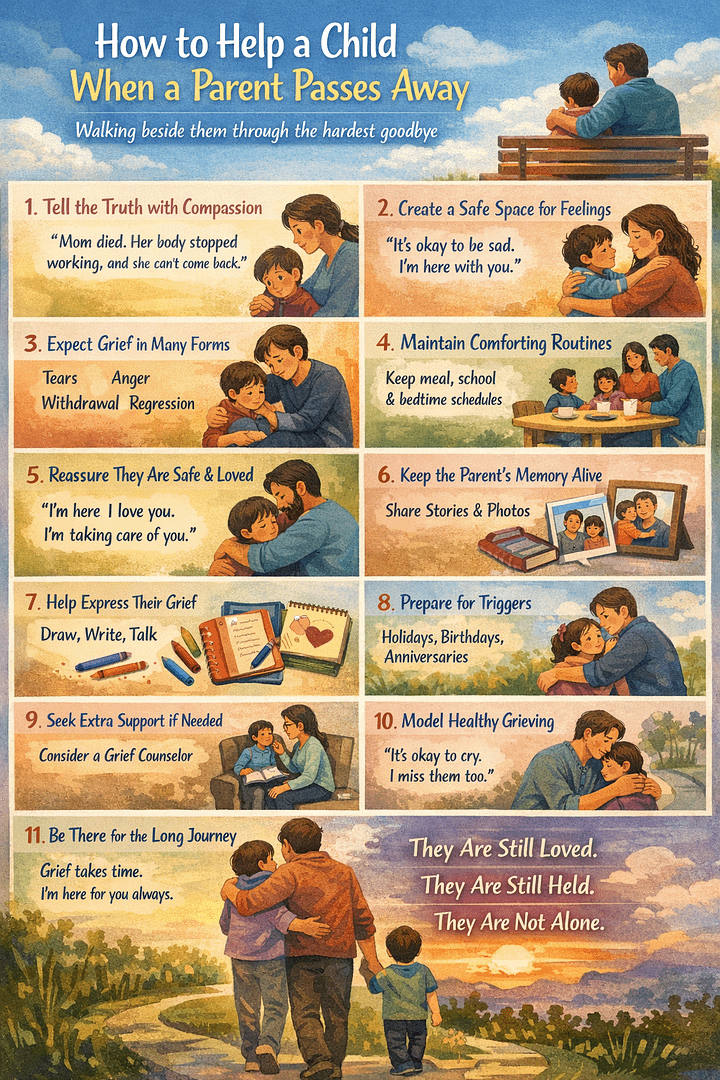
    1. Tell the Truth—With Compassion and Clarity

    Honesty is essential, even when the truth is painful. Avoid vague phrases like “we lost Mom” or “Dad went to sleep,” as these can confuse or frighten children.

    Instead, use clear, simple language:
    “Dad died. His body stopped working, and he can’t come back.”

    Be prepared for repeated questions. Children process grief in layers, and asking the same question is often their way of trying to understand something that feels impossible.

    Answer patiently—even if it hurts every time.

    2. Create a Safe Space for Every Emotion

    A child who has lost a parent may feel:

    Deep sadness
    Anger or frustration
    Fear of losing someone else
    Guilt (“Did I cause this?”)
    Confusion or numbness

    Sometimes, they may not feel anything at all—and that’s okay too.

    Let them know:
    “Whatever you’re feeling is okay. You don’t have to hide it from me.”

    Avoid trying to “fix” their emotions. Instead, sit with them in it. Your calm presence tells them they are not alone in their pain.

    3. Expect Grief to Show Up in Unexpected Ways

    Children often express grief through behavior rather than words. You might notice:

    Increased clinginess
    Regression (bedwetting, needing help with tasks they once did alone)
    Trouble concentrating
    Acting out or becoming withdrawn

    These are not signs of “bad behavior”—they are signals of a hurting heart.

    Respond with patience, not punishment.
    Behind every difficult behavior is a child trying to cope with something they don’t yet understand.

    4. Keep Routines as Anchors in a Shaken World

    When everything feels uncertain, routine becomes stability.

    Try to maintain:

    Regular meal times
    School attendance
    Bedtime routines

    These everyday structures send a powerful message:
    Life is still moving, and you are still safe within it.

    At the same time, allow flexibility. Some days will be harder than others.

    5. Reassure Them—Again and Again

    After losing a parent, many children develop a deep fear of losing the people they have left.

    They may ask:

    “Are you going to die too?”
    “Who will take care of me?”

    Answer gently and honestly, while offering reassurance:
    “I’m here. I love you. I’m taking care of you.”

    They may need to hear this many times. Repetition builds security.

    6. Keep the Parent’s Memory Alive

    Grief is not about forgetting—it’s about remembering with love.

    Talk about the parent often:

    Share stories
    Look through photos
    Celebrate their birthday
    Continue traditions they loved

    You might say:
    “Your mom loved the way you laugh. It always made her smile.”

    Encourage the child to express their memories too—through drawing, writing, or simply talking.

    Keeping that connection alive helps transform loss into lasting love.

    7. Help Them Express Their Grief in Their Own Way

    Not all children can put their feelings into words. Offer different ways for them to express themselves:

    Drawing pictures
    Writing letters to their parent
    Creating a memory box
    Playing or acting out feelings through toys

    Sometimes a child will say something profound in the middle of play. Listen closely—those moments matter.

    8. Prepare for “Grief Triggers”

    Grief often resurfaces during:

    Birthdays
    Holidays
    School events
    Anniversaries of the death

    These moments can reopen wounds.

    Acknowledge them ahead of time:
    “I know this birthday might feel different without Dad. We can talk about him or do something special to remember him.”

    By naming the pain, you help the child feel seen rather than alone.

    9. Watch for When Extra Support Is Needed

    While grief has no timeline, some signs may indicate a child needs additional help:

    Ongoing withdrawal or isolation
    Persistent sadness that doesn’t lift
    Severe anxiety or fear
    Declining school performance
    Expressions of hopelessness

    In these cases, a grief counselor or child therapist can provide tools and support that go beyond what family alone can offer.

    Seeking help is not a failure—it is an act of love.

    10. Model Healthy Grieving

    Children learn how to grieve by watching the adults around them.

    It’s okay for them to see you cry.
    It’s okay to say:
    “I miss them too.”

    This teaches them that grief is not something to hide—it is something we carry together.

    At the same time, show them that even in grief, there is still life, love, and moments of peace.

    11. Be There for the Long Journey—Not Just the Immediate Loss

    Support doesn’t end after the funeral. In many ways, that’s when the real journey begins.

    Grief evolves as a child grows. A loss experienced at age five will be understood differently at age ten, and again at fifteen.

    They may revisit their grief over and over—and each time, they may need you in a new way.

    Stay present. Stay patient. Stay available.

    A Final Reflection

    You cannot take away a child’s grief when a parent dies. That pain is real, deep, and lasting.

    But you can give them something just as powerful:

    A safe place to feel
    A steady presence in the storm
    A reminder that love does not end with death

    And over time, that love becomes the foundation they stand on.

    Because even in their deepest loss, what a child needs to know most is this:

    They are still loved. They are still held. And they are not alone.

    A Father’s Guide to Surviving the Loss of a Child
  • Whisper Their Name: A Journey Through Child Loss and Grief

    Advertisements

    There are losses that alter the very structure of a person’s life—and then there is the loss of a child. It is not something you “get through.” It is something you learn to carry. It changes how you see the world, how you measure time, and how you understand love.

    Because when a child is gone, everything after is divided into two parts:
    before… and after.

    Before, life may have felt ordinary—busy, loud, full of plans.
    After, even the smallest moments feel different, marked by an absence that never fully leaves.

    And in that space between memory and reality…
    you whisper their name.

    The Sound of Their Name

    There is something sacred about a child’s name.

    It is more than letters or syllables—it holds their laughter, their personality, their presence. It carries every moment you shared, every memory you hold onto.

    After loss, saying their name can feel both comforting and painful.
    Some people hesitate. Some avoid it.
    But for a grieving parent, hearing or speaking that name is everything.

    Because it means they are still seen.
    Still remembered.
    Still loved.

    You whisper their name in the quiet hours of the night when sleep won’t come.
    You whisper it in the morning when the world feels too heavy to face.
    You whisper it because it connects you to them in a way nothing else can.

    And sometimes… you whisper it just to feel close again.

    Grief That Lives in Every Moment

    Child loss grief is not something that stays in one place. It follows you into every part of life.

    It is there in the grocery store when you pass their favorite snack.
    It is there at family gatherings when one chair is empty.
    It is there in the milestones that should have been—graduations, birthdays, weddings that will never come.

    Grief doesn’t wait for the “right” time.
    It arrives unannounced.

    A song.
    A smell.
    A place.

    And suddenly, you are back in a moment that feels both distant and painfully close.

    People often expect grief to lessen in neat stages, but child loss does not follow that pattern. It expands, contracts, reshapes itself over time—but it never disappears.

    It becomes part of who you are.

    The Weight of “What If”

    One of the heaviest burdens in child loss is the question that never finds an answer:

    What if?

    What if I had done something differently?
    What if I had known?
    What if things had changed, even just slightly?

    These questions can echo endlessly, creating a cycle of guilt and doubt that is hard to escape.

    But the truth—no matter how difficult—is that love does not cause loss.

    You loved your child.
    You still love your child.
    And nothing about that love was ever wrong.

    Learning to release the weight of “what if” is not easy. It takes time, patience, and compassion for yourself. And even then, those thoughts may still come.

    When they do, remind yourself:
    Your love was real.
    Your presence mattered.
    And your child knew they were loved.

    The Invisible Pain

    Grief is often misunderstood—especially the grief of losing a child.

    In the beginning, there may be support. People reach out. They offer words, meals, and comfort. But as time passes, the world quietly returns to normal.

    Yours does not.

    The pain doesn’t follow a timeline. It doesn’t expire after weeks or months. It stays, even when others stop asking how you’re doing.

    And that can create a deep loneliness.

    You may feel like you have to hide your grief to make others comfortable.
    You may feel like your child’s name is spoken less and less.
    You may feel like the world is forgetting someone you can never forget.

    But your grief is not something to hide.
    Your child’s life is not something to minimize.

    You have every right to speak their name.
    To share their story.
    To remember them out loud.

    Love That Has Nowhere to Go

    One of the most painful parts of child loss is this:

    The love you have for your child does not go away.

    It remains—full, strong, and constant—but without the physical presence to receive it.

    That love has nowhere obvious to go… so it settles into your heart, often becoming grief.

    But that love can still move.

    It moves through the way you honor them.
    Through the kindness you show others.
    Through the way you carry their memory into the world.

    Some parents create foundations, scholarships, or charities in their child’s name.
    Some write, speak, or share their stories.
    Some simply live each day trying to reflect the love their child gave them.

    There is no right way to carry that love forward.

    Only your way.

    The Moments That Break and Heal You

    There will always be moments that bring the pain rushing back.

    Birthdays that should have been celebrated.
    Holidays that feel incomplete.
    Anniversaries that mark time without them.

    These days can feel unbearable.

    But they can also hold something else—connection.

    Lighting a candle.
    Releasing a balloon.
    Looking through old photos.
    Sharing stories with others who remember.

    In these moments, grief and love exist side by side.

    And sometimes, through the tears, there is a quiet sense of closeness that cannot be explained.

    Learning to Live With Both Joy and Pain

    One of the hardest lessons in grief is allowing yourself to feel joy again.

    There can be guilt in smiling.
    In laughing.
    In experiencing moments of happiness.

    It can feel like you are leaving your child behind.

    But you are not.

    Your child is a part of you.
    And every moment you live carries them forward.

    Learning to live again does not mean forgetting.
    It means making space—for both the pain and the beauty that still exists in life.

    Some days, that balance feels impossible.
    Other days, it comes quietly.

    Both are okay.

    A Bond That Death Cannot Break

    The relationship between a parent and child does not end with death.

    It changes—but it does not disappear.

    You may no longer hold their hand, hear their voice, or see their smile.
    But the bond remains.

    In your thoughts.
    In your dreams.
    In the way you still speak to them when no one else is around.

    Love does not require presence to exist.
    It simply requires connection.

    And that connection is unbreakable.

    Whisper Their Name

    There will be days when the grief is too heavy to carry quietly.

    On those days, whisper their name.

    Say it out loud.
    Write it down.
    Share it with someone who will listen.

    Let it be heard.

    Because your child’s name deserves to live in the world.
    Their story deserves to be told.
    Their life—no matter how short—matters.

    And so does your love.

    Forever Changed, Forever Connected

    You will never be the same person you were before this loss.

    And that is not a failure—it is a reflection of love.

    You have loved deeply.
    You have lost deeply.
    And you continue to carry both.

    That is strength, even when it doesn’t feel like it.

    So in the quiet moments, when the world slows down and your heart speaks the loudest…

    Whisper their name.

    Not just in grief,
    but in love.

    Because they are still part of your story.
    Still part of your life.
    Still part of you.

    Always.

    A Father’s Guide to Surviving the Loss of a Child
Exit mobile version