
Have you ever opened the refrigerator, stared inside for a few seconds, and realized you weren’t actually hungry?
Maybe you closed it, walked away, and then returned ten minutes later.
Or perhaps you sat down to watch television and automatically grabbed a bag of chips, cookies, crackers, or another snack—not because your stomach was telling you to eat, but because eating gave you something to do.
Most people experience this occasionally.
Food isn’t always consumed because of physical hunger. We also eat because we’re celebrating, socializing, stressed, tired, emotional, distracted, or simply bored.
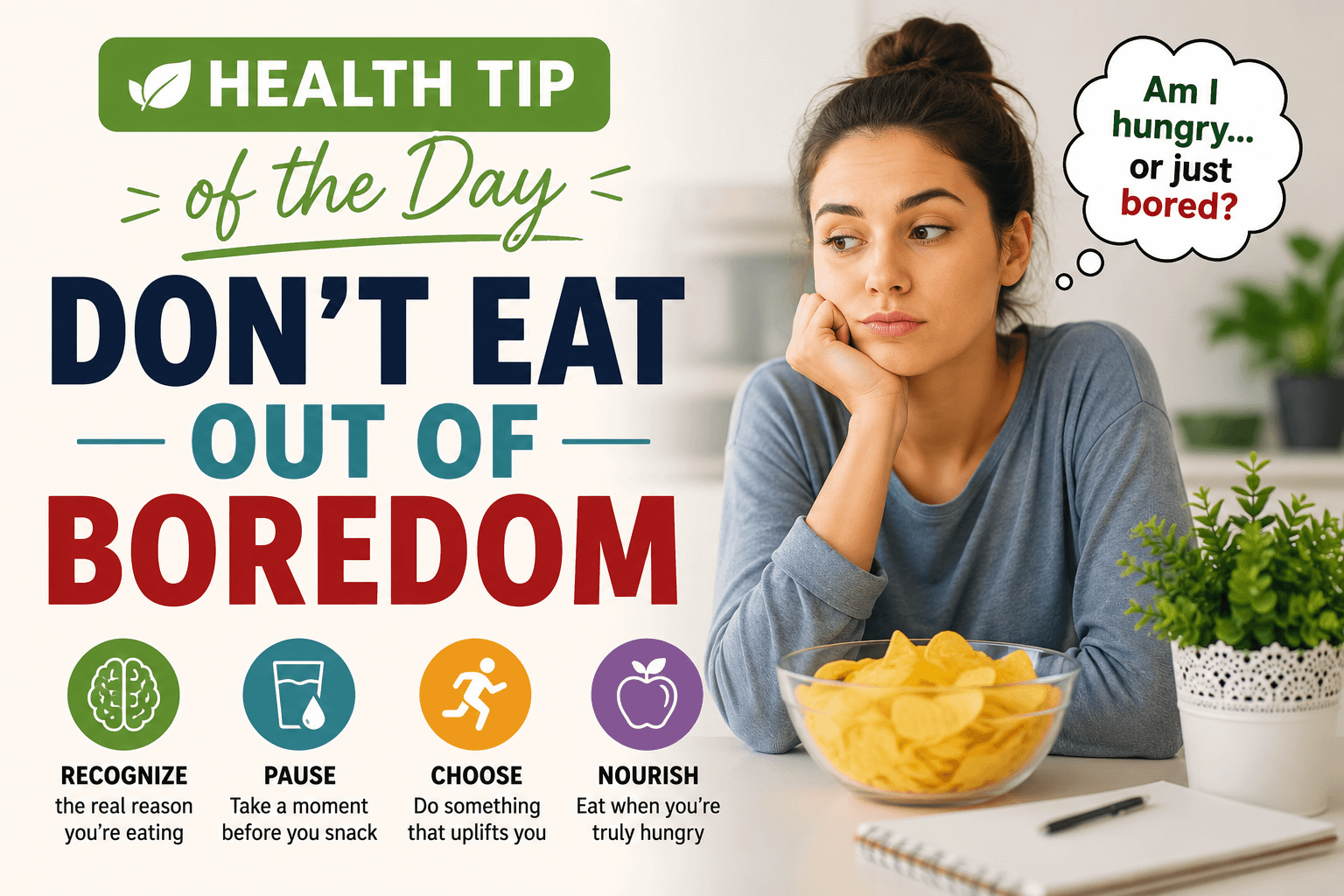
That is why today’s Health Tip of the Day is: Don’t Eat Out of Boredom.
The goal isn’t to become afraid of snacking or to feel guilty whenever you enjoy food. It’s about becoming more aware of what your body actually needs.
When you can recognize the difference between physical hunger and boredom, you give yourself the opportunity to make more intentional choices.
What Is Boredom Eating?
Boredom eating is exactly what it sounds like: eating primarily because you have nothing interesting or stimulating to do rather than because you’re physically hungry.
It can happen almost anywhere.
You’re watching television and suddenly want popcorn.
You’re working from home and make another trip to the kitchen.
You’re scrolling through your phone late at night and start thinking about cookies.
You’re sitting around on a quiet afternoon and decide to check the refrigerator.
Sometimes you’re not even craving anything specific. You’re simply looking for something to do.
Food becomes entertainment.
Because eating can provide immediate pleasure and stimulation, the brain can gradually associate boredom with snacking.
Eventually, the behavior can become automatic:
Boredom → Kitchen → Snack → Temporary satisfaction.
Breaking that cycle begins with awareness.
Why Do We Eat When We’re Bored?
Human beings naturally look for stimulation.
When there’s little happening around us, our brains search for something interesting, rewarding, comforting, or enjoyable.
Food can easily fill that role.
The smell, taste, texture, and anticipation of eating can temporarily make an uneventful moment more interesting.
This is especially true with foods designed to be highly enjoyable—sweet, salty, crunchy, creamy, or rich foods.
You may not necessarily need additional energy. Your brain may simply be looking for a rewarding experience.
That doesn’t make you weak or undisciplined. It means you’ve developed an association between a feeling and a behavior.
And habits can be changed.
Hunger and Appetite Aren’t Always the Same
One useful distinction is understanding the difference between hunger and appetite.
Hunger generally refers to your body’s physical need for nourishment.
Appetite is your desire to eat.
The two frequently occur together—but not always.
You can be physically hungry without strongly craving a particular food.
And you can have a strong appetite even when you’ve recently eaten.
Imagine finishing dinner and then seeing your favorite dessert.
Your stomach may be satisfied, but you can still think:
“That looks really good.”
That doesn’t necessarily mean your body suddenly needs more food. It means the food has triggered your appetite.
Understanding this difference can make eating habits easier to recognize.
Physical Hunger Usually Develops Gradually
Everyone experiences hunger differently, but physical hunger commonly develops over time.
You might notice:
- An empty or hollow feeling in your stomach
- Stomach growling
- Reduced energy
- Difficulty concentrating
- Irritability
- Feeling ready to eat several different foods
Boredom-driven cravings can sometimes appear more suddenly.
Instead of thinking:
“I’m hungry and should probably eat something.”
you might think:
“I really want chips right now.”
That doesn’t automatically mean it’s boredom, but it gives you an opportunity to check in with yourself.
Try the Hunger Question
Before grabbing a snack, ask yourself:
“Would I eat something simple and nutritious right now?”
Imagine something you normally enjoy but don’t necessarily consider exciting.
If the answer is yes, you may genuinely be hungry.
If your reaction is:
“No, but I really want cookies,”
you may be dealing more with a craving than physical hunger.
Again, there’s nothing inherently wrong with enjoying cookies. The exercise simply helps you identify what’s motivating you.
The Power of the Ten-Minute Pause
One of the easiest ways to reduce automatic boredom eating is to introduce a small delay.
When you suddenly want something to eat between meals, wait approximately ten minutes.
Don’t spend those ten minutes staring at the refrigerator trying not to eat.
Change your environment.
Get up.
Walk around.
Drink some water.
Go outside.
Answer a message.
Fold some laundry.
Read something.
Put on music.
After ten minutes, ask yourself again:
“Do I still want something to eat?”
If you’re genuinely hungry, have a snack or meal.
If the craving has disappeared, boredom was probably playing a role.
The purpose isn’t restriction.
It’s creating enough space between impulse and action to make a conscious decision.
Change Your Environment
Your surroundings can strongly influence your eating behavior.
Imagine sitting on the couch with a large bag of chips beside you.
Even if you weren’t originally hungry, simply seeing the bag can encourage you to start eating.
Now imagine the chips are stored in a cabinet in the kitchen.
You have to consciously decide to get up, walk into the kitchen, open the cabinet, and get them.
That small amount of effort gives you another opportunity to decide whether you actually want them.
Try keeping frequently craved snack foods somewhere less visible while making nutritious options easier to access.
Your environment can either encourage automatic behavior or support intentional choices.
Avoid Eating Directly From Large Packages
Mindless eating becomes much easier when you’re eating directly from a large bag, box, or container.
You might start with the intention of eating a little and suddenly realize you’ve consumed far more than expected.
Instead, place a reasonable amount in a bowl or on a plate.
Then put the package away.
You can always get more if you’re genuinely hungry.
This simple strategy creates a natural stopping point where you can ask:
“Do I actually want more?”
Pay Attention While You’re Eating
Distracted eating makes it harder to recognize satisfaction.
If you’re watching television, working, scrolling through social media, or playing games while eating, much of your attention is focused somewhere else.
Before you know it, the food is gone.
When practical, try giving your food more attention.
Notice the flavor.
Notice the texture.
Slow down.
Actually enjoy what you’re eating.
Eating intentionally can often feel more satisfying than eating quickly and barely remembering the experience.
Create a Boredom List
One practical strategy is creating a list of things you can do when boredom strikes.
Instead of trying to think of something in the moment, you’ll already have alternatives available.
Your list might include:
- Take a 10-minute walk
- Listen to a favorite song
- Call someone you haven’t spoken to recently
- Organize one drawer
- Watch a short video
- Work on a hobby
- Read
- Write
- Stretch
- Do a puzzle
- Play with your pet
- Step outside
- Water your plants
- Take a shower
- Clean your desk
- Plan tomorrow
- Work on a creative project
- Listen to a podcast
- Do something you’ve been putting off
- Simply relax without food
Your alternatives don’t have to be productive.
The purpose isn’t turning every free moment into work.
The goal is simply teaching your brain:
“Food isn’t my only source of stimulation.”
Watch Your Most Vulnerable Times
Boredom eating often follows patterns.
For some people, it’s late at night.
For others, it’s the afternoon.
Some people snack while watching television.
Others eat when they’re alone.
Pay attention to when your cravings happen most often.
You might discover that you’re rarely tempted to snack unnecessarily during busy mornings but frequently struggle between 8:00 and 10:00 at night.
Once you’ve identified your vulnerable time, you can create a plan.
Maybe you take an evening walk.
Maybe you drink tea.
Maybe you work on a hobby.
Maybe you schedule a phone call.
Maybe you watch television without keeping snacks beside you.
Understanding your patterns makes changing them much easier.
Make Sure You’re Eating Enough During Meals
Not every snack craving is boredom.
If you’re consistently eating very small meals or skipping meals entirely, you may genuinely become hungry later.
Trying to fight legitimate hunger by telling yourself you’re “just bored” isn’t helpful.
Balanced meals containing appropriate amounts of protein, carbohydrates, healthy fats, fiber-rich foods, and other nutrients can help support satisfaction.
If you’re hungry, eat.
The goal is not to ignore hunger.
The goal is to recognize it accurately.
Don’t Confuse Thirst With the Desire to Snack
Sometimes when people feel like having something, a drink may satisfy the urge.
Keep water nearby throughout the day and drink regularly according to your needs.
When an unexpected snack craving appears, you can have some water and wait a few minutes.
If you’re still hungry afterward, eat.
Hydration isn’t a trick for suppressing hunger. It’s simply another way of checking what your body might need.
Stress Can Look Like Boredom
Sometimes what appears to be boredom is actually emotional discomfort.
Maybe you’re procrastinating because something is stressful.
Maybe you’re lonely.
Maybe you’re frustrated.
Maybe you’ve had a difficult day and want something comforting.
Food can become an easy distraction from uncomfortable emotions.
When you notice yourself wandering toward the kitchen unexpectedly, ask:
“What am I feeling right now?”
You might discover the answer isn’t boredom at all.
Build a Healthier Response to Emotions
If stress is triggering your eating, consider other ways of responding to stress.
Take a walk.
Call someone.
Write down what you’re feeling.
Listen to music.
Practice slow breathing.
Spend a few minutes outside.
Work on something enjoyable.
Rest.
Different situations require different solutions.
Food may temporarily distract you from an emotion, but it usually doesn’t solve the underlying problem.
Learning healthier coping strategies gives you more options.
Don’t Keep Yourself Busy Every Second
There’s another important side to this conversation.
You don’t need to eliminate boredom completely.
Being bored occasionally is normal.
You don’t have to fill every quiet moment with work, entertainment, exercise, social media, or another activity.
Sometimes it’s healthy to simply sit quietly.
The challenge is learning that boredom doesn’t automatically require food.
You can experience boredom without immediately trying to escape it.
Sometimes the urge passes on its own.
Stop Using Guilt as Motivation
Suppose you planned not to snack while watching television, but you ended up eating several cookies.
What should you do?
Move on.
Don’t turn one snack into a reason to criticize yourself.
Thinking:
“I ruined everything, so I might as well keep eating badly today”
can be much more damaging than the original snack.
Healthy living isn’t an all-or-nothing challenge.
One choice is one choice.
Your next decision is another opportunity.
Food Should Still Be Enjoyable
Developing healthier habits doesn’t require removing pleasure from eating.
You can enjoy dessert.
You can eat your favorite snacks.
You can celebrate with food.
You can enjoy meals with friends and family.
You can occasionally eat something simply because it tastes good.
A healthy relationship with food includes enjoyment.
The difference is learning to make those choices intentionally rather than automatically.
Instead of eating because you’re bored and barely noticing the food, choose something you genuinely want and enjoy it.
Build Structure Into Your Day
If boredom eating happens frequently, adding some structure to your day may help.
You don’t need a strict schedule.
Simply knowing roughly when you’ll eat meals, exercise, work, relax, handle responsibilities, and enjoy hobbies can reduce long stretches of unplanned time.
Structure can also make your eating patterns more predictable.
When your body becomes accustomed to regular meals, recognizing genuine hunger may become easier.
Make Your Kitchen Less Tempting
You don’t necessarily need to remove every snack you enjoy from your home.
Instead, make automatic eating slightly less convenient.
Keep snacks inside cabinets instead of on countertops.
Avoid leaving candy bowls where you constantly see them.
Put leftovers away soon after meals.
Keep fruit or other nutritious foods easily accessible.
Visual cues matter.
If you see food constantly, you’ll probably think about food more often.
Create an Evening Routine
Nighttime can be especially challenging for boredom eating.
After dinner, responsibilities may slow down. You’re relaxing, watching television, or scrolling through your phone.
Try developing a simple evening routine that signals that dinner is finished.
You might clean the kitchen, prepare something for tomorrow, make a non-caloric beverage if appropriate for you, read, take a walk, or work on a relaxing activity.
Over time, your brain can begin associating evenings with your new routine rather than constant snacking.
Practice Eating Without Judgment
Pay attention to your eating habits like you’re gathering information.
Instead of saying:
“I have terrible eating habits.”
try:
“I noticed I usually want something sweet when I’m watching television at night.”
The second statement gives you useful information.
Once you know the trigger, you can experiment with changing the behavior.
Judgment often creates shame.
Awareness creates opportunity.
Keep a Simple Hunger Journal
If boredom eating is something you want to understand better, keep a simple journal for a few days.
You don’t necessarily need to count every calorie or measure everything you eat.
Simply record:
Time: 8:30 p.m.
What I wanted: Chips
Hunger level: 3/10
What I was doing: Watching TV
Feeling: Bored
What I decided: Took a short walk, then decided I wasn’t hungry.
Or:
Time: 3:00 p.m.
What I wanted: Snack
Hunger level: 8/10
What I was doing: Working
Feeling: Hungry and tired
What I decided: Ate yogurt and fruit.
After several days, patterns may become obvious.
Try the Kitchen Test
The next time you wander into the kitchen without knowing what you want, stop before opening anything.
Ask yourself:
“Why did I come in here?”
If the answer is:
“I’m hungry,”
great. Decide what you want to eat.
If the answer is:
“I don’t know,”
that’s valuable information too.
You may simply be acting out of habit.
Walk away for a few minutes and see what happens.
Small Changes Can Make a Big Difference
You don’t have to transform your eating habits overnight.
Start with one change.
Maybe you’ll stop eating directly from packages.
Maybe you’ll introduce the ten-minute pause.
Maybe you’ll stop keeping snacks beside the couch.
Maybe you’ll start drinking water regularly.
Maybe you’ll take a short walk when evening boredom appears.
One small habit practiced consistently can eventually become part of your normal routine.
Then you can build another.
Today’s Health Challenge
For the next 24 hours, practice one simple exercise:
Every time you want to eat outside your regular meals, pause and ask why.
Don’t automatically stop yourself from eating.
Just identify the reason.
Ask:
Am I physically hungry?
Am I bored?
Am I stressed?
Am I tired?
Am I thirsty?
Am I procrastinating?
Am I eating because the food is simply sitting in front of me?
If you’re hungry, eat something that satisfies you.
If you’re bored, experiment with doing something else for ten minutes.
The goal for today isn’t perfection.
It’s awareness.
A Simple Reminder
The next time you find yourself standing in front of the refrigerator without knowing what you’re looking for, remember:
You may not need another snack. You may simply need something meaningful, interesting, relaxing, or enjoyable to do.
Listen to your body before automatically following the craving.
Final Thoughts
Developing healthier eating habits isn’t about creating endless rules around food.
It’s about understanding yourself.
Why do you eat?
When do you eat?
What makes you hungry?
What triggers cravings?
Which situations lead to mindless eating?
The more you understand those patterns, the easier it becomes to make intentional decisions.
There will still be times when you snack simply because something sounds delicious.
That’s okay.
There will be celebrations, desserts, movie-night popcorn, restaurant meals, holidays, and favorite foods.
Healthy living has room for enjoyment.
The important thing is preventing boredom from becoming the automatic signal that tells you it’s time to eat.
When boredom appears, pause.
Check your hunger.
Change your activity.
Give yourself another source of stimulation.
Then decide what you actually need.
Sometimes the answer will be food.
Sometimes it will be movement.
Sometimes it will be conversation.
Sometimes it will be rest.
And sometimes you simply need to give yourself permission to be bored for a little while.
Health Tip of the Day: Don’t Eat Out of Boredom. Eat when you’re hungry, enjoy what you eat, and learn to recognize when your mind is asking for stimulation rather than your body asking for nourishment.
One mindful decision might seem small, but repeated day after day, those small decisions can become healthier habits that last.
Leave a ReplyCancel reply