
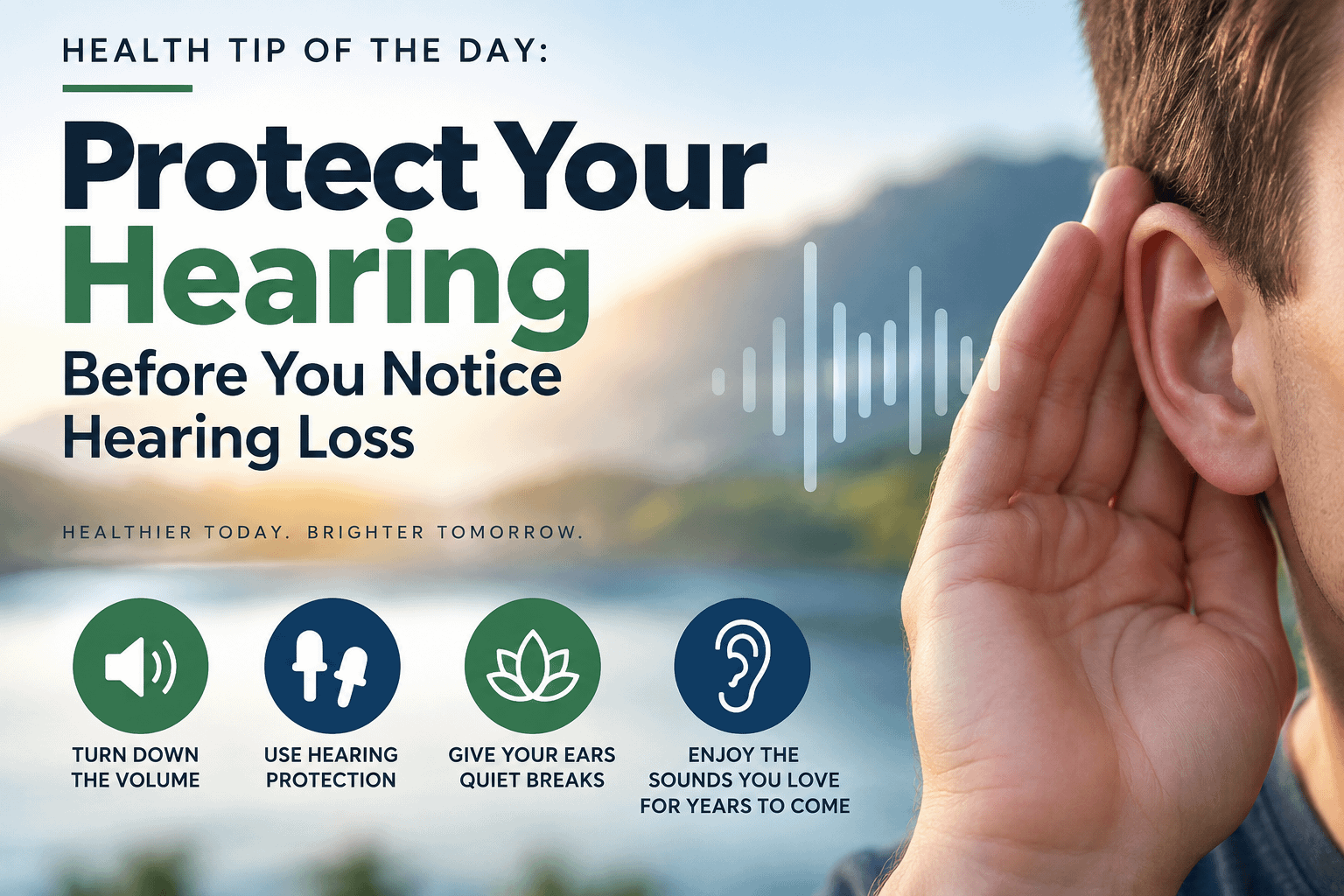
We protect many parts of our health without thinking twice.
We wear sunglasses when the sun is bright. We put on sunscreen before spending hours outdoors. We wear seat belts in the car. We try to eat better, exercise, drink enough water, and get enough sleep.
But there is another part of our health that is incredibly important and surprisingly easy to overlook:
Our hearing.
Most of us don’t spend much time thinking about our ears until something changes.
Maybe the television starts getting turned up a little louder.
Maybe conversations in crowded restaurants become harder to follow.
Perhaps you notice ringing after leaving a concert.
Maybe you find yourself asking people to repeat themselves more often.
The problem is that hearing damage can develop gradually. Because the changes may happen slowly, you might not immediately realize how much your hearing has changed.
That is why today’s Health Tip of the Day is simple:
Protect your hearing now instead of waiting until you notice a problem.
You don’t have to stop listening to music, attending concerts, using power tools, or enjoying the things you love. The goal is simply to become more aware of how much noise your ears experience and take reasonable steps to protect them.
Your Hearing Deserves the Same Attention as the Rest of Your Health
Think about everything hearing allows you to experience.
Your favorite song.
A loved one’s voice.
Children laughing.
Birds singing in the morning.
Rain hitting the window.
A movie you’ve been waiting to see.
A conversation with an old friend.
Someone saying, “I love you.”
Hearing is deeply connected to how we communicate and experience the world around us.
Yet because hearing usually works automatically, it can be easy to take it for granted.
You wake up and hear your alarm.
You hear the coffee maker.
You turn on the television.
You listen to music in the car.
You talk to coworkers.
You answer the phone.
You hear traffic while crossing the street.
Sound surrounds us throughout the entire day.
The question is not whether we are exposed to sound.
The question is how loud that sound is and how long we are exposed to it.
Loud Noise Can Damage Your Hearing
Our ears are remarkable, but they are not indestructible.
Repeated exposure to excessive noise can damage delicate structures involved in hearing. Sometimes a single extremely loud event can cause damage, while other problems develop after repeated exposure over time.
That is why hearing protection matters even when something doesn’t immediately feel painful.
You might leave a loud concert with ringing in your ears and think:
“It’ll be gone tomorrow.”
Maybe it will.
But ringing, muffled hearing, or other changes after loud noise are signs that your ears have experienced significant sound exposure.
Rather than treating those symptoms as a normal part of attending concerts, working around machinery, or listening to loud music, consider them reminders to protect your hearing more carefully next time.
Turn the Volume Down
One of the easiest ways to protect your hearing is also one of the simplest:
Turn down the volume.
Headphones and earbuds make it possible to carry music, podcasts, videos, movies, and phone calls everywhere.
That convenience is wonderful.
But it also means sound can be delivered directly into our ears for hours at a time.
It’s easy for the volume to creep upward.
You are walking near traffic, so you turn up the music.
You are at the gym and want to block out background noise.
You are mowing the lawn while listening to a podcast.
You are traveling on an airplane and increase the volume so you can hear a movie.
Before long, your listening level may be much louder than you realize.
Try becoming more intentional about your volume.
If your phone or listening device provides headphone-level warnings or volume notifications, don’t automatically dismiss them.
Use them as reminders.
Your favorite song doesn’t have to shake your skull to be enjoyable.
Give Your Ears Quiet Breaks
Volume isn’t the only consideration.
Duration matters too.
Even when you’re enjoying yourself, spending long periods around loud sound can be tiring for your ears.
Give yourself breaks.
If you’re attending a concert, sporting event, festival, nightclub, or another loud environment, occasionally move somewhere quieter when possible.
If you’ve been wearing headphones for hours, take them off for a while.
If you work around loud equipment, use appropriate hearing protection and follow workplace safety requirements.
Think of quiet time as recovery time for your ears.
We understand this concept with other parts of our bodies.
After exercising, muscles need recovery.
After a busy day, your mind benefits from rest.
After staring at a computer screen, your eyes appreciate a break.
Your ears deserve breaks too.
Use Hearing Protection Around Loud Equipment
Some everyday activities can be surprisingly loud.
Lawn mowers.
Leaf blowers.
Power saws.
Drills.
Shop equipment.
Motorcycles.
Construction equipment.
Certain sporting events.
Concerts.
Fireworks.
Instead of assuming, “I’ll only be around it for a little while,” make hearing protection part of the activity.
Earplugs and earmuff-style hearing protection can reduce the amount of sound reaching your ears when used correctly.
Keep hearing protection where you’re likely to need it.
If you regularly use lawn equipment, keep ear protection near the equipment.
If you work in a garage or workshop, leave hearing protection somewhere visible and convenient.
If you attend concerts frequently, consider carrying appropriate earplugs with you.
Making protection convenient increases the chances that you’ll actually use it.
Don’t Be Embarrassed to Wear Earplugs at Concerts
There was once an idea that wearing earplugs at a concert somehow meant you weren’t fully enjoying the music.
That’s a terrible trade.
You shouldn’t have to risk your future ability to enjoy music just to enjoy tonight’s music.
Modern hearing protection designed for music environments can help reduce sound levels while still allowing you to experience the performance.
The goal isn’t necessarily silence.
It’s reducing excessive exposure.
If you attend concerts, festivals, clubs, races, sporting events, or other loud entertainment regularly, hearing protection can become as normal as bringing your wallet and phone.
Enjoy the event.
Sing along.
Cheer.
Dance.
Have fun.
Just remember that your ears need to go home with you too.
Be Careful With Fireworks and Sudden Loud Sounds
Not all dangerous noise comes from prolonged exposure.
Some sounds are extremely loud and sudden.
Fireworks are a good example.
People may stand surprisingly close to fireworks because the display lasts only a short time.
But explosive sounds can be extremely intense.
If you’re attending a fireworks display, keep a reasonable distance from the source and consider hearing protection, particularly for children.
The same principle applies to other extremely loud impulse noises.
You don’t have to be exposed for hours for sound to potentially affect your hearing.
Sometimes protecting yourself means simply moving farther away.
Distance Can Make a Difference
When something is uncomfortably loud, one of the easiest things you can do is increase the distance between yourself and the sound source.
Move away from the speakers.
Stand farther from loud machinery.
Don’t position yourself directly beside a concert speaker.
Step away from a noisy area when you don’t need to be there.
You may not always have control over the volume, but sometimes you have control over your location.
Use that advantage.
If your ears are telling you something is painfully loud, listen to them.
Pay Attention to Ringing in Your Ears
Have you ever left a loud event and heard ringing or buzzing afterward?
This is commonly called tinnitus.
Tinnitus can sound different from person to person. Some people describe ringing, buzzing, humming, clicking, or other noises that seem to come from inside the ear.
Temporary ringing after loud sound shouldn’t simply be viewed as proof that you had a great night.
It is a reason to reconsider your sound exposure.
Persistent or bothersome tinnitus deserves medical attention.
Don’t automatically assume you just have to live with a new or unexplained symptom.
Talk with an appropriate healthcare professional, particularly if symptoms are sudden, severe, one-sided, associated with dizziness, or accompanied by noticeable hearing changes.
Don’t Ignore Changes in Your Hearing
Hearing loss doesn’t always announce itself dramatically.
Sometimes it appears in subtle ways.
You may notice that people seem to mumble more.
You might struggle to understand conversations when several people are talking.
You may have difficulty hearing someone when there is background noise.
You might turn the television volume higher than other people prefer.
You may frequently ask:
“What?”
“Can you say that again?”
“What did they say?”
You might hear someone talking but have trouble understanding individual words.
Family and friends sometimes notice these changes before the person experiencing them does.
If people repeatedly tell you that your television is extremely loud or that you seem to have trouble hearing conversations, don’t immediately dismiss their observations.
Consider having your hearing evaluated.
Hearing Tests Aren’t Only for Older Adults
There is a common misconception that hearing tests are something you only need when you’re elderly.
Hearing problems can affect people at different ages for many different reasons.
Your occupation, hobbies, medical history, medications, noise exposure, and other factors can all matter.
If you have concerns about your hearing, talk with a healthcare professional about whether an evaluation is appropriate.
A hearing test can provide information about how well you’re hearing different frequencies and speech.
More importantly, it gives you a baseline.
Knowing where your hearing stands today can make future changes easier to recognize.
Protect Children’s Hearing Too
Children are surrounded by sound just like adults.
Headphones.
Tablets.
Video games.
Concerts.
Sporting events.
Fireworks.
Movie theaters.
School events.
Children may not understand when something is too loud or recognize the importance of protecting their ears.
Adults can help by teaching healthy listening habits early.
Show children how to keep headphone volume reasonable.
Provide hearing protection at especially loud events.
Encourage breaks from headphones.
Explain why hearing protection matters instead of simply telling them to turn something down.
Healthy habits are easier to maintain when they become normal from childhood.
Don’t Put Objects Deep Into Your Ears
Protecting hearing also means being careful about how you care for your ears.
Many people use cotton swabs or other objects to try to clean inside their ear canals.
But inserting objects deeply into the ear can push earwax farther inside or potentially cause injury.
Your ears generally have natural mechanisms for moving wax outward.
If you believe earwax is blocking your hearing or causing discomfort, talk with a healthcare professional about safe removal rather than aggressively trying to dig it out yourself.
Your ear canal isn’t something that needs to be scrubbed like the kitchen sink.
Treat it gently.
Watch for Earbud Habits
Earbuds have become part of everyday life.
People wear them while exercising, working, shopping, commuting, cleaning, cooking, and even falling asleep.
Convenience can make it easy to forget how many hours our ears are exposed to amplified sound.
Try occasionally asking yourself:
Do I actually need my earbuds in right now?
Sometimes the answer is yes.
Other times, you may discover that you have been wearing them simply out of habit.
Take them out.
Let your ears experience normal environmental sound.
Enjoy a little quiet.
You don’t need entertainment filling every second of the day.
Don’t Try to Drown Out Noise With More Noise
Imagine you’re on an airplane.
The engine noise is loud, so you turn your headphones louder.
Or you’re using a treadmill in a noisy gym.
You increase your music because you can’t hear it clearly.
This creates a competition between environmental noise and your headphones.
Instead of constantly increasing the volume, consider options that help reduce background noise so you can listen comfortably at lower levels.
The solution to a loud environment shouldn’t always be adding even more sound directly into your ears.
Make Quiet Part of Your Day
There is something else valuable about protecting your hearing:
It can encourage you to rediscover quiet.
Modern life is noisy.
Televisions are running.
Phones are playing videos.
Music is streaming.
Cars are moving.
Notifications are sounding.
Podcasts are playing.
People are talking.
Machines are operating.
Sometimes we move from one source of noise to another from the moment we wake up until we go to sleep.
Try intentionally creating quiet periods.
Turn off the television.
Take out your earbuds.
Silence the unnecessary notifications.
Sit outside.
Read.
Take a quiet walk.
Drink your coffee without something playing in the background.
You might discover that silence isn’t empty.
It can be peaceful.
Start With One Simple Change Today
Protecting your hearing doesn’t require completely changing your lifestyle.
Start with one small decision.
Lower your headphone volume.
Put earplugs in your car or bag before your next concert.
Buy appropriate hearing protection for yard work.
Move farther away from speakers.
Take a break from your earbuds.
Pay attention when your device gives you a loud-volume warning.
Schedule an evaluation if you’ve noticed hearing changes.
Small decisions can become habits.
And habits repeated over years can make a meaningful difference.
Health Tip of the Day: Protect the Sounds You Love
Think about the sounds that matter most to you.
Maybe it’s your favorite music.
Maybe it’s waves crashing along the shore.
Maybe it’s birds outside your window.
Maybe it’s a friend’s laugh.
Maybe it’s the voice of someone you love.
Our hearing connects us to countless moments we rarely think about until something changes.
That’s why hearing protection shouldn’t begin after you’ve already noticed significant difficulty.
It should begin today.
Turn the volume down a little.
Give your ears occasional quiet breaks.
Wear hearing protection around loud equipment and entertainment.
Keep your distance from extremely loud sound when possible.
Pay attention to ringing, muffled hearing, or other changes.
And don’t hesitate to speak with a healthcare professional when something doesn’t seem right.
You don’t need to live in silence to protect your hearing.
You simply need to become more intentional about the noise you allow into your life.
Your ears have been listening to the world around you every day of your life.
Take care of them so you can continue enjoying the sounds that make life meaningful for years to come.
What is one change you could make today to better protect your hearing—lowering your headphone volume, using hearing protection, or simply giving your ears more quiet time?
Leave a ReplyCancel reply