
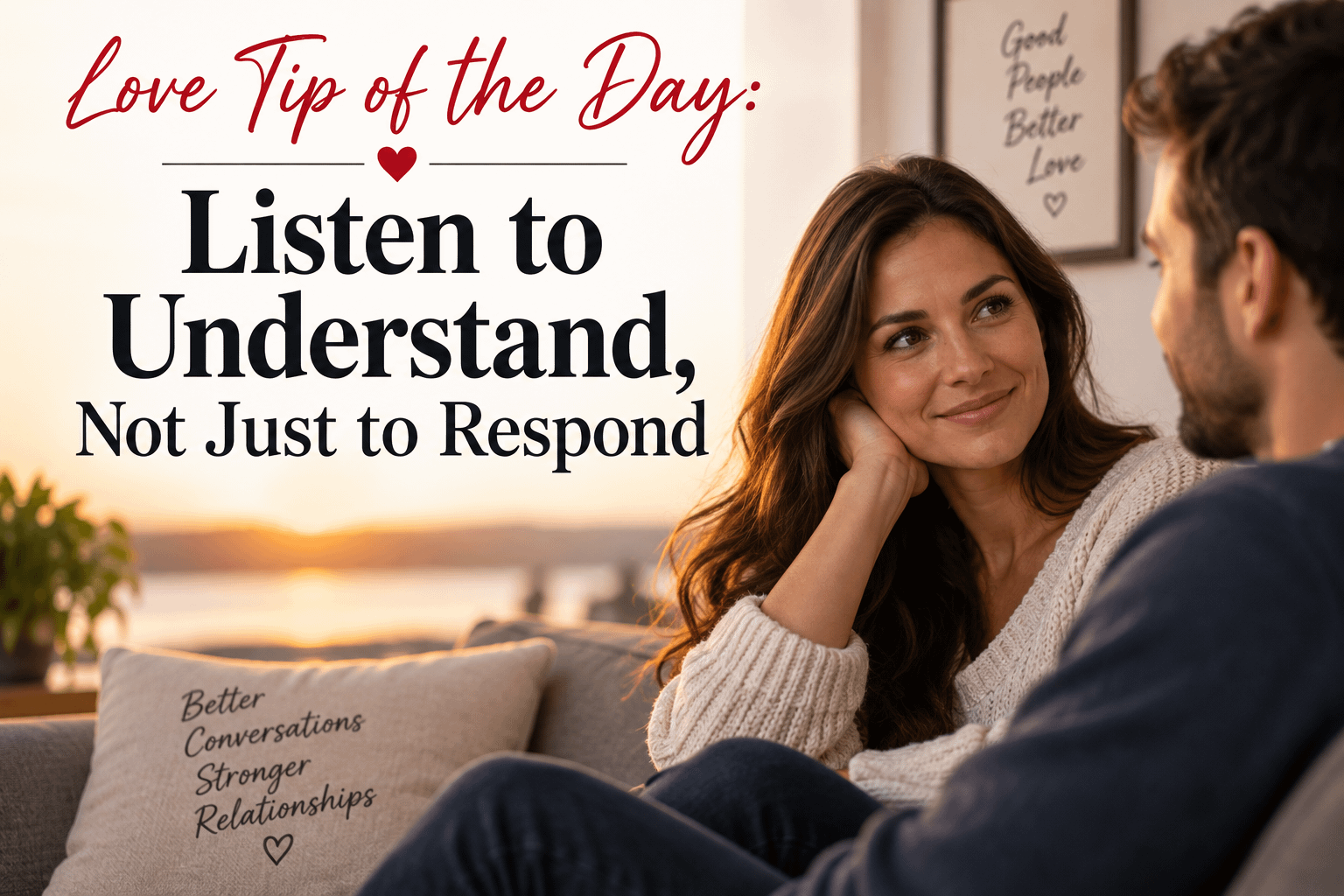
One of the greatest gifts you can give someone you love is your full attention.
Relationships are built through countless conversations. Some are serious. Some are funny. Some happen while sitting together at the dinner table, while others happen in the car, late at night, or during an ordinary moment that unexpectedly becomes important.
But simply hearing someone speak is not the same as truly listening to them.
Today’s love tip is simple: Listen to understand, not just to respond.
When the person you love is talking to you, they may not always be looking for advice, a solution, or an explanation. Sometimes they simply want to know that their thoughts matter to you. They want to feel heard, understood, and emotionally connected.
Learning how to listen with patience and genuine interest can strengthen a relationship in ways that grand gestures never will.
Hearing Someone and Listening to Someone Are Different
We hear things all day long.
We hear conversations, televisions, phones, traffic, music, notifications, coworkers, family members, and countless other sounds competing for our attention.
Listening requires something more.
Listening requires intention.
When you truly listen to your partner, you are communicating something without necessarily saying a word:
You matter to me.
Your attention tells them that their feelings are important enough for you to stop what you are doing and hear what they have to say.
Unfortunately, many conversations become less about understanding and more about preparing a response.
While one person is talking, the other person may already be thinking:
How am I going to defend myself?
What should I say next?
How can I prove my point?
How can I fix this?
When that happens, communication becomes a competition instead of a connection.
Healthy love requires learning to slow down and listen.
You Don’t Have to Fix Everything
One of the most important lessons in relationships is realizing that not every problem needs an immediate solution.
Sometimes the person you love needs advice.
Sometimes they need help.
But sometimes they simply need you.
Maybe they had a terrible day at work.
Maybe someone hurt their feelings.
Maybe they are worried about something they cannot control.
Maybe they are overwhelmed.
Maybe they are carrying something emotionally that they haven’t been able to explain.
Our natural reaction may be to jump into problem-solving mode.
“Here’s what you should do.”
“Don’t worry about it.”
“Just forget about them.”
“You need to…”
Those responses may come from a good place, but they can accidentally make someone feel dismissed.
Sometimes a better response is:
“I’m listening.”
Or:
“Tell me more.”
Or simply:
“I understand why you feel that way.”
Those few words can provide something advice cannot: emotional support.
Put Away the Distractions
One of the easiest ways to show someone that they matter is also one of the hardest habits for many people today:
Put the phone down.
Phones have become constant companions. We check messages, social media, emails, videos, news, and notifications throughout the day.
But imagine trying to share something important while the person across from you keeps looking at a screen.
Even if they hear every word, it may not feel like they are listening.
When your partner wants to talk about something important, give them your attention whenever possible.
Put the phone down.
Turn away from the television.
Look at them.
Listen.
You don’t have to do this perfectly every second of every day. Real life is busy. People multitask.
But there should be moments in a relationship when your partner knows:
Right now, you have my attention.
Those moments matter.
Listen Without Immediately Becoming Defensive
Some of the hardest conversations in relationships involve hearing something we don’t necessarily want to hear.
Maybe your partner says they feel neglected.
Maybe they tell you something you did hurt them.
Maybe they say they need more affection, communication, quality time, or support.
The instinctive response may be to defend yourself.
“I didn’t mean it that way.”
“That’s not what happened.”
“You do the same thing.”
“You’re overreacting.”
Defensiveness may protect your pride for a moment, but it rarely strengthens the relationship.
Instead, try listening to the emotion underneath the words.
Your partner may not be saying you’re a terrible person.
They may simply be saying:
“I need something from you.”
You can disagree with someone’s interpretation of an event while still respecting how they felt about it.
There is enormous power in saying:
“I didn’t realize that hurt you. Help me understand.”
That sentence opens the door to communication instead of slamming it shut.
Ask Questions Because You Care
Good listeners don’t just remain silent.
They participate.
Ask thoughtful questions.
“What happened next?”
“How did that make you feel?”
“Is there anything I can do?”
“Do you want advice, or do you just need me to listen?”
That last question can be especially helpful.
Sometimes people want solutions.
Other times they want support.
Instead of guessing, ask.
It prevents frustration and shows that you’re trying to give your partner what they actually need rather than what you assume they need.
Remember the Little Things They Tell You
Listening doesn’t end when the conversation does.
One of the most meaningful signs that someone was truly listening is when they remember something later.
Maybe your partner mentioned an important meeting coming up.
Ask how it went.
Maybe they told you their friend was going through a difficult situation.
Ask for an update.
Maybe they mentioned a restaurant they wanted to try.
Remember it for a future date.
Maybe they casually mentioned something they loved.
Surprise them with it someday.
These small actions communicate something powerful:
I remember what you tell me because what matters to you matters to me.
Love is often found in these tiny details.
Create a Relationship Where Honesty Feels Safe
People communicate more openly when they believe they can speak without being attacked, mocked, ignored, or punished.
If someone repeatedly feels dismissed when they express themselves, eventually they may stop talking.
That’s when distance begins growing.
The conversations become shorter.
The important things remain unspoken.
Eventually two people can live beside each other while feeling emotionally miles apart.
Healthy relationships create room for honesty.
That doesn’t mean every conversation will be comfortable.
Sometimes love requires difficult conversations.
But both people should know they can express themselves respectfully without fearing that their vulnerability will later be used against them.
When someone trusts you enough to share their heart, protect that trust.
Don’t Turn Every Disagreement Into a Battle
Listening becomes especially important during disagreements.
When emotions rise, people often stop listening entirely.
They interrupt.
They raise their voices.
They repeat their arguments.
They search for weaknesses in the other person’s words.
But the goal of a disagreement shouldn’t always be determining who wins.
If one person wins an argument while the relationship becomes more damaged, did anyone really win?
Sometimes the healthiest question is:
“What are we actually trying to solve here?”
Remember that you’re supposed to be partners.
It should be the two of you against the problem—not the two of you against each other.
Listen carefully enough to understand what the disagreement is really about.
Many arguments aren’t actually about dishes, text messages, schedules, money, or small inconveniences.
There may be something deeper underneath.
“I don’t feel appreciated.”
“I don’t feel important.”
“I feel alone.”
“I need reassurance.”
“I want us to spend more time together.”
Listening helps uncover what is actually being communicated.
Pay Attention to What Isn’t Being Said
Communication isn’t always verbal.
Sometimes the person you love may say, “I’m fine,” while everything about them suggests otherwise.
Their tone changes.
They become quieter.
Their energy feels different.
They withdraw.
They stop laughing the way they normally do.
Knowing someone deeply means learning to recognize these changes.
You don’t need to pressure them.
Sometimes simply saying:
“You seem quieter today. If something is bothering you, I’m here.”
can make a tremendous difference.
It gives them an invitation without forcing them to speak before they’re ready.
Make Time for Conversations That Aren’t About Responsibilities
Long-term relationships can easily become dominated by logistics.
What time are we leaving?
Did you pay that bill?
What’s for dinner?
Who is picking this up?
What are we doing this weekend?
Did you call them?
Those conversations are necessary, but they aren’t enough to maintain emotional intimacy.
Talk about life.
Talk about dreams.
Talk about fears.
Talk about memories.
Ask questions you haven’t asked in a while.
“What are you excited about lately?”
“Is there anything you’ve been wanting to do?”
“What’s something you’ve been thinking about a lot?”
“What would make this year better for you?”
People continue changing throughout their lives.
The person you love today isn’t exactly the same person they were five or ten years ago.
Keep getting to know them.
Listen During the Good Moments Too
Listening isn’t only important when something is wrong.
Listen when your partner is excited.
If they tell you about something they accomplished, celebrate it.
If they’re passionate about something you don’t completely understand, let them tell you about it.
If they share a dream, don’t immediately explain why it won’t work.
Sometimes love means becoming excited because someone you love is excited.
You don’t have to share every interest.
You simply need to care that it matters to them.
Being Heard Creates Emotional Intimacy
Physical affection is important in many relationships, but emotional intimacy matters too.
Emotional intimacy develops when two people feel safe being themselves around each other.
They can laugh together.
They can admit when they’re afraid.
They can talk about disappointment.
They can share hopes.
They can reveal insecurities.
They can say, “I’m struggling,” without pretending everything is perfect.
Listening helps create that environment.
When someone knows you’ll hear them without immediately judging them, they are more likely to open their heart.
That openness creates connection.
Learn to Say, “I Was Wrong”
Listening sometimes reveals something uncomfortable:
Maybe you were wrong.
Maybe you misunderstood.
Maybe you reacted poorly.
Maybe your words hurt someone even though that wasn’t your intention.
There is strength in admitting it.
You don’t lose anything by saying:
“I’m sorry.”
“I shouldn’t have said that.”
“I understand now.”
“I was wrong.”
A sincere apology doesn’t weaken a relationship.
It can strengthen one.
Pride builds walls.
Humility opens doors.
Give the Person You Love Your Presence
You don’t need expensive gifts every day to show someone you love them.
You don’t need elaborate dates every weekend.
You don’t need to constantly create perfect romantic moments.
Sometimes the greatest gift is simply being present.
Sit together.
Talk.
Listen.
Laugh.
Ask questions.
Remember what they tell you.
Notice when something feels different.
Be someone they can talk to when life is wonderful and when life feels overwhelming.
Because eventually, one of the things people remember most about a relationship isn’t everything their partner bought them.
They remember how that person made them feel.
They remember whether they felt important.
They remember whether they felt safe.
They remember whether they felt understood.
Love Tip of the Day
Listen to understand, not just to respond.
When the person you love speaks, don’t always rush to defend yourself, solve the problem, or prepare your next sentence.
Give them your attention.
Listen to their words.
Listen to their feelings.
Ask questions.
Try to understand their perspective.
You won’t always agree.
You won’t always know what to say.
You won’t always be able to fix what they’re going through.
But sometimes love isn’t about having the perfect answer.
Sometimes love simply says:
“I’m here. I’m listening. What you have to say matters to me.”
And those may be some of the most meaningful words a person can hear from someone they love.
When was the last time you put everything else aside and truly listened to the person you love?
Leave a ReplyCancel reply