Category: Health & Wellness

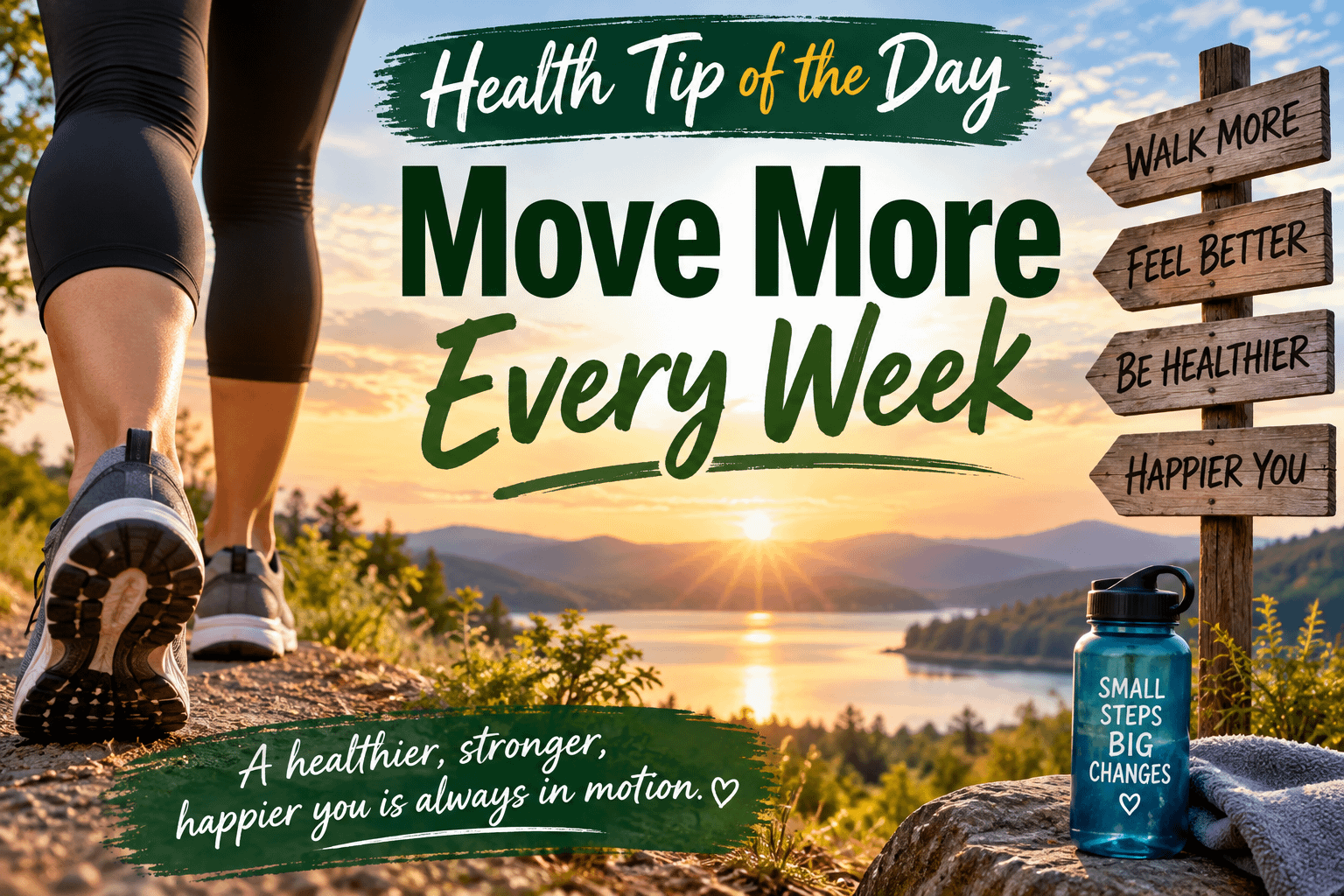
  • Health Tip of the Day: Move More Every Week

    Health Tip of the Day: Move More Every Week

    Advertisements

    Improving your health does not always require a dramatic transformation, an expensive gym membership, or an intense workout program. Sometimes one of the most powerful things you can do is also one of the simplest:

    Move more every week.

    Our bodies are designed for movement. Walking, stretching, climbing stairs, cleaning the house, working in the yard, dancing, exercising, and even taking a few minutes to stand up and move around all count.

    The goal does not have to be becoming an athlete. The goal is to spend a little less time sitting and a little more time moving.

    And when you consistently increase your activity—even gradually—you can begin building habits that support your physical and mental well-being.

    Movement Is About More Than Exercise

    When people hear that they need to become more active, they often immediately think about going to the gym.

    That can make getting healthier seem overwhelming.

    You might imagine running several miles, lifting heavy weights, attending fitness classes, or spending an hour exercising every day.

    But movement is much broader than traditional exercise.

    You can increase your physical activity simply by making small changes throughout your day.

    Take a walk after dinner.

    Park a little farther from the entrance.

    Walk around while talking on the phone.

    Stretch while watching television.

    Take the stairs when you’re able.

    Do some yard work.

    Play outside with your children or grandchildren.

    Put on your favorite music and dance around the house.

    These activities may seem small, but they add movement to a day that might otherwise have been mostly sedentary.

    Over an entire week, those minutes can add up.

    Start With Where You Are

    One of the biggest mistakes people make when trying to become more active is comparing themselves with someone else.

    Someone else might walk five miles every morning.

    Someone else might work out six days a week.

    Someone else might be training for a marathon.

    That doesn’t mean you need to do the same thing.

    Your starting point belongs to you.

    If you currently aren’t very active, walking for ten minutes can be progress.

    If you already walk regularly, perhaps your next goal is adding another walk each week.

    If you’re already exercising several days a week, maybe you can increase your strength training, flexibility work, or everyday movement.

    Progress should be measured against where you started, not against someone else’s routine.

    Why Weekly Movement Matters

    Regular physical activity can support many areas of health.

    Movement helps strengthen muscles and bones, supports cardiovascular fitness, improves mobility and can help maintain physical independence as we age.

    It can also affect how you feel mentally.

    A walk can give you time to clear your thoughts.

    Exercise can provide a healthy break from stress.

    Movement can give you something positive to focus on when you’ve spent too much time worrying, working, scrolling through your phone, or sitting indoors.

    You don’t necessarily need a complicated workout to experience those benefits.

    Sometimes getting outside and walking around the neighborhood is enough to change the direction of your afternoon.

    Stop Thinking in Terms of All or Nothing

    One of the most damaging attitudes toward exercise is:

    If I can’t do a full workout, there’s no point doing anything.

    That mindset can turn a busy day into a completely inactive one.

    Suppose you planned to exercise for 45 minutes but suddenly became busy.

    You might think the workout is ruined.

    But what if you walked for 15 minutes instead?

    That’s still movement.

    Maybe tomorrow you have only ten minutes.

    Move for ten minutes.

    Another day, you might have time for 30.

    The important thing is developing the habit of looking for opportunities to move instead of waiting for perfect conditions.

    Something is usually better than nothing.

    Make Walking Your Secret Weapon

    Walking is one of the simplest ways many people can add movement to their lives.

    You don’t need complicated equipment.

    You don’t have to learn an elaborate routine.

    And you can adjust the distance and pace according to your abilities.

    Try walking:

    • Before work
    • During your lunch break
    • After dinner
    • Around a shopping center
    • At a local park
    • While waiting for an appointment
    • With a friend or family member
    • While listening to music, an audiobook, or a podcast

    If a long walk feels difficult, break it into shorter sessions.

    Three ten-minute walks throughout the day may feel much more manageable than trying to complete one long session.

    Make Movement Part of Your Normal Routine

    The easiest habits to maintain are often the ones that fit naturally into your existing life.

    Instead of constantly trying to “find time” to exercise, attach movement to something you already do.

    For example:

    After drinking your morning coffee, take a short walk.

    After lunch, walk for ten minutes.

    After work, stretch before sitting down for the evening.

    After dinner, walk around the neighborhood.

    While watching television, stand and move during commercial breaks or between episodes.

    When movement becomes connected to your normal routine, you don’t have to rely entirely on motivation.

    Eventually, it simply becomes part of your day.

    Add Strength, Too

    Moving more isn’t limited to walking.

    Strength exercises can also be an important part of an active lifestyle.

    Depending on your abilities, this might include exercises such as squats, wall push-ups, resistance-band exercises, light weights, or body-weight movements.

    Strength matters because everyday life requires it.

    Standing up from a chair requires strength.

    Carrying groceries requires strength.

    Climbing stairs requires strength.

    Maintaining muscle becomes increasingly important as we get older.

    You don’t have to become a bodybuilder. The goal is simply to challenge your muscles safely and consistently.

    Don’t Forget Flexibility and Mobility

    Movement should also include activities that help your body maintain its range of motion.

    Gentle stretching can be especially helpful after you’ve spent long periods sitting.

    Try periodically stretching your:

    Shoulders.

    Neck.

    Back.

    Hips.

    Legs.

    Calves.

    Even a few minutes can help break up extended periods of inactivity.

    Activities such as yoga, gentle mobility routines, and stretching exercises can also provide another way to stay active without requiring high-intensity workouts.

    Find Movement You Actually Enjoy

    You are much more likely to continue doing something if you enjoy it.

    Not everyone likes running.

    Not everyone enjoys lifting weights.

    Not everyone wants to spend time in a gym.

    That’s okay.

    There are countless ways to move.

    Maybe you enjoy swimming.

    Maybe you like hiking.

    Maybe you enjoy dancing.

    Perhaps you love gardening.

    You might prefer cycling, walking your dog, playing basketball, doing home workouts, or exploring local parks.

    Exercise doesn’t have to feel like punishment.

    Finding something you genuinely enjoy can turn physical activity from something you “have to do” into something you actually look forward to.

    Increase Your Activity Gradually

    You don’t need to double your activity overnight.

    In fact, making dramatic changes can make a new routine harder to maintain.

    Instead, build gradually.

    Imagine you currently walk twice per week.

    Your next goal might be walking three times.

    Once that becomes comfortable, perhaps you increase the length of one of those walks.

    Then you might add some strength exercises.

    Small improvements are easier to repeat.

    And repeated improvements become habits.

    Pay Attention to Your Body

    Increasing activity doesn’t mean ignoring pain or forcing yourself through something that doesn’t feel right.

    There is a difference between challenging yourself and hurting yourself.

    If something causes unusual or significant pain, stop and reassess what you’re doing. People with medical conditions, injuries, significant mobility limitations, or concerns about beginning an exercise program should consider discussing an appropriate activity level with a qualified healthcare professional.

    Your goal is to build your health, not prove something by pushing beyond what your body can safely handle.

    Break Up Long Periods of Sitting

    Even if you exercise regularly, it’s worth paying attention to how much time you spend sitting.

    Many of us sit for hours without realizing it.

    We sit while working.

    We sit while driving.

    We sit while eating.

    We sit while watching television.

    We sit while scrolling through our phones.

    Try creating small reasons to stand throughout your day.

    Refill your water.

    Walk around the room.

    Stretch.

    Take a quick trip outside.

    Do a small household task.

    Walk to speak with someone instead of sending a message when practical.

    These little interruptions can help make movement part of everyday life rather than something confined to a single workout.

    Keep Track of Your Progress

    Tracking activity can be motivating because it allows you to see improvement that you might otherwise overlook.

    You could track:

    Minutes spent walking.

    Number of active days each week.

    Workout sessions completed.

    Distance walked.

    Strength workouts.

    Daily steps.

    You don’t have to obsess over numbers.

    Tracking is simply a way to remind yourself that you’re making progress.

    There may be weeks when you do more and weeks when you do less.

    What matters is returning to the habit.

    Don’t Let One Bad Week Become a Bad Month

    Life happens.

    You get busy.

    You become tired.

    The weather changes.

    Work becomes stressful.

    Your routine gets disrupted.

    Missing a few workouts doesn’t mean you’ve failed.

    The danger comes when you think:

    “I already messed up, so there’s no point continuing.”

    Instead, start again.

    If last week wasn’t active, make this week different.

    You don’t need to punish yourself for what you didn’t do.

    You simply need to decide what you’re going to do next.

    Set a Simple Weekly Goal

    Instead of making an enormous fitness resolution, give yourself one achievable goal for the coming week.

    Maybe your goal is:

    Walk three times.

    Take a ten-minute walk every evening.

    Stretch every morning.

    Try one new physical activity.

    Add two short strength sessions.

    Get outside and move on Saturday.

    Choose something realistic enough that you believe you can actually accomplish it.

    Once you reach that goal, build on it.

    Movement Is an Investment in Your Future

    One of the best reasons to become more active isn’t necessarily changing how you look.

    It’s protecting your ability to live your life.

    You want the strength to keep doing the things you enjoy.

    You want the mobility to remain independent.

    You want the endurance to travel, explore, work, play, and participate in life.

    Every walk, stretch, workout, and active choice is a small investment in that future.

    You may not notice the difference after one day.

    But healthy habits aren’t built in one day.

    They’re built through weeks, months, and years of small decisions.

    Health Tip of the Day

    Move more every week.

    Don’t worry about creating the perfect fitness routine.

    Start with what you can do today.

    Walk for ten minutes.

    Stand up and stretch.

    Take the stairs if you’re able.

    Spend some time outside.

    Do a few simple exercises at home.

    Then do something again tomorrow.

    The goal isn’t perfection.

    The goal is movement.

    A little more today.

    A little more this week.

    And eventually, what once required effort can become part of your lifestyle.

    Your body was made to move—and every bit of movement you safely add to your life is another step toward taking better care of yourself.

    What is one simple way you can move a little more this week?

  • Health Tip of the Day: One Step at a Time

    Advertisements

    When we decide we want to become healthier, it is easy to believe we need to change everything at once.

    Eat healthier.

    Exercise every day.

    Drink more water.

    Lose weight.

    Sleep better.

    Reduce stress.

    Spend less time on our phones.

    Take better care of our mental health.

    Break unhealthy habits.

    The list can become overwhelming before we even begin.

    But improving your health does not require transforming your entire life overnight. In fact, trying to make too many changes at once can make it harder to stick with any of them.

    Sometimes the healthiest thing you can do is much simpler:

    Take one step at a time.

    You don’t have to become the healthiest version of yourself today. You only need to make one decision that moves you in a healthier direction.

    Then tomorrow, you make another.

    Over time, those small steps can become something much bigger.

    Small Steps Still Move You Forward

    We often underestimate small improvements because they don’t produce dramatic results immediately.

    Walking for ten minutes might not feel like enough.

    Drinking one extra glass of water might seem insignificant.

    Going to bed thirty minutes earlier might not seem life-changing.

    Choosing fruit instead of a sugary snack once might feel too small to matter.

    But health isn’t built from one perfect day.

    It is built from hundreds of ordinary decisions repeated over weeks, months, and years.

    Think about walking up a long staircase.

    You don’t jump from the bottom to the top.

    You climb one step.

    Then another.

    Then another.

    Eventually, you look behind you and realize how far you’ve traveled.

    Your health can work the same way.

    Stop Waiting for the Perfect Time

    One of the biggest obstacles to improving our health is waiting for the perfect moment to begin.

    We tell ourselves:

    “I’ll start Monday.”

    “I’ll start next month.”

    “I’ll start when life calms down.”

    “I’ll start when I’m more motivated.”

    “I’ll start after the holidays.”

    But life rarely becomes perfectly convenient.

    There will always be responsibilities, stress, unexpected problems, busy schedules, celebrations, difficult days, and moments when motivation disappears.

    Instead of waiting for the perfect time, start with something small enough that you can do it today.

    Take a short walk.

    Drink some water.

    Stretch for five minutes.

    Prepare one healthier meal.

    Turn your phone off a little earlier tonight.

    You don’t need the perfect beginning.

    You simply need a beginning.

    You Don’t Have to Fix Everything Today

    Sometimes people become discouraged because they look at everything they want to change simultaneously.

    Maybe you want to lose weight, improve your strength, eat better, sleep more, lower your stress, and feel happier.

    Looking at the entire journey can make the distance seem impossible.

    So stop staring at the entire road.

    Look at the next step.

    Ask yourself:

    What is one healthy thing I can do today?

    Not twenty things.

    Not everything you’ve been putting off.

    Just one.

    Perhaps today your step is drinking more water.

    Tomorrow it might be taking a walk.

    Another day it might be preparing vegetables with dinner.

    Eventually, those individual choices begin working together.

    Start Where You Are

    Your starting point doesn’t need to look like anyone else’s.

    One person might comfortably walk five miles.

    Another person might be working toward walking around the block.

    Both are making progress.

    One person may exercise five days a week.

    Another may be celebrating completing their first ten-minute workout in years.

    Both achievements matter.

    Your health journey belongs to you.

    Comparing your beginning with someone else’s middle can quickly destroy motivation.

    Instead, compare yourself with where you were yesterday.

    Can you take one additional step?

    Can you make one healthier choice?

    Can you try again?

    That’s progress.

    Create Habits You Can Actually Maintain

    Extreme changes often sound impressive.

    “I’m never eating sugar again.”

    “I’m exercising two hours every day.”

    “I’m completely changing my diet tomorrow.”

    Sometimes those commitments work temporarily.

    But sustainable health usually comes from habits that fit into your real life.

    Instead of exercising an hour every day immediately, perhaps begin with fifteen minutes three times a week.

    Instead of completely changing your diet overnight, improve one meal.

    Instead of eliminating every food you enjoy, begin adding healthier foods to what you already eat.

    Instead of trying to drink a huge amount of water suddenly, carry a water bottle and drink consistently throughout the day.

    The goal isn’t to create the most impressive health routine.

    The goal is to create one you can continue.

    Walking Is a Great First Step

    For many people who are able to walk safely, walking can be one of the simplest ways to become more active.

    You don’t necessarily need expensive equipment or complicated routines.

    Start with what feels manageable.

    Maybe it’s five minutes.

    Maybe it’s ten.

    Maybe it’s walking to the end of your street and returning home.

    As your fitness improves, you may gradually increase the distance or time.

    Don’t dismiss a short walk because someone else walks farther.

    You aren’t competing with them.

    You’re building yourself.

    Every walk counts.

    Give Your Mental Health the Same Attention

    Taking things one step at a time isn’t only about physical health.

    It can also be valuable for your mental and emotional well-being.

    When life becomes overwhelming, thinking about every problem simultaneously can make everything feel heavier.

    Instead, focus on what is directly in front of you.

    What needs your attention today?

    What can wait until tomorrow?

    What is actually within your control?

    Sometimes your next healthy step might be resting.

    Sometimes it might be talking with someone you trust.

    Sometimes it might mean stepping outside and getting some fresh air.

    Sometimes it could mean putting your phone down and giving your mind a break.

    And sometimes it means recognizing that you’re struggling and reaching out to a qualified mental-health professional for support.

    Taking care of yourself includes knowing when you shouldn’t carry something alone.

    Rest Is Part of Moving Forward

    We often associate progress with constantly doing something.

    But rest is also part of health.

    Your body needs recovery.

    Your mind needs quiet.

    You don’t have to feel guilty because you’re tired.

    Some days your healthiest decision may be going to bed earlier instead of finishing another task.

    There will be days when you accomplish a lot.

    There will also be days when you need to slow down.

    Both can be part of a healthy life.

    Taking one step at a time also means recognizing when the next step is rest.

    Don’t Let One Bad Day Become a Bad Month

    You will have imperfect days.

    Everyone does.

    You might skip your workout.

    You might eat more than you planned.

    You might stay up too late.

    You might spend an entire weekend doing absolutely nothing productive.

    That doesn’t erase your previous progress.

    One unhealthy meal doesn’t destroy a healthy lifestyle any more than one healthy meal creates one.

    What matters is what you do next.

    Don’t tell yourself:

    “I ruined everything.”

    Instead say:

    “My next decision can be different.”

    Then continue.

    You don’t need to restart next Monday.

    You can restart with your next choice.

    Celebrate the Small Victories

    Don’t wait until you’ve reached your ultimate goal before allowing yourself to feel proud of your progress.

    Celebrate the smaller victories too.

    You drank more water today.

    You went for your walk.

    You cooked dinner instead of ordering fast food.

    You went to bed earlier.

    You took your medication as prescribed.

    You scheduled an appointment you’ve been avoiding.

    You stretched for ten minutes.

    You took a break when you needed one.

    You asked someone for help.

    Those things matter.

    Small victories create momentum.

    Momentum builds habits.

    Habits can change lives.

    Make Tomorrow’s Step Easier Tonight

    One useful strategy for healthier living is preparing for the next decision before you have to make it.

    Fill your water bottle tonight.

    Put your walking shoes somewhere visible.

    Prepare tomorrow’s lunch.

    Place healthier snacks where they’re easy to grab.

    Set a bedtime reminder.

    Write down one health goal for tomorrow.

    Small preparations reduce the amount of effort required when motivation is low.

    Sometimes success isn’t about having more willpower.

    It’s about making the healthier choice easier.

    Progress Doesn’t Always Look Dramatic

    There may be periods when you feel like nothing is changing.

    But progress can appear in many forms.

    Maybe you’re sleeping slightly better.

    Maybe walking doesn’t leave you as tired as it used to.

    Maybe your mood is improving.

    Maybe you’ve become more consistent.

    Maybe you’ve learned how to recover after a difficult day instead of giving up completely.

    Maybe you’re simply thinking about your health differently.

    Not every improvement appears immediately on a scale, fitness tracker, or mirror.

    Sometimes the first changes happen in your habits and mindset.

    Those changes matter too.

    Your Health Is a Lifelong Journey

    There isn’t a finish line where you suddenly become perfectly healthy forever.

    Life changes.

    Bodies change.

    Schedules change.

    Responsibilities change.

    What works for you today may need adjustment later.

    That’s okay.

    Health isn’t about perfection.

    It’s about continuing to care for yourself through the different seasons of your life.

    Some seasons may allow you to push harder.

    Others may require you to slow down.

    The important thing is to keep choosing the next reasonable step.

    Today’s Health Challenge

    Don’t try to completely transform your life today.

    Choose one small action that supports your health.

    Walk for ten minutes.

    Drink another glass of water.

    Eat a piece of fruit.

    Stretch.

    Take your prescribed medication.

    Schedule a medical appointment you’ve been postponing.

    Go outside.

    Turn your phone off before bed.

    Take five quiet minutes for yourself.

    Choose something realistic.

    Then do it.

    Tomorrow, take another step.

    Final Thoughts

    You don’t have to see the entire path before you begin walking.

    You don’t have to have everything figured out.

    You don’t have to change your entire life overnight.

    And you certainly don’t have to be perfect.

    You simply have to keep moving in the direction you want your life to go.

    Some days you’ll make big progress.

    Other days your progress may seem almost invisible.

    And occasionally, you’ll have days when simply getting through the day is enough.

    Keep going.

    One healthier meal.

    One walk.

    One glass of water.

    One better night’s sleep.

    One appointment.

    One healthier decision.

    One step at a time.

    Because when you keep taking small steps in the right direction, someday you may look back and realize those little steps carried you farther than you ever imagined.

    What is one small step you can take today to become a healthier version of yourself?

  • Health Tip of the Day: Meditate When You’re Stressed

    Advertisements

    Stress has a way of showing up when we least need it.

    It can hit during a busy workday, after an uncomfortable conversation, while dealing with financial pressures, when thinking about the future, or even late at night when everything around us has finally become quiet. Sometimes there is an obvious reason for feeling stressed. Other times, we simply notice that our mind is racing, our muscles are tense, and we cannot seem to relax.

    When that happens, one simple habit may help:

    Meditate.

    Meditation does not require hours of silence, special equipment, or a perfectly peaceful environment. Even a few minutes of intentional stillness and focused breathing can give you an opportunity to slow down and regain your composure.

    Today’s health tip is simple: When stress starts building, give yourself a few minutes to meditate instead of allowing the stress to control the rest of your day.

    Stress Affects More Than Your Mood

    We often think about stress as an emotional problem, but stress can affect the entire body.

    When you experience stress, your body activates its natural stress response. This response can be useful when you are facing an immediate challenge because it prepares you to react quickly.

    The problem occurs when stress becomes frequent or persistent.

    You may notice symptoms such as:

    • Muscle tension
    • Headaches
    • Difficulty sleeping
    • Irritability
    • Racing thoughts
    • Trouble concentrating
    • Changes in appetite
    • Feeling overwhelmed
    • Fatigue
    • Restlessness
    • A faster heartbeat

    Everyone experiences stress differently, but the important thing is recognizing when your body and mind are telling you that you need a break.

    Meditation can become one of the tools you use during those moments.

    What Is Meditation?

    Meditation is the practice of intentionally focusing your attention.

    There are many different types of meditation, but you do not have to master complicated techniques to benefit from taking a few quiet moments.

    One of the easiest approaches is simply focusing on your breathing.

    Instead of thinking about everything that happened yesterday or worrying about everything that could happen tomorrow, you bring your attention back to what is happening right now.

    You breathe in.

    You breathe out.

    You notice your thoughts without feeling obligated to chase every one of them.

    That sounds incredibly simple, but simplicity is part of what makes meditation useful.

    Our minds spend so much time jumping between responsibilities, worries, memories, notifications, conversations, and plans that intentionally doing one thing for several minutes can provide a welcome mental reset.

    You Don’t Have to Stop Thinking

    One of the biggest misconceptions about meditation is that you have to completely empty your mind.

    That expectation can actually make meditation more frustrating.

    Thoughts are going to appear.

    You might sit down to meditate and suddenly remember that you need groceries.

    Then you remember an email you forgot to answer.

    Then you start thinking about tomorrow.

    Then you remember something embarrassing that happened ten years ago.

    That’s normal.

    Meditation isn’t necessarily about preventing thoughts from appearing. Instead, you practice noticing when your attention has wandered and gently bringing it back to your chosen focus.

    For a simple breathing meditation, that focus is your breath.

    Your mind wanders.

    You notice it.

    You return to your breathing.

    That process itself is part of the practice.

    Try a Five-Minute Stress Meditation

    The next time you notice stress building, try giving yourself five minutes.

    Find somewhere reasonably comfortable where you can sit without being disturbed.

    You don’t need complete silence. You simply need a place where you can safely pause.

    Sit comfortably and relax your shoulders.

    Close your eyes if that feels comfortable, or simply lower your gaze.

    Then begin noticing your breathing.

    Don’t worry about forcing yourself to breathe in a particular way. Start by noticing your natural breath.

    After a few moments, you can intentionally slow your breathing.

    Take a comfortable breath in.

    Pause briefly.

    Slowly breathe out.

    Continue breathing comfortably while paying attention to the sensation of each breath.

    If stressful thoughts appear, acknowledge them without criticizing yourself.

    Then bring your attention back to your breathing.

    Continue for several minutes.

    When you’re finished, don’t immediately jump up and rush back into whatever you were doing.

    Give yourself a moment.

    Notice how your body feels.

    Notice whether your shoulders have relaxed.

    Notice whether your thoughts feel slightly less chaotic.

    You may not eliminate every stressful feeling, but even creating a little distance between yourself and your stress can be valuable.

    Meditation Can Be Short

    There is no rule saying meditation has to last 20, 30, or 60 minutes.

    Sometimes you only have two minutes.

    Use them.

    A two-minute meditation is better than deciding you don’t have enough time to meditate at all.

    You can meditate for a few minutes before leaving for work.

    You can meditate during your lunch break.

    You can sit quietly in your parked car before walking into an appointment.

    You can meditate after arriving home.

    You can spend a few minutes meditating before bed.

    You can even take several intentional breaths while sitting at your desk.

    The goal isn’t perfection.

    The goal is developing the habit of recognizing stress and responding to it in a healthier, more intentional way.

    Meditation Creates a Pause Between Feeling and Reacting

    Stress can make us reactive.

    Someone says something frustrating, and we immediately respond.

    Something goes wrong, and suddenly it feels like the entire day has been ruined.

    An unexpected problem appears, and our minds instantly jump toward the worst possible outcome.

    Meditation can help you practice pausing.

    That pause can become incredibly valuable.

    Instead of immediately reacting to every stressful feeling, you learn to notice what you’re experiencing.

    You might recognize:

    “I’m frustrated right now.”

    Or:

    “I’m overwhelmed.”

    Or:

    “I’m worrying about something that hasn’t happened yet.”

    Recognizing the emotion doesn’t automatically make it disappear.

    But awareness can give you more control over what you do next.

    You can decide whether the situation requires action, patience, a conversation, rest, or simply a little time.

    Use Your Breath as an Anchor

    Your breathing is always with you, which makes it one of the easiest tools for meditation.

    You don’t need an app.

    You don’t need music.

    You don’t need candles.

    You don’t need a meditation room.

    You simply need a moment to pay attention.

    When your mind starts racing, bring your attention to your breathing.

    Notice the air entering your nose.

    Notice your chest or abdomen moving.

    Notice the air leaving your body.

    If your attention wanders, return to your breath.

    Think of your breathing as an anchor bringing you back to the present moment.

    You may have to return to it dozens of times during a meditation session.

    That’s okay.

    Every return is part of the practice.

    Meditation Doesn’t Mean Ignoring Your Problems

    Meditation should not become a way of pretending that problems don’t exist.

    If you’re stressed because something needs to be addressed, you may still need to take action.

    You may need to have a difficult conversation.

    You may need to make a decision.

    You may need to reorganize your schedule.

    You may need to ask someone for help.

    You may need professional guidance.

    Meditation doesn’t magically solve those problems.

    What it can do is give you an opportunity to approach them with a calmer mind.

    Instead of making an important decision while your emotions are at their highest point, you can pause, breathe, settle yourself, and then determine your next step.

    Create a Small Meditation Routine

    Meditation can be especially useful when it becomes part of your regular routine instead of something you only try when you’re completely overwhelmed.

    Start small.

    Choose five minutes during your day.

    Maybe it’s shortly after waking up.

    Sit quietly before checking your phone and think about your breathing.

    Or make meditation part of your evening routine.

    Turn off the television, put your phone aside, sit somewhere comfortable, and spend several minutes quietly breathing.

    Consistency matters more than trying to create the perfect meditation session.

    Five minutes each day can help you develop the habit.

    Once meditation becomes familiar, you’re more likely to remember it when a stressful moment arrives.

    Try a Simple Body Scan

    Breathing meditation isn’t your only option.

    Another simple technique is a body scan.

    Sit or lie somewhere comfortable.

    Begin by noticing your feet.

    Are they relaxed?

    Are you holding tension there?

    Gradually move your attention upward.

    Notice your legs.

    Your hips.

    Your stomach.

    Your chest.

    Your hands.

    Your arms.

    Your shoulders.

    Your neck.

    Your jaw.

    Your forehead.

    Stress often causes us to tighten muscles without realizing it.

    You may discover that your shoulders are raised, your hands are clenched, or your jaw is tight.

    As you notice those areas, intentionally allow them to relax.

    Combine the body scan with slow, comfortable breathing.

    This can be especially helpful after a stressful day when you feel like you’re carrying tension throughout your body.

    Walking Can Become Meditation Too

    Sitting still isn’t comfortable for everyone.

    If traditional meditation doesn’t appeal to you, try mindful walking.

    Put your phone away and take a short walk.

    Instead of spending the entire walk thinking about your problems, intentionally notice what’s around you.

    Feel your feet touching the ground.

    Notice the temperature.

    Listen to the sounds around you.

    Look at the trees, buildings, clouds, or whatever happens to be nearby.

    Pay attention to your breathing.

    When your thoughts drift back toward your worries, gently return your attention to your surroundings.

    You’re giving your brain something different to focus on while also getting your body moving.

    Meditation Before Bed

    Stress often becomes louder at night.

    During the day, we’re surrounded by activity and distractions. Then we finally lie down, the room becomes quiet, and our minds decide it’s time to review every problem in our lives.

    A short meditation before bed can become part of your nighttime wind-down routine.

    Dim the lights.

    Put your phone aside.

    Get comfortable.

    Spend five or ten minutes focusing on slow, relaxed breathing.

    When thoughts about tomorrow appear, remind yourself that you can deal with tomorrow when it arrives.

    For now, your job is simply to rest.

    Meditation isn’t guaranteed to make you immediately fall asleep, but establishing a calming routine may help you transition away from the stimulation and stress of the day.

    Don’t Judge Your Meditation

    Some meditation sessions will feel peaceful.

    Others won’t.

    There will be days when your mind wanders constantly.

    There may be days when five minutes feels like 30.

    Don’t turn meditation into another thing you have to be perfect at.

    You aren’t failing because you became distracted.

    You aren’t doing it wrong because stressful thoughts appeared.

    You noticed that your mind wandered and returned your attention to the present.

    That’s the practice.

    Over time, meditation may begin to feel more natural.

    Know When Stress Requires More Support

    Meditation can be a useful stress-management practice, but it isn’t a replacement for appropriate medical or mental-health care.

    If stress or anxiety is persistent, severe, interfering with your sleep or everyday life, or causing concerning physical symptoms, consider speaking with a qualified healthcare professional.

    And if you experience new or severe symptoms such as significant chest pain, difficulty breathing, fainting, or other potentially urgent symptoms, don’t assume they’re simply caused by stress. Seek appropriate medical attention.

    Taking care of your health includes knowing when a self-care strategy is enough and when additional help is necessary.

    Today’s Health Challenge

    At some point today, intentionally stop for five minutes.

    Put down your phone.

    Step away from whatever you’re doing if it’s safe to do so.

    Sit comfortably.

    Relax your shoulders.

    Close your eyes or lower your gaze.

    Breathe slowly.

    Don’t worry about solving everything.

    Don’t worry about tomorrow.

    Don’t replay yesterday.

    For those five minutes, simply be where you are.

    When thoughts appear, notice them and return your attention to your breathing.

    Then continue with your day.

    You may discover that those five minutes become something you look forward to.

    Final Thoughts

    Stress is an unavoidable part of life.

    There will always be responsibilities, unexpected problems, difficult conversations, busy days, and situations beyond our control.

    We may not always be able to control what causes stress, but we can work on how we respond to it.

    Meditation gives us an opportunity to stop reacting for a moment and simply breathe.

    It doesn’t require perfection.

    It doesn’t require an hour.

    It doesn’t require expensive equipment.

    Sometimes all you need is a quiet place, a few minutes, and your breath.

    So the next time you feel stress beginning to take over, don’t immediately let yourself get pulled deeper into the chaos.

    Pause.

    Sit down.

    Breathe.

    Give your mind a few minutes of stillness.

    Then take the next step.

    When you’re feeling stressed, what helps you slow down, clear your mind, and feel more grounded?

  • Health Tip of the Day: Add More Fiber to Your Diet

    Advertisements

    When people think about improving their diet, they often focus on calories, protein, sugar, carbohydrates, or fat. Those things can certainly matter, but there is another important part of nutrition that is easy to overlook:

    Fiber.

    Fiber may not receive the same attention as protein or the latest diet trend, but getting enough fiber can be an important part of a balanced eating pattern.

    The good news is that adding more fiber doesn’t require buying expensive foods, following a complicated diet, or completely changing everything you eat.

    You can start with simple foods you may already enjoy—beans, berries, apples, pears, oatmeal, vegetables, nuts, seeds, and whole grains.

    Today’s health tip is simple:

    Look for small opportunities to add more fiber-rich foods to your meals.

    Those little choices can add up.

    What Is Fiber?

    Dietary fiber is a type of carbohydrate found mainly in plant foods.

    Unlike many other carbohydrates, fiber isn’t completely broken down and absorbed by the body. Instead, it moves through the digestive system and plays several useful roles along the way.

    Fiber is generally discussed in two categories: soluble and insoluble fiber.

    Soluble fiber dissolves in water and forms a gel-like material during digestion. Foods containing soluble fiber include oats, beans, apples, citrus fruits and certain other plant foods.

    Insoluble fiber adds bulk and helps material move through the digestive system. Whole grains, vegetables and other plant foods can provide insoluble fiber.

    You don’t necessarily need to memorize which food contains which type.

    A much easier approach is to eat a variety of fiber-rich plant foods.

    Fiber Supports Healthy Digestion

    One of fiber’s best-known benefits is supporting digestive regularity.

    Nobody particularly enjoys talking about bowel movements, but digestive health is part of overall health.

    Not eating enough fiber can contribute to constipation for some people.

    Fiber adds bulk to stool and can help food and waste move through the digestive system.

    However, there is an important detail:

    When increasing fiber, increase it gradually.

    Suddenly eating much more fiber than your body is accustomed to may cause bloating, gas or digestive discomfort.

    Give your digestive system time to adjust.

    It is also important to drink adequate fluids as you increase fiber.

    Think of improving your fiber intake as a gradual lifestyle change rather than something you need to accomplish overnight.

    Fiber Can Help You Feel Satisfied

    Have you ever eaten something and felt hungry again surprisingly quickly?

    The composition of a meal can affect how satisfying it feels.

    Fiber-rich foods can help make meals more filling.

    Consider the difference between drinking apple juice and eating a whole apple.

    Both come from apples, but the whole fruit contains fiber that juice may have much less of depending on how it was processed.

    The same principle applies to many foods.

    Whole fruits, vegetables, beans, lentils and whole grains can add both volume and fiber to meals.

    That can make them useful additions when you’re trying to build meals that leave you feeling satisfied.

    Fiber Is Found in Everyday Foods

    You don’t need specialty products to get more fiber.

    Many common foods naturally contain it.

    Examples include:

    • Beans
    • Lentils
    • Chickpeas
    • Oatmeal
    • Whole-grain breads and cereals
    • Brown rice
    • Barley
    • Apples
    • Pears
    • Raspberries
    • Blackberries
    • Oranges
    • Broccoli
    • Brussels sprouts
    • Carrots
    • Peas
    • Sweet potatoes
    • Avocados
    • Almonds
    • Chia seeds
    • Flaxseeds

    Instead of asking yourself, “How am I going to completely change my diet?” ask a much easier question:

    What is one fiber-rich food I can add to this meal?

    That question makes healthy eating feel much more manageable.

    Start With Breakfast

    Breakfast can be an easy opportunity to increase your fiber intake.

    If you normally eat eggs, consider adding whole-grain toast and fruit.

    If you enjoy oatmeal, top it with berries, chopped fruit, nuts or seeds.

    If you eat cereal, compare nutrition labels and look for whole-grain options that contain more fiber.

    If you make smoothies, consider using whole fruits and adding ingredients such as berries or chia seeds when appropriate for you.

    You don’t need to turn breakfast into a complicated nutritional project.

    One simple addition can make a difference.

    For example:

    Instead of: Eggs and bacon.

    Try: Eggs, whole-grain toast and berries.

    Or:

    Instead of: Sweetened cereal.

    Try: Oatmeal topped with blueberries and nuts.

    Small changes are often easier to maintain than dramatic ones.

    Add Beans to More Meals

    Beans are one of the most versatile fiber-rich foods.

    They can be added to:

    Chili.

    Soups.

    Salads.

    Tacos.

    Burritos.

    Rice bowls.

    Casseroles.

    Pasta dishes.

    Even scrambled eggs.

    Black beans, kidney beans, chickpeas, pinto beans and lentils can all provide fiber along with other nutrients.

    You don’t have to become vegetarian to eat more beans.

    You could simply use beans alongside meat or replace a portion of the meat in certain dishes.

    For example, instead of making chili entirely with ground beef, try using some ground beef and additional beans.

    You’ve increased the amount of plant food in the meal without completely changing a dish you already enjoy.

    Eat the Whole Fruit More Often

    Fruit can be an easy and enjoyable way to increase fiber.

    Whenever practical, choose whole fruit rather than relying exclusively on fruit juice.

    Try:

    An apple with lunch.

    A pear for an afternoon snack.

    Berries with breakfast.

    An orange after dinner.

    Blackberries in yogurt.

    Fruit can also help satisfy a desire for something naturally sweet.

    Keep fruit where you can see it.

    If apples or oranges are sitting on the counter, you’re more likely to remember them than if they’re hidden in the back of the refrigerator.

    Sometimes healthier eating isn’t about willpower.

    It’s about making the healthier option convenient.

    Add Vegetables Instead of Trying to Create Perfect Meals

    People sometimes make nutrition unnecessarily complicated.

    They imagine that eating healthier means every meal must suddenly look like something from a nutrition textbook.

    It doesn’t.

    Start with the meals you’re already eating and add something.

    Making pizza?

    Add vegetables.

    Making scrambled eggs?

    Add spinach, peppers, onions or mushrooms.

    Making pasta?

    Add broccoli or another vegetable.

    Making tacos?

    Add beans, lettuce, tomatoes and avocado.

    Making a sandwich?

    Add lettuce, tomato or other vegetables you enjoy.

    Making soup?

    Add additional vegetables or beans.

    Instead of thinking about everything you should remove from your diet, sometimes it is easier to think about what nutritious foods you can add.

    Try the Half-and-Half Approach With Grains

    If you’re accustomed to white rice, white pasta or refined grains, you don’t necessarily have to switch everything immediately.

    Experiment.

    Try mixing brown rice with white rice.

    Try a whole-grain pasta and see whether you enjoy it.

    Use whole-grain bread for some sandwiches.

    Try oatmeal instead of a heavily refined breakfast option.

    Your taste preferences can change gradually.

    A food you aren’t sure about the first time may become something you enjoy after you’ve prepared it differently.

    Healthy eating doesn’t need to feel like punishment.

    Find nutritious foods that you genuinely enjoy.

    Read Nutrition Labels

    Food labels can help you compare similar products.

    Two breads may look almost identical but contain different amounts of fiber.

    The same can be true for cereal, tortillas, crackers and other packaged foods.

    Take a few seconds to compare the Nutrition Facts labels.

    Look at the fiber amount per serving and examine the ingredient list.

    When choosing grain products, look for options that list a whole grain prominently among the ingredients.

    You don’t have to obsess over every number.

    Simply becoming more aware of what you’re buying can help you make more informed decisions.

    Don’t Increase Fiber Too Quickly

    If your current diet is relatively low in fiber, don’t suddenly attempt to dramatically increase it overnight.

    Your digestive system may not appreciate that.

    Instead, increase fiber gradually.

    For example:

    During the first few days, add a piece of fruit.

    Then add a vegetable serving to another meal.

    Later, switch one refined grain to a whole-grain option.

    Then experiment with adding beans to a few meals each week.

    Give your body time to adjust.

    Healthy habits don’t have to happen all at once.

    Remember Your Fluids

    Fiber and hydration work together as part of healthy digestion.

    As you add more fiber-rich foods, make sure you’re also drinking fluids throughout the day according to your individual needs.

    Keep water nearby.

    Drink with meals.

    Take a reusable water bottle when you’re away from home.

    If plain water becomes boring, you can add lemon, lime, cucumber or another flavor you enjoy.

    The goal isn’t perfection.

    It’s simply paying attention to your body’s needs.

    Don’t Depend Entirely on Fiber Supplements

    Fiber supplements can be useful in certain situations, but whole foods provide more than fiber.

    An apple provides fiber along with vitamins and other plant compounds.

    Beans provide fiber along with protein and minerals.

    Vegetables provide fiber along with a variety of nutrients.

    Whole grains can provide fiber, vitamins and minerals.

    That’s why getting fiber from a variety of foods is generally a useful foundation.

    If you’re considering supplements because of a medical issue or persistent digestive problem, discussing your situation with a healthcare professional can help you determine what’s appropriate.

    Make Your Snacks Work Harder

    Snacks are another opportunity to add fiber.

    Instead of automatically reaching for cookies, candy or chips every time you’re hungry between meals, occasionally try something containing more fiber.

    For example:

    Apple slices with peanut butter.

    Berries with yogurt.

    Vegetables with hummus.

    Pear slices.

    Air-popped popcorn.

    Whole-grain crackers.

    Nuts and fruit.

    You don’t have to eliminate every snack you enjoy.

    A sustainable diet should leave room for enjoyment.

    The goal is simply to make nutritious choices more often.

    Build a Better Lunch

    Lunch is another meal where small improvements can add up.

    If you’re having a sandwich, choose a whole-grain bread and add vegetables.

    If you’re eating soup, choose one containing beans or vegetables.

    If you’re making a salad, add chickpeas, beans, vegetables, seeds or fruit.

    If you’re eating leftovers, add a vegetable on the side.

    If you’re having a rice bowl, include beans and vegetables.

    Notice the pattern?

    You don’t necessarily need completely different meals.

    You can improve the nutritional value of meals you’re already eating.

    Make Dinner More Colorful

    Look at your dinner plate.

    How many plant foods do you see?

    If the answer is none, consider adding one.

    Start with vegetables you actually enjoy.

    You don’t have to eat kale simply because somebody on the internet says you should.

    Maybe you prefer:

    Roasted broccoli.

    Corn.

    Carrots.

    Green beans.

    Peas.

    A baked sweet potato.

    A side salad.

    Brussels sprouts.

    Mixed vegetables.

    Find preparation methods that make vegetables taste good to you.

    Roasting vegetables can produce a completely different flavor and texture than boiling them.

    Season them.

    Experiment with herbs and spices.

    Healthy food doesn’t need to be bland.

    Your Gut Benefits From Variety

    Instead of eating the exact same fiber source every day, try eating a variety of plant foods over time.

    Different fruits, vegetables, beans, nuts, seeds and whole grains provide different nutrients and types of fiber.

    One week you might buy blueberries.

    The next week, raspberries.

    You might eat broccoli one night and carrots the next.

    Try black beans in tacos and chickpeas in a salad.

    Healthy eating becomes much more interesting when you explore different foods instead of forcing yourself to eat the same “healthy meal” repeatedly.

    Healthy Eating Doesn’t Have to Be Expensive

    There’s a common belief that eating healthier always costs significantly more.

    Some specialty health products can certainly be expensive.

    But many traditional fiber-rich foods are relatively simple staples.

    Dried beans.

    Lentils.

    Oats.

    Brown rice.

    Frozen vegetables.

    Seasonal fruit.

    Potatoes with the skin.

    Popcorn kernels.

    Whole grains.

    You don’t need foods labeled “superfood” to improve your diet.

    Some of the healthiest changes can begin with basic ingredients that have been eaten for generations.

    Frozen and Canned Foods Can Count

    Fresh produce is wonderful, but it isn’t your only option.

    Frozen vegetables and fruits can be convenient because they last longer and can reduce food waste.

    Canned beans are especially useful.

    Open the can, drain and rinse when appropriate, and they’re ready to add to many meals.

    Canned vegetables and fruits can also be options; compare labels when you want to watch added sodium or added sugars.

    Convenience matters.

    A nutritious food that is easy enough for you to actually eat is more useful than fresh produce that repeatedly gets forgotten until it spoils.

    Don’t Chase Perfection

    One of the fastest ways to abandon a healthy lifestyle is believing you have to do everything perfectly.

    You don’t.

    You might eat oatmeal and berries for breakfast and pizza for dinner.

    That’s okay.

    You might eat plenty of vegetables one day and very few the next.

    That’s okay too.

    Health is built over time.

    What matters is the overall pattern of your choices.

    If you’re consistently adding more fruits, vegetables, beans, whole grains, nuts and seeds to your diet, you’re moving in a positive direction.

    There is no prize for having a perfect diet.

    The goal is to create eating habits you can realistically maintain.

    A Simple Fiber Challenge

    Try this simple challenge for the next seven days.

    Each day, add one additional fiber-rich food to something you’re already eating.

    Monday: Add berries to breakfast.

    Tuesday: Add beans to lunch.

    Wednesday: Add broccoli to dinner.

    Thursday: Eat an apple for a snack.

    Friday: Choose whole-grain bread.

    Saturday: Add avocado or vegetables to your meal.

    Sunday: Have oatmeal topped with fruit and nuts.

    That’s it.

    No extreme diet.

    No complicated rules.

    No forbidden foods.

    You’re simply practicing the habit of adding nutritious foods to your routine.

    After a week, continue with the foods you enjoyed most.

    Small Changes Become Habits

    One healthy meal won’t transform your health overnight.

    Neither will one unhealthy meal destroy it.

    The real power comes from what you do repeatedly.

    One apple becomes a regular afternoon snack.

    One bowl of oatmeal becomes your weekday breakfast.

    One serving of vegetables becomes part of dinner.

    Beans become a regular addition to tacos.

    Whole-grain bread becomes the bread you automatically buy.

    Eventually, you don’t have to think as much about those choices.

    They become normal.

    That’s how sustainable habits are often built—not through dramatic transformations, but through small decisions repeated often enough that they become part of everyday life.

    Health Tip of the Day: Add One Fiber-Rich Food Today

    Don’t worry about completely rebuilding your diet today.

    Just add one fiber-rich food.

    Have an apple.

    Eat some berries.

    Add beans to your tacos.

    Put vegetables in your eggs.

    Choose oatmeal for breakfast.

    Add broccoli to dinner.

    Try whole-grain bread.

    Snack on some nuts.

    Then tomorrow, look for another opportunity.

    Better health doesn’t always require dramatic changes.

    Sometimes it begins with something as simple as putting one more nutritious food on your plate.

    What is one fiber-rich food you could add to your meals today?

  • Health Tip of the Day: Protect Your Hearing Before You Notice Hearing Loss

    Advertisements

    We protect many parts of our health without thinking twice.

    We wear sunglasses when the sun is bright. We put on sunscreen before spending hours outdoors. We wear seat belts in the car. We try to eat better, exercise, drink enough water, and get enough sleep.

    But there is another part of our health that is incredibly important and surprisingly easy to overlook:

    Our hearing.

    Most of us don’t spend much time thinking about our ears until something changes.

    Maybe the television starts getting turned up a little louder.

    Maybe conversations in crowded restaurants become harder to follow.

    Perhaps you notice ringing after leaving a concert.

    Maybe you find yourself asking people to repeat themselves more often.

    The problem is that hearing damage can develop gradually. Because the changes may happen slowly, you might not immediately realize how much your hearing has changed.

    That is why today’s Health Tip of the Day is simple:

    Protect your hearing now instead of waiting until you notice a problem.

    You don’t have to stop listening to music, attending concerts, using power tools, or enjoying the things you love. The goal is simply to become more aware of how much noise your ears experience and take reasonable steps to protect them.

    Your Hearing Deserves the Same Attention as the Rest of Your Health

    Think about everything hearing allows you to experience.

    Your favorite song.

    A loved one’s voice.

    Children laughing.

    Birds singing in the morning.

    Rain hitting the window.

    A movie you’ve been waiting to see.

    A conversation with an old friend.

    Someone saying, “I love you.”

    Hearing is deeply connected to how we communicate and experience the world around us.

    Yet because hearing usually works automatically, it can be easy to take it for granted.

    You wake up and hear your alarm.

    You hear the coffee maker.

    You turn on the television.

    You listen to music in the car.

    You talk to coworkers.

    You answer the phone.

    You hear traffic while crossing the street.

    Sound surrounds us throughout the entire day.

    The question is not whether we are exposed to sound.

    The question is how loud that sound is and how long we are exposed to it.

    Loud Noise Can Damage Your Hearing

    Our ears are remarkable, but they are not indestructible.

    Repeated exposure to excessive noise can damage delicate structures involved in hearing. Sometimes a single extremely loud event can cause damage, while other problems develop after repeated exposure over time.

    That is why hearing protection matters even when something doesn’t immediately feel painful.

    You might leave a loud concert with ringing in your ears and think:

    “It’ll be gone tomorrow.”

    Maybe it will.

    But ringing, muffled hearing, or other changes after loud noise are signs that your ears have experienced significant sound exposure.

    Rather than treating those symptoms as a normal part of attending concerts, working around machinery, or listening to loud music, consider them reminders to protect your hearing more carefully next time.

    Turn the Volume Down

    One of the easiest ways to protect your hearing is also one of the simplest:

    Turn down the volume.

    Headphones and earbuds make it possible to carry music, podcasts, videos, movies, and phone calls everywhere.

    That convenience is wonderful.

    But it also means sound can be delivered directly into our ears for hours at a time.

    It’s easy for the volume to creep upward.

    You are walking near traffic, so you turn up the music.

    You are at the gym and want to block out background noise.

    You are mowing the lawn while listening to a podcast.

    You are traveling on an airplane and increase the volume so you can hear a movie.

    Before long, your listening level may be much louder than you realize.

    Try becoming more intentional about your volume.

    If your phone or listening device provides headphone-level warnings or volume notifications, don’t automatically dismiss them.

    Use them as reminders.

    Your favorite song doesn’t have to shake your skull to be enjoyable.

    Give Your Ears Quiet Breaks

    Volume isn’t the only consideration.

    Duration matters too.

    Even when you’re enjoying yourself, spending long periods around loud sound can be tiring for your ears.

    Give yourself breaks.

    If you’re attending a concert, sporting event, festival, nightclub, or another loud environment, occasionally move somewhere quieter when possible.

    If you’ve been wearing headphones for hours, take them off for a while.

    If you work around loud equipment, use appropriate hearing protection and follow workplace safety requirements.

    Think of quiet time as recovery time for your ears.

    We understand this concept with other parts of our bodies.

    After exercising, muscles need recovery.

    After a busy day, your mind benefits from rest.

    After staring at a computer screen, your eyes appreciate a break.

    Your ears deserve breaks too.

    Use Hearing Protection Around Loud Equipment

    Some everyday activities can be surprisingly loud.

    Lawn mowers.

    Leaf blowers.

    Power saws.

    Drills.

    Shop equipment.

    Motorcycles.

    Construction equipment.

    Certain sporting events.

    Concerts.

    Fireworks.

    Instead of assuming, “I’ll only be around it for a little while,” make hearing protection part of the activity.

    Earplugs and earmuff-style hearing protection can reduce the amount of sound reaching your ears when used correctly.

    Keep hearing protection where you’re likely to need it.

    If you regularly use lawn equipment, keep ear protection near the equipment.

    If you work in a garage or workshop, leave hearing protection somewhere visible and convenient.

    If you attend concerts frequently, consider carrying appropriate earplugs with you.

    Making protection convenient increases the chances that you’ll actually use it.

    Don’t Be Embarrassed to Wear Earplugs at Concerts

    There was once an idea that wearing earplugs at a concert somehow meant you weren’t fully enjoying the music.

    That’s a terrible trade.

    You shouldn’t have to risk your future ability to enjoy music just to enjoy tonight’s music.

    Modern hearing protection designed for music environments can help reduce sound levels while still allowing you to experience the performance.

    The goal isn’t necessarily silence.

    It’s reducing excessive exposure.

    If you attend concerts, festivals, clubs, races, sporting events, or other loud entertainment regularly, hearing protection can become as normal as bringing your wallet and phone.

    Enjoy the event.

    Sing along.

    Cheer.

    Dance.

    Have fun.

    Just remember that your ears need to go home with you too.

    Be Careful With Fireworks and Sudden Loud Sounds

    Not all dangerous noise comes from prolonged exposure.

    Some sounds are extremely loud and sudden.

    Fireworks are a good example.

    People may stand surprisingly close to fireworks because the display lasts only a short time.

    But explosive sounds can be extremely intense.

    If you’re attending a fireworks display, keep a reasonable distance from the source and consider hearing protection, particularly for children.

    The same principle applies to other extremely loud impulse noises.

    You don’t have to be exposed for hours for sound to potentially affect your hearing.

    Sometimes protecting yourself means simply moving farther away.

    Distance Can Make a Difference

    When something is uncomfortably loud, one of the easiest things you can do is increase the distance between yourself and the sound source.

    Move away from the speakers.

    Stand farther from loud machinery.

    Don’t position yourself directly beside a concert speaker.

    Step away from a noisy area when you don’t need to be there.

    You may not always have control over the volume, but sometimes you have control over your location.

    Use that advantage.

    If your ears are telling you something is painfully loud, listen to them.

    Pay Attention to Ringing in Your Ears

    Have you ever left a loud event and heard ringing or buzzing afterward?

    This is commonly called tinnitus.

    Tinnitus can sound different from person to person. Some people describe ringing, buzzing, humming, clicking, or other noises that seem to come from inside the ear.

    Temporary ringing after loud sound shouldn’t simply be viewed as proof that you had a great night.

    It is a reason to reconsider your sound exposure.

    Persistent or bothersome tinnitus deserves medical attention.

    Don’t automatically assume you just have to live with a new or unexplained symptom.

    Talk with an appropriate healthcare professional, particularly if symptoms are sudden, severe, one-sided, associated with dizziness, or accompanied by noticeable hearing changes.

    Don’t Ignore Changes in Your Hearing

    Hearing loss doesn’t always announce itself dramatically.

    Sometimes it appears in subtle ways.

    You may notice that people seem to mumble more.

    You might struggle to understand conversations when several people are talking.

    You may have difficulty hearing someone when there is background noise.

    You might turn the television volume higher than other people prefer.

    You may frequently ask:

    “What?”

    “Can you say that again?”

    “What did they say?”

    You might hear someone talking but have trouble understanding individual words.

    Family and friends sometimes notice these changes before the person experiencing them does.

    If people repeatedly tell you that your television is extremely loud or that you seem to have trouble hearing conversations, don’t immediately dismiss their observations.

    Consider having your hearing evaluated.

    Hearing Tests Aren’t Only for Older Adults

    There is a common misconception that hearing tests are something you only need when you’re elderly.

    Hearing problems can affect people at different ages for many different reasons.

    Your occupation, hobbies, medical history, medications, noise exposure, and other factors can all matter.

    If you have concerns about your hearing, talk with a healthcare professional about whether an evaluation is appropriate.

    A hearing test can provide information about how well you’re hearing different frequencies and speech.

    More importantly, it gives you a baseline.

    Knowing where your hearing stands today can make future changes easier to recognize.

    Protect Children’s Hearing Too

    Children are surrounded by sound just like adults.

    Headphones.

    Tablets.

    Video games.

    Concerts.

    Sporting events.

    Fireworks.

    Movie theaters.

    School events.

    Children may not understand when something is too loud or recognize the importance of protecting their ears.

    Adults can help by teaching healthy listening habits early.

    Show children how to keep headphone volume reasonable.

    Provide hearing protection at especially loud events.

    Encourage breaks from headphones.

    Explain why hearing protection matters instead of simply telling them to turn something down.

    Healthy habits are easier to maintain when they become normal from childhood.

    Don’t Put Objects Deep Into Your Ears

    Protecting hearing also means being careful about how you care for your ears.

    Many people use cotton swabs or other objects to try to clean inside their ear canals.

    But inserting objects deeply into the ear can push earwax farther inside or potentially cause injury.

    Your ears generally have natural mechanisms for moving wax outward.

    If you believe earwax is blocking your hearing or causing discomfort, talk with a healthcare professional about safe removal rather than aggressively trying to dig it out yourself.

    Your ear canal isn’t something that needs to be scrubbed like the kitchen sink.

    Treat it gently.

    Watch for Earbud Habits

    Earbuds have become part of everyday life.

    People wear them while exercising, working, shopping, commuting, cleaning, cooking, and even falling asleep.

    Convenience can make it easy to forget how many hours our ears are exposed to amplified sound.

    Try occasionally asking yourself:

    Do I actually need my earbuds in right now?

    Sometimes the answer is yes.

    Other times, you may discover that you have been wearing them simply out of habit.

    Take them out.

    Let your ears experience normal environmental sound.

    Enjoy a little quiet.

    You don’t need entertainment filling every second of the day.

    Don’t Try to Drown Out Noise With More Noise

    Imagine you’re on an airplane.

    The engine noise is loud, so you turn your headphones louder.

    Or you’re using a treadmill in a noisy gym.

    You increase your music because you can’t hear it clearly.

    This creates a competition between environmental noise and your headphones.

    Instead of constantly increasing the volume, consider options that help reduce background noise so you can listen comfortably at lower levels.

    The solution to a loud environment shouldn’t always be adding even more sound directly into your ears.

    Make Quiet Part of Your Day

    There is something else valuable about protecting your hearing:

    It can encourage you to rediscover quiet.

    Modern life is noisy.

    Televisions are running.

    Phones are playing videos.

    Music is streaming.

    Cars are moving.

    Notifications are sounding.

    Podcasts are playing.

    People are talking.

    Machines are operating.

    Sometimes we move from one source of noise to another from the moment we wake up until we go to sleep.

    Try intentionally creating quiet periods.

    Turn off the television.

    Take out your earbuds.

    Silence the unnecessary notifications.

    Sit outside.

    Read.

    Take a quiet walk.

    Drink your coffee without something playing in the background.

    You might discover that silence isn’t empty.

    It can be peaceful.

    Start With One Simple Change Today

    Protecting your hearing doesn’t require completely changing your lifestyle.

    Start with one small decision.

    Lower your headphone volume.

    Put earplugs in your car or bag before your next concert.

    Buy appropriate hearing protection for yard work.

    Move farther away from speakers.

    Take a break from your earbuds.

    Pay attention when your device gives you a loud-volume warning.

    Schedule an evaluation if you’ve noticed hearing changes.

    Small decisions can become habits.

    And habits repeated over years can make a meaningful difference.

    Health Tip of the Day: Protect the Sounds You Love

    Think about the sounds that matter most to you.

    Maybe it’s your favorite music.

    Maybe it’s waves crashing along the shore.

    Maybe it’s birds outside your window.

    Maybe it’s a friend’s laugh.

    Maybe it’s the voice of someone you love.

    Our hearing connects us to countless moments we rarely think about until something changes.

    That’s why hearing protection shouldn’t begin after you’ve already noticed significant difficulty.

    It should begin today.

    Turn the volume down a little.

    Give your ears occasional quiet breaks.

    Wear hearing protection around loud equipment and entertainment.

    Keep your distance from extremely loud sound when possible.

    Pay attention to ringing, muffled hearing, or other changes.

    And don’t hesitate to speak with a healthcare professional when something doesn’t seem right.

    You don’t need to live in silence to protect your hearing.

    You simply need to become more intentional about the noise you allow into your life.

    Your ears have been listening to the world around you every day of your life.

    Take care of them so you can continue enjoying the sounds that make life meaningful for years to come.

    What is one change you could make today to better protect your hearing—lowering your headphone volume, using hearing protection, or simply giving your ears more quiet time?

  • Health Tip of the Day: Slow Down While You Eat

    Advertisements

    Eating is something most of us do several times every day, yet it is surprisingly easy to rush through a meal without really paying attention to it.

    Breakfast might be eaten while getting ready for work.

    Lunch might happen at a desk while answering emails.

    Dinner might be eaten in front of the television.

    Snacks might disappear while scrolling through a phone without us even realizing how much we have eaten.

    Modern life encourages us to move quickly, and eating has become another activity we often try to squeeze into an already busy schedule.

    But today’s Health Tip of the Day is remarkably simple:

    Slow down while you eat.

    You do not need a complicated diet plan.

    You do not need special foods.

    You do not need to count every calorie.

    You do not need to completely change what is on your plate.

    Simply paying more attention to how quickly you eat can help make meals more intentional and enjoyable.

    Slowing down gives you an opportunity to actually taste your food, recognize your body’s hunger and fullness signals, and turn eating back into an experience rather than another task you are trying to finish as quickly as possible.

    How Fast Do You Actually Eat?

    Think about your last few meals.

    How long did they take?

    Did you sit at a table?

    Were you watching television?

    Were you looking at your phone?

    Were you working?

    Did you take time to chew your food thoroughly?

    Did you notice when you began feeling satisfied?

    Or did you simply continue eating until everything on your plate was gone?

    Many people have become so accustomed to eating quickly that they don’t realize they’re doing it.

    You may have learned the habit years ago.

    Maybe your lunch breaks have always been short.

    Perhaps you grew up in a busy household.

    Maybe your work schedule requires you to eat whenever you get an opportunity.

    Or perhaps you simply developed the habit of finishing meals quickly.

    Whatever the reason, slowing down can be practiced.

    Your Meal Doesn’t Have to Be a Race

    There is usually no prize for being the first person to finish dinner.

    Yet watch people eating together and you will often notice dramatically different eating speeds.

    One person may still have most of their meal remaining while another person’s plate is already empty.

    Fast eating can happen automatically.

    Take a bite.

    Chew quickly.

    Swallow.

    Immediately take another bite.

    Repeat.

    Before long, the entire meal is gone.

    Try changing the rhythm.

    Take a bite.

    Put your fork down.

    Chew.

    Taste the food.

    Finish the bite before preparing the next one.

    Take a drink.

    Have a conversation.

    Then continue eating.

    You’re still enjoying exactly the same meal, but you’re giving yourself more time to experience it.

    Give Your Body Time to Recognize Fullness

    Hunger and fullness are not simply on-and-off switches.

    You can experience different levels of hunger.

    You might be extremely hungry, moderately hungry, slightly hungry, comfortable, satisfied, very full, or uncomfortably stuffed.

    When you eat very quickly, it can be easier to move from hungry to overly full before you’ve paid much attention to what your body is telling you.

    Slowing down creates more opportunities to check in with yourself.

    Halfway through your meal, ask:

    Am I still hungry?

    That is different from asking:

    Is there still food on my plate?

    Those two questions do not necessarily have the same answer.

    You may discover that you are comfortably satisfied even though food remains.

    Or you may discover that you’re still genuinely hungry and want to continue eating.

    The goal isn’t to follow a rigid rule.

    The goal is awareness.

    Learn the Difference Between Satisfied and Stuffed

    Many of us were taught to finish everything on our plates.

    There are understandable reasons for that lesson. Nobody wants food wasted, and parents often want children to eat enough.

    But adulthood gives us an opportunity to become more aware of our body’s signals.

    There is a difference between feeling comfortably satisfied and feeling completely stuffed.

    Think about how you feel after overeating.

    Your stomach may feel uncomfortable.

    You might feel sluggish.

    You may want to loosen your belt or lie down.

    Instead of automatically eating until you reach that point, try noticing the earlier signal that says:

    I’ve had enough.

    You don’t have to wait until you physically cannot imagine another bite.

    Put Your Fork Down Between Bites

    One of the easiest ways to slow your eating is also one of the simplest.

    Put your fork or spoon down occasionally.

    Many people prepare their next bite while they are still chewing the previous one.

    The fork becomes a conveyor belt between the plate and mouth.

    Instead, take a bite and put the utensil down.

    Chew.

    Swallow.

    Take a breath.

    Then pick your utensil back up.

    It may feel strange at first because you’re interrupting an automatic habit.

    That’s exactly the point.

    You’re making eating intentional again.

    Actually Taste Your Food

    Imagine ordering one of your favorite meals.

    The food arrives looking incredible.

    You’re hungry.

    You immediately start eating.

    Five minutes later, half of it is gone.

    Did you really experience the flavor?

    Slowing down gives you an opportunity to notice what you’re eating.

    Pay attention to the temperature.

    Notice the texture.

    Taste the seasoning.

    Notice sweetness, saltiness, acidity, bitterness, richness, or spice.

    Think about what you enjoy about the meal.

    Food is not only fuel.

    It can also be one of life’s simple pleasures.

    If you’re eating something you enjoy, give yourself enough time to actually enjoy it.

    Chew Your Food Thoroughly

    Chewing is the first physical step of digestion.

    Yet when people eat quickly, chewing can become rushed too.

    You don’t need to count every chew or turn dinner into a mathematical exercise.

    Simply become more aware of it.

    Instead of taking several quick chews and immediately swallowing, chew until the food is comfortably broken down.

    This is especially useful with foods that naturally require more chewing, such as vegetables, meats, whole grains, nuts, and certain fruits.

    Slower chewing naturally reduces the pace of your meal.

    It also forces you to pay attention to what you’re doing.

    Remove Some Distractions

    Think about how often eating happens while something else has most of your attention.

    Television.

    Phones.

    Computers.

    Social media.

    Videos.

    Work.

    Emails.

    Games.

    None of these things automatically makes a meal unhealthy.

    But distraction can make it much easier to eat without paying attention.

    You reach for another bite while watching the screen.

    Then another.

    Then another.

    Suddenly the plate is empty, and you barely remember eating it.

    Try having some meals without a screen.

    You don’t necessarily have to ban electronics from every meal forever.

    Start small.

    Put your phone away for the first ten minutes.

    Turn off the television during breakfast.

    Step away from your computer during lunch.

    Sit at the table for dinner.

    Give the food some of your attention.

    Don’t Wait Until You’re Absolutely Starving

    Think about what happens when you become extremely hungry.

    Patience tends to disappear.

    You aren’t thinking about eating slowly.

    You’re thinking:

    Give me food now.

    Extreme hunger can make it much harder to slow down because your body wants energy quickly.

    When practical, try to avoid allowing yourself to become overwhelmingly hungry before eating.

    Regular meals and appropriately timed snacks can make it easier to approach food calmly rather than feeling desperate to eat everything immediately.

    Your schedule will not always cooperate, but recognizing the pattern can help.

    Start With a Smaller Portion and Get More If Needed

    Large portions can sometimes encourage us to keep eating simply because the food is there.

    One strategy is to begin with a reasonable amount.

    Eat slowly.

    Then wait a few minutes.

    If you’re still hungry, you can always have more.

    This is very different from telling yourself that certain foods are forbidden or that you aren’t allowed seconds.

    You’re simply giving your body an opportunity to provide feedback.

    Maybe you want more.

    Maybe you don’t.

    Either answer is fine.

    The important part is making the decision intentionally rather than automatically.

    Take a Short Pause Halfway Through Your Meal

    Try this experiment.

    When you are approximately halfway through your meal, stop eating for a minute.

    Take a drink of water.

    Talk to someone.

    Look around.

    Then ask yourself:

    How hungry am I right now?

    You might discover that you still have plenty of appetite.

    Continue eating.

    Or you might realize that you’re beginning to feel satisfied.

    Continue more slowly and see how you feel.

    This small pause interrupts autopilot.

    Eat at a Table When You Can

    Meals can happen almost anywhere.

    In the car.

    At a desk.

    On the couch.

    Standing over the kitchen counter.

    Sometimes that’s unavoidable.

    But when possible, sitting at a table can help create a clearer beginning and end to your meal.

    You sit down.

    You eat.

    You finish.

    Then you leave.

    That structure can make eating feel more deliberate.

    It may also help separate eating from other habits, such as automatically snacking whenever you watch television.

    You don’t need a beautifully decorated dining room.

    A kitchen table works.

    A break-room table works.

    A picnic table works.

    The goal is simply to give the meal its own space.

    Make Meals Social When Possible

    Eating with other people can naturally slow the pace of a meal.

    You take a bite.

    Someone says something.

    You respond.

    You laugh.

    You continue eating.

    Conversation creates natural pauses.

    Shared meals can also provide something beyond nutrition: connection.

    Invite your family to sit together.

    Have lunch with a coworker.

    Meet a friend for breakfast.

    Prepare dinner with someone you care about.

    Instead of everyone eating separately while looking at different screens, occasionally make the meal an opportunity to connect.

    Slow Eating Isn’t About Perfection

    There will be days when you have ten minutes for lunch.

    There will be mornings when you’re running late.

    There will be road trips, work emergencies, appointments, family responsibilities, and unpredictable schedules.

    You don’t need to eat every meal at an incredibly slow pace.

    Health habits don’t need to be perfect to be useful.

    If you normally finish dinner in seven minutes, maybe your first goal is simply to make it last ten.

    Then perhaps twelve.

    Small changes matter.

    Don’t Turn Eating Into Another Source of Stress

    Health advice sometimes becomes so complicated that eating starts feeling like homework.

    Count this.

    Measure that.

    Avoid this.

    Track that.

    Never eat this.

    Always eat that.

    For some people, this creates unnecessary anxiety around meals.

    Today’s tip is intentionally different.

    You aren’t being asked to label foods as good or bad.

    You’re simply being encouraged to pay attention.

    Slow down.

    Taste your meal.

    Notice your hunger.

    Notice your fullness.

    Enjoy what you’re eating.

    Then continue with your day.

    Try the 20-Minute Meal Experiment

    For one meal today, see whether you can make the experience last approximately 20 minutes.

    Don’t obsess over the clock.

    The purpose is simply to slow your normal pace.

    You might:

    • Take smaller bites.
    • Chew thoroughly.
    • Put your fork down periodically.
    • Take occasional sips of water.
    • Have a conversation.
    • Pause halfway through the meal.
    • Keep your phone away.
    • Pay attention to the flavor.
    • Notice when your hunger begins disappearing.

    At the end of the meal, compare the experience with how you normally eat.

    Did you enjoy your food more?

    Did you notice flavors you normally ignore?

    Did you recognize fullness sooner?

    Did the meal feel more satisfying?

    Those observations can teach you more about your eating habits.

    Use the First Few Bites as a Reminder

    You don’t have to remember dozens of rules.

    Create one simple habit:

    Make the first three bites slow.

    Take the first bite and really taste it.

    Chew thoroughly.

    Pause.

    Take another bite.

    Do the same thing.

    Then a third.

    Those first few intentional bites can help establish a slower rhythm for the rest of the meal.

    This is especially helpful if you tend to attack your plate when you’re hungry.

    Pay Attention to Hunger Before You Eat

    Before eating, briefly ask yourself:

    How hungry am I?

    There’s no right answer.

    You may be very hungry.

    You may be moderately hungry.

    You may realize you’re eating because you’re bored.

    Maybe you’re stressed.

    Maybe someone else is eating.

    Maybe food simply happens to be available.

    Again, this doesn’t mean you’re forbidden from eating unless you’re physically hungry.

    It simply helps you recognize why you’re reaching for food.

    Awareness gives you information.

    Information gives you choices.

    Enjoy Foods You Love Without Rushing Them

    Slowing down becomes especially meaningful when you’re eating something you really enjoy.

    If you’ve been looking forward to a piece of cake, why finish it in ninety seconds?

    Enjoy it.

    If you’re eating your favorite pizza, taste it.

    If you’ve ordered an incredible steak, don’t rush through it.

    If you’re enjoying fresh fruit at its peak, notice the sweetness.

    Sometimes slowing down allows a smaller amount of something enjoyable to feel more satisfying because you’re actually experiencing every bite.

    Make Water Part of the Meal

    Keeping water nearby can create natural pauses while you’re eating.

    Take a few bites.

    Have a sip.

    Continue eating.

    You don’t need to force yourself to drink excessive amounts of water during meals.

    Simply having a glass available can help interrupt the rapid bite-after-bite rhythm that often happens when we’re extremely hungry.

    Notice Your Eating Environment

    Your surroundings can influence your pace more than you realize.

    Are you standing?

    Are you rushing?

    Is the television loud?

    Are you scrolling through stressful news?

    Are you trying to answer work emails?

    Are you eating directly from a large container?

    Creating a calmer environment doesn’t require candles and relaxing music at every meal.

    Sometimes it simply means sitting down and putting the phone away.

    Teach Children That Meals Don’t Have to Be Rushed

    Families can also practice slower meals together.

    Children often learn eating habits by watching adults.

    If everyone at the table eats quickly while staring at phones, that becomes normal.

    Instead, create opportunities for conversation.

    Ask about everyone’s day.

    Talk about something funny that happened.

    Let dinner become a moment when people reconnect.

    Healthy eating habits aren’t only about which vegetables are served.

    They’re also about the relationship we develop with food and meals.

    Give Yourself Permission to Leave Food

    You are allowed to stop eating when you’re satisfied.

    That can be difficult for people who were raised with a strict “clean your plate” rule.

    Food waste isn’t ideal, but eating beyond comfortable fullness doesn’t undo the waste.

    When practical, leftovers can be saved.

    Restaurant meals can be taken home.

    Large portions can become tomorrow’s lunch.

    Listening to your body doesn’t mean disrespecting food.

    It means recognizing that your stomach doesn’t have to become the storage container for everything remaining on the plate.

    Slowing Down Can Make Healthy Eating Feel Simpler

    Healthy living is often presented as a massive transformation.

    Join a gym.

    Completely change your diet.

    Meal prep every Sunday.

    Track everything you eat.

    Exercise every day.

    Drink enormous amounts of water.

    Never eat your favorite foods again.

    That approach can feel overwhelming.

    But meaningful health habits can also be incredibly simple.

    Take a walk.

    Drink water.

    Eat vegetables.

    Get enough sleep.

    Stretch.

    Spend time outside.

    And slow down when you eat.

    You don’t have to completely reinvent your life overnight.

    Sometimes the habits that stick are the ones small enough to repeat.

    Try It at Your Next Meal

    Your next meal gives you an opportunity to practice.

    You don’t have to wait until Monday.

    You don’t need to buy anything.

    You don’t need an app.

    You don’t need special equipment.

    When your food is ready, sit down if possible.

    Put your phone aside.

    Take a bite.

    Chew.

    Taste it.

    Put your fork down occasionally.

    Take a drink.

    Pause halfway through.

    Ask yourself whether you’re still hungry.

    Then continue eating according to what your body is telling you.

    That’s it.

    Simple doesn’t mean meaningless.

    Health Tip of the Day: Give Your Meal More Time

    Today, make one meal a little slower than usual.

    You don’t have to dramatically change what you eat.

    Instead, change how you eat it.

    Give yourself enough time to notice the food in front of you.

    Taste the flavors.

    Chew thoroughly.

    Take a few pauses.

    Pay attention to your hunger.

    Notice when you begin feeling satisfied.

    Put distractions away when possible.

    Most importantly, stop treating every meal like another item you need to cross off your schedule.

    Food provides nourishment, but meals can also provide enjoyment, conversation, connection, and a much-needed pause during a busy day.

    Your health is shaped by countless small decisions repeated over time.

    Slowing down while you eat is one of the simplest experiments you can try.

    At your next meal, don’t race toward the final bite.

    Give yourself permission to slow down and enjoy the ones along the way.

    How long does it usually take you to finish a meal, and do you think you could slow it down today?

  • Health Tip of the Day: Protect Your Eyes With the 20-20-20 Rule

    Advertisements

    Screens have become part of almost everything we do.

    We look at our phones when we wake up. We work on computers. We watch television. We scroll through social media. We answer messages, read articles, shop online, check directions, watch videos, and sometimes spend hours looking at a screen without realizing how much time has passed.

    Our eyes are working through all of it.

    While screens are an unavoidable part of modern life for many people, long periods of close-up screen use can leave your eyes feeling tired, dry, irritated, or strained.

    Today’s Health Tip of the Day is remarkably simple:

    Use the 20-20-20 rule.

    Every 20 minutes, look at something approximately 20 feet away for at least 20 seconds.

    That’s it.

    You don’t need special equipment.

    You don’t need an app.

    You don’t need to leave your desk.

    You simply give your eyes regular opportunities to shift their focus away from something close and look into the distance.

    It’s a small habit that can make you more aware of how long you’ve been staring at a screen and encourage regular visual breaks throughout your day.

    What Is the 20-20-20 Rule?

    The 20-20-20 rule is an easy way to remember to give your eyes periodic breaks during prolonged close-up work.

    The idea is:

    Every 20 minutes

    Look approximately 20 feet away

    For at least 20 seconds

    If you’re working at a desk, you could look out a window.

    You might look down a hallway.

    You could focus on a picture or object on the opposite side of the room.

    If you’re at home, look into your backyard.

    The exact distance doesn’t have to be measured. The important idea is to stop focusing on the nearby screen and look at something farther away.

    Then return to whatever you were doing.

    Twenty seconds may not seem significant, but these tiny breaks are easy to incorporate into a busy schedule.

    Why Your Eyes Can Feel Tired After Screen Time

    Think about how you use a computer or phone.

    Your eyes may remain focused at approximately the same distance for long periods while you read small text, watch moving images, switch between windows, and concentrate on detailed information.

    You may also blink differently while concentrating on a screen.

    After enough time, you might notice symptoms such as:

    • Tired eyes
    • Dryness
    • Burning or irritation
    • Blurry vision
    • Difficulty refocusing
    • Headaches
    • Increased sensitivity to light
    • General eye discomfort

    These symptoms are often grouped under terms such as digital eye strain or computer vision syndrome.

    The answer isn’t necessarily abandoning technology.

    For most people, that’s unrealistic.

    A more practical approach is improving the way we use technology.

    Start by Noticing How Long You Actually Spend on Screens

    Many of us underestimate our screen time.

    Computer use at work is only part of it.

    Consider an average day.

    You might wake up and check your phone.

    Then you use your phone while drinking coffee.

    You drive to work and occasionally check your navigation screen.

    You spend several hours working at a computer.

    During lunch, you scroll through your phone.

    After work, you check email.

    You watch television while also using your phone.

    Then you spend another 30 minutes scrolling before going to sleep.

    None of these individual activities may seem excessive.

    Combined, however, they can represent a large portion of your waking day.

    That’s why intentional breaks matter.

    Set a 20-Minute Reminder

    Remembering the 20-20-20 rule can be harder than following it.

    You begin working.

    You become focused.

    Twenty minutes becomes an hour.

    An hour becomes two hours.

    Suddenly you’ve been staring at your computer for most of the afternoon.

    A reminder can help.

    Set a repeating timer while you’re doing prolonged screen work.

    When it goes off, don’t automatically dismiss it.

    Look away.

    Find something in the distance.

    Relax your gaze.

    Count slowly to 20.

    Then return to work.

    After you’ve practiced this consistently, you may begin remembering without the reminder.

    Look Out the Window

    A window can make the 20-20-20 rule especially easy.

    Instead of looking across your office, look outside.

    Focus on a tree.

    Look at a building in the distance.

    Watch clouds.

    Look toward the horizon.

    Notice a bird.

    You aren’t trying to study the object.

    You’re simply changing your visual focus for a short period.

    As an added benefit, those 20 seconds can also become a small mental break.

    You temporarily stop looking at emails, spreadsheets, social media, news, messages, and notifications.

    For 20 seconds, you’re simply looking outside.

    Sometimes a tiny pause is exactly what a busy day needs.

    Remember to Blink

    Blinking is so automatic that we rarely think about it.

    But when we’re intensely concentrating on a screen, we can become less conscious of blinking normally.

    If your eyes frequently feel dry while working at your computer, occasionally remind yourself to blink fully.

    You can even incorporate this into your 20-20-20 break.

    Look into the distance.

    Relax your eyes.

    Blink slowly several times.

    Then return to your screen.

    It sounds almost too simple to qualify as a health habit, but some of the best everyday health habits are exactly that—simple things we can actually remember and repeat.

    Adjust Your Screen Position

    Where you place your monitor can affect how comfortable it is to use.

    Avoid positioning yourself so that you’re constantly leaning forward, squinting, twisting your neck, or holding your head in an uncomfortable position.

    Sit at a comfortable distance where text is easy to read.

    If you constantly find yourself moving closer to the screen to see clearly, increasing the text size may be better than repeatedly leaning forward.

    Your workstation should adapt to you.

    You shouldn’t have to spend eight hours adapting your body to an uncomfortable workstation.

    Increase the Text Size

    Tiny text forces you to work harder than necessary.

    Fortunately, almost every modern device allows you to increase text size or zoom.

    Use it.

    There is no prize for reading the smallest possible font.

    If increasing text size allows you to sit comfortably and read without squinting, that’s a worthwhile adjustment.

    On websites, documents, and many applications, zoom controls can make reading considerably more comfortable.

    Your phone also likely has accessibility settings that allow you to increase the default text size.

    Experiment until you find something comfortable.

    Pay Attention to Glare

    Have you ever tried using your phone outside while sunlight reflected directly off the screen?

    You instinctively move the phone because the glare makes it difficult to see.

    The same issue can happen indoors.

    Overhead lighting, lamps, windows, and other light sources can reflect from computer screens.

    If you’re constantly fighting glare, consider adjusting your setup.

    Move the monitor slightly.

    Close or partially adjust blinds.

    Change the position of a lamp.

    Experiment with screen brightness.

    Small environmental adjustments can make your workspace considerably more comfortable.

    Don’t Automatically Turn Your Screen to Maximum Brightness

    Brighter isn’t always better.

    Your screen should generally be comfortable for the environment you’re using it in.

    A screen that feels comfortable outdoors may feel overwhelmingly bright in a dark bedroom.

    Likewise, a very dim screen in a brightly lit room may cause you to struggle to see it.

    Adjust the brightness to something comfortable rather than automatically leaving it at maximum.

    Most modern devices make this easy, and many include automatic brightness features.

    Take Bigger Breaks Too

    The 20-20-20 rule shouldn’t be your only break.

    If you’ve been sitting at a computer for a long period, occasionally get up.

    Walk around.

    Stretch.

    Refill your water.

    Use the restroom.

    Step outside.

    Talk to a coworker.

    Do something that doesn’t involve another screen.

    This gives your eyes a longer break while also helping you interrupt prolonged periods of sitting.

    Instead of spending your work break looking at your computer and then immediately picking up your phone, give yourself a genuine screen break occasionally.

    Your Lunch Break Doesn’t Have to Be Another Hour of Screen Time

    Lunch is a perfect example.

    You close the laptop.

    Then you immediately open your phone.

    Technically, you stopped working.

    Your eyes, however, are still staring at a nearby screen.

    Try spending at least part of your lunch away from screens.

    Eat outside.

    Talk with someone.

    Take a short walk.

    Sit somewhere comfortable.

    Look around.

    Give your eyes—and your mind—a different environment.

    Even ten minutes can provide a welcome change.

    Be Careful With Screen Time Before Bed

    Many people finish their day exactly where they started it: looking at their phones.

    You climb into bed.

    Check social media.

    Watch a few videos.

    Read some news.

    Respond to messages.

    Look at tomorrow’s weather.

    Check email one last time.

    Then suddenly 45 minutes have passed.

    Beyond eye comfort, nighttime screen habits can also compete with something extremely important for your health: sleep.

    If scrolling regularly keeps you awake later than you intended, consider creating a point in the evening when your phone goes down.

    Charge it away from the bed if that helps.

    Your eyes aren’t the only part of your body that benefits from disconnecting occasionally.

    Remember That Phones Count Too

    When people think about digital eye strain, they often picture office workers sitting in front of computer monitors.

    Phones deserve attention too.

    In fact, phones can encourage even closer viewing distances.

    Think about how close you hold your phone while reading small text.

    If you’re spending a long time on your phone, apply the same principle.

    Every so often:

    Put the phone down.

    Look across the room.

    Look out the window.

    Blink.

    Move around.

    Then decide whether you actually need to pick the phone back up.

    Sometimes the break reminds you that you’ve been scrolling much longer than intended.

    Try the Rule While Watching Television Too

    Television is usually viewed from farther away than a phone or computer, but long viewing sessions can still mean spending hours looking in essentially the same direction.

    Commercial breaks or the end of an episode can become natural opportunities to move.

    Stand up.

    Walk around.

    Look outside.

    Get some water.

    Stretch.

    Instead of immediately beginning the next episode, give yourself a few minutes away from the screen.

    Make Your Workspace More Eye-Friendly

    If you spend hours at a computer every day, your workstation deserves some attention.

    Ask yourself:

    Is the screen comfortable to read?

    Is the text large enough?

    Is there glare?

    Am I sitting comfortably?

    Is the monitor positioned well?

    Do my eyes regularly feel dry?

    Do I take breaks?

    Do I spend my breaks looking at another screen?

    Sometimes the problem isn’t one major issue.

    It’s several small things happening for hours every day.

    Fixing those small things can make your workday more comfortable.

    Teach Children to Take Screen Breaks Too

    Adults aren’t the only ones spending more time with screens.

    Children may use computers or tablets for school, video games, entertainment, communication, and homework.

    Healthy technology habits can start early.

    Encourage children to take breaks.

    Send them outside to play.

    Encourage activities that don’t involve screens.

    Remind them to look away periodically during long computer sessions.

    The goal doesn’t have to be declaring technology bad.

    Technology provides incredible educational and entertainment opportunities.

    The goal is balance.

    Combine the 20-20-20 Rule With Movement

    You can make the habit even more useful by occasionally adding movement.

    After several 20-minute cycles, stand up during one of your breaks.

    Walk across the room.

    Roll your shoulders.

    Stretch gently.

    Get a drink of water.

    Walk to the window.

    Then look into the distance.

    Now you’ve interrupted both prolonged screen focus and prolonged sitting.

    That’s a great example of stacking healthy habits together.

    Use Natural Stopping Points

    If a timer constantly interrupts your concentration, use natural stopping points instead.

    Finish an email.

    Then look away.

    Complete a section of your document.

    Take a visual break.

    Finish a phone call.

    Look out the window.

    Complete a task.

    Stand up for a minute.

    You don’t have to follow the clock with absolute precision.

    The larger goal is developing the habit of regularly giving your eyes a change of focus instead of staring at the same screen continuously for hours.

    Don’t Ignore Persistent Eye Problems

    The 20-20-20 rule is a general wellness habit, not a treatment for every eye problem.

    If you experience persistent blurry vision, significant eye pain, frequent headaches, ongoing dryness or irritation, sudden vision changes, flashes of light, new floaters, double vision, or other concerning symptoms, don’t assume you simply need another screen break.

    Talk with an appropriate healthcare or eye-care professional.

    Regular eye examinations are also important because vision can change gradually.

    Sometimes you don’t realize how much your vision has changed until you have it checked.

    Small Health Habits Are Easier to Maintain

    Health advice often sounds complicated.

    Completely change your diet.

    Exercise every day.

    Transform your sleep schedule.

    Eliminate stress.

    Spend less time online.

    Those goals can feel overwhelming because they involve major lifestyle changes.

    The 20-20-20 rule is different.

    It asks for 20 seconds.

    That’s what makes it useful.

    You can start today without buying anything or completely changing your schedule.

    Twenty minutes pass.

    Look away.

    Twenty seconds pass.

    Return to what you were doing.

    Repeat.

    Tiny habits become powerful when they’re repeated consistently.

    Try a Screen-Break Challenge Today

    For one day, pay attention to your screen habits.

    Each time you realize you’ve been staring at your computer or phone for a long period, stop.

    Look into the distance for at least 20 seconds.

    Blink slowly.

    Relax your eyes.

    Then continue.

    Also notice how often you automatically move from one screen to another.

    Computer to phone.

    Phone to television.

    Television back to phone.

    Simply becoming aware of that pattern can help you make more intentional choices.

    Health Tip of the Day: Give Your Eyes Regular Breaks

    Your eyes work hard every day.

    They help you read, drive, work, recognize faces, enjoy photographs, watch sunsets, see the people you love, and experience countless details of everyday life.

    Taking care of them doesn’t always require something complicated.

    Sometimes it begins with remembering three numbers:

    20-20-20.

    Every 20 minutes of prolonged close-up screen use, look at something roughly 20 feet away for at least 20 seconds.

    While you’re doing it, blink.

    Relax your gaze.

    Maybe stand up.

    Look outside if you can.

    Then return to your screen.

    Twenty seconds isn’t going to derail your workday.

    But it can remind you that your body wasn’t designed to spend hour after hour staring continuously at a glowing rectangle.

    Use your technology.

    Enjoy your technology.

    Work with your technology.

    Just remember to look away once in a while.

    When was the last time you intentionally gave your eyes a break from your phone, computer, or television?

  • Health Tip of the Day: Protect Your Hearing Before Damage Happens

    Advertisements

    Hearing connects us to conversations, music, laughter, nature, entertainment, warning signals, and the voices of the people we love. It helps us participate in everyday life, yet many of us rarely think about protecting it until something begins to feel different.

    We turn up the television.

    We increase the volume in our headphones.

    We use lawn equipment without ear protection.

    We attend concerts, sporting events, and celebrations where the sound becomes uncomfortable.

    We work around machinery, power tools, traffic, or other loud environments and assume our ears will recover afterward.

    Sometimes they do seem to recover. The ringing fades, sounds become clear again, and we move on with our day. However, repeated exposure to excessive noise can gradually affect hearing, and that damage may not always be reversible.

    Today’s Health Tip of the Day is simple:

    Protect your hearing before you notice a problem.

    You do not have to avoid music, stop attending events, or live in complete silence. Protecting your hearing is about becoming more aware of how loud your surroundings are, how long you remain exposed, and what simple precautions you can take.

    Hearing Health Deserves Daily Attention

    Many healthy habits are easy to recognize.

    We know that brushing our teeth helps protect our dental health. We understand that sunscreen helps protect our skin. We wear seat belts because we know accidents can happen without warning.

    Hearing protection should become just as normal.

    Your ears are exposed to sound throughout the day. Most ordinary sounds are not dangerous, but loud noise can become harmful depending on its intensity and the amount of time you spend around it.

    A brief sound may be uncomfortable but quickly pass. A moderately loud environment may become risky when exposure continues for hours. An extremely loud sound can potentially cause harm much more quickly.

    This means hearing health is not determined by volume alone. Duration matters too.

    The louder the sound, the less time you should spend around it without appropriate protection.

    Hearing Damage Can Develop Gradually

    One reason people underestimate hearing health is that noise-related changes can happen slowly.

    You may not wake up one morning and suddenly realize that your hearing has changed dramatically. Instead, you might begin noticing small differences.

    You may need to turn up the television a little louder than before.

    You may have difficulty understanding conversations in restaurants.

    You might frequently ask people to repeat themselves.

    You may feel that others are mumbling.

    You might hear speech but have trouble understanding individual words.

    You may find group conversations exhausting because you are constantly trying to follow what everyone is saying.

    These changes can be easy to dismiss, especially when they happen gradually. You become accustomed to compensating without realizing how much effort you are using.

    That is why prevention matters.

    It is much easier to lower the volume, move away from a speaker, or wear hearing protection today than to wish you had done so years later.

    Pay Attention to Warning Signs From Your Ears

    Your body often gives you clues when an environment is too loud.

    You may experience ringing, buzzing, humming, or another sound in your ears after leaving a noisy location. This is commonly called tinnitus.

    Sounds may also seem muffled, distant, or less clear for a while. Your ears may feel full or uncomfortable. You might notice that normal conversation sounds different after attending a concert, using loud equipment, or spending time in another noisy setting.

    These symptoms should not simply be treated as proof that you had a great time.

    They are signs that your ears experienced significant sound exposure.

    Even if the symptoms eventually disappear, repeated episodes should encourage you to take stronger precautions the next time.

    Move farther away from the source of the sound.

    Wear appropriate hearing protection.

    Reduce the amount of time you remain in the loud environment.

    Give your ears quiet breaks.

    If ringing, muffled hearing, pain, dizziness, drainage, sudden hearing changes, or other concerning symptoms persist, contact a qualified healthcare professional.

    Turn Down Your Headphones

    Headphones and earbuds make it possible to listen to music, podcasts, audiobooks, videos, and phone calls almost anywhere. They can make commutes more enjoyable, workouts more energetic, and quiet moments more entertaining.

    The problem is that the sound is delivered directly into or around your ears.

    When you are walking near traffic, riding public transportation, exercising in a busy gym, or sitting in another noisy environment, you may automatically raise the volume to overpower the background noise. You might not realize how loud your audio has become.

    Before increasing the volume, pause and ask whether you truly need it that loud.

    If someone sitting beside you can clearly hear the audio coming from your headphones, the volume may be higher than necessary. If you cannot hear someone speaking nearby, you may also be listening too loudly.

    Choose the lowest comfortable volume that still allows you to enjoy the content.

    If your device provides listening-level alerts, pay attention to them instead of automatically dismissing them. Those notifications can help you recognize patterns you might otherwise overlook.

    Take Listening Breaks

    Volume is only part of safe listening. Time matters too.

    Even when your headphones do not seem excessively loud, wearing them continuously for hours can contribute to listening fatigue and extended sound exposure.

    Take regular breaks.

    Remove your headphones between podcast episodes.

    Pause your music while completing part of your workout.

    Spend a few minutes driving without audio.

    Allow your ears to experience periods of lower sound.

    You do not need to follow a complicated schedule. Simply develop the habit of giving your ears a rest, especially after prolonged listening.

    Quiet breaks can also give your mind an opportunity to slow down. Not every moment has to be filled with music, conversation, video, or another form of stimulation.

    Sometimes silence can be healthy.

    Use Noise-Canceling Features Wisely

    Noise-canceling headphones can sometimes help you listen more comfortably in noisy environments because you may not need to increase the volume as much to hear your content.

    However, noise cancellation does not make every listening level safe.

    You can still play music too loudly through noise-canceling headphones. Continue monitoring your volume and taking breaks.

    You should also remain aware of your surroundings. Blocking outside sound while walking near traffic, cycling, exercising outdoors, or working around hazards may prevent you from hearing approaching vehicles, alarms, warnings, or other important sounds.

    Protecting your hearing should not create a different safety risk.

    Wear Hearing Protection Around Loud Equipment

    Power tools, lawn mowers, leaf blowers, woodworking equipment, motorcycles, firearms, and industrial machinery can expose you to high sound levels.

    Hearing protection should not be considered optional simply because you will only be using the equipment for a few minutes.

    Earplugs and protective earmuffs are widely available, relatively inexpensive, and easy to keep nearby. Place them where you are most likely to use them.

    Keep a pair in your toolbox.

    Store hearing protection beside your lawn equipment.

    Carry earplugs in your vehicle.

    Put a reusable pair in your backpack, purse, or work bag.

    The easier they are to reach, the more likely you are to use them.

    Choose hearing protection appropriate for the activity and follow the product instructions. Earplugs must be inserted correctly to provide the intended protection. Earmuffs should fit securely and create a proper seal around the ears.

    For especially loud environments, additional protection or professional guidance may be necessary.

    Bring Earplugs to Concerts and Sporting Events

    Concerts, clubs, festivals, stadiums, movie theaters, and other entertainment venues can become extremely loud.

    You do not have to stop attending the events you enjoy. A small pair of earplugs can reduce your exposure while still allowing you to experience the music and excitement.

    Some earplugs are designed specifically for concerts and aim to reduce overall sound levels without making the music seem excessively muffled. The experience may sound slightly different at first, but many people adjust quickly.

    The location you choose also matters.

    Standing directly beside a large speaker creates a very different level of exposure than listening from farther away. If the sound is physically uncomfortable, move.

    Do not remain in a harmful position simply because it provides a closer view.

    If you attend loud events regularly, make hearing protection part of your routine:

    Tickets.

    Phone.

    Wallet.

    Keys.

    Earplugs.

    A few seconds of preparation can help protect years of future hearing.

    Protect Children’s Hearing Too

    Children may not recognize when sound is too loud, and they may not know how to explain ringing, muffled hearing, or discomfort.

    Adults must help protect them.

    Monitor the volume of their headphones, tablets, televisions, toys, and gaming devices. Encourage listening breaks and make sure their headphones fit properly.

    Consider child-sized hearing protection for fireworks, concerts, races, sporting events, festivals, and other loud activities.

    Do not assume children are safe simply because they are not complaining. They may accept the noise because everyone around them appears comfortable.

    Teach them that covering their ears, moving away from loud noise, or asking for ear protection is responsible—not embarrassing.

    Hearing protection becomes easier when it is introduced as a normal part of staying safe.

    Be Careful With Fireworks and Sudden Explosive Sounds

    Fireworks, gunshots, explosions, and other sudden sounds can reach dangerous levels very quickly.

    Unlike a steadily noisy environment, these sounds may not give you time to recognize the risk and walk away.

    Plan ahead.

    Watch public fireworks from a reasonable distance instead of standing close to the launch area. Bring hearing protection for adults and children. Follow safety instructions, and never hold or ignite explosive devices close to your head.

    Anyone participating in recreational shooting should use suitable hearing protection and follow all recommended safety procedures.

    A single event may last only seconds, but the sound can be intense enough to matter.

    Give Your Ears Time to Recover

    After a noisy event, choose a quieter environment when possible.

    Avoid leaving a loud concert and immediately turning up your car stereo.

    Do not follow hours of power-tool use with loud headphone listening.

    You cannot erase sound exposure by sitting quietly afterward, but reducing additional noise gives your ears a break.

    Think of your total exposure across the day.

    A morning spent using machinery, an afternoon workout with loud music, and an evening at a concert can create much more combined exposure than any one activity considered alone.

    Your ears experience the entire day, not each event in isolation.

    Do Not Put Objects Inside Your Ears

    Protecting your hearing also means being careful about how you clean your ears.

    Earwax serves a purpose. It helps trap dust and debris while supporting the natural protection of the ear canal. In many cases, the ears move excess wax outward on their own.

    Inserting cotton swabs, hairpins, keys, or other objects into the ear canal can push wax deeper, irritate the skin, or cause an injury.

    A common rule is to avoid putting anything smaller than your elbow inside your ear.

    Clean only the outer portion gently. If you believe you have excessive earwax, a blockage, discomfort, or reduced hearing, ask a healthcare professional about safe removal options.

    Trying to dig wax out yourself can turn a minor problem into a painful one.

    Review Medications With a Healthcare Professional

    Certain medications and medical treatments can affect hearing or balance in some circumstances. This does not mean you should stop taking prescribed medication.

    Never discontinue medication or change your dosage without professional guidance.

    Instead, discuss concerns with your doctor or pharmacist, particularly if you notice ringing, dizziness, balance problems, ear pressure, or hearing changes after beginning a new medication.

    Your healthcare professional can review your medications, consider other possible causes, and determine whether any adjustments or additional evaluation may be appropriate.

    Know When to Get Your Hearing Checked

    Hearing evaluations are not only for people who have severe hearing loss.

    A hearing test can establish a baseline and help identify changes. This may be especially valuable if you work in a noisy environment, frequently attend loud events, use firearms, have a family history of hearing problems, or have noticed difficulty understanding speech.

    Consider speaking with a healthcare professional if:

    • You frequently ask people to repeat themselves.
    • You struggle to follow conversations in noisy places.
    • You regularly increase the television or phone volume.
    • Other people tell you that you speak loudly.
    • You hear ringing or buzzing in your ears.
    • One ear seems to hear differently from the other.
    • Sounds frequently seem muffled.
    • You experience dizziness or balance problems.
    • Ear pain, pressure, or drainage continues.
    • Hearing changes suddenly.

    Sudden hearing loss, particularly in one ear, should be treated seriously and evaluated promptly. Do not wait several days hoping it will resolve on its own.

    Hearing Health Supports Connection

    Hearing is about more than detecting sound.

    It supports communication.

    When hearing becomes difficult, conversations may require more concentration. Restaurants and family gatherings may become tiring. People may begin avoiding social activities because they are embarrassed about misunderstanding others or asking them to repeat themselves.

    They may appear distracted when they are actually struggling to hear.

    Protecting your hearing helps protect your ability to remain connected.

    It allows you to hear a loved one’s voice.

    It helps you enjoy music.

    It lets you participate in conversations.

    It helps you notice alarms, approaching vehicles, and other warning sounds.

    It connects you to the small sounds that make life feel familiar: birds outside the window, rain against the roof, laughter from another room, or someone you love saying your name.

    Those sounds are worth protecting.

    Start With One Simple Change Today

    You do not have to redesign your entire life to care for your hearing.

    Start with one change.

    Lower the volume on your headphones.

    Take a listening break.

    Move away from a loud speaker.

    Buy a pair of reusable earplugs.

    Wear protective earmuffs while mowing the lawn.

    Schedule a hearing evaluation if you have concerns.

    Talk to your children about safe listening.

    Small choices become powerful when they are repeated.

    Health Tip of the Day

    Protect your hearing before damage happens.

    Keep personal audio at a comfortable level, take breaks from headphones, wear proper hearing protection around loud equipment, and bring earplugs to concerts, fireworks displays, sporting events, and other noisy environments.

    Pay attention to ringing, muffled sound, discomfort, or changes in your ability to understand conversations. Your ears may be telling you that the volume is too high or that it is time to seek professional advice.

    You do not have to give up the sounds you enjoy.

    You simply need to enjoy them responsibly.

    Hearing loss can affect communication, independence, safety, relationships, and quality of life. Taking a few practical precautions today can help preserve the sounds that matter tomorrow.

    What is one noisy activity in your life where you could begin protecting your hearing more consistently?

  • Health Tip of the Day: Talk About Your Feelings

    Advertisements

    Talking about your feelings may sound simple, but for many people, it is one of the hardest things to do.

    We learn how to take care of our physical health in countless ways. We are told to eat healthier foods, drink enough water, exercise regularly, get enough sleep, and schedule medical checkups. Yet emotional health deserves attention too.

    Sometimes taking care of yourself begins with three simple words:

    “I’m not okay.”

    Other times, it might sound like:

    “I’m overwhelmed.”

    “I’m scared.”

    “I’m hurting.”

    “I feel alone.”

    “I need someone to talk to.”

    You don’t have to wait until everything becomes unbearable before talking about what you are feeling. Sharing your emotions with someone you trust can help you process difficult experiences, feel supported, and recognize that you don’t have to carry every burden silently.

    Feelings Are Part of Being Human

    Everyone experiences emotions.

    Happiness. Sadness. Anger. Fear. Loneliness. Excitement. Frustration. Grief. Love. Anxiety. Hope. Disappointment.

    There are times when several of these emotions can exist at once.

    You can be grateful for your life while still struggling.

    You can love someone while being frustrated with them.

    You can smile while carrying sadness that nobody around you sees.

    You can experience moments of happiness while grieving someone you deeply miss.

    Emotional health isn’t about feeling happy every moment of the day. It is about recognizing what you are feeling, understanding those emotions, and finding healthy ways to respond to them.

    One of those ways is talking.

    Why We Sometimes Keep Everything Inside

    There are countless reasons people hide their emotions.

    Some people don’t want to burden their families or friends. Others are afraid they will be judged or misunderstood. Some have opened up before and received a response that made them regret saying anything.

    Others were raised to believe emotions should remain private.

    This can be especially difficult for men.

    Many men grow up hearing messages such as:

    “Be strong.”

    “Don’t cry.”

    “Handle it yourself.”

    “Get over it.”

    “Don’t show weakness.”

    After hearing those messages for years, opening up can feel uncomfortable or even wrong. A man may become incredibly good at saying, “I’m fine,” regardless of what is happening internally.

    But strength doesn’t have to mean silence.

    Sometimes strength means admitting that something hurts.

    Sometimes strength means telling someone you are struggling.

    Sometimes strength means asking for help before you reach your breaking point.

    You Don’t Have to Explain Everything

    Talking about your feelings doesn’t mean sitting down and telling someone every detail of your life.

    Start wherever you are comfortable.

    You might simply say:

    “I’ve had a difficult week.”

    That sentence can open a door.

    Maybe the next sentence becomes:

    “I’ve been feeling overwhelmed lately.”

    And eventually:

    “There’s something I’ve been carrying that I think I need to talk about.”

    You control how much you share and when you share it.

    Sometimes people avoid opening up because they don’t know exactly how to describe what they are feeling. That’s okay too.

    You can say:

    “I don’t really know how to explain it. I just know I haven’t felt like myself lately.”

    You don’t need the perfect words.

    You just need somewhere to begin.

    Find Someone You Trust

    Not everyone deserves access to your most vulnerable thoughts and emotions.

    Choose someone who has demonstrated that they can listen without immediately judging, criticizing, dismissing, or turning the conversation back toward themselves.

    That person might be your spouse or partner, family member, close friend, mentor, faith leader, counselor, therapist, or another trusted person.

    The important thing is finding someone with whom you feel emotionally safe.

    Sometimes one meaningful conversation with the right person can make a difficult day feel a little less lonely.

    They may not be able to solve your problem.

    They don’t necessarily need to.

    Sometimes what we desperately need isn’t a solution.

    We need someone to listen.

    Talking Can Help You Understand What You’re Feeling

    Have you ever had something racing through your mind for hours, only to understand it differently once you finally said it out loud?

    There is something powerful about putting emotions into words.

    When thoughts stay inside your head, they can become tangled together.

    You might simultaneously feel angry, hurt, disappointed, scared, and confused without completely understanding why.

    Talking forces you to slow those thoughts down.

    You begin identifying what is actually happening.

    Instead of:

    “Everything is terrible.”

    You may realize:

    “I’m overwhelmed because I have too many responsibilities right now.”

    Instead of:

    “Nobody cares.”

    You might discover:

    “I’ve been feeling lonely because I haven’t spent meaningful time with anyone lately.”

    Naming what you’re experiencing doesn’t automatically make the problem disappear, but understanding the problem can help you determine what you need next.

    Don’t Judge Yourself for What You Feel

    One of the biggest obstacles to emotional openness is believing you shouldn’t feel a certain way.

    You may think:

    “I shouldn’t be sad about this.”

    “I shouldn’t still be grieving.”

    “I shouldn’t be angry.”

    “I should be stronger.”

    “I should have moved on already.”

    But emotions don’t always follow the timeline we think they should.

    You may understand something logically while still struggling with it emotionally.

    Instead of judging yourself immediately, become curious about what you are experiencing.

    Ask yourself:

    What am I actually feeling right now?

    Then ask:

    Why might I be feeling this way?

    Finally:

    What do I need?

    Sometimes you need rest.

    Sometimes you need reassurance.

    Sometimes you need boundaries.

    Sometimes you need companionship.

    Sometimes you need to cry.

    Sometimes you need professional support.

    And sometimes you simply need someone to sit beside you and listen.

    Talking About Grief Is Especially Important

    Grief can be incredibly isolating.

    When someone you love dies, the world continues moving even though part of your world has stopped.

    People return to their routines.

    Conversations become normal again.

    Holidays continue arriving.

    Birthdays appear on the calendar.

    Years pass.

    Yet love doesn’t disappear simply because time has passed.

    Talking about the person you miss can be an important part of carrying grief.

    Say their name.

    Tell their stories.

    Share the memories that make you laugh.

    Talk about the moments that still make you cry.

    Tell someone when an anniversary, birthday, song, photograph, smell, or unexpected memory has made the grief feel especially heavy.

    You don’t have to pretend that someone stopped mattering simply because they are no longer physically here.

    Sometimes talking about grief isn’t about trying to “move on.”

    It is about giving your love somewhere to go.

    Your Feelings Don’t Always Need to Be Fixed

    One reason people hesitate to talk is because conversations sometimes turn into unwanted advice.

    You tell someone you’re hurting, and they immediately start explaining what you should do.

    But sometimes you don’t want a solution.

    You want understanding.

    It is perfectly reasonable to tell someone what you need from the conversation.

    Try saying:

    “I don’t really need advice right now. I just need someone to listen.”

    That simple statement can completely change the conversation.

    A good listener doesn’t always need to have an answer.

    Sometimes the most meaningful response is:

    “I’m here.”

    Writing Can Help When Talking Feels Too Difficult

    If speaking about your emotions feels overwhelming, start by writing them down.

    You don’t have to show anyone what you write.

    Open a notebook, journal, or note on your phone and complete this sentence:

    “Today I feel…”

    Then keep writing.

    Don’t worry about grammar.

    Don’t worry about spelling.

    Don’t worry about whether your feelings make sense.

    Just write honestly.

    You may discover emotions you didn’t realize you were carrying.

    Writing can also help you prepare for a conversation. If you struggle to explain yourself verbally, write down what you want to say beforehand.

    You can even send someone a message such as:

    “There’s something I’ve been struggling with, and I’d really like to talk when you have some time.”

    You don’t have to start with the entire story.

    Start with the invitation.

    Check In With the People You Love

    Talking about feelings isn’t only about sharing your own.

    It is also about creating space for other people to share theirs.

    Instead of always asking:

    “How are you?”

    Try asking:

    “How are you really doing?”

    Then give the person time to answer.

    If they say they are struggling, resist the urge to immediately compare their experience to yours.

    Listen.

    Ask questions.

    Let them know they don’t have to pretend around you.

    Sometimes the person who appears strongest is carrying something nobody knows about.

    Sometimes the funniest person in the room is hurting.

    Sometimes the person who is constantly helping everyone else desperately needs someone to ask how they are doing.

    Pay attention to the people you love.

    Make Emotional Check-Ins a Habit

    You don’t have to wait for a crisis to talk about your emotional health.

    Make it part of your regular routine.

    Once a day, take a moment and ask yourself:

    What am I feeling today?

    What has been weighing on me?

    What made me happy today?

    Is there something I’m avoiding?

    Do I need to talk to someone?

    The goal isn’t to analyze every emotion endlessly. It is simply to become more aware of what is happening inside you.

    Emotions are easier to address when you notice them before they become overwhelming.

    Know When You Need More Support

    Friends and family can provide tremendous emotional support, but sometimes what you’re experiencing requires additional help.

    If difficult emotions are persistent, interfering with everyday life, damaging relationships, affecting your ability to work or sleep, or becoming increasingly difficult to manage, consider speaking with a qualified mental health professional.

    Therapy and counseling provide structured spaces where you can discuss emotions, experiences, grief, stress, relationships, and other challenges.

    Seeking professional support isn’t an admission that you have failed.

    It is another way of taking your health seriously.

    Just as you might see a medical professional when something is wrong physically, there are times when getting professional support for your emotional well-being makes sense.

    And if you ever feel that you might hurt yourself or someone else, seek immediate help from emergency services or an appropriate crisis resource where you live.

    Being Vulnerable Can Strengthen Relationships

    Healthy relationships require more than conversations about schedules, bills, errands, work, children, and weekend plans.

    They require emotional connection.

    That means sometimes saying:

    “That hurt me.”

    “I’m afraid of losing you.”

    “I’ve been feeling disconnected.”

    “I appreciate you.”

    “I need you right now.”

    “I love you.”

    Vulnerability carries risk because you are allowing someone to see parts of yourself you normally protect.

    But when vulnerability is met with compassion and respect, it can create deeper trust.

    People cannot always understand what you need if you never tell them what you’re experiencing.

    You Can Be Strong and Still Need Someone

    There is a harmful idea that strong people should be able to handle everything alone.

    But human beings aren’t designed to live completely disconnected from one another.

    We need relationships.

    We need conversation.

    We need encouragement.

    We need people who celebrate with us when life is good and sit beside us when life becomes painful.

    You can be independent and still need support.

    You can be resilient and still have difficult days.

    You can be strong and still cry.

    You can encourage everyone around you and still need encouragement yourself.

    Needing someone doesn’t erase your strength.

    Don’t Wait Until You’re Falling Apart

    One of the most important lessons about emotional health is learning to speak before everything becomes unbearable.

    Talk when you’re frustrated.

    Talk when you’re lonely.

    Talk when you’re grieving.

    Talk when you’re confused.

    Talk when you’re afraid.

    Talk when something is bothering you and you can’t seem to shake it.

    And don’t forget to talk about the good things too.

    Share your excitement.

    Celebrate your victories.

    Tell someone when you’re proud of yourself.

    Express gratitude.

    Tell the people you love how much they mean to you.

    Emotional openness isn’t only for painful moments.

    It allows us to experience life’s joyful moments more deeply too.

    Today’s Health Tip

    Talk about your feelings.

    You don’t have to tell everyone everything.

    You don’t have to become vulnerable with people you don’t trust.

    And you don’t have to find the perfect words.

    Just stop convincing yourself that you always have to carry everything alone.

    Find someone safe.

    Start small.

    Tell the truth about how you’re doing.

    Listen when others do the same.

    And remember that taking care of your emotional well-being is part of taking care of your overall health.

    Sometimes the healthiest thing you can do today isn’t another workout, another glass of water, or another healthy meal.

    Sometimes it’s sitting across from someone you trust and finally saying:

    “Can we talk? I’ve been holding something inside for a while.”

    That conversation might not solve everything.

    But it may make what you’re carrying feel a little less heavy.

    Who is someone in your life you feel safe enough to talk to when you need to share what’s really on your heart?

  • Health Tip of the Day: Limit Doomscrolling

    Advertisements

    It starts innocently enough. You pick up your phone to check a notification, read a message, or see what is happening in the world. A few minutes later, you are scrolling through breaking news, upsetting headlines, arguments, disasters, political conflicts, crime stories, and troubling posts.

    Before you realize it, 30 minutes—or even an hour—has disappeared.

    This habit is commonly called doomscrolling, and while staying informed is important, constantly consuming negative or emotionally intense information can leave you feeling mentally exhausted.

    Today’s Health Tip of the Day is simple: Limit doomscrolling and give your mind permission to disconnect.

    Your brain needs breaks from bad news just as your body needs breaks from physical activity. Creating healthier boundaries around your phone, social media, and news consumption can help protect your time, attention, sleep, and emotional well-being.

    What Is Doomscrolling?

    Doomscrolling is the habit of continuously scrolling through negative, frightening, stressful, or upsetting information online.

    You may know you should stop, yet you keep looking.

    One headline leads to another. One video leads to another. One social media post leads to a comment section, which leads to another discussion, another article, and another search.

    The problem isn’t simply reading bad news. Difficult events are part of life, and staying informed about important issues can be valuable.

    The problem begins when consuming negative information becomes repetitive and difficult to control.

    Instead of learning what you need to know and moving on with your day, you become trapped in an endless cycle of searching for more information.

    And there will almost always be more.

    Why Is Doomscrolling So Hard to Stop?

    Human beings naturally pay attention to potential threats.

    For much of human history, noticing danger quickly was essential for survival. While the threats we encounter today may look very different, our brains can still become highly focused on information that appears dangerous, uncertain, or emotionally significant.

    Your mind may essentially be asking:

    What happened?

    Could this affect me?

    Has anything changed?

    Is there something else I need to know?

    The problem is that the internet never really gives you an answer of “You’re finished.”

    There is always another update.

    Another opinion.

    Another video.

    Another comment.

    Another headline.

    Another notification.

    Social media feeds and news platforms can provide seemingly endless amounts of information. If you don’t intentionally decide when to stop, you can continue scrolling much longer than you originally intended.

    Doomscrolling Can Steal Your Time

    One of the most noticeable consequences of doomscrolling is lost time.

    You might intend to spend five minutes checking your phone and suddenly discover that you’ve been scrolling for 45 minutes.

    Think about what that time could have been used for.

    You could have taken a walk.

    Called someone you care about.

    Prepared a healthy meal.

    Read a few chapters of a book.

    Worked on a personal goal.

    Played with your children.

    Cleaned part of your home.

    Spent time outside.

    Listened to music.

    Prayed or reflected.

    Or simply rested.

    You don’t need to turn every free minute into something productive. Rest is valuable too.

    But there is a significant difference between intentionally choosing to relax and accidentally losing an hour to your phone.

    Taking control of your scrolling habits allows you to decide where your time goes instead of allowing an algorithm to decide for you.

    Pay Attention to How You Feel After Scrolling

    One useful way to evaluate your online habits is to notice how you feel afterward.

    Ask yourself:

    Do I feel better after spending 30 minutes scrolling?

    Sometimes the answer may be yes. Perhaps you laughed at something, learned something useful, connected with friends, or discovered an interesting idea.

    Other times, you may notice that you feel worse.

    You might feel:

    • Anxious
    • Angry
    • Frustrated
    • Overwhelmed
    • Helpless
    • Distracted
    • Mentally exhausted
    • Irritable
    • Afraid
    • Discouraged

    Those feelings are worth noticing.

    You don’t necessarily need to eliminate social media or stop following current events. Instead, become more intentional about what you consume and how much of it you allow into your day.

    Staying Informed Doesn’t Mean Staying Connected Constantly

    One of the biggest reasons people continue checking the news is the fear that they will miss something important.

    But you usually don’t need to monitor events every few minutes to stay informed.

    Consider checking reliable news sources at specific times instead.

    For example, you might check the news once in the morning and once later in the afternoon.

    Read the important developments.

    Learn what you need to know.

    Then move on with your day.

    If something truly significant happens, chances are you will hear about it.

    Being informed and being constantly connected are not the same thing.

    You can care deeply about what is happening in the world without allowing every breaking-news alert to interrupt your life.

    Create a Time Limit for Scrolling

    Setting a time limit can be one of the easiest ways to reduce doomscrolling.

    Instead of opening social media with no stopping point, decide beforehand how long you will spend there.

    Maybe you give yourself 10 or 15 minutes.

    You can even set a timer.

    When the timer goes off, close the app.

    At first, this might feel surprisingly difficult. You may immediately think:

    “Just one more post.”

    That’s exactly when the boundary becomes valuable.

    You are teaching yourself that you control when the scrolling ends.

    Don’t Start and End Your Day With Bad News

    The first and last parts of your day deserve special protection.

    Imagine waking up, reaching for your phone, and immediately reading about disasters, violence, arguments, financial worries, political conflicts, and other upsetting events.

    Before you have even gotten out of bed, your mind is already processing stress.

    Now imagine beginning your day differently.

    Stretch.

    Drink some water.

    Open the curtains.

    Take a shower.

    Eat breakfast.

    Pray.

    Write down something you’re grateful for.

    Take a short walk.

    Talk to someone you love.

    Give yourself a little time to enter the day before inviting the entire world’s problems into your mind.

    The same principle applies before bed.

    Late-night doomscrolling can keep your mind engaged when it should be winding down.

    Consider creating a phone-free period before bedtime.

    Use that time for something quieter: reading, stretching, listening to calming music, preparing for tomorrow, talking with your family, or simply resting.

    Turn Off Unnecessary Notifications

    Every notification is an invitation to pick up your phone.

    Breaking news.

    Social media alerts.

    Trending topics.

    Recommended videos.

    Suggested posts.

    Someone commented.

    Someone liked something.

    Someone posted something.

    Something is happening somewhere.

    Most of these notifications aren’t emergencies.

    Turning off unnecessary alerts reduces the number of times your attention is pulled toward your phone throughout the day.

    You don’t have to respond to everything immediately.

    The internet will still be there later.

    Make Doomscrolling Slightly More Difficult

    Small barriers can make a surprisingly big difference.

    Try moving social media apps away from your phone’s home screen.

    Log out after using them.

    Disable automatic notifications.

    Remove news widgets from your lock screen.

    Use your phone’s built-in screen-time limits.

    Keep your phone away from your bed.

    Charge it across the room at night.

    You don’t necessarily need enormous changes.

    Sometimes adding just a few seconds between the urge to scroll and actually opening an app gives you enough time to reconsider.

    You may catch yourself thinking:

    “Why am I opening this?”

    That moment of awareness can help break an automatic habit.

    Replace Scrolling Instead of Simply Removing It

    Habits are often easier to change when you replace them.

    If you normally scroll when you’re bored, ask yourself what else you could do during those moments.

    You might:

    • Walk around the block.
    • Listen to a podcast.
    • Read a book.
    • Make coffee or tea.
    • Stretch for five minutes.
    • Work on a hobby.
    • Write in a journal.
    • Call a friend.
    • Sit outside.
    • Play with a pet.
    • Listen to your favorite music.
    • Work on something you’ve been putting off.

    You don’t need to replace doomscrolling with something impressive.

    The goal is simply to give your mind another option.

    Be Selective About Who and What You Follow

    Your social media feed doesn’t appear randomly.

    It is partly shaped by what you follow, click, watch, comment on, and interact with.

    Take some time to clean up your feed.

    Unfollow or mute accounts that consistently leave you angry, anxious, discouraged, or emotionally drained.

    Then intentionally add content that contributes something positive to your life.

    Follow accounts related to:

    Healthy recipes.

    Exercise.

    Nature.

    Art.

    Comedy.

    History.

    Faith.

    Personal development.

    Travel.

    Animals.

    Music.

    Hobbies.

    Educational topics.

    Inspirational stories.

    Your online environment affects what you see every day.

    Curating that environment can make your time online healthier and more intentional.

    Don’t Live in the Comment Section

    Sometimes the original article isn’t what causes the most stress.

    It’s the comments underneath it.

    People argue.

    Insult each other.

    Spread rumors.

    Make extreme claims.

    Attack strangers.

    Turn complicated situations into angry debates.

    You can easily spend far more time reading people’s reactions than reading the actual information.

    Give yourself permission to skip the comments.

    You don’t need to know what hundreds of strangers think about every issue.

    Sometimes reading the facts and closing the page is enough.

    Ask Yourself One Question Before Opening an App

    Before opening social media or a news app, ask:

    “What am I looking for?”

    Maybe you’re checking today’s weather.

    Maybe you’re responding to a message.

    Maybe you’re looking for a recipe.

    Maybe you’re checking the latest headlines.

    Maybe you’re simply taking a short break.

    Having a purpose helps prevent mindless scrolling.

    Once you’ve accomplished what you intended to do, close the app.

    This small habit can transform your relationship with technology from automatic consumption into intentional use.

    Your Attention Is Valuable

    Every app, website, advertisement, video, and headline is competing for one thing:

    Your attention.

    Your attention is limited.

    Where you place it influences your thoughts, emotions, habits, relationships, and priorities.

    That doesn’t mean you should ignore difficult realities.

    It means you should decide how much access those realities receive to your mind each day.

    You cannot personally carry every tragedy happening around the world.

    You cannot solve every problem you read about.

    And consuming another 100 upsetting posts doesn’t necessarily make you more informed or more prepared.

    Sometimes the healthiest thing you can do is close the screen.

    Give Your Brain Some Quiet

    Modern life provides very few naturally quiet moments.

    Standing in line?

    Check the phone.

    Waiting for food?

    Check the phone.

    Sitting in the car before an appointment?

    Check the phone.

    Commercial break?

    Check the phone.

    Five minutes before bed?

    Check the phone.

    We’ve become accustomed to filling nearly every empty moment with information.

    But your brain doesn’t need constant stimulation.

    Try allowing yourself to experience small moments without reaching for your phone.

    Look out the window.

    Notice your surroundings.

    Think.

    Daydream.

    Pray.

    Breathe.

    Listen.

    Let yourself be bored for a few minutes.

    Quiet isn’t wasted time.

    Sometimes it is exactly what your mind needs.

    Try a Daily Digital Reset

    Consider creating one period each day when you intentionally step away from screens.

    It doesn’t need to be several hours.

    Start with 20 or 30 minutes.

    Put your phone somewhere else and do something offline.

    Take a walk.

    Eat dinner without your phone.

    Sit outside.

    Work in the yard.

    Cook.

    Exercise.

    Talk with your family.

    Read.

    Take a shower.

    Clean.

    Relax.

    The activity itself isn’t particularly important.

    What matters is reminding yourself that you can exist without constantly checking what is happening online.

    Over time, those small breaks can become something you look forward to.

    Don’t Let the World’s Worst Moments Become Your Entire View of the World

    News naturally focuses on unusual and significant events.

    Unfortunately, those events are often negative.

    Accidents.

    Crime.

    War.

    Conflict.

    Natural disasters.

    Economic problems.

    Political controversies.

    Scandals.

    If this becomes most of what you consume, it can become easy to believe that everything everywhere is terrible.

    But while difficult things are happening, countless good things are happening too.

    Someone is helping a stranger.

    Someone is recovering.

    Someone is volunteering.

    Someone is falling in love.

    Someone is adopting a pet.

    Someone is rebuilding their life.

    Someone is graduating.

    Someone is feeding a hungry family.

    Someone is forgiving another person.

    Someone is starting over.

    Someone is quietly doing something kind without ever posting about it.

    The internet’s loudest stories don’t represent every moment of human life.

    Sometimes you need to look away from your screen and notice the world directly around you.

    You Don’t Have to Know Everything Right Now

    One of the healthiest boundaries you can create with information is accepting that you don’t need to know everything immediately.

    The latest update can wait.

    The trending topic can wait.

    The argument can wait.

    The comments can wait.

    The notification can wait.

    You are allowed to put your phone down.

    You are allowed to enjoy dinner without checking the news.

    You are allowed to watch a movie without checking social media.

    You are allowed to spend an afternoon outside without knowing what is trending.

    You are allowed to protect some parts of your day from the constant stream of information.

    A Healthier Relationship With Your Phone

    The goal isn’t necessarily to delete every social media account or completely disconnect from the internet.

    Technology can be incredibly useful.

    It helps us communicate, learn, work, discover new ideas, stay informed, and maintain relationships.

    The goal is intentional use.

    Use technology when it serves you.

    Put it down when it starts consuming your attention without giving anything meaningful back.

    Some days you’ll do this better than others.

    That’s okay.

    Changing digital habits takes practice.

    Start small.

    Turn off a few notifications.

    Move one distracting app.

    Set one time limit.

    Take one phone-free walk.

    Stop scrolling 30 minutes before bed.

    Small boundaries can gradually create healthier habits.

    Final Thoughts

    Doomscrolling can make you feel as though you’re accomplishing something because you’re gathering information. But there comes a point when more information stops being useful and simply becomes more mental noise.

    You don’t have to carry the weight of the entire internet.

    Stay informed about the things that matter.

    Pay attention to what is happening in your community and around the world.

    But also recognize when you’ve had enough for today.

    Close the app.

    Put down your phone.

    Step outside.

    Talk to someone.

    Listen to music.

    Make dinner.

    Watch the sunset.

    Read something uplifting.

    Spend time with people you love.

    Give your mind an opportunity to experience life beyond the screen.

    The world will still be there when you return.

    Health Tip of the Day: Set boundaries around news and social media consumption, especially first thing in the morning and before bed. Even a short daily break from constant scrolling can help you reclaim your attention and make more room for the people, activities, and experiences happening right in front of you.

    How much time could you reclaim each day if you replaced just 30 minutes of doomscrolling with something that genuinely makes you feel better?

Exit mobile version