Category: Health

  • The Highs and Lows of Emotions

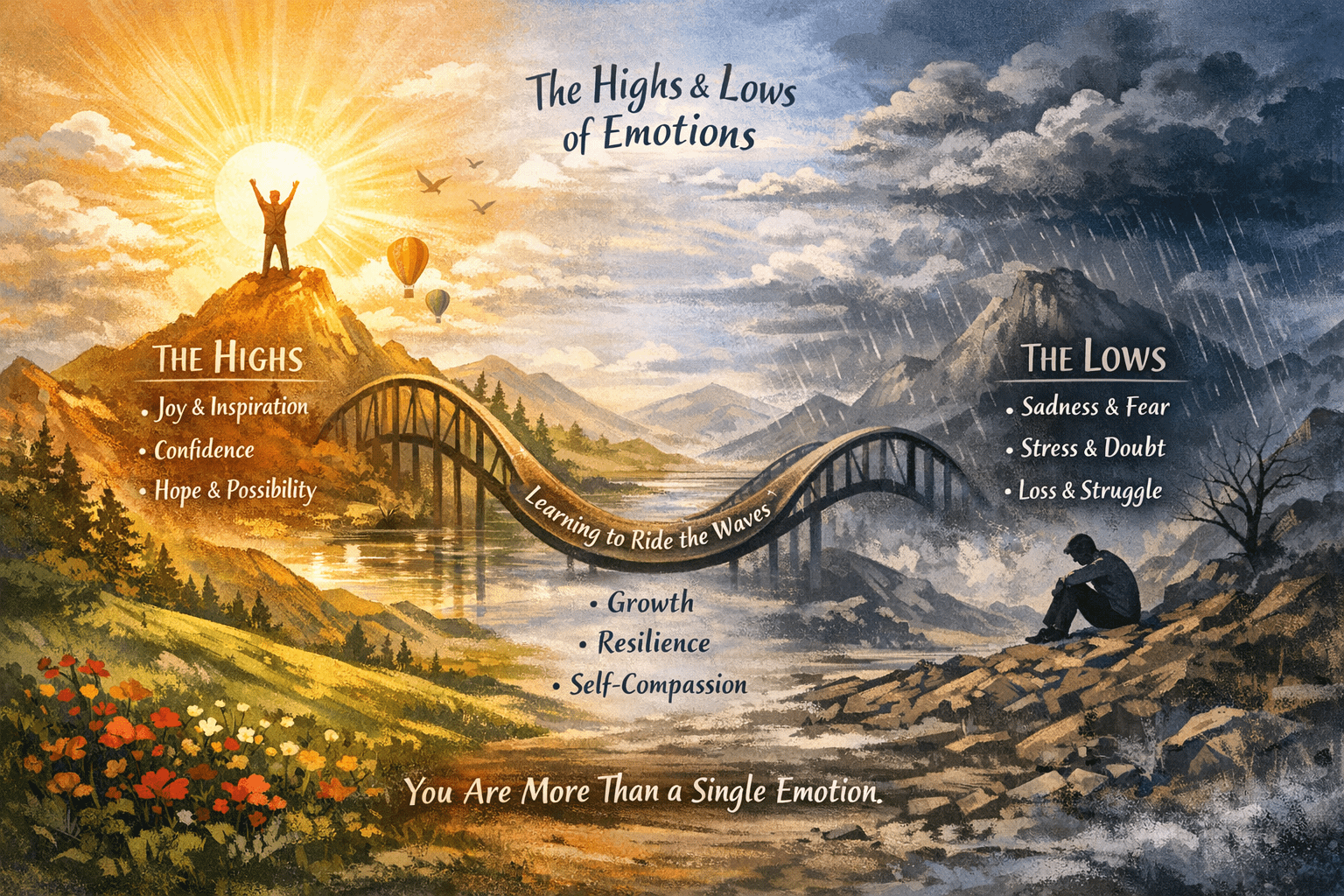
    The Highs and Lows of Emotions

    Advertisements

    Life is not lived in a straight line. It moves in waves—moments of clarity followed by confusion, joy followed by sorrow, confidence followed by doubt. Our emotions rise and fall just as naturally as the tide. These highs and lows are not signs of weakness or instability; they are the very rhythm of being human. To feel deeply is not a flaw—it is a reflection of our capacity to care, to hope, to love, and to grow.

    Understanding Emotional Highs

    Emotional highs are the moments when life feels meaningful and vibrant. They may come from major milestones—achieving a long-term goal, falling in love, finding purpose—or from small, quiet victories like being understood, feeling appreciated, or finally taking a breath after a long struggle.

    In these moments, we feel:

    • Motivated and energized

    • More connected to others

    • Confident in who we are

    • Hopeful about what lies ahead

    Highs remind us of our potential. They show us what we are capable of when we believe in ourselves. They give us proof that our effort matters, that growth is real, and that light does exist—even if we cannot always see it.

    Yet emotional highs are not meant to be permanent. If they were, they would lose their meaning. What makes them powerful is their contrast—the knowledge that they exist alongside difficulty.

    Understanding Emotional Lows

    Emotional lows are often misunderstood. They are seen as weakness, failure, or something to “get over.” In reality, emotional lows are part of our internal processing system. They surface when something inside us needs attention.

    Lows may be triggered by:

    • Loss, grief, or disappointment

    • Stress, exhaustion, or burnout

    • Feeling unseen or misunderstood

    • Fear of change or uncertainty about the future

    During these times, we may feel disconnected, heavy, or stuck. Our inner voice may become critical. Motivation fades. Hope feels distant. But emotional lows are not the end of our story—they are pauses that invite reflection.

    Pain reveals what matters. It shows us where we are hurting, where boundaries are needed, and where healing must begin. Often, the most meaningful transformations are born in moments when we feel broken, not when we feel comfortable.

    Why We Need Both the Highs and the Lows

    Without emotional highs, life would feel flat, mechanical, and uninspired. Without emotional lows, we would never develop depth, empathy, or resilience.

    • Highs show us what is possible.

    • Lows show us what is necessary.

    Our struggles teach us compassion for others. Our joy teaches us gratitude for the present. Together, they shape our identity. The person you are today is not defined by your happiest moments alone—but also by the challenges you survived, the nights you endured, and the strength you discovered when you thought you had none left.

    Learning to Ride Emotional Waves

    Emotional balance does not mean staying positive at all times. It means learning how to move through emotions rather than resisting them.

    1. Acknowledge What You Feel
    Suppressing emotions does not make them disappear—it simply buries them. Naming what you feel gives you power over it. Sadness, anger, fear, and confusion are not enemies; they are signals asking to be heard.

    2. Practice Emotional Self-Compassion
    You would not criticize a friend for struggling—so do not do it to yourself. When you are low, speak to yourself with patience and kindness. Growth is not linear, and healing has no deadline.

    3. Create Space for Reflection
    Emotions often carry messages about what is missing or misaligned in our lives. Ask yourself:
    What is this feeling trying to tell me?
    What do I need right now—rest, connection, change, or forgiveness?

    4. Honor Your Highs Without Fear
    Many people hesitate to enjoy happiness, worried it will be taken away. But joy is not something to ration. Celebrate progress. Savor peace. Let yourself feel proud of how far you have come.

    You Are More Than a Single Emotion

    No moment defines you. Not your best day. Not your worst. You are the sum of everything you have felt and everything you continue to become.

    Emotions are temporary visitors, not permanent identities. You are not your sadness. You are not your anxiety. You are not even your joy. You are the one experiencing them—learning from them, growing through them, and moving forward despite them.

    Finding Meaning in the Emotional Journey

    The highs remind us that life holds beauty.
    The lows remind us that we are human.

    Together, they give life its depth. They teach us resilience, empathy, gratitude, and self-awareness. They show us that strength is not the absence of struggle—it is the courage to keep going through it.

    When you accept both the light and the darkness within yourself, you stop fighting who you are and start becoming who you are meant to be.

    Read More Health & Wellness

  • Invisible Pain Day: Honoring the Struggles We Cannot See

    Advertisements

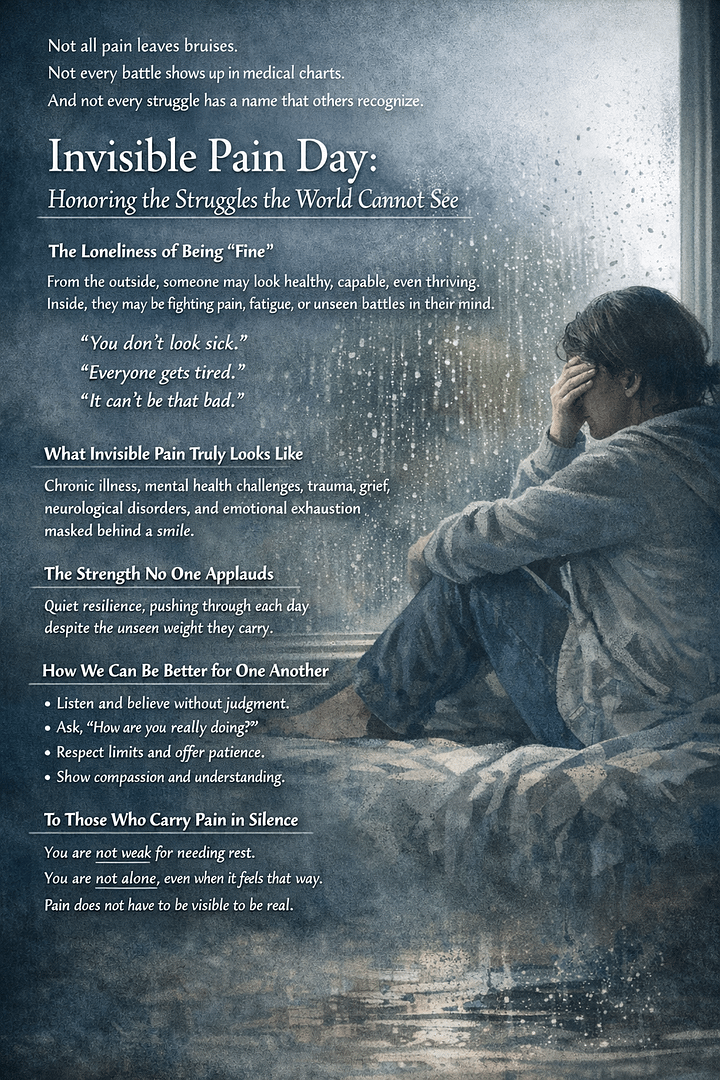
    Not all pain leaves bruises.
    Not every battle shows up in medical charts.
    And not every struggle has a name that others recognize.

    Invisible Pain Day exists to honor the millions of people who carry suffering that cannot be seen on the surface—those living with chronic illness, mental health challenges, trauma, grief, neurological conditions, autoimmune disorders, emotional wounds, and exhaustion that never truly lifts. These are the battles that don’t announce themselves, the hardships that don’t always receive sympathy, and the realities that are too often misunderstood or dismissed.

    The Loneliness of Being “Fine”

    One of the greatest burdens of invisible pain is the expectation to appear normal. From the outside, someone may look healthy, capable, even successful. Inside, they may be navigating constant pain, debilitating fatigue, anxiety that tightens the chest, or memories that resurface without warning.

    Because their struggle isn’t obvious, many people living with invisible pain hear phrases like:
    “You don’t look sick.”
    “Everyone gets tired.”
    “You were fine yesterday.”
    “It can’t be that bad.”

    Often these words are not meant to be cruel—but they can be deeply isolating. When pain isn’t visible, it becomes easier for the world to overlook it. And when someone feels unseen, they may stop trying to explain at all, choosing silence instead of repeatedly defending their reality.

    What Invisible Pain Truly Looks Like

    Invisible pain does not follow one shape or diagnosis. It lives in countless bodies and minds, in ways that rarely make headlines or receive long-term understanding.

    It can look like:

    • Chronic illnesses that fluctuate without warning

    • Mental health struggles hidden behind professionalism and smiles

    • Trauma that quietly shapes reactions, relationships, and trust

    • Grief that never fully leaves, even when life moves forward

    • Autoimmune conditions that attack from within

    • Neurological disorders that disrupt daily functioning

    • Emotional burnout from years of “pushing through”

    • Disabilities that do not match society’s expectations of what disability “looks like”

    Invisible pain may show up as canceled plans, long pauses before answering simple questions, or a person who seems “distant” when they are simply exhausted. It may sound like forced laughter or short replies when energy is gone. It may feel like surviving each day while carrying a weight that no one else can see.

    The Emotional Cost of Being Misunderstood

    Living with invisible pain often means navigating not only symptoms, but also doubt—from others and sometimes from oneself. Many people question their own experience when it is repeatedly minimized. They may wonder if they are being “too sensitive,” “too tired,” or “too weak,” even when their pain is real and ongoing.

    This constant invalidation can lead to:

    • Guilt for needing rest

    • Shame for canceling plans or asking for help

    • Anxiety about being perceived as unreliable

    • Fear of being judged or dismissed

    • Emotional withdrawal to avoid explanation

    When society measures health by appearance, those with invisible pain are often forced into a quiet performance—smiling through discomfort, showing up when they should be resting, and proving their worth through endurance rather than well-being.

    The Strength No One Applauds

    Those living with invisible pain develop a resilience that is rarely recognized. They manage medications, appointments, flare-ups, and emotional strain while continuing to fulfill roles as employees, parents, partners, friends, and caregivers. Their strength is not loud, but it is constant.

    They wake up each day unsure of how their body or mind will feel. They calculate energy before committing to tasks. They learn to adapt, to adjust expectations, to redefine what “success” looks like. They become experts in listening to their limits—often after years of being taught to ignore them.

    But strength should never be mistaken for ease.
    Just because someone continues doesn’t mean the journey is light.
    Just because they smile doesn’t mean they are not hurting.

    Why Invisible Pain Deserves Recognition

    Invisible Pain Day is about more than awareness—it is about validation. It is a reminder that pain does not require physical evidence to be real. That suffering is not less legitimate because it cannot be photographed, measured, or easily explained.

    It calls us to question a culture that praises productivity over well-being, that often asks, “What did you accomplish?” instead of “What did you survive?”

    Invisible pain deserves recognition because:

    • It affects daily functioning, relationships, and mental health

    • It shapes identity and self-worth

    • It requires emotional labor that few acknowledge

    • It demands resilience that often goes unseen

    When we honor invisible pain, we make space for honesty. We tell people they do not have to prove their suffering to deserve compassion.

    How We Can Be Better for One Another

    Invisible Pain Day also asks us to reflect on how we show up for others. Compassion does not require full understanding. We do not need to experience someone’s pain to respect it.

    Here are ways we can offer support:

    • Listen without minimizing. Avoid phrases that dismiss or compare pain.

    • Believe first. Trust people when they tell you they are struggling.

    • Be patient. Energy and ability can change from day to day.

    • Ask with care. “How are you really doing today?” can open space for honesty.

    • Respect boundaries. When someone says they need rest or space, honor it.

    • Offer flexibility. Understanding means allowing people to show up in the ways they can.

    Sometimes, the most meaningful support is not advice or solutions—but simply presence without judgment.

    To Those Who Carry Pain in Silence

    If you are living with invisible pain, know this: your experience is real. Your exhaustion is valid. Your need for rest is not weakness. Your limits do not define your worth.

    You are not dramatic for acknowledging your struggle.
    You are not broken for needing support.
    You are not alone—even when it feels that way.

    Invisible Pain Day is a reminder that you matter, even when your pain cannot be seen. That your strength counts, even when it goes unnoticed. And that your story deserves space, dignity, and compassion.

    Because pain does not have to be visible to be real.
    And healing begins when we choose to truly see one another.

    A Father’s Guide to Surviving the Loss of a Child

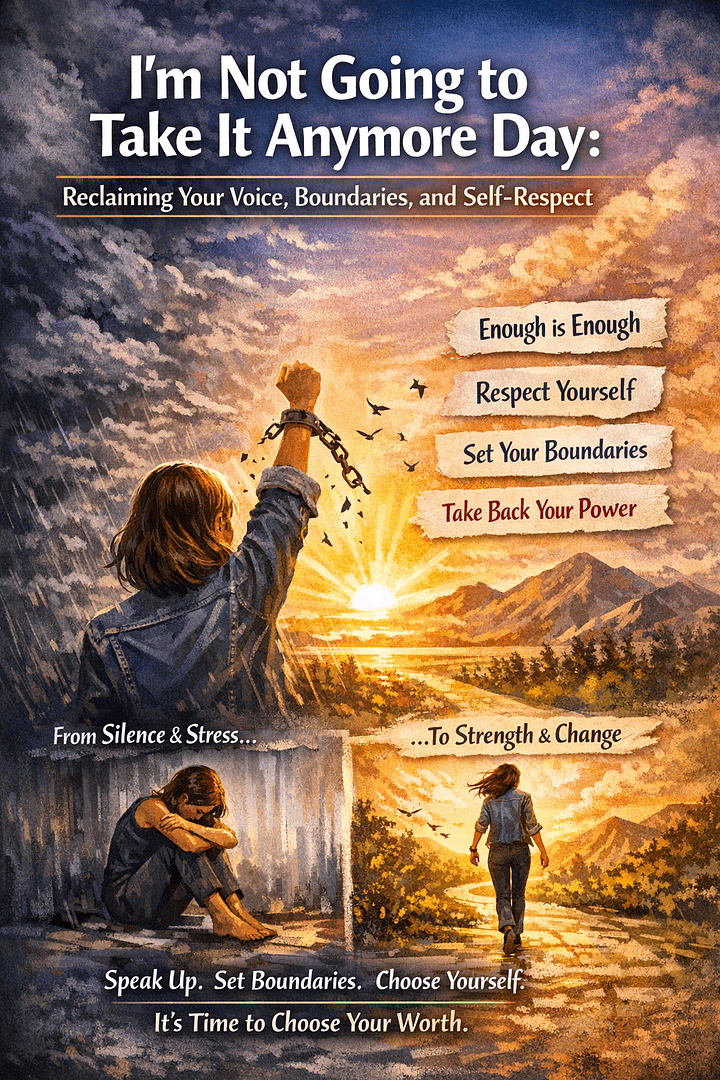
  • I’m Not Going to Take It Anymore Day: Reclaiming Your Voice, Boundaries, and Self-Respect

    Advertisements

    There comes a moment in every life when endurance stops feeling noble and starts feeling harmful. When “just getting through it” costs more than it gives. I’m Not Going to Take It Anymore Day exists for that moment—the quiet, powerful turning point when you realize that something in your life is no longer sustainable, no longer healthy, and no longer worthy of your energy.

    This day is not about rage, rebellion, or dramatic ultimatums. It is about awareness. It is about finally listening to the voice inside that has been whispering—sometimes for years—that you deserve better. It is the day when survival is no longer enough, and self-respect begins to take its rightful place.


    When Endurance Turns into Self-Neglect

    We are often praised for how much we can handle. For staying strong, being patient, “keeping the peace,” and pushing through discomfort. Endurance is treated like a virtue, even when it costs us our mental health, our sense of identity, or our joy.

    But there is a difference between resilience and self-abandonment.

    Resilience helps you rise after hardship.
    Self-abandonment keeps you trapped inside it.

    Many people remain in situations that slowly erode them—unhealthy relationships, draining jobs, emotional neglect, or even harmful habits—because leaving feels scary, confrontational, or uncertain. We tell ourselves: It could be worse. I should be grateful. I don’t want to rock the boat. And so we stay, shrinking a little more each day.

    “I’m Not Going to Take It Anymore Day” reminds us that reaching your limit is not a failure. It is awareness. It is the moment you stop numbing yourself to what hurts and start honoring what matters.


    Naming What You’re Done Accepting

    This day invites honest reflection—without guilt, without judgment.

    What have you been tolerating that quietly drains you?

    • A relationship where your needs are consistently dismissed.

    • A workplace that values productivity over your well-being.

    • A cycle of people-pleasing that leaves you exhausted and unseen.

    • A pattern of negative self-talk that tells you to settle for less.

    Sometimes what we’re “not taking anymore” isn’t something outside of us—it’s something we’ve been carrying within. Old beliefs that say you must earn love by overgiving. Fear that tells you change is too risky. Guilt that convinces you to stay where you are uncomfortable so others can remain comfortable.

    Letting go of these patterns is not selfish. It is necessary.


    The Courage to Say “Enough”

    Saying “I’m not going to take it anymore” does not always mean confrontation or walking away. Sometimes it means making a quiet but firm decision inside yourself: I will no longer ignore my needs.

    It can look like:

    • Speaking up instead of staying silent.

    • Asking for respect instead of accepting disregard.

    • Creating space where you’ve always felt crowded.

    • Choosing rest where you once chose burnout.

    This kind of courage is often invisible to the outside world, but it changes everything on the inside. It shifts the way you see yourself—from someone who endures to someone who chooses.


    Boundaries: The Language of Self-Respect

    At the heart of this day is the concept of boundaries. Boundaries are not punishments. They are not walls built out of anger. They are expressions of clarity and self-worth.

    When you say:

    • “I will not tolerate being spoken to this way,”

    • “I need balance in my life,”

    • “This situation is no longer healthy for me,”

    you are not being difficult—you are being honest.

    Healthy boundaries teach others how to treat you, but more importantly, they teach you that your time, energy, and emotional well-being matter. Every boundary you set is a declaration that you value yourself enough to protect what is precious.


    Change Doesn’t Have to Be Loud to Be Real

    Not every turning point comes with dramatic exits or bold announcements. Sometimes change begins in quiet, steady ways:

    • Choosing not to respond to what drains you.

    • Taking one small step toward something better.

    • Releasing one obligation that no longer fits who you are becoming.

    You don’t need to have everything figured out to begin. You only need the willingness to stop betraying your own needs.

    “I’m Not Going to Take It Anymore Day” is not about perfection or instant transformation. It is about momentum. About choosing, again and again, not to return to what diminishes you.


    Choosing Peace Over Approval

    One of the hardest parts of change is the fear of disappointing others. We worry about being misunderstood. About being labeled “too sensitive,” “too much,” or “selfish.” But choosing yourself will always upset any system that benefits from your silence.

    And that is okay.

    You were never meant to live your life solely to meet expectations that cost you your peace. Growth often requires discomfort—both yours and others’. But the discomfort of change is temporary. The discomfort of staying where you are unhappy can last a lifetime.


    Your Turning Point

    “I’m Not Going to Take It Anymore Day” is an invitation. Not to fight the world—but to stand with yourself. To stop carrying what is not yours to bear. To choose dignity over endurance, clarity over fear, and self-respect over quiet suffering.

    Whatever you have been tolerating that no longer aligns with who you are becoming—today is a day to acknowledge it. To honor your limits. To remind yourself that you are allowed to change your mind, rewrite your story, and step away from what no longer serves you.

    Because the moment you decide you will not accept what diminishes you is the moment you begin to reclaim your life.

    Read More Health & Wellness

    Read More Of Inspiration & Motivation

  • When the Past Is Haunting You While You’re Trying to Move Forward

    Advertisements

    Moving forward is often described as a clean break—a fresh start, a new chapter, a chance to leave everything behind. But real life rarely works that way. For many people, the past doesn’t stay in the past. It lingers quietly in the background or shows up unexpectedly, right when you’re trying your hardest to heal, grow, and become someone new. When the past is haunting you while you’re trying to move forward, progress can feel exhausting, confusing, and painfully slow.

    The past haunts us because unresolved pain doesn’t fade on its own. Experiences that hurt deeply—loss, trauma, betrayal, abandonment, failure, or regret—leave emotional imprints. Even when circumstances change, the emotions tied to those moments can resurface. You might find yourself reliving conversations, replaying mistakes, or feeling emotions that seem out of place in your current life. It’s not because you’re weak; it’s because your mind and heart are still trying to make sense of what happened.

    Trying to move forward while carrying unresolved pain can feel like walking through fog. You know where you want to go, but your vision is clouded by memories that won’t release their grip. Certain places, songs, dates, or even smells can pull you back without warning. One moment you’re focused on the future, and the next you’re overwhelmed by a past you thought you had already faced.

    What makes this especially difficult is the pressure—both internal and external—to “be over it.” Society often treats healing like a deadline, as if pain should expire after a certain amount of time. You may tell yourself you should be stronger by now, happier by now, more healed by now. This self-judgment can be just as painful as the memories themselves, creating shame on top of grief.

    Fear also plays a powerful role. The past haunts us when it taught us lessons through pain. If you were hurt deeply, your mind may try to protect you by staying alert, always watching for signs of danger. This can make it hard to trust again, love again, or fully embrace new opportunities. Even good things can feel threatening when your past taught you how quickly joy can turn into loss.

    Moving forward doesn’t mean erasing the past or pretending it didn’t shape you. It means learning how to carry your experiences in a way that doesn’t define or limit you. Healing is not about forgetting—it’s about integrating. The pain becomes part of your story, but it no longer controls how the rest of the story is written.

    There will be days when you feel strong and hopeful, convinced that you’re finally turning a corner. And then there will be days when the past feels closer than ever, when emotions resurface and progress feels undone. This doesn’t mean you’re failing. Healing is not linear. Growth often looks like revisiting the same wounds with a little more understanding each time.

    Sometimes the past haunts us because it still needs compassion. Not judgment. Not denial. Compassion. That may mean allowing yourself to grieve what you lost, acknowledge what hurt you, or forgive yourself for choices you made while doing the best you could with what you knew at the time. Letting yourself feel—without rushing the process—is often the most powerful step forward.

    You are allowed to move forward while still healing. You are allowed to build a future even if parts of you are still tender. Progress can be slow, quiet, and imperfect—and still be real. Each step you take, no matter how small, matters.

    One day, the memories that once haunted you will soften. They may still exist, but they won’t hold the same power. They will become reminders of what you survived rather than proof of what broke you. And when that day comes, you’ll realize that moving forward was never about outrunning the past—it was about learning how to walk alongside it without letting it lead.

    If the past is haunting you right now, know this: you are not stuck. You are healing. And even on the days it doesn’t feel like it, you are still moving forward.

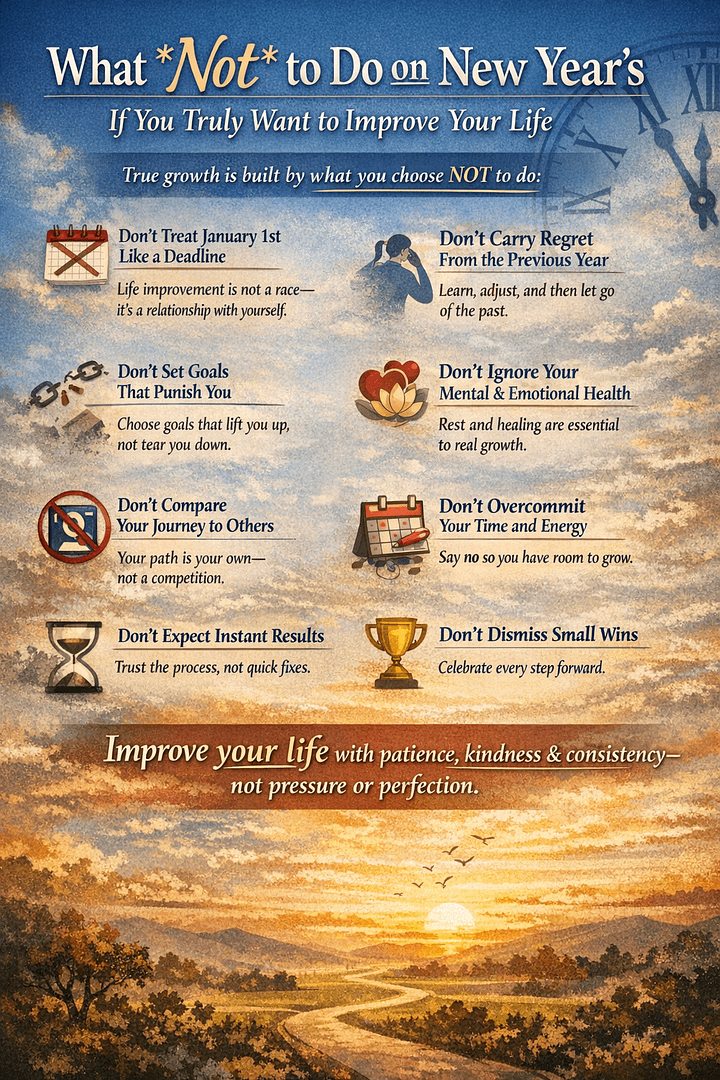
  • What Not to Do on New Year’s If You Truly Want to Improve Your Life

    Advertisements

    The arrival of a new year often comes with loud messages telling us to do more, be more, change faster. While the idea of a fresh start can feel inspiring, it can also create unnecessary pressure. Many people begin the year exhausted, overwhelmed, or discouraged—long before any real progress is made.

    If the goal is lasting improvement rather than temporary motivation, it’s just as important to know what not to do as it is to know what to do. True growth isn’t born from force; it’s built through awareness, compassion, and consistency.


    1. Don’t Treat January 1st Like a Deadline

    One of the biggest mistakes people make is believing they must have everything figured out by the first day of the year. This mindset turns the new year into a test instead of an opportunity.

    Life doesn’t reset overnight. Growth is ongoing, and meaningful change happens gradually. When you pressure yourself to “start perfectly,” you risk giving up as soon as things feel uncomfortable.

    Life improvement is not a race—it’s a relationship with yourself.


    2. Don’t Set Goals That Punish You

    Resolutions rooted in self-criticism—lose weight because I’m not enough, work harder because I failed, fix everything that’s wrong with me—are rarely sustainable. When goals come from shame, they drain motivation rather than build it.

    Improvement should feel supportive, not harsh. If a goal makes you feel anxious, exhausted, or inadequate before you’ve even begun, it may be time to rethink it.

    Choose goals that add to your life, not ones that make you feel smaller.


    3. Don’t Compare Your Journey to Someone Else’s Progress

    At the start of the year, social media becomes flooded with bold declarations, vision boards, and success stories. While inspiring to some, this constant comparison can quietly sabotage your confidence.

    Everyone starts the year with different circumstances, struggles, and resources. Comparing your chapter one to someone else’s chapter ten will only make you feel behind—even when you’re exactly where you need to be.

    Your path is valid, even if it looks quieter or slower than others’.


    4. Don’t Carry Regret From the Previous Year

    Many people enter the new year dragging the emotional weight of what they didn’t accomplish. Unfinished goals, missed opportunities, and past mistakes can linger like shadows.

    But regret doesn’t create change—it creates fear. The lessons of the past year are meant to guide you forward, not keep you stuck.

    You are allowed to learn, adjust, and move on without punishment.


    5. Don’t Ignore Rest, Healing, and Emotional Health

    Self-improvement is often framed around productivity, achievement, and hustle. What’s rarely discussed is how deeply important rest and emotional well-being are to long-term growth.

    If you’re mentally drained, emotionally grieving, or physically exhausted, pushing harder won’t fix it. Healing is not a delay—it’s a requirement.

    A well-rested, emotionally supported person grows faster than a burned-out one.


    6. Don’t Overcommit Your Time and Energy

    New year enthusiasm can lead to saying yes to every plan, project, and promise. Before long, you’re overwhelmed, resentful, and stretched too thin.

    Growth requires space. When your calendar is packed, there’s no room to reflect, adjust, or breathe.

    Learning to say no is one of the most powerful acts of self-improvement.


    7. Don’t Expect Immediate Results

    We live in a world that celebrates overnight success, but real change rarely works that way. Expecting quick outcomes sets you up for disappointment and self-doubt.

    Consistency may feel boring, but it’s where transformation lives. Small habits repeated daily will always outperform dramatic bursts of effort.

    Trust slow progress—it lasts longer.


    8. Don’t Dismiss Small Wins

    Many people overlook progress because it doesn’t feel “big enough.” But improvement is built from countless small choices that often go unnoticed.

    Waking up earlier, setting one boundary, choosing rest, or showing kindness to yourself—these are victories worth honoring.

    Small steps, taken consistently, create powerful change.


    Final Reflection

    The new year is not about becoming someone new. It’s about becoming more honest, more compassionate, and more aligned with who you already are.

    Let go of pressure. Release comparison. Replace perfection with patience.

    True life improvement doesn’t begin with grand resolutions—it begins with treating yourself like someone worth caring for.

    And that choice can start today, no matter what day the calendar says.

    Read More Of Health & Wellness

  • When You Can Feel Yourself Slipping Again: Signs, Truths, and a Reminder You’re Not Alone

    Advertisements

    There are moments in life when you can sense it—before anyone else notices, before anything dramatic happens on the outside. It’s that quiet shift inside you. The heaviness. The fog. The feeling that you’re slipping back into a space you worked so hard to climb out of.

    You don’t need a crisis to know something is getting bad again. Often, it shows up in the small, subtle ways first.

    Your body feels it.

    You start sleeping far too much or hardly at all. Your appetite swings from nothing to everything. Your energy fluctuates in ways that make no sense. Even simple tasks feel exhausting. You catch yourself rubbing your eyes, your forehead, your temples—as if you could physically push the overwhelm away.

    You might notice your hands shaking, your heart racing, or an ache in your chest that has nothing to do with physical pain. These are signs—not of weakness—but of a body signaling that it’s overwhelmed.

    Your mind starts disconnecting.

    You space out more than usual. Time slips away from you. You feel uninterested, numb, or detached, even from things you once enjoyed. You ramble too much because you’re trying to force clarity… or you don’t speak at all because you can’t find the words.

    You catch your thoughts turning darker or more cynical, especially about yourself. It’s not that you want to be negative—you’re just tired, worn, and trying to make sense of your own emotions.

    Your heart retreats for protection.

    You avoid conversations that feel too heavy. You avoid eye contact. You don’t want to burden anyone, so you push people away before they can ask what’s wrong. Not because you don’t care—because you care too much. Because you’re afraid of letting them see you unravel.

    You choose isolation over explanation. And even though part of you wants connection, another part is convinced it’s safer to withdraw.

    These signs aren’t failure—they’re signals.

    They’re your mind and body whispering, “Hey… something’s off. Something hurts. Please listen.”

    These behaviors don’t mean you’re broken.
    They mean you’re overwhelmed.
    They mean you’re carrying too much.
    They mean you’ve pushed through for so long that your system is begging for rest, support, and compassion.

    What You Can Do When It’s Getting Bad Again

    Talk to someone, even if it’s just one safe person. You don’t need perfect words—just honesty.

    Slow down, even if only for a moment. Small pauses can interrupt spirals.

    Take care of your basics—eat, drink water, rest. Your foundation matters.

    Do one gentle thing for yourself, not to fix everything, but to show yourself you’re worth care.

    Reach out for professional support if you’re able; having guidance matters, especially during heavy seasons.

    Most importantly: give yourself grace.

    You’ve survived every hard day up to this one.
    You’re more resilient than you feel right now.
    And what you’re experiencing doesn’t make you weak—
    it makes you human.

    You’re not going backward. You’re noticing the signs early. That awareness is strength. That awareness is hope.

    And you don’t have to navigate this season alone.

    A Father’s Guide to Surviving the Loss of a Child

  • We Fight Monsters: Battling Darkness, Restoring Hope

    Advertisements

    What Is We Fight Monsters?

    We Fight Monsters is a U.S.-based non-profit organization founded by Ben and Jessica Owen. Headquartered in Memphis, Tennessee, its core work confronts and combats human trafficking, narcotics trafficking, addiction, and the ripple effects of violence and homelessness.

    Their mission combines intervention, rehabilitation, and community restoration. They aim not just to rescue individuals but to provide sustained support, reintegrate people into healthy living, and address systemic issues that enable exploitation and addiction.

    Who Are the Founders & Key People

    Ben and Jessica Owen are co-founders. Their backgrounds deeply inform the organization’s work: they both experienced addiction, homelessness, arrests, and in Jessica’s case childhood trauma. These experiences drive their empathy and understanding in working with people facing similar crises.

    The leadership draws in people with diverse experiences: former special operators, law enforcement professionals, ex-gang members, and people in recovery. This composition enables a mix of practical operational knowledge, outreach capability, and lived experience.

    What We Fight Monsters Does: Programs & Operations

    Here are the main pillars of their work:

    Rescue & Recovery Initiatives
    They locate and assist individuals trapped in sex trafficking, narcotics addiction, homelessness, or in perilous living situations. Those rescued are then moved into treatment, safe housing, or recovery programs.

    Safe & Transitional Housing
    Refuge is a priority: We Fight Monsters partners to build or renovate facilities like the “Hope House” in Memphis, which offer trauma-informed care, transitional housing, and longer-term support to survivors.

    Neighborhood & Community Revitalization
    They run operations aimed at reclaiming neighborhoods: shutting down harmful or exploitative houses, especially those used for drug dealing or trafficking, transforming them into recovery or safe living spaces. Community restoration efforts are part of their strategy.

    Advocacy & Collaboration
    They work with law enforcement, street gangs, and community agents to build trust, gather intelligence, and effect change from multiple fronts. Recently, they joined with other nonprofits in multi-state coordinated efforts to surge against trafficking networks.

    Support Services & Rehabilitation
    After rescue, there is care: shelters, sober-living, addiction recovery, psychological and trauma informed support. The aim is to help people not just survive but rebuild.

    Recent Collaborations & Highlights

    Interstate Justice Coalition: In 2025, We Fight Monsters partnered with other organizations to form this coalition. The purpose is to conduct surge operations across multiple U.S. states to disrupt trafficking networks, rescue victims, and amplify law enforcement and civic efforts.

    Hope House, Memphis: Alongside partners, they are renovating a facility in Memphis to provide safe housing and comprehensive care to survivors of sex trafficking.

    Quantifiable Impact: According to their public reporting, they have reclaimed a number of lives — people recovered from addiction, safe housing provided, homeless families rehoused, babies born into safer environments.

    Strengths & Challenges
    Strengths

    Lived Experience: Because many in leadership and operation have personal history with addiction, homelessness, or trafficking, there’s authenticity and empathy in their interventions. This often builds trust where purely institutional efforts might falter.

    Multi-Front Approach: Rescue + rehabilitation + community restoration + advocacy = more holistic impact.

    Collaborative Model: They partner with other nonprofits, law enforcement, and even groups often considered “outside the system” to reach places many organizations can’t or won’t.

    Community Engagement: Their operations aren’t just top-down rescues, but involve neighborhoods and volunteers. This helps in sustainability and broader awareness.

    Challenges

    Scale & Resources: To meet the level of need in human trafficking, addiction, and community decay, enormous resources—financial, personnel, logistical—are required. Nonprofits often run on limited budgets.

    Complexity of Trauma: Survivors of trafficking or addiction often have deep trauma. Healing is not linear; relapse, setbacks, legal and mental health challenges are common. Sustained, long-term support is demanding.

    Coordination & Risk: Working in dangerous or legally sensitive areas involves risks: safety, legal liability, confidentiality, and ensuring operations don’t re-traumatize survivors. Coordination with law enforcement and other agencies sometimes has bureaucratic or trust-barrier challenges.

    Public Awareness & Stigma: Topics like addiction, human trafficking, and former gang involvement still carry stigma. Raising awareness in a way that draws support and reduces stigma is always tough.

    Impact & Why It Matters

    We Fight Monsters represents a model of social change built from the ground up, motivated by personal stories of survival. Its impact is two-fold:

    For individuals: offering rescue, healing, and a path out of cycles of abuse, addiction, and exploitation.

    For communities: restoring safety, reclaiming neighborhoods, and reducing harm by addressing root causes rather than only symptoms.

    Moreover, by increasing awareness, forming coalitions, and setting up survivor-centered facilities, it contributes to systemic change. It demonstrates that interventions which are compassionate, operationally grounded, and coalition-based can make meaningful inroads into some of society’s most intractable problems.

    Looking Ahead

    Some of the opportunities and possible directions for growth:

    Expanding safe homes and recovery houses in more locations.

    Strengthening aftercare and reintegration programs, especially for survivors of trafficking and long-term addiction recovery.

    Building more robust partnerships with mental health services, legal support, and housing agencies.

    Increasing fundraising and resource mobilization to sustain and scale operations.

    Public education campaigns to reduce stigma, especially around addiction and trafficking, so communities are more informed, supportive, and engaged.

    Conclusion

    We Fight Monsters is more than a name—it’s a movement. It’s an organization that fights both visible and invisible battles: against trafficking, addiction, homelessness, and trauma. Born out of personal suffering, it channels hard-won insight into real change. While the obstacles are great, the combination of lived experience, operational capacity, community engagement, and collaboration gives We Fight Monsters the potential to make a deep, lasting difference.

    Read More Health & Wellness

  • Turning Pain Into Action: Finding Strength in Struggle

    Advertisements

    Pain is something we cannot escape in life. It shows up in many forms—heartbreak, grief, failure, rejection, or life changes we didn’t ask for. When we are in the middle of it, pain feels heavy, suffocating, and endless. It can leave us questioning our worth, our purpose, and even our ability to move forward.

    But here’s the truth: pain, as difficult as it is, doesn’t have to destroy us. It can shape us. It can teach us. And when we decide to use it as fuel instead of a chain, pain can become the very thing that propels us toward growth, strength, and purpose. Turning pain into action is not about ignoring your struggles or pretending everything is fine—it’s about choosing to rise, step by step, and allowing your hardest moments to become your greatest teachers.

    Pain as a Teacher, Not a Punishment

    When we’re hurting, it’s natural to ask, “Why me?” or “What did I do to deserve this?” But pain isn’t punishment—it’s part of being human. Every person on earth experiences it, and while we cannot control when or how it comes, we can control how we respond to it.

    Pain strips away the illusions of comfort and control, forcing us to look deeper. It often reveals strengths we didn’t know we had, and it sharpens our vision about what truly matters in life. Sometimes, the pain we go through pushes us to make changes we never would have considered otherwise—changes that ultimately lead us to healthier, more authentic, and more fulfilling paths.

    Steps to Transform Your Pain Into Action

    Turning pain into growth doesn’t happen overnight. It’s a process that takes patience, intention, and courage. Here are some steps to guide the transformation:

    1. Acknowledge the Pain Fully

    Growth starts with honesty. Too often we push pain down, avoid it, or distract ourselves. But unacknowledged pain lingers. Facing it directly—through journaling, reflection, or talking with someone you trust—allows you to release its grip. Naming the struggle gives you clarity and opens the door to healing.

    2. Give Meaning to the Experience

    When life hurts, meaning helps us endure. Ask yourself: What can this teach me? How can this shape me for the better? This doesn’t mean the pain was “meant to be” or that it was fair—it means you are reclaiming control by choosing what you will take from it. Finding purpose in suffering transforms it into a stepping stone rather than a stumbling block.

    3. Redirect the Energy

    Pain stirs up powerful emotions—anger, sadness, frustration, restlessness. Left unmanaged, these emotions can consume us. But when channeled, they become fuel for progress. You might pour your energy into physical movement, creative expression, personal goals, or even helping others who are walking a similar path. Action turns pain from something that holds you down into something that moves you forward.

    4. Surround Yourself With Support

    Pain can make us feel isolated, like no one else understands. But healing happens in connection. Whether it’s family, friends, mentors, or support groups, sharing your journey brings encouragement and strength. Sometimes, the simple act of being heard is the first step toward transformation. And when you surround yourself with people who lift you up, you realize you are not alone in your struggles.

    5. Commit to Growth

    Turning pain into action is not a one-time event—it’s a daily choice. Some days will feel like progress, others will feel like setbacks. Both are part of the journey. What matters is that you keep moving forward, even in small ways. Choose one thing each day that brings you closer to healing and growth. Over time, those small actions add up to lasting change.

    Real-Life Growth Through Pain

    History, and even our own communities, are full of examples of people who transformed their deepest struggles into powerful growth:

    Survivors of loss who start support groups, helping others navigate grief.

    Individuals who experienced failure, only to use it as the foundation for future success.

    People who faced rejection but used it to fuel determination and pursue dreams they once thought impossible.

    Their stories remind us of a simple truth: pain does not have to be the end of the story. It can be the beginning of something new.

    Turning Pain Into Your Power

    At its core, pain is energy. Left unchecked, it weighs us down. But redirected, it can become power—the kind of power that builds resilience, strengthens character, and ignites courage. When you take your pain and turn it into action, you stop being defined by what happened to you and start being defined by how you responded.

    Final Thought

    No one asks for pain, but everyone faces it. And when it comes, you have a choice: to let it break you, or to let it build you. Pain may change your story, but it doesn’t have to be the ending. It can be the spark of transformation, the fuel for your growth, and the reason you discover just how strong you truly are.

    Your pain can push you.
    Your action can define you.
    And your growth can inspire others.

    Read More Health & Wellness

  • National Recovery Month: Celebrating Hope, Healing, and Resilience

    Advertisements

    Every September, communities across the United States observe National Recovery Month—a time dedicated to celebrating the strength of those in recovery from substance use and mental health disorders. Established in 1989, this national observance highlights the importance of treatment, support services, and community, while spreading the powerful message that recovery is possible.

    Why Recovery Month Matters

    Millions of individuals and families are affected by addiction and mental health challenges. While these struggles can be overwhelming, National Recovery Month shines a light on the reality that people do recover and go on to lead fulfilling, healthy, and meaningful lives.

    This observance seeks to:

    Honor individuals in recovery and their journeys.

    Recognize the professionals and organizations who provide care and support.

    Educate the public about effective treatment and recovery services.

    Reduce stigma by normalizing conversations around addiction and mental health.

    The Power of Recovery

    Recovery is not a single event, but a lifelong process. It looks different for every person, whether it involves therapy, peer support, medication-assisted treatment, faith, or a combination of resources. What unites all recovery stories is resilience, determination, and the courage to seek a healthier future.

    By sharing recovery stories, communities inspire hope for those who may be just beginning their journey or who are still struggling. Hearing that “you are not alone” can be a turning point for someone in need.

    How Communities Can Get Involved

    National Recovery Month encourages individuals, families, and organizations to participate in raising awareness and supporting those in recovery. Some ways to get involved include:

    Hosting or attending local recovery events, walks, or workshops.

    Sharing personal stories of recovery to inspire others.

    Promoting recovery resources on social media.

    Volunteering with local mental health or substance use organizations.

    Advocating for accessible and affordable treatment services.

    Support and Resources

    For anyone seeking help, support is always available. In the U.S., you can call the 988 Suicide & Crisis Lifeline or SAMHSA’s National Helpline at 1-800-662-HELP (4357), a free, confidential service that provides treatment referrals and information 24/7.

    A Month of Hope and Connection

    National Recovery Month is about more than awareness—it’s about hope, empowerment, and community. It celebrates the millions of Americans who are living proof that recovery is possible, while also reminding us that compassion, understanding, and support are vital in helping others begin their own journeys.

    When we come together to recognize recovery, we help break down barriers and build a culture where seeking help is seen as a sign of strength.

    Read More Holidays & National Days

  • National Suicide Prevention Awareness Month: Shining a Light on Hope

    Advertisements

    Every September, communities across the United States come together to observe National Suicide Prevention Awareness Month. This month-long initiative is dedicated to raising awareness about suicide, breaking the stigma surrounding mental health struggles, and reminding people that help is always available.

    Suicide is one of the leading causes of death worldwide, impacting people of all ages, backgrounds, and walks of life. Behind the statistics are families, friends, and communities forever changed by loss. While the topic can be difficult to talk about, open conversations are essential to preventing suicide and supporting those who may be struggling.

    Why Awareness Matters

    Stigma often keeps individuals from reaching out for help. National Suicide Prevention Awareness Month provides an opportunity to:

    Educate the public about warning signs and risk factors.

    Encourage those who are struggling to seek help without shame.

    Empower communities with resources to support friends, family, and coworkers.

    Honor those who have been lost while offering hope to those still fighting.

    Recognizing the Warning Signs

    Being able to identify the warning signs of suicide can save lives. Some signs may include:

    Talking about feeling hopeless, trapped, or being a burden.

    Withdrawing from friends, family, or activities.

    Sudden mood changes, including extreme sadness or calmness after turmoil.

    Giving away possessions or saying goodbye.

    If you notice these behaviors in someone you know, it’s important to reach out, listen without judgment, and encourage them to seek professional help.

    How to Make a Difference

    Everyone has a role to play in suicide prevention. You can make an impact by:

    Starting conversations about mental health in your community or workplace.

    Sharing resources and helplines on social media.

    Supporting organizations dedicated to mental health and suicide prevention.

    Checking in regularly with loved ones, even when they seem “fine.”

    Resources and Support

    If you or someone you know is struggling, remember you are not alone. In the U.S., you can dial or text 988, the Suicide & Crisis Lifeline, for free and confidential support 24/7.

    Additional resources include:

    The National Alliance on Mental Illness (NAMI)

    The American Foundation for Suicide Prevention (AFSP)

    Crisis Text Line: Text HELLO to 741741

    A Month of Remembrance and Hope

    National Suicide Prevention Awareness Month is not only about loss—it is also about hope. It reminds us that recovery is possible, that conversations matter, and that reaching out can save lives. By standing together, raising awareness, and supporting one another, we can help build a world where no one feels alone in their struggles.

    Read More Holidays & National Days

Exit mobile version