
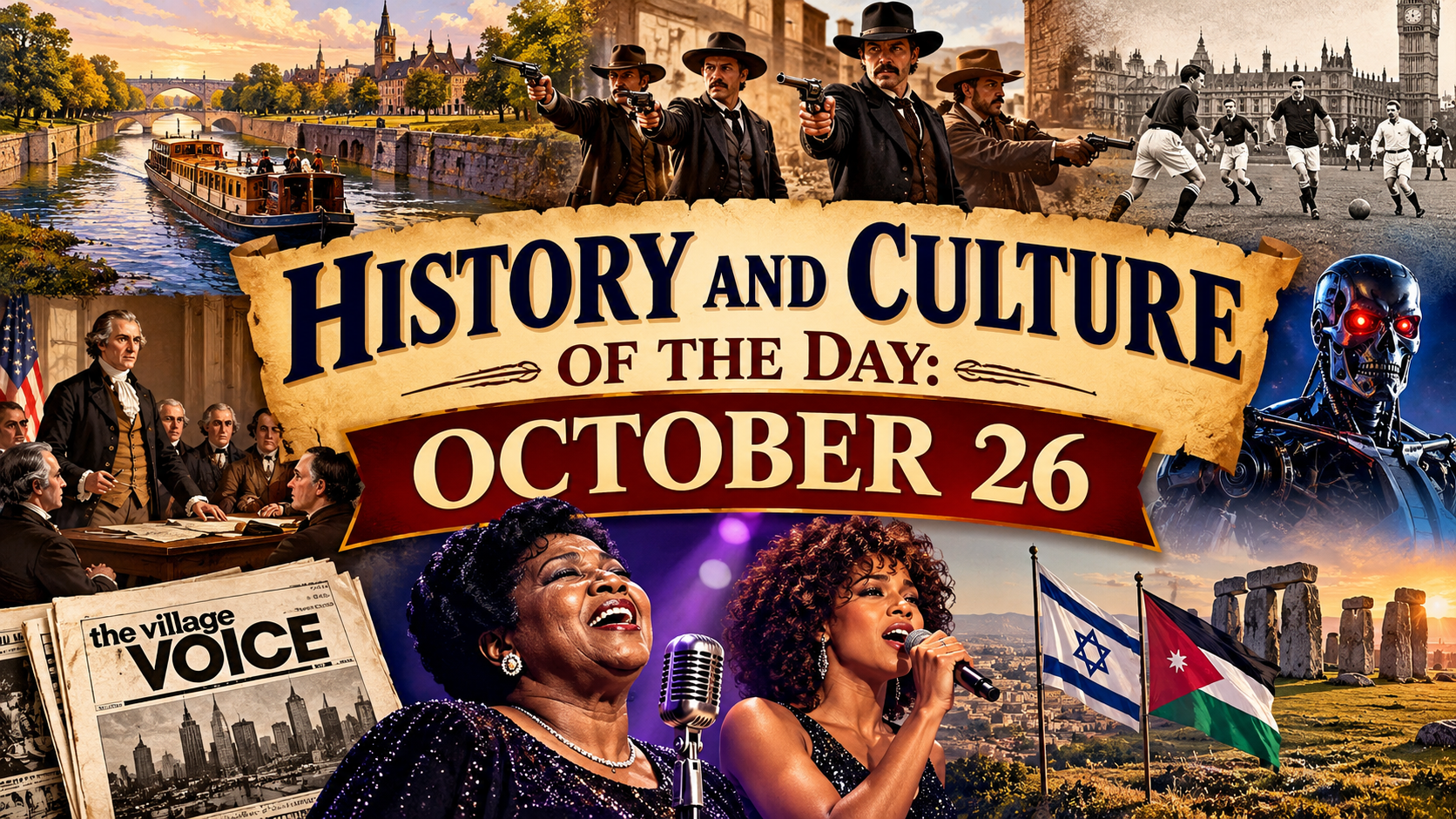
Every date on the calendar carries a story. Some days are remembered for historic battles, scientific discoveries, or political turning points. Others are celebrated through traditions, art, literature, and the achievements of people who changed the world.
October 26 is one of those dates that brings together history and culture in fascinating ways.
From the opening of a legendary transportation route to the publication of a beloved children’s book, October 26 reminds us that history is not simply a collection of dates. It is the story of human ambition, creativity, struggle, and progress.
Today, we explore the events, people, and cultural influences that make October 26 worth remembering.
1. The Erie Canal Opens — October 26, 1825
One of the most important transportation achievements in early American history occurred on October 26, 1825, when the Erie Canal officially opened.
Stretching approximately 363 miles across New York State, the canal connected the Hudson River near Albany with Lake Erie at Buffalo.
Before its construction, transporting goods between the Atlantic coast and the American interior was expensive, slow, and difficult.
The Erie Canal changed that.
Why the Erie Canal mattered
The canal created a major commercial transportation route between the Great Lakes region and the Atlantic Ocean.
Its impact included:
-
Reducing transportation costs for agricultural products and manufactured goods.
-
Helping New York City become a dominant commercial center.
-
Encouraging settlement and economic development across western New York and the Midwest.
-
Supporting the growth of communities along the canal.
-
Demonstrating the possibilities of large-scale American infrastructure projects.
Governor DeWitt Clinton was a leading advocate of the project, which critics initially dismissed as unrealistic.
When the canal opened, Clinton traveled along the waterway to New York Harbor, where he ceremonially poured Lake Erie water into the Atlantic in an event remembered as the Wedding of the Waters.
Cultural significance
The Erie Canal became more than an engineering achievement. It helped shape American identity during a period of westward expansion and economic transformation.
Songs, stories, and local traditions developed around canal life. Workers, boat operators, merchants, and families helped create a distinct canal culture.
Today, the Erie Canal remains an important symbol of innovation and the determination to connect communities through transportation.
2. The Gunfight at the O.K. Corral — October 26, 1881
One of the most famous confrontations in the history of the American West took place on October 26, 1881, in Tombstone, Arizona Territory.
The Gunfight at the O.K. Corral involved lawmen associated with the Earp family and a group of men known as the Cowboys.
Among the participants were Wyatt Earp, Virgil Earp, Morgan Earp, and Doc Holliday.
The confrontation lasted approximately 30 seconds, yet it became one of the most recognizable events in Western history.
Three men were killed, and several others were wounded.
The reality behind the legend
Hollywood often portrays the confrontation as a simple battle between heroic lawmen and dangerous outlaws.
The historical reality was considerably more complicated.
Tombstone was a rapidly growing mining community where economic competition, political disagreements, personal rivalries, and disputes over law enforcement created considerable tension.
The gunfight represented the culmination of those conflicts.
Its influence on American culture
The confrontation inspired countless Western movies, television programs, novels, and historical reenactments.
Films such as Tombstone (1993) and Wyatt Earp (1994) helped introduce the story to new generations.
The event also demonstrates how historical incidents can become larger-than-life legends.
Over time, storytelling can simplify complicated people and circumstances into recognizable heroes and villains.
The Gunfight at the O.K. Corral reminds us that understanding history requires looking beyond entertainment to examine the people and circumstances involved.

3. The Football Association Is Founded — October 26, 1863
On October 26, 1863, representatives of several football clubs gathered in London to establish the Football Association.
This meeting marked a significant moment in the development of modern association football, known as soccer in the United States.
During the nineteenth century, different schools and clubs played various forms of football, often following different rules.
Some permitted players to handle the ball, while others emphasized kicking.
The creation of the Football Association helped begin the process of establishing standardized rules.
How soccer became a global cultural phenomenon
The development of organized football eventually contributed to the growth of professional leagues, international competitions, and worldwide sporting traditions.
Today, soccer connects communities across continents.
Its cultural importance extends beyond athletic competition.
Soccer can represent national pride, neighborhood identity, family traditions, and a shared love of competition.
From children playing in neighborhood parks to international tournaments watched by millions, the sport demonstrates how a common activity can unite people across languages and cultures.
A lasting lesson
The founding of the Football Association reminds us that cooperation and shared rules can transform a collection of local activities into something with worldwide influence.
What began as an effort to organize a sport ultimately helped shape one of the world’s most recognizable cultural traditions.
4. The First Continental Congress Adjourns — October 26, 1774
On October 26, 1774, the First Continental Congress concluded its meetings in Philadelphia.
Delegates from twelve of Britain’s thirteen mainland American colonies had gathered to discuss their growing disagreements with British rule.
The meetings occurred during a period of increasing political tension over taxation, colonial rights, and British policies.
Although the delegates did not declare independence in 1774, their discussions represented an important step toward organized colonial resistance.
Why the meeting mattered
The First Continental Congress demonstrated that separate colonies could cooperate on issues affecting their shared interests.
Delegates debated political principles, developed coordinated responses to British policies, and helped establish a framework for future cooperation.
Their efforts contributed to the political developments that eventually led to the American Revolution.
Cultural impact
The Congress also helped shape an emerging American political identity.
Colonists who had previously viewed themselves primarily as residents of individual colonies increasingly recognized common concerns.
Ideas about representation, liberty, political accountability, and collective action became central to the growing revolutionary movement.
The events of October 26, 1774, remind us that major historical transformations often begin with discussion, organization, and the willingness to challenge established authority.
5. The Village Voice Begins Publication — October 26, 1955
On October 26, 1955, a new weekly newspaper began publication in New York City.
Its name was The Village Voice.
Founded by Dan Wolf, Ed Fancher, and Norman Mailer, the publication became an influential voice in American alternative journalism.
Its first issue contained just twelve pages and sold for five cents.
Despite its modest beginning, the newspaper would become associated with cultural criticism, investigative reporting, politics, music, theater, and artistic expression.
A platform for independent voices
The Village Voice became especially important because it offered coverage and perspectives that were not always represented in mainstream newspapers.
Its writers examined subjects including:
-
Underground music and emerging artistic movements.
-
Independent theater and experimental performance.
-
Political activism and social change.
-
New York City’s neighborhoods and cultural communities.
-
Film, literature, and contemporary social issues.
The publication helped document the cultural transformations of the second half of the twentieth century.
Why alternative journalism matters
Independent publications can provide opportunities for writers, artists, and community members whose experiences might otherwise receive limited attention.
The history of The Village Voice illustrates the importance of maintaining space for cultural criticism, unconventional ideas, and independent expression.
It also reminds us that a small publication can develop a substantial influence when it speaks to the interests and concerns of its readers.
6. Mahalia Jackson Is Born — October 26, 1911
October 26 also marks the birthday of one of the most influential gospel singers in American history.
Mahalia Jackson was born on October 26, 1911, in New Orleans, Louisiana.
She became internationally recognized for her extraordinary voice, emotional performances, and contributions to gospel music.
Often called the Queen of Gospel, Jackson helped bring the genre to audiences far beyond its traditional church settings.
The power of gospel music
Gospel music developed through generations of African American religious and musical traditions.
It combines spiritual messages with powerful vocal expression and musical influences that helped shape American popular music.
Jackson’s performances reflected faith, perseverance, sorrow, hope, and spiritual strength.
Her music connected with audiences because it expressed emotions that crossed cultural and social boundaries.
Music and the Civil Rights Movement
Mahalia Jackson was also closely associated with the American Civil Rights Movement.
She supported the movement and performed at significant gatherings, including the 1963 March on Washington.
Her participation demonstrated how music could become an important part of the struggle for equality and justice.
Jackson’s legacy reaches beyond her recordings.
She represents the ability of music to comfort people, strengthen communities, preserve cultural traditions, and inspire social change.
Her birthday offers an opportunity to recognize the contributions of gospel music to American cultural history.
7. The Assassination of South Korean President Park Chung-hee — October 26, 1979
On October 26, 1979, South Korean President Park Chung-hee was assassinated by Kim Jae-gyu, the director of the Korean Central Intelligence Agency.
Park had ruled South Korea since taking power in a military coup in 1961.
His presidency was associated with rapid industrial development and economic transformation, but also authoritarian government, political repression, and restrictions on democratic freedoms.
A turning point in South Korean history
Park’s assassination created considerable political uncertainty.
Although some hoped his death would lead quickly to democratic reforms, South Korea experienced further political turmoil and military intervention.
The country would not achieve its decisive democratic transition until later in the 1980s.
Understanding its cultural significance
South Korea’s modern history demonstrates the complicated relationship between economic growth, political authority, civil rights, and national identity.
The legacy of Park Chung-hee remains debated because his leadership involved both major economic developments and serious violations of democratic principles.
Remembering October 26, 1979, encourages a broader understanding of how political decisions affect ordinary people and how societies struggle to balance stability, prosperity, and freedom.
8. The Terminator Arrives in Theaters — October 26, 1984
On October 26, 1984, the science-fiction action film The Terminator was released in the United States.
Directed by James Cameron and starring Arnold Schwarzenegger, the movie introduced audiences to a frightening vision of a future shaped by intelligent machines.
Its story follows a cyborg assassin sent from the future to kill Sarah Connor, whose unborn son will become an important leader in humanity’s resistance against machines.
Why the film became culturally influential
The Terminator combined action, science fiction, suspense, and questions about humanity’s relationship with technology.
Its success helped establish a major film franchise and influenced the development of modern science-fiction storytelling.
The film also popularized discussions about artificial intelligence, autonomous machines, and the possibility of technology escaping human control.
Technology and the human imagination
Science fiction frequently explores fears and hopes surrounding emerging technologies.
While The Terminator presents an extreme fictional scenario, its themes encourage audiences to consider important questions.
How much control should humans give to machines?
What responsibilities accompany technological innovation?
Can scientific progress create dangers that society fails to anticipate?
These questions remain relevant as artificial intelligence and automation continue to develop.
The film’s October 26 anniversary demonstrates how popular entertainment can influence cultural conversations about science, ethics, and the future.

9. Whitney Houston Reaches Number One — October 26, 1985
On October 26, 1985, Whitney Houston reached number one on the Billboard Hot 100 with her recording of Saving All My Love for You.
The achievement marked her first number-one single on that chart.
Houston would go on to become one of the most celebrated vocalists in popular music.
A voice that influenced generations
Whitney Houston’s extraordinary vocal range, technical ability, and emotional delivery helped establish her as an international superstar.
Her music brought together influences from gospel, soul, rhythm and blues, and pop.
Songs such as Greatest Love of All, I Wanna Dance with Somebody, and I Will Always Love You became defining recordings of their eras.
Cultural legacy
Houston helped shape expectations for vocal performance in contemporary popular music.
Her influence can be heard in generations of singers who followed her.
The October 26 milestone represents the beginning of an extraordinary period of commercial success and cultural influence.
It also highlights how one recording can introduce an artist to a worldwide audience and help change the direction of popular music.
10. The Israel–Jordan Peace Treaty — October 26, 1994
On October 26, 1994, Israel and Jordan signed a historic peace treaty.
The agreement formally ended the state of war between the two countries and established a framework for diplomatic relations and cooperation.
The treaty was signed at a ceremony near their shared border, attended by international leaders.
Why the agreement mattered
The treaty addressed several important issues, including borders, water resources, security arrangements, and diplomatic cooperation.
It represented a major development in Middle Eastern diplomacy.
Although regional tensions and political disagreements have continued, the agreement remains an important example of two neighboring countries attempting to resolve longstanding disputes through negotiation.
The cultural importance of peace
Peace agreements involve more than political leaders signing documents.
They can affect the daily lives of families, communities, businesses, and future generations.
Successful diplomatic relationships may create opportunities for cultural exchange, tourism, trade, and greater understanding between societies.
The October 26 anniversary serves as a reminder that cooperation often requires difficult negotiations, compromises, and a willingness to imagine a different future.
11. Other Important Events Associated With October 26
Several additional historical milestones make October 26 a noteworthy date.
1861 — The Pony Express officially ends. The legendary mail delivery service helped connect the eastern and western United States before advances in telegraph technology made its costly operations obsolete.
1918 — Stonehenge is gifted to the nation. Cecil Chubb, the monument’s last private owner, donated Stonehenge to the British nation, helping secure the preservation of one of the world’s most recognizable prehistoric sites.
1944 — The Battle of Leyte Gulf concludes. One of World War II’s largest naval battles ended in a major Allied victory, severely weakening Japanese naval capabilities in the Pacific.
2001 — The USA PATRIOT Act becomes law. President George W. Bush signed the legislation following the September 11 terrorist attacks. The law significantly expanded federal counterterrorism powers and prompted lasting debates about security, surveillance, and civil liberties.
These events illustrate the wide variety of historical subjects connected with a single calendar date, from cultural preservation and communication technology to warfare and public policy.
12. What October 26 Teaches Us About History and Culture
When we examine the events associated with October 26, several important themes emerge.
Innovation can transform entire societies
The Erie Canal demonstrated how transportation infrastructure could change commerce, settlement patterns, and economic opportunities.
The development of organized football showed how shared rules could help transform a local pastime into a global sport.
Both examples remind us that ideas often have consequences far beyond what their original creators imagined.
Culture preserves the voices of generations
Mahalia Jackson’s gospel performances and Whitney Houston’s recordings demonstrate the power of music to express emotions, preserve traditions, and influence future artists.
The Village Voice illustrates the importance of independent journalism in documenting cultural change.
Films such as The Terminator show how entertainment can introduce important questions about humanity’s future.
Culture is not simply something people enjoy. It is also a record of what societies value, fear, celebrate, and hope to become.
History is often more complicated than legends suggest
The Gunfight at the O.K. Corral provides a valuable example of how popular storytelling can transform complex events into simplified narratives.
Understanding history requires curiosity and a willingness to examine different perspectives.
The people who lived through historical events rarely understood them in exactly the same way later generations would.
Progress and freedom require continued attention
The assassination of Park Chung-hee and the Israel–Jordan peace treaty illustrate different aspects of political transformation.
One reflects the consequences of authoritarian rule and political instability.
The other demonstrates the possibility of resolving international disputes through diplomacy.
Together, these events remind us that peace, freedom, and stability should never be taken for granted.
13. Ways to Explore History and Culture on October 26
Learning about history does not have to involve memorizing dates or reading lengthy textbooks.
There are many enjoyable ways to connect with the past.
You might explore historical photographs of the Erie Canal, watch a documentary about Tombstone, or learn how the original rules of football differed from those used today.
Listening to Mahalia Jackson or Whitney Houston offers another way to appreciate the cultural achievements associated with October 26.
You could also explore an archive of The Village Voice to discover how journalists documented changing attitudes toward art, politics, and society.
For families, history can become an opportunity to share stories across generations.
Older relatives may remember events that younger family members know only through books or documentaries.
Those conversations help connect personal experiences with broader historical developments.
One of the most meaningful ways to appreciate history is to ask how the past continues to influence the present.
The transportation systems we use, the music we enjoy, the sports we follow, and the freedoms we value all have historical roots.
Understanding those connections can make everyday life more meaningful.
14. Why Preserving History Matters
History is not only about famous individuals or major world events.
It is also about ordinary people whose lives contributed to the communities and cultures we know today.
Canal workers, musicians, newspaper editors, athletes, political activists, and countless others helped shape the world through their actions.
Some became internationally famous.
Others remain largely unknown.
Yet their experiences are part of the larger human story.
Preserving history means protecting records, photographs, buildings, traditions, music, and personal memories.
It also means recognizing that history includes difficult chapters.
War, injustice, political repression, and social conflict deserve thoughtful examination alongside achievements in science, culture, and human cooperation.
A meaningful understanding of the past requires acknowledging both accomplishment and suffering.
When we preserve history, we give future generations opportunities to learn from experiences they did not personally witness.
We also recognize that today’s choices will eventually become part of tomorrow’s historical record.
Conclusion: October 26 Is a Day of Discovery, Creativity, and Change
October 26 connects an extraordinary range of events across centuries.
The opening of the Erie Canal transformed transportation and commerce.
The founding of the Football Association helped establish the foundation for modern soccer.
The Gunfight at the O.K. Corral became an enduring legend of the American West.
Mahalia Jackson and Whitney Houston contributed unforgettable voices to American musical culture.
The Village Voice helped shape independent journalism, while The Terminator influenced the way audiences imagined technology and the future.
Political events in South Korea and the Middle East remind us that the pursuit of stability, freedom, and peace remains an important part of the human experience.
Each event represents a different chapter in our shared history.
Together, they demonstrate that history and culture are constantly evolving through the choices, struggles, creativity, and determination of people around the world.
The greatest value of studying history is not simply discovering what happened. It is understanding how the past shaped the present and how the lessons we learn can help guide the future.
As we recognize October 26, we can appreciate the achievements of earlier generations while remembering that every day provides another opportunity to contribute something meaningful to the world.
Which October 26 historical event or cultural milestone do you find most fascinating, and why?




Leave a ReplyCancel reply