
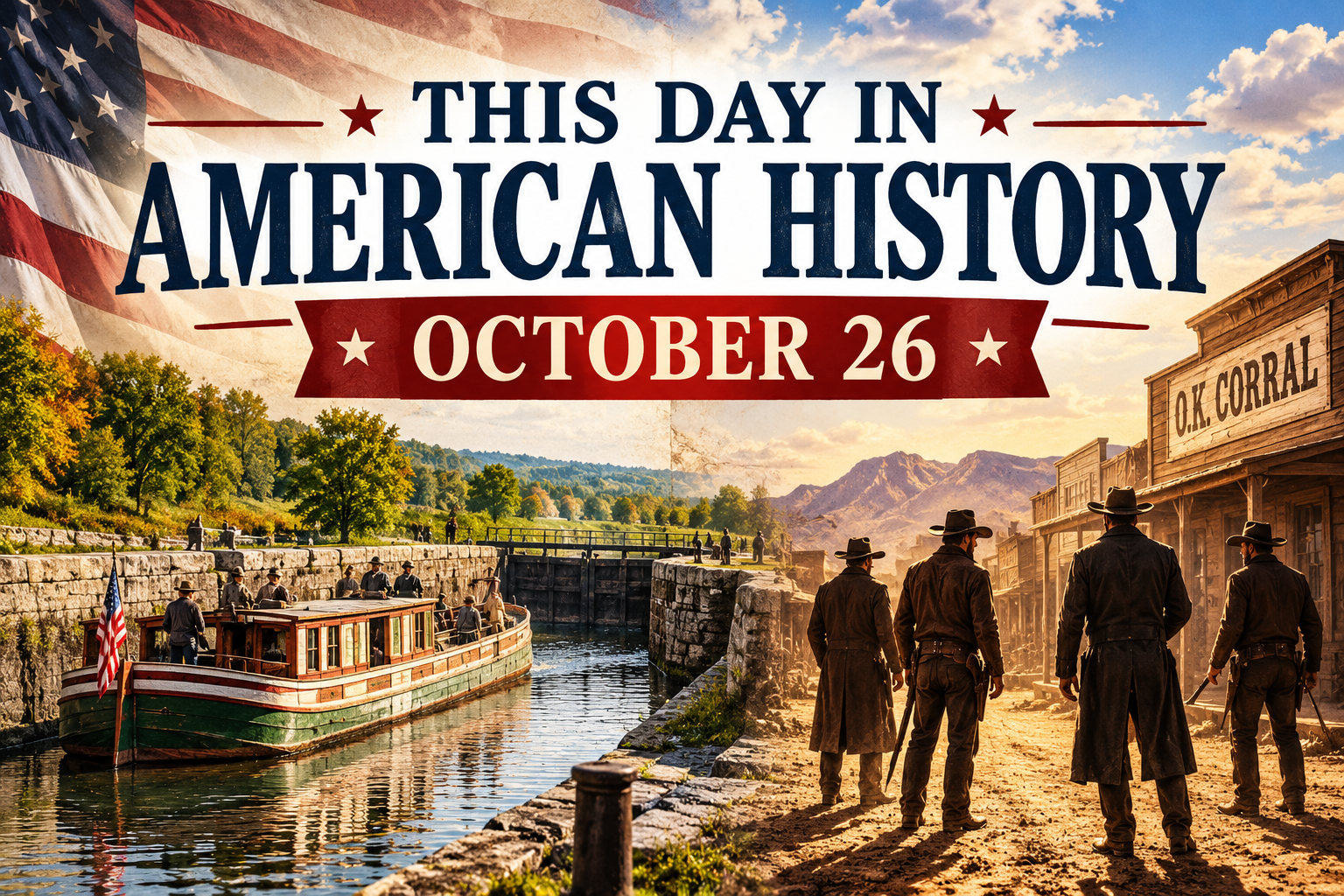
October 26 has witnessed some remarkable moments in American history. From the opening of a waterway that transformed the nation’s economy to one of the most legendary gunfights of the American West, this date offers a fascinating look at how the United States developed.
Perhaps no event on October 26 changed America’s economic future more than the completion of the Erie Canal in 1825. More than half a century later, on October 26, 1881, a brief burst of gunfire in Tombstone, Arizona Territory, became one of the defining legends of the Old West.
October 26 would later bring significant moments involving medicine, national security, politics, sports, and American culture.
Let’s travel through history and explore some of the most memorable events associated with October 26.
1774: The First Continental Congress Adjourns
On October 26, 1774, the First Continental Congress concluded its meetings in Philadelphia.
Representatives from twelve of Britain’s thirteen American colonies had gathered in response to Britain’s increasingly restrictive policies, particularly the measures colonists called the Intolerable Acts.
The delegates did not yet gather with the purpose of creating an independent United States. Many still hoped their grievances with Britain could be resolved.
But the Congress represented something historically important: colonies that had often acted independently were beginning to cooperate politically.
The delegates coordinated resistance to British policies, supported economic pressure against Britain, and helped establish a framework for future cooperation among the colonies.
Within months, armed conflict would erupt at Lexington and Concord in April 1775. The Second Continental Congress would then meet as the Revolutionary War began.
The First Continental Congress therefore represented an important step toward something much larger.
The colonies were beginning to think collectively.
The idea of Americans governing themselves was moving closer to reality.
1825: The Erie Canal Opens
One of the most consequential infrastructure projects in early American history officially opened on October 26, 1825.
The Erie Canal connected the Hudson River with Lake Erie, creating a navigable route between the Great Lakes region and the Atlantic world through New York.
The original canal stretched approximately 363 miles and took about eight years to construct. The project was strongly associated with New York Governor DeWitt Clinton, and critics initially mocked the ambitious project with names such as “Clinton’s Folly.”
They underestimated what the canal would accomplish.
The Library of Congress notes that the canal accelerated settlement in western New York and farther west, while dramatically improving transportation between America’s interior and eastern markets.
Before modern highways, railroads, airplanes, and tractor-trailers, moving heavy goods over land was expensive and difficult.
Water transportation could move much larger quantities of cargo more efficiently.
The Erie Canal helped change that equation.
Agricultural products and other goods from the interior could travel east toward New York City, while manufactured goods and settlers could move west.
Communities along the canal expanded.
Trade increased.
Migration accelerated.
And New York City’s position as a commercial center became even stronger.
The Seneca Chief Begins Its Historic Journey
The canal’s opening was celebrated in dramatic fashion.
On October 26, Governor DeWitt Clinton boarded the Seneca Chief in Buffalo.
Among the cargo were barrels containing water from Lake Erie.
The boat traveled east across the canal toward Albany and then continued toward New York City. Eight days later, Clinton poured Lake Erie water into the Atlantic Ocean during a ceremony symbolizing the connection between the Great Lakes and the ocean.
The event became known as the “Wedding of the Waters.”
It represented far more than a ceremonial gesture.
America’s interior and its Atlantic ports had become connected through one of the greatest engineering projects of the young nation.
Why the Erie Canal Changed America
The Erie Canal’s importance extended far beyond New York.
It encouraged westward migration and helped farmers and businesses reach larger markets. Towns along the route grew into important commercial centers.
Buffalo became a major gateway to the Great Lakes.
Cities such as Rochester and Syracuse benefited from the increased movement of people and goods.
New York City gained enormous advantages as goods flowing from the interior increasingly traveled through New York.
The canal demonstrated another important lesson: infrastructure could reshape the economic geography of an entire nation.
Railroads would eventually surpass canals as America’s dominant transportation system, followed later by highways and aviation.
But in 1825, the Erie Canal represented something extraordinary.
It effectively brought America’s interior closer to the Atlantic coast.
1861: The Pony Express Comes to an End
October 26 is also associated with the end of another famous chapter in American transportation history.
In 1861, the Pony Express ceased operations.
The Pony Express has become one of the most romanticized institutions of the American West.
Beginning in 1860, riders carried mail across nearly 2,000 miles between Missouri and California using a network of relay stations and fresh horses.
It dramatically reduced the amount of time required to send messages across the country.
But technological progress moved quickly.
The completion of the transcontinental telegraph made the Pony Express largely unnecessary.
Instead of physically carrying a message across mountains, deserts, and plains, information could now travel electronically.
The Pony Express lasted only about eighteen months, but its riders became enduring symbols of determination, speed, and the American frontier.
Its disappearance also demonstrated something that would happen repeatedly throughout American history:
New technology replaces older systems remarkably quickly.
1881: The Gunfight at the O.K. Corral
Another legendary American event occurred on October 26, 1881.
At approximately 3 p.m. in Tombstone, Arizona Territory, tensions between local lawmen and a group commonly associated with the Cowboys erupted into gunfire.
On one side were Virgil Earp, Wyatt Earp, Morgan Earp, and Doc Holliday.
Opposing them were members and associates of the Clanton and McLaury families.
The confrontation lasted only about 30 seconds.
Around 30 shots were reportedly fired.
When the shooting stopped, Billy Clanton, Tom McLaury, and Frank McLaury were dead. Virgil Earp, Morgan Earp, and Doc Holliday were wounded. Wyatt Earp escaped without injury.
It became one of the most famous gunfights in American history.
The Gunfight Wasn’t Really Inside the O.K. Corral
Popular culture has simplified the story considerably.
Despite its famous name, the confrontation did not actually take place inside the O.K. Corral itself.
It occurred in a narrow vacant lot nearby and spilled toward Fremont Street.
The broader dispute was also far more complicated than the traditional story of heroic lawmen confronting evil outlaws.
Tombstone was a rapidly growing silver-mining community filled with competing political, economic, and personal interests.
The Earps had connections with Tombstone’s law-enforcement and business establishment.
Their opponents were connected to ranching interests and the loosely organized group known as the Cowboys.
Accusations of cattle rustling, stagecoach robbery, political favoritism, weapons violations, and personal feuds created an increasingly volatile atmosphere.
By October 26, the tension had reached its breaking point.
How 30 Seconds Became an American Legend
The gunfight itself was remarkably brief.
Yet those few seconds became larger than life.
Books, television programs and Hollywood movies transformed Wyatt Earp and Doc Holliday into some of the most recognizable characters associated with the Old West.
The confrontation has often been presented as a simple battle between lawmen and criminals.
The actual history is more complicated.
The O.K. Corral’s own historical account notes that interpretations of the Earps and Cowboys remain disputed, reflecting the complicated political, economic, and social environment surrounding Tombstone.
That complexity makes the story even more interesting.
The American frontier was rarely as simple as heroes wearing white hats and villains wearing black ones.
Real people had competing loyalties, financial interests, political alliances, and personal grudges.
History usually lives somewhere between legend and reality.
1984: Baby Fae Receives a Baboon Heart
October 26 also marked a controversial milestone in American medical history.
In 1984, an infant known publicly as Baby Fae received a transplanted heart from a baboon at Loma Linda University Medical Center in California.
Baby Fae had been born with a severe congenital heart defect.
The experimental operation represented an attempt to save her life through xenotransplantation, the transplantation of cells, tissues, or organs between different species.
The procedure attracted enormous international attention.
Although the transplanted heart initially functioned, Baby Fae’s body eventually rejected it. She died several weeks after the operation.
The case generated intense discussion about experimental medicine, organ transplantation and medical ethics.
It also demonstrated how difficult transplantation could be when the recipient’s immune system recognized the donor organ as foreign.
Decades later, researchers would continue exploring whether genetically modified animal organs might someday help address shortages of human donor organs.
2000: The New York Yankees Win Their Third Straight World Series
October 26 has a place in American sports history as well.
On October 26, 2000, the New York Yankees defeated the New York Mets to capture the World Series.
The matchup became known as the Subway Series because both teams were based in New York City.
The Yankees won the series four games to one.
The victory gave the Yankees their third consecutive World Series championship after titles in 1998 and 1999.
It also continued one of the most successful periods in the franchise’s long history.
For New York baseball fans, the 2000 World Series was particularly memorable because it brought the city’s two Major League Baseball teams together on baseball’s biggest stage.
2001: President George W. Bush Signs the USA PATRIOT Act
Exactly one year later, October 26 became associated with a far more serious chapter in American history.
On October 26, 2001, President George W. Bush signed the USA PATRIOT Act into law.
The legislation came only weeks after the September 11 terrorist attacks.
Its formal title was the Uniting and Strengthening America by Providing Appropriate Tools Required to Intercept and Obstruct Terrorism Act of 2001.
The legislation expanded federal investigative and surveillance authorities intended to help detect and prevent terrorism.
Supporters argued that law-enforcement and intelligence agencies needed stronger tools to confront the threat of terrorism.
Critics raised serious concerns about privacy, government surveillance, due process and civil liberties.
Those debates continued for years.
The PATRIOT Act became one of the most consequential pieces of national-security legislation passed in the aftermath of September 11.
Its history also illustrates a recurring challenge in American government:
How should a free society balance national security with individual liberty?
There is rarely a simple answer.
2020: Amy Coney Barrett Is Confirmed to the Supreme Court
On October 26, 2020, the United States Senate confirmed Amy Coney Barrett to the U.S. Supreme Court.
Her confirmation filled the vacancy created by the death of Justice Ruth Bader Ginsburg.
The confirmation occurred only days before the 2020 presidential election and generated intense political debate over the timing of the nomination and confirmation process.
Barrett’s arrival also shifted the ideological composition of the Court, giving conservative-appointed justices a 6–3 majority at the time.
It was another reminder that October 26 has repeatedly intersected with major moments involving American law, politics and government.
Born on October 26: Mahalia Jackson
October 26 also marks the birthday of one of America’s most influential gospel singers.
Mahalia Jackson was born October 26, 1911, in New Orleans, Louisiana.
Jackson became known as the “Queen of Gospel.”
Her powerful voice helped introduce gospel music to audiences far beyond traditional church settings.
But her influence was not limited to music.
Jackson was also associated with the Civil Rights Movement and performed at important events connected with the struggle for racial equality.
Her career demonstrated the enormous influence that gospel music has had on American culture, including its impact on soul, rhythm and blues, rock, and popular music.
October 26 Connects Several Different American Stories
Looking across the centuries, the events of October 26 might initially seem unrelated.
The First Continental Congress.
The Erie Canal.
The Pony Express.
The O.K. Corral.
Experimental heart transplantation.
The World Series.
The PATRIOT Act.
A Supreme Court confirmation.
Yet together they illustrate several recurring themes in American history.
Innovation
The Erie Canal demonstrated how engineering could transform transportation and commerce.
The telegraph helped make the Pony Express obsolete.
Experimental transplantation demonstrated medicine’s continuing search for new ways to save lives.
Expansion
The Erie Canal helped connect eastern markets with western settlement.
The Pony Express connected distant communities across a rapidly expanding nation.
Tombstone represented the growth—and instability—of America’s western frontier.
Conflict
The First Continental Congress emerged from political conflict with Britain.
The O.K. Corral grew from disputes involving law, economics, politics and personal rivalries.
The PATRIOT Act generated a different kind of conflict: a national debate over the balance between security and liberty.
Transformation
Perhaps the strongest theme connecting October 26 is transformation.
America in 1774 looked dramatically different from America in 1825.
America in 1825 looked dramatically different from America in 1881.
And the country entering the twenty-first century faced challenges its founders could never have imagined.
History is a continuing story of people responding to change.
The Lasting Legacy of October 26
If one event deserves special recognition on October 26, it may be the opening of the Erie Canal.
The canal does not possess the Hollywood drama of the O.K. Corral.
There were no legendary gunslingers facing each other in a dusty Arizona street.
Yet the Erie Canal arguably changed everyday American life far more profoundly.
It changed where goods traveled.
It influenced where people settled.
It helped cities grow.
It strengthened New York’s economic position.
And it demonstrated how a massive infrastructure project could alter the future of an entire country.
Then there is the O.K. Corral.
Its economic importance cannot compare with the Erie Canal, but its cultural legacy is enormous.
Those roughly thirty seconds of gunfire became part of America’s mythology.
Wyatt Earp and Doc Holliday became legendary figures.
Tombstone became synonymous with the Wild West.
The story has been retold so many times that separating history from mythology can sometimes be difficult.
And perhaps that provides one of the most valuable lessons from studying history.
History is not simply about remembering famous stories. It is about discovering what actually happened, understanding why it happened, and recognizing how later generations changed the way the story was told.
Remembering October 26
October 26 offers a remarkable journey through the American experience.
On this date, colonial representatives completed an early experiment in political unity.
An enormous canal opened a new transportation corridor across New York.
The Pony Express faded into history as technology advanced.
A thirty-second gunfight became one of the enduring legends of the American West.
Doctors attempted a groundbreaking and controversial transplant.
New York celebrated another baseball championship.
The federal government dramatically expanded national-security powers after the September 11 attacks.
And another justice joined the nation’s highest court.
Some events changed America immediately.
Others became important because of how Americans remembered them.
Together, they remind us that history isn’t only found in textbooks or museums.
It surrounds the places we live, the technology we use, the institutions that govern us, and the stories Americans continue telling about their past.
Which October 26 event do you think had the greatest impact on American history—the opening of the Erie Canal, the Gunfight at the O.K. Corral, or another event from this date?




Leave a ReplyCancel reply