
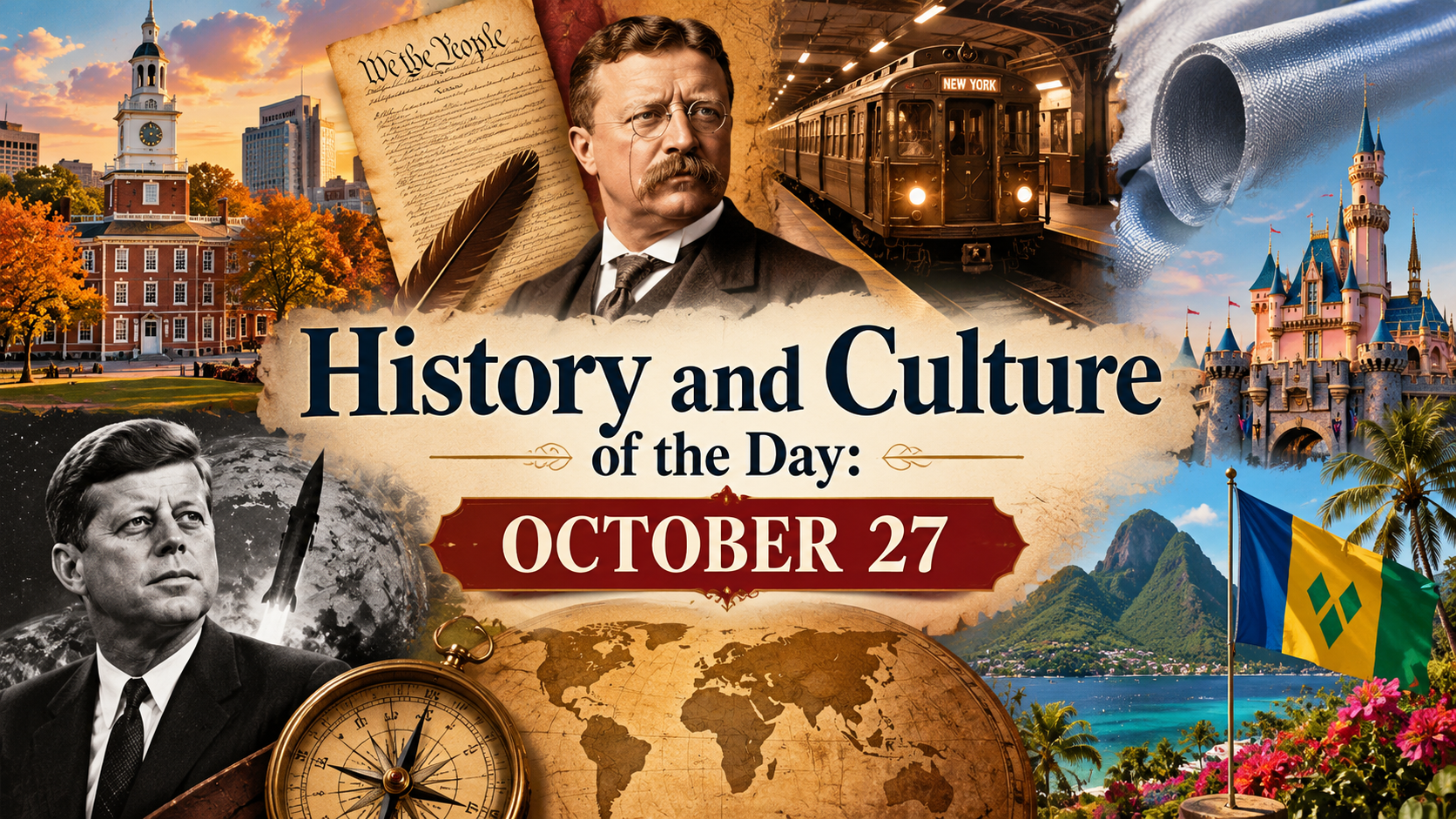
October 27 is a day filled with fascinating history, cultural milestones, remarkable achievements, and events that have influenced the world we live in today. From the founding of important institutions to breakthroughs in technology, political transformations, and the celebration of cultural traditions, this date reminds us that history is constantly shaping our present and future.
Every day on the calendar carries stories worth remembering. Some involve individuals whose courage and determination changed society, while others highlight inventions, artistic accomplishments, and traditions that have connected generations.
October 27 offers an opportunity to explore these stories, appreciate the diversity of human experiences, and understand how the past continues to influence our everyday lives.
Why October 27 Matters in History and Culture
History is more than a collection of dates and names. It represents the experiences, struggles, accomplishments, and decisions of people who lived before us.
Cultural history adds another important dimension by revealing how societies developed their identities through art, music, literature, language, celebrations, and shared traditions.
By studying the events associated with October 27, we can better understand how individual moments become part of a much larger historical story.
Some events changed the direction of nations. Others transformed entertainment, communication, or the way people understood the world.
Together, these moments demonstrate that progress often emerges through a combination of innovation, perseverance, creativity, and change.
1682: The Founding of Philadelphia
On October 27, 1682, Philadelphia was founded by William Penn in the English colony of Pennsylvania.
Penn envisioned a city that would become a center of commerce, religious tolerance, and opportunity. His Quaker beliefs influenced his desire to establish a community where people from different religious backgrounds could live with greater freedom.
The name Philadelphia comes from Greek words meaning brotherly love, reflecting Penn’s vision for the settlement.
Over time, Philadelphia became one of America’s most historically significant cities.
It played a central role in the American Revolution, hosted the signing of the Declaration of Independence in 1776, and became the location where delegates drafted the United States Constitution in 1787.
Philadelphia’s development also reflects the complicated history of colonial settlement, including the displacement of Indigenous communities and the growth of slavery in colonial America.
Today, the city’s historic neighborhoods, museums, architecture, and cultural institutions preserve many chapters of American history.
Cultural significance: Philadelphia represents the development of American democracy, the importance of religious freedom, and the continuing effort to build communities around equality and opportunity.
1787: The Federalist Papers Begin Shaping American Democracy
October 27, 1787, marked the publication of the first essay in a series that would become known as The Federalist Papers.
Written by Alexander Hamilton, James Madison, and John Jay under the shared pseudonym Publius, these essays argued in favor of ratifying the proposed United States Constitution.
The American colonies had gained independence, but the new nation faced serious questions about how its government should operate.
Would a stronger federal government protect the country or threaten individual liberties? How should power be divided among different branches of government? What safeguards could prevent tyranny?
The Federalist Papers explored these questions and offered arguments for a constitutional system based on checks and balances, representative government, and the separation of powers.
Although the essays were originally intended to influence public debate over ratification, they eventually became foundational documents in the study of American constitutional history.
Their significance extends beyond the United States because they contributed to international conversations about constitutional government and democratic institutions.
Cultural significance: The Federalist Papers demonstrate how written arguments, public discussion, and political philosophy can influence the development of a nation.
1858: Theodore Roosevelt Is Born
On October 27, 1858, Theodore Roosevelt was born in New York City.
Roosevelt would eventually become the 26th president of the United States and one of the most recognizable political figures of the early twentieth century.
His life combined politics, military service, conservation, exploration, and writing.
As president, Roosevelt advocated for stronger federal oversight of large corporations, consumer protections, and the preservation of natural resources.
His conservation efforts helped establish a lasting tradition of federal involvement in protecting national forests, monuments, and wildlife.
Roosevelt also understood the growing importance of public communication. His energetic personality and use of emerging media helped reshape expectations of presidential leadership.
His presidency was not without controversy. His views on American expansion, race, and international power reflected many of the inequalities and imperial ambitions of his era.
Nevertheless, his influence on conservation and the modern presidency remains significant.
Cultural significance: Roosevelt’s birthday provides an opportunity to explore the relationship between leadership, environmental protection, national identity, and political change.
1904: The New York City Subway Opens
One of the most important transportation milestones associated with October 27 occurred in 1904, when New York City’s first subway line opened.
The original Interborough Rapid Transit subway connected City Hall in Lower Manhattan with neighborhoods farther north.
At the beginning of the twentieth century, New York City was growing rapidly. Its expanding population created an urgent need for reliable transportation.
Crowded streets, horse-drawn vehicles, streetcars, and elevated railways could no longer meet every transportation need.
The subway offered a new solution.
Underground electric trains allowed large numbers of passengers to move across the city more efficiently, connecting residential neighborhoods with commercial districts and employment opportunities.
The subway quickly became more than a transportation system.
It helped shape New York City’s identity, influencing where people lived, worked, shopped, and spent their leisure time.
Over the decades, subway stations became places where commuters encountered musicians, performers, artists, and people from countless cultural backgrounds.
The system helped connect communities that might otherwise have remained separated by distance.
Cultural significance: The opening of the New York City subway demonstrates how transportation infrastructure can transform urban culture, economic opportunities, and everyday life.
1938: Nylon Receives Its Name
On October 27, 1938, DuPont announced the name nylon for its new synthetic fiber.
This development represented an important milestone in the history of materials science and consumer manufacturing.
Before synthetic fibers became widely available, clothing and other textiles depended heavily on natural materials such as cotton, wool, silk, and linen.
Nylon offered new possibilities because it was strong, versatile, and suitable for a wide variety of applications.
Its introduction eventually influenced clothing, household goods, industrial equipment, and military supplies.
During World War II, nylon became particularly important in manufacturing products such as parachutes and other equipment.
After the war, synthetic materials became increasingly common in consumer goods.
Nylon helped introduce a broader era of synthetic fabrics that changed fashion, manufacturing, and everyday life.
However, the growing use of synthetic materials also created environmental challenges, including concerns about plastic waste and microplastic pollution.
Cultural significance: Nylon illustrates how scientific discoveries can reshape consumer habits, fashion trends, industrial production, and society’s relationship with the environment.
1954: Walt Disney’s Disneyland Television Series Premieres
October 27, 1954, marked an important moment in entertainment history when Walt Disney’s television program Disneyland premiered on ABC.
The series introduced audiences to a combination of storytelling, animation, documentary programming, and previews of the theme park that would open in California the following year.
At a time when television was becoming a central part of American family life, Disney recognized the opportunity to connect entertainment with imagination and innovation.
The program introduced different themed areas inspired by adventure, fantasy, history, and the future.
It also helped audiences become familiar with the Disneyland concept before the physical park opened.
This relationship between television programming and themed entertainment would become a major part of the entertainment industry’s business model.
Disney’s approach demonstrated how stories and characters could extend beyond movies into television, attractions, merchandise, and shared family experiences.
Cultural significance: The premiere of Disneyland helped establish the relationship between television, popular culture, theme parks, and family entertainment that continues today.
1962: One of the Most Dangerous Days of the Cuban Missile Crisis
October 27, 1962, is remembered as one of the most dangerous days of the Cold War.
During the Cuban Missile Crisis, the United States and the Soviet Union confronted the possibility of nuclear conflict after American intelligence discovered Soviet nuclear missile installations in Cuba.
The confrontation had already created extraordinary international tension.
On October 27, a Soviet surface-to-air missile shot down an American U-2 reconnaissance aircraft over Cuba, killing pilot Major Rudolf Anderson Jr.
Additional incidents involving military aircraft and naval forces increased the possibility that misunderstandings or unauthorized decisions could trigger a larger war.
President John F. Kennedy and Soviet leader Nikita Khrushchev faced intense pressure as they searched for a way to resolve the crisis without military escalation.
The following day, the two governments reached an agreement that helped bring the confrontation toward a peaceful resolution.
The crisis remains one of history’s clearest examples of how close the world came to nuclear war.
It also demonstrates the importance of communication, diplomacy, restraint, and responsible decision-making during international emergencies.
Cultural significance: October 27, 1962, reminds us that decisions made during moments of fear and uncertainty can have consequences for millions of people.
1978: Anwar Sadat and Menachem Begin Receive Nobel Peace Prize Recognition
On October 27, 1978, Egyptian President Anwar Sadat and Israeli Prime Minister Menachem Begin were announced as recipients of the Nobel Peace Prize.
Their recognition followed diplomatic efforts that produced the Camp David Accords, an important step toward peace between Egypt and Israel.
For decades, conflict had shaped relations between Israel and several neighboring Arab countries.
The peace negotiations represented a major diplomatic breakthrough, although they did not resolve the broader Israeli-Palestinian conflict or all regional tensions.
The agreement eventually contributed to the 1979 Egypt-Israel peace treaty.
The Nobel recognition highlighted the importance of negotiation and diplomacy, even between governments with long histories of hostility.
Cultural significance: This anniversary illustrates how diplomacy can challenge longstanding divisions while reminding us that lasting peace requires continued work beyond the signing of agreements.
1991: Turkmenistan Declares Independence
On October 27, 1991, Turkmenistan declared independence from the Soviet Union.
The declaration came during a period of extraordinary political change as the Soviet Union moved toward dissolution.
For Turkmenistan, independence marked a major transformation in its political identity and national institutions.
The country began establishing itself as a sovereign state while drawing on its distinctive cultural heritage, language, traditions, and history.
Turkmen culture includes rich traditions of carpet weaving, music, poetry, horsemanship, and craftsmanship.
Its famous handmade carpets are particularly important expressions of cultural identity, with patterns and designs reflecting generations of artistic tradition.
Independence also brought new political challenges, including the development of an authoritarian system under Saparmurat Niyazov.
The anniversary therefore provides an opportunity to examine both national self-determination and the complexities of political change.
Cultural significance: Turkmenistan’s independence highlights the importance of cultural identity, national sovereignty, and the preservation of traditions during major political transitions.
Famous Birthdays on October 27
October 27 is also the birthday of several influential figures whose contributions helped shape literature, politics, entertainment, and culture.
Theodore Roosevelt – 1858
The 26th president of the United States is remembered for his conservation policies, political reforms, and influential public leadership.
Dylan Thomas – 1914
Welsh poet Dylan Thomas was born on October 27, 1914, in Swansea, Wales.
His expressive writing, memorable imagery, and powerful use of language made him one of the most celebrated poets of the twentieth century.
His works include Under Milk Wood and Do Not Go Gentle into That Good Night.
Thomas’s writing frequently explored mortality, memory, nature, and the human experience.
His poetry continues to inspire readers and writers around the world.
Ruby Dee – 1922
American actress and civil rights activist Ruby Dee was born on October 27, 1922.
Her career included influential performances in theater, film, and television.
Dee also used her public platform to advocate for civil rights and social justice, demonstrating how artists can influence cultural and political conversations.
Sylvia Plath – 1932
American poet and novelist Sylvia Plath was born on October 27, 1932.
Her writing explored identity, emotional struggle, personal experience, and the complexities of human relationships.
Her novel The Bell Jar and her poetry became important works in modern literature.
Plath’s literary influence remains significant, particularly in discussions of confessional poetry and the representation of personal experience in art.
Fran Lebowitz – 1950
American author and cultural commentator Fran Lebowitz was born on October 27, 1950.
Known for her sharp observations about society, city life, and human behavior, Lebowitz has become a distinctive voice in American cultural commentary.
Her essays and public appearances have influenced conversations about literature, humor, and contemporary culture.
Cultural Traditions and Observances on October 27
Historical anniversaries are only one part of what makes October 27 meaningful. The date also includes national celebrations and informal observances.
Independence Day in Saint Vincent and the Grenadines
October 27 is Independence Day in Saint Vincent and the Grenadines, commemorating the Caribbean nation’s independence from Britain in 1979.
The occasion celebrates national identity, sovereignty, and cultural heritage.
The country’s culture reflects Indigenous Caribbean history, African influences, European colonial history, and the traditions of its communities.
Music, food, dance, and public celebrations play important roles in expressing national pride.
Caribbean musical traditions, including calypso and soca, contribute to the festive atmosphere surrounding independence celebrations.
The holiday also provides an opportunity to reflect on the country’s history and the challenges and achievements of nationhood.
American Beer Day
October 27 is also associated with the informal celebration known as American Beer Day.
The observance recognizes the history and development of brewing in the United States.
American brewing traditions have been influenced by Indigenous practices, European immigration, industrial production, and the modern craft brewing movement.
Beer has also played a role in social gatherings, festivals, neighborhood businesses, and regional food traditions.
From early colonial breweries to contemporary craft breweries, the industry reflects changing tastes, technology, and entrepreneurship.
The day can be appreciated through the history of brewing, local business culture, and the relationship between food and community.
How October 27 Reflects the Evolution of Society
When we examine the events associated with October 27, several important themes emerge.
Innovation Changes Everyday Life
The opening of the New York City subway and the development of nylon demonstrate how technological innovation can transform ordinary routines.
Transportation systems influence where people live and work, while new materials change the products people use.
Innovations that initially appear limited to one industry often create changes throughout society.
Culture Connects Generations
Literature, music, television, and national celebrations preserve experiences that might otherwise be forgotten.
The writings of Dylan Thomas and Sylvia Plath continue to reach readers long after their lifetimes.
Entertainment programs such as Disneyland demonstrate how stories can become shared cultural experiences across generations.
Cultural traditions remind us that human history is preserved not only through official records but also through creativity and personal expression.
Political Decisions Shape the Future
The Federalist Papers, the Cuban Missile Crisis, and the diplomatic achievements recognized by the 1978 Nobel Peace Prize demonstrate the lasting importance of political decisions.
Governments influence the lives of citizens through laws, diplomacy, economic policies, and international relationships.
Studying these events encourages a better understanding of leadership, responsibility, and the consequences of political choices.
Cultural Identity Deserves Preservation
The independence histories of Turkmenistan and Saint Vincent and the Grenadines highlight the importance of cultural identity.
Language, food, music, artistic traditions, and shared history contribute to how communities understand themselves.
Preserving cultural heritage allows future generations to remain connected to the experiences of their ancestors.
What We Can Learn From October 27
History becomes especially valuable when we use it to understand the present.
The events of October 27 offer several lasting lessons.
Progress requires imagination. The people who developed new transportation systems, technologies, and entertainment experiences imagined possibilities beyond what already existed.
Leadership carries responsibility. Political decisions can create opportunities for peace and reform, but they can also produce conflict and lasting harm.
Words can change societies. Political essays, poetry, literature, and public speeches can influence beliefs and inspire future generations.
Peace requires communication. The Cuban Missile Crisis demonstrates the danger of escalation and the importance of diplomacy when tensions are high.
Culture helps preserve identity. Traditions, artistic expressions, and national celebrations connect communities to their histories.
The past is rarely simple. Historical figures and events often contain both achievements and failures. Understanding history requires examining those complexities rather than treating every story as entirely heroic or entirely negative.
These lessons remain relevant because many of the challenges faced by earlier generations continue to appear in different forms today.
Ways to Explore History and Culture on October 27
You do not have to visit a famous historical landmark to develop a deeper appreciation for history.
Reading about an unfamiliar event can introduce new perspectives. Exploring a museum, listening to music from another culture, or watching a historical documentary can help bring the past to life.
You might read a poem by Dylan Thomas or Sylvia Plath, learn about the founding of Philadelphia, or explore how the New York City subway influenced the development of modern urban life.
Another meaningful activity is to learn about a country’s independence celebration and discover how its people express their national identity through music, food, language, and traditions.
Family history can also offer valuable cultural insights.
Speaking with relatives about their childhood experiences, family traditions, and important memories can preserve stories that may never appear in a history book.
Even small acts of curiosity can deepen our understanding of the world.
Why Remembering History Matters
The past cannot be changed, but it can be understood.
Every generation inherits a world shaped by the decisions, discoveries, conflicts, and cultural achievements of those who came before.
When we study history, we gain a better understanding of how societies developed and why certain traditions, institutions, and beliefs continue to exist.
History also reminds us that progress is not always straightforward.
Technological advances can improve lives while creating new challenges. Political reforms can expand opportunities while leaving important inequalities unresolved. Cultural movements can inspire change while challenging established traditions.
Understanding these complexities helps us approach the present with greater awareness.
It also encourages us to recognize the contributions of people whose experiences have sometimes been overlooked.
History belongs not only to presidents, inventors, and famous artists but also to workers, families, immigrants, community leaders, and ordinary individuals whose daily lives helped shape society.
Final Thoughts: October 27 Is a Reminder That Every Day Has a Story
October 27 connects us to centuries of human history.
From the founding of Philadelphia and the publication of the Federalist Papers to the opening of the New York City subway, the development of nylon, the Cuban Missile Crisis, and important cultural celebrations, this date represents a remarkable collection of human experiences.
These events remind us that history is not simply about remembering what happened. It is about understanding why events mattered and how their consequences continue to influence our world.
The writers, leaders, inventors, and communities associated with October 27 contributed to stories that extend far beyond a single date.
Some inspired creativity. Others advanced technology, shaped political institutions, or demonstrated the importance of diplomacy.
Each story offers an opportunity to learn something new.
As we reflect on October 27, we can appreciate the achievements of the past, acknowledge its difficulties, and recognize our responsibility to help shape a better future.
History is the story of where we have been, culture is the expression of who we are, and the future is shaped by what we choose to do with the lessons of both.
What historical event or cultural milestone from October 27 do you find most interesting, and why?




Leave a ReplyCancel reply