
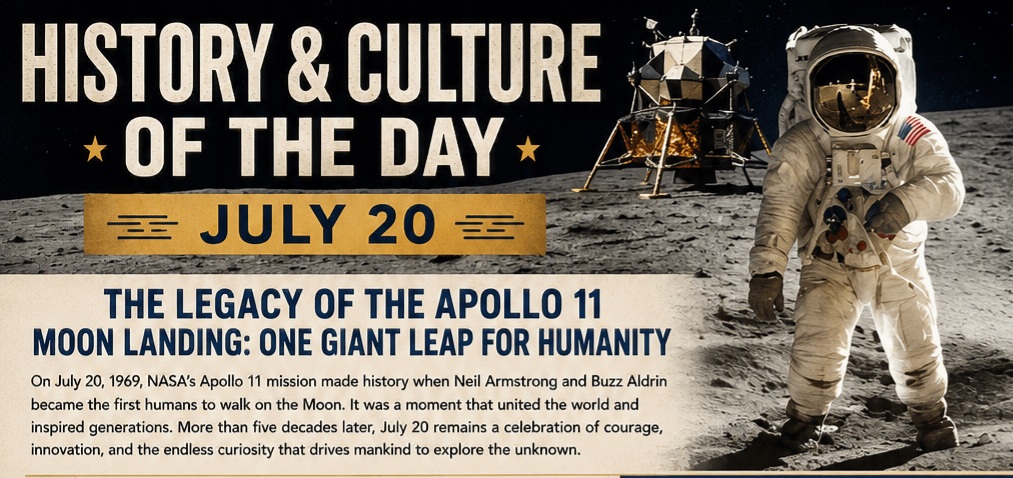
The Legacy of the Apollo 11 Moon Landing: One Giant Leap for Humanity
Every day in history offers a chance to remember the moments that shaped our world. On July 20, few events stand as tall as the successful landing of Apollo 11 on the Moon in 1969. It was a day that forever changed science, technology, exploration, and the way humanity viewed its place in the universe.
What began as a daring mission during the height of the Space Race became one of the greatest achievements in human history. Millions of people around the globe gathered around televisions, radios, and newspapers, witnessing an accomplishment that united people across political, cultural, and geographic boundaries.
More than half a century later, July 20 remains a celebration of courage, innovation, and the endless curiosity that drives mankind to explore the unknown.
The Race to Reach the Moon
Throughout the 1960s, the United States and the Soviet Union competed to achieve major milestones in space exploration.
The Soviet Union had achieved several historic firsts, including:
- The first artificial satellite (Sputnik)
- The first human in space (Yuri Gagarin)
- The first spacewalk
Determined to lead the next chapter of exploration, President John F. Kennedy challenged America in 1961 to land a man on the Moon and return him safely to Earth before the decade ended.
What seemed almost impossible quickly became a national mission involving more than 400,000 engineers, scientists, technicians, contractors, and support staff.
Launch of Apollo 11
Apollo 11 launched from Kennedy Space Center in Florida on July 16, 1969, aboard the massive Saturn V rocket.
The crew consisted of:
- Neil Armstrong – Mission Commander
- Buzz Aldrin – Lunar Module Pilot
- Michael Collins – Command Module Pilot
After traveling nearly 240,000 miles through space, the spacecraft entered lunar orbit.
The most dangerous part of the mission was still ahead.
July 20, 1969: The Moon Landing
On July 20, Neil Armstrong and Buzz Aldrin climbed into the Lunar Module, known as Eagle, leaving Michael Collins orbiting the Moon aboard the Command Module.
As Eagle descended, several problems emerged.
The onboard computer generated unexpected alarms, and Armstrong realized the automatic landing system was steering them toward a field filled with large rocks.
Taking manual control with only seconds of fuel remaining, Armstrong carefully guided Eagle to a safe landing site.
Mission Control received the unforgettable words:
“Houston, Tranquility Base here. The Eagle has landed.”
Cheers erupted inside Mission Control, while millions watching around the world celebrated one of humanity’s greatest accomplishments.
“One Small Step”
Several hours later, Neil Armstrong descended the ladder and became the first human being to walk on the Moon.
His first words became among the most famous ever spoken:
“That’s one small step for man, one giant leap for mankind.”
Soon afterward, Buzz Aldrin joined him on the lunar surface.
Together they:
- Collected Moon rocks
- Conducted scientific experiments
- Took photographs
- Planted the American flag
- Left commemorative items honoring peace and exploration
Although only two astronauts walked on the Moon that day, the achievement belonged to thousands who made the mission possible.
Michael Collins: The Forgotten Hero
While Armstrong and Aldrin explored the lunar surface, Michael Collins remained alone in lunar orbit.
His responsibility was equally critical.
If something went wrong, Collins would have been responsible for returning to Earth—or, in the worst-case scenario, returning alone.
His professionalism and calm leadership were essential to the mission’s success.
Today, many historians recognize Collins as one of the unsung heroes of Apollo 11.
Technology That Changed the World
The Apollo program accelerated innovation across countless industries.
Technologies developed during the mission contributed to advances in:
- Computer engineering
- Telecommunications
- Navigation systems
- Materials science
- Medical equipment
- Water purification
- Fire-resistant materials
- Miniaturized electronics
Many everyday technologies trace part of their development to innovations made possible by the space program.
A Cultural Moment Unlike Any Other
The Moon landing was more than a scientific achievement—it became a defining cultural event.
People across continents paused to watch history unfold.
Schools discussed the mission.
Families stayed up late to witness the first Moon walk.
Newspapers printed special editions.
The event inspired artists, filmmakers, writers, educators, and musicians for generations.
It reminded people that extraordinary goals become achievable when nations invest in education, research, and cooperation.
Inspiring Future Explorers
The Apollo 11 mission inspired millions of young people to pursue careers in:
- Science
- Engineering
- Aviation
- Astronomy
- Medicine
- Robotics
- Computer programming
Many of today’s scientists, astronauts, and innovators credit the Moon landing as the spark that ignited their passion for discovery.
Its influence continues through modern missions to the Moon, Mars, and beyond.
Why July 20 Still Matters
The significance of July 20 reaches beyond space exploration.
It represents:
- Human determination
- Teamwork
- Innovation
- Courage under pressure
- Peaceful exploration
- The belief that impossible dreams can become reality
The Moon landing demonstrated that when people work together with a shared purpose, they can accomplish feats once thought unattainable.
Lessons We Can Learn Today
The story of Apollo 11 offers timeless lessons:
- Great achievements require preparation.
- Success depends on teamwork.
- Courage often means moving forward despite uncertainty.
- Innovation begins with curiosity.
- History is made by those willing to attempt the impossible.
These lessons remain just as relevant today as they were in 1969.
Final Thoughts
As we observe History & Culture of the Day on July 20, we remember far more than a spacecraft touching down on another world.
We celebrate the engineers who solved impossible problems, the astronauts who accepted enormous risks, and the millions who believed humanity could reach farther than ever before.
Apollo 11 reminds us that history is not only about remembering the past—it is about inspiring the future. Every generation faces challenges that seem beyond reach, yet the story of July 20, 1969, proves that bold vision, perseverance, and collaboration can turn the extraordinary into reality.
More than five decades later, the footprints left on the Moon remain a powerful symbol of what humanity can achieve when it dares to dream.
Leave a ReplyCancel reply