
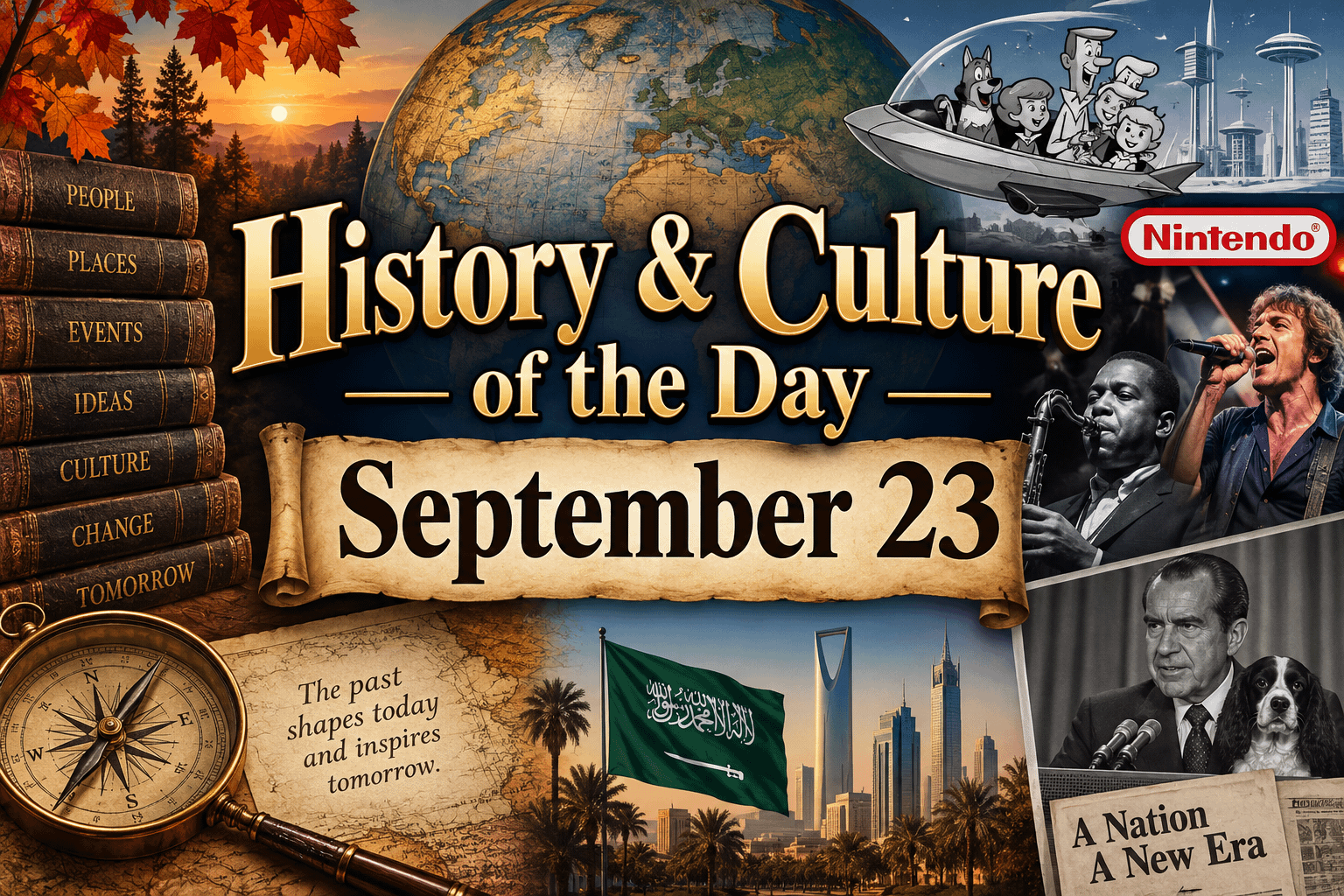
September 23 sits near one of the most noticeable turning points of the year. In the Northern Hemisphere, September brings the transition from summer toward autumn, while in the Southern Hemisphere it marks the arrival of spring. Depending on the year, the September equinox may fall on September 22 or September 23.
But September 23 is about much more than a changing season.
Across centuries and cultures, this date has been connected with political change, artistic expression, music, technology, national identity, and important moments that helped shape the modern world.
From ancient seasonal traditions to the rise of Nintendo, the birth of jazz legend John Coltrane, the emergence of Bruce Springsteen, and the celebration of Saudi Arabia’s National Day, September 23 offers an interesting journey through history and culture.
The September Equinox and the Changing Seasons
One of the most important cultural themes associated with this time of September is the autumnal equinox in the Northern Hemisphere and the vernal equinox in the Southern Hemisphere.
An equinox occurs when the Sun crosses Earth’s celestial equator. Around the equinox, day and night are close to equal in length, although they are not necessarily exactly 12 hours each.
For people living in the Northern Hemisphere, the September equinox represents the astronomical beginning of autumn.
Temperatures begin to cool. Leaves eventually change color. Harvest season arrives in many agricultural regions. Families begin preparing for the colder months ahead.
In the Southern Hemisphere, the opposite transition takes place. September signals spring—a season associated with warmer weather, blooming plants, renewal, and new growth.
Long before modern calendars and astronomy explained the movement of Earth around the Sun, civilizations carefully observed seasonal changes.
Agricultural societies depended upon them.
Knowing when seasons changed helped communities determine when to plant crops, harvest food, prepare livestock, and store supplies.
Because survival was closely connected with the seasons, the equinox became culturally significant in many societies.
Harvest Traditions Around the World
The arrival of autumn has historically been associated with harvest celebrations.
Farmers worked for months growing crops, and the harvest represented the reward for their labor.
Communities often celebrated successful harvests with feasts, ceremonies, music, dancing, and religious observances.
Different cultures developed their own traditions.
Across Europe, harvest festivals became important community gatherings. Churches sometimes held thanksgiving services celebrating the food produced from the land.
In parts of Asia, autumn festivals became associated with family gatherings, gratitude, food, and the moon.
The Mid-Autumn Festival, celebrated in China and several other Asian cultures according to a lunar calendar, is one of the world’s best-known autumn celebrations. Families gather, share food such as mooncakes, and appreciate the full moon.
Although these celebrations do not necessarily occur on September 23, they demonstrate the larger cultural importance of the seasonal transition surrounding this part of the year.
Autumn has traditionally represented both abundance and preparation.
People celebrate what has been gathered while recognizing that winter is approaching.
That combination has made autumn a powerful symbol in art, literature, religion, and philosophy.
September 23, 1889 — Nintendo Is Founded
One of the most fascinating cultural connections to September 23 began in Kyoto, Japan.
On September 23, 1889, Fusajiro Yamauchi founded the company that would eventually become Nintendo.
Modern audiences immediately associate Nintendo with video games, but the company began in a completely different industry.
Nintendo originally produced handmade hanafuda playing cards.
Hanafuda cards feature beautifully illustrated flowers and plants representing different months of the year. The cards became popular for various traditional Japanese games.
Nintendo spent decades operating primarily within the playing-card business before experimenting with other products and industries.
Eventually, the company entered electronic entertainment.
That decision transformed not only Nintendo but popular culture around the world.
Nintendo later became responsible for some of the most recognizable characters and franchises in entertainment history.
Mario, Luigi, Donkey Kong, Link, Princess Zelda, Kirby, and many others became internationally recognized characters.
The Nintendo Entertainment System helped revitalize the home video game market during the 1980s.
Later systems—including the Game Boy, Super Nintendo Entertainment System, Nintendo 64, Wii, Nintendo DS, and Nintendo Switch—continued influencing generations of players.
What makes Nintendo’s history especially remarkable is its longevity.
A business that began by making traditional Japanese playing cards in 1889 eventually became one of the world’s most influential entertainment companies.
September 23 therefore holds a unique place in gaming and entertainment history.
September 23, 1926 — John Coltrane Is Born
September 23 is also an important date in American music history.
Jazz saxophonist and composer John Coltrane was born on September 23, 1926, in Hamlet, North Carolina.
Coltrane became one of the most influential musicians in jazz history.
His career included collaborations with legendary performers such as Miles Davis and Thelonious Monk before he emerged as an innovative bandleader in his own right.
Coltrane continually experimented with musical structure, harmony, improvisation, and spirituality.
Albums such as Giant Steps and A Love Supreme became landmarks of jazz.
A Love Supreme, released in 1965, became especially important because it combined extraordinary musical creativity with Coltrane’s spiritual reflections.
His music could be intense, complicated, emotional, and deeply personal.
Coltrane died in 1967 at only 40 years old, but his influence continued growing after his death.
Musicians across jazz, rock, experimental music, and other genres have studied and drawn inspiration from his work.
His birthday on September 23 provides an opportunity to remember how one musician’s willingness to explore new artistic possibilities permanently changed American music.
September 23, 1949 — Bruce Springsteen Is Born
Another major figure in American music was born on September 23.
Bruce Springsteen was born in Long Branch, New Jersey, in 1949.
Springsteen eventually became known worldwide for songs exploring working-class life, hope, frustration, love, dreams, economic hardship, and the complicated experience of pursuing the American Dream.
His music became closely associated with New Jersey and American working-class culture.
With the E Street Band, Springsteen developed a reputation for energetic concerts that could last for hours.
Songs including “Born to Run,” “Thunder Road,” “Dancing in the Dark,” and “Born in the U.S.A.” became major parts of American popular music.
But beneath the catchy melodies and arena-sized performances, many Springsteen songs contain complicated stories about ordinary people.
Factory workers.
Young couples.
Veterans.
Families.
People trying to escape struggling towns.
People chasing opportunities that sometimes remain just beyond their reach.
That storytelling helped Springsteen become more than a successful rock musician. His catalog became a musical portrait of different aspects of American life.
September 23 — Saudi National Day
September 23 is also an important national celebration in Saudi Arabia.
Saudi National Day commemorates the unification of the Kingdom of Saudi Arabia.
In 1932, King Abdulaziz announced the unification of the regions under the name Kingdom of Saudi Arabia.
September 23 became the date associated with that historic transformation.
Today, Saudi National Day is celebrated with public events, decorations, flags, entertainment, cultural programs, and displays of national pride.
Cities may be illuminated in green, the color strongly associated with the Saudi flag and national identity.
The celebration provides an opportunity for people to reflect on Saudi history while also highlighting modern developments and national goals.
Like national days around the world, it demonstrates how historical events eventually become cultural traditions passed from one generation to another.
September 23, 1952 — Richard Nixon’s “Checkers Speech”
September 23 also played a memorable role in American political and television history.
During the 1952 presidential campaign, vice-presidential candidate Richard Nixon faced controversy involving a political expense fund.
Nixon responded with a nationally televised speech on September 23, 1952.
The address became known as the “Checkers speech.”
The unusual nickname came from Nixon’s discussion of a gift his family had received—a black-and-white cocker spaniel named Checkers.
Nixon said his daughters loved the dog and that the family intended to keep it.
The speech became a significant moment in the relationship between television and American politics.
Television was becoming an increasingly powerful medium.
Politicians could now speak directly to millions of Americans in their homes.
Political communication would never be quite the same.
Later presidential debates, campaign advertisements, televised addresses, political interviews, and eventually internet and social-media campaigning continued that transformation.
The Checkers speech demonstrated early on how television could influence a political controversy by allowing a candidate to appeal directly to the public.
September 23, 1962 — The Jetsons Enter American Pop Culture
September 23, 1962, introduced television audiences to one of popular culture’s most memorable visions of the future.
The Jetsons premiered on ABC.
Created by Hanna-Barbera, the animated television series followed George Jetson and his family as they lived in a futuristic world filled with flying cars, robots, moving sidewalks, video communication, and automated household technology.
The show became a cultural counterpart to The Flintstones.
While The Flintstones humorously imagined modern family life in the Stone Age, The Jetsons imagined family life in the future.
Some of the show’s futuristic technology seemed impossible to viewers in the 1960s.
Video calls were science fiction.
Home automation seemed futuristic.
Robotic household assistants belonged to cartoons.
Today, video conferencing, smart-home devices, robotic vacuum cleaners, digital assistants, and other technologies make portions of The Jetsons feel surprisingly familiar.
We may not commute to work in flying cars, but the program remains an interesting example of how entertainment imagines the future.
The Cultural Meaning of Autumn
Beyond specific historical events, September 23 represents something deeper.
Autumn has always carried powerful symbolism.
Spring represents beginnings.
Summer represents growth and energy.
Autumn often represents maturity, change, reflection, and letting go.
Leaves that were once green begin turning yellow, orange, red, and brown before eventually falling.
The transformation has inspired poets, painters, photographers, musicians, and writers for generations.
Autumn reminds us that change can be beautiful even when something is ending.
The season also encourages reflection.
As the days become shorter and another year moves toward its final months, people often begin thinking about what has happened during the year.
What changed?
What did we accomplish?
What did we lose?
What did we learn?
What do we still hope to accomplish before the year ends?
These questions are part of what makes seasonal transitions culturally meaningful.
September 23 Connects the Past With the Present
One of the most interesting things about studying history is discovering how seemingly unrelated events can share the same calendar date.
On September 23, we can remember a Japanese playing-card company founded in 1889 that eventually transformed global video gaming.
We can celebrate the birth of John Coltrane and his extraordinary contribution to jazz.
We can recognize Bruce Springsteen and the stories of American life told through his music.
We can learn about Saudi National Day and the formation of modern Saudi Arabia.
We can look back at Richard Nixon’s Checkers speech and see how television began changing political communication.
We can remember the premiere of The Jetsons and smile at how yesterday’s imagined future sometimes resembles today’s everyday life.
And around this point in September, we can look toward the changing seasons and recognize something humanity has observed for thousands of years.
The world is always changing.
Why History and Culture Matter
History isn’t simply a collection of dates that students memorize.
History is the story of people.
Culture is what those people create, celebrate, believe, share, preserve, and pass forward.
A playing-card company can eventually transform entertainment.
A saxophonist can change music forever.
A songwriter can tell stories that generations recognize themselves in.
A television cartoon can influence how people imagine the future.
A national celebration can preserve the memory of a country’s formation.
And the changing seasons can connect modern people with ancestors who watched the same skies thousands of years ago.
That is what makes studying history and culture so fascinating.
Every date contains stories.
Some changed nations.
Some changed technology.
Some changed music.
Some changed entertainment.
And others changed the way people understood the world around them.
Final Thoughts
September 23 reminds us that history and culture are constantly connected.
The inventions we use, music we hear, traditions we celebrate, entertainment we enjoy, and even the way we understand the seasons have histories behind them.
Some began hundreds or thousands of years ago.
Others began with one person willing to create something different.
As September moves deeper into the changing season, September 23 offers an opportunity to appreciate where humanity has been while wondering where we are going next.
History tells us what happened.
Culture tells us what those experiences meant to people.
Together, they help tell the story of who we are.
What piece of September 23 history or culture do you find the most interesting?
Leave a ReplyCancel reply