
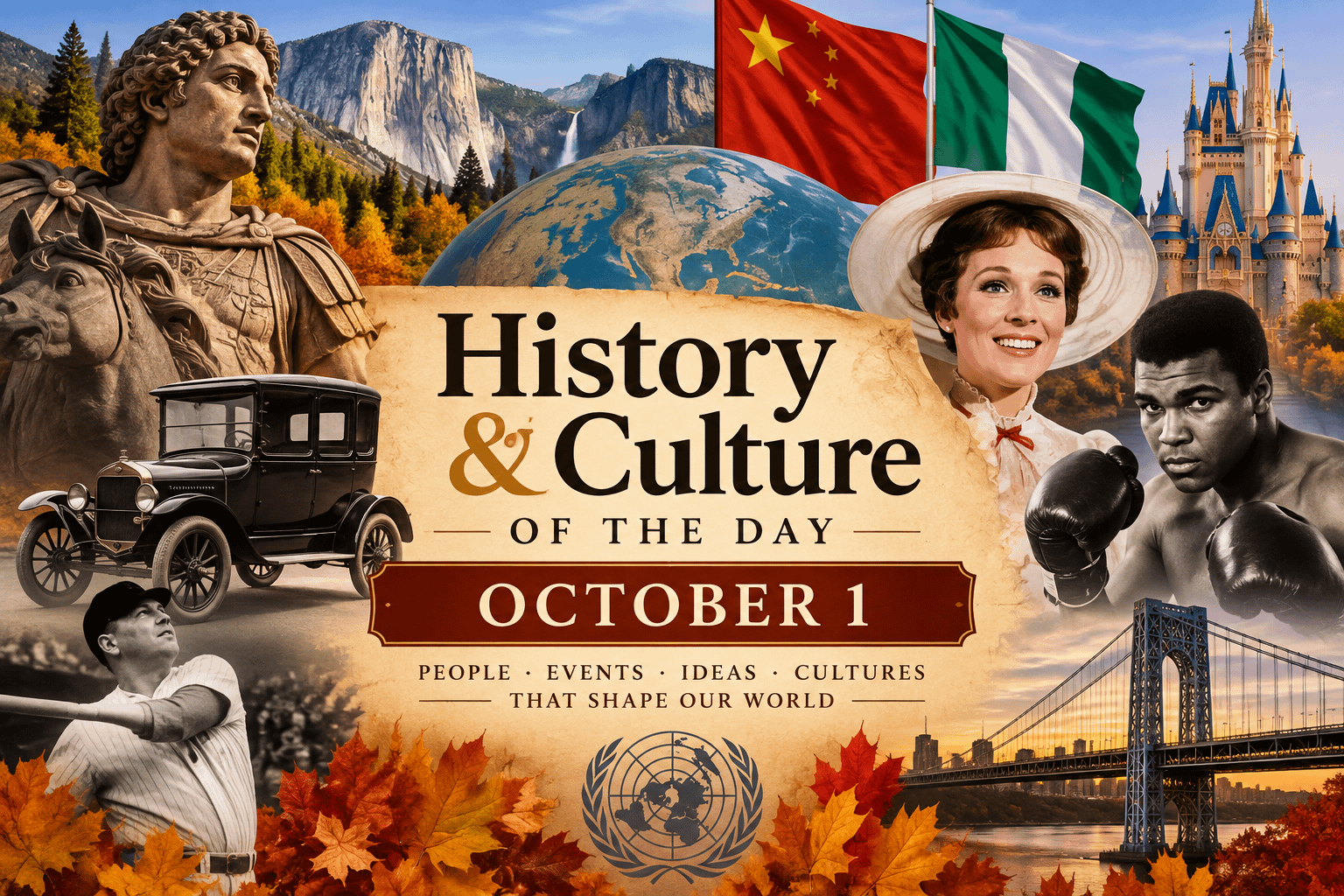
October 1 marks the beginning of a new month and, in many parts of the Northern Hemisphere, a deeper step into autumn. It is a day connected to independence movements, cultural traditions, music, innovation, social change, and moments that have influenced the way people live today.
From the birth of influential leaders and entertainers to major milestones in transportation and international history, October 1 offers a fascinating look at how individual events can become part of a much larger cultural story.
Here is a journey through some of the history and culture connected to October 1.
331 BC – The Battle of Gaugamela
One of the ancient world’s most significant military confrontations is traditionally dated to October 1, 331 BC.
Alexander the Great of Macedonia faced the forces of Persian king Darius III at the Battle of Gaugamela, near what is now northern Iraq.
Alexander’s victory was a decisive moment in his campaign against the Persian Empire. It helped open the way for Macedonian control over major Persian centers and contributed to the enormous expansion of Alexander’s empire.
The consequences went far beyond military conquest.
As Alexander’s armies moved across Egypt, Persia, Central Asia, and toward India, Greek language, philosophy, art, architecture, and customs interacted with the cultures already established throughout these regions.
The centuries that followed became known for the spread of Hellenistic culture—a blending of Greek traditions with Egyptian, Persian, Middle Eastern, and Asian influences.
It is an early example of how conquest, migration, trade, and political change can also reshape culture.
1890 – Yosemite National Park Is Established
October 1, 1890, became an important date in the history of conservation when legislation established Yosemite National Park in California.
The spectacular landscape of Yosemite—including granite cliffs, waterfalls, giant sequoias, forests, and valleys—had already attracted artists, photographers, naturalists, and travelers.
Conservation advocates helped convince Americans that places of extraordinary natural beauty deserved protection.
Yosemite eventually became much more than a tourist destination. It became an important symbol of the American conservation movement and helped shape the country’s evolving idea of national parks.
The park also has a much older human history.
Indigenous peoples lived in and around the Yosemite region for thousands of years before the establishment of the national park. Understanding Yosemite’s history therefore means recognizing both the modern conservation movement and the Native communities whose relationships with the land stretch back generations.
Today, Yosemite remains one of the most recognizable landscapes in the United States.
1903 – The First Modern World Series Begins
Baseball history reached an important milestone on October 1, 1903, when the first modern World Series began.
The Pittsburgh Pirates of the National League faced the Boston Americans of the American League.
The championship was structured as a best-of-nine series rather than today’s familiar best-of-seven format.
Boston ultimately won the series five games to three.
The event helped establish what would become one of America’s most enduring sports traditions.
Over the following decades, the World Series became deeply woven into American popular culture. Families gathered around radios and later televisions to follow the games. Baseball stars became national celebrities, and championship moments became shared memories passed from one generation to another.
October baseball remains one of the sport’s defining traditions.
1908 – The Ford Model T Is Introduced
October 1, 1908, is closely associated with one of the most influential automobiles ever produced: the Ford Model T.
The Model T helped transform transportation in the United States.
Automobiles existed before it, but cars were still beyond the financial reach of many ordinary families. Henry Ford and the Ford Motor Company sought to create a reliable automobile that could eventually be produced and sold on a much larger scale.
The Model T became enormously successful.
Its impact extended far beyond the automobile industry.
As car ownership expanded, American communities began changing around the automobile. Roads improved. Gas stations, roadside restaurants, motels, repair shops, and other businesses emerged.
People could live farther from their workplaces and travel greater distances for recreation.
The automobile helped reshape American geography and culture.
The Model T therefore represents more than an old car. It symbolizes a major shift toward personal mobility and mass consumer culture.
1924 – Jimmy Carter Is Born
James Earl Carter Jr. was born October 1, 1924, in Plains, Georgia.
Carter would eventually become the 39th president of the United States, serving from 1977 to 1981.
Before entering national politics, he served in the U.S. Navy and later returned to Georgia, where he became involved in business and public service. He served as governor of Georgia before winning the presidency in 1976.
After leaving the White House, Carter remained internationally prominent through humanitarian, diplomatic, public-health, and election-monitoring work.
He also became closely associated with Habitat for Humanity, regularly participating in home-building projects.
Carter lived to the age of 100, dying on December 29, 2024.
His long post-presidential life became a notable part of his public legacy.
1931 – The George Washington Bridge Opens
Another major transportation milestone occurred on October 1, 1931, when the George Washington Bridge opened to traffic.
Connecting Manhattan with Fort Lee, New Jersey, across the Hudson River, the bridge represented an impressive achievement in engineering.
At the time of its completion, its main suspension span was the longest in the world.
The bridge became increasingly important as automobile travel expanded.
Today, it remains a vital transportation connection in the New York metropolitan region and an enduring example of early 20th-century American infrastructure.
Bridges are often more than engineering projects. They can change commuting patterns, economic relationships, population growth, and the ways neighboring communities interact.
The George Washington Bridge did exactly that.
1935 – Julie Andrews Is Born
Dame Julie Andrews was born October 1, 1935, in England.
Her remarkable voice and acting career made her one of the most recognizable performers of the 20th century.
Andrews achieved enormous fame through stage and film, particularly with performances in Mary Poppins and The Sound of Music.
Her portrayal of Mary Poppins earned her the Academy Award for Best Actress.
But her cultural influence goes beyond individual awards.
Songs and scenes from her films have been introduced to generation after generation of children and families. The Sound of Music, in particular, became one of the most enduring movie musicals ever produced.
Andrews later expanded her career through writing, voice acting, and other creative projects.
Her October 1 birthday provides an opportunity to recognize the lasting cultural influence of musical theater and film.
1949 – The People’s Republic of China Is Proclaimed
October 1, 1949, is one of the most consequential dates in modern Chinese history.
On that day, Mao Zedong proclaimed the establishment of the People’s Republic of China in Beijing following years of civil war.
October 1 subsequently became celebrated as China’s National Day.
The creation of the People’s Republic dramatically changed China’s political system and influenced international relations throughout the Cold War and beyond.
Modern China has since developed into one of the world’s most populous countries and largest economies, making the events of October 1, 1949, significant not only to Chinese history but also to global history.
1960 – Nigeria Gains Independence
October 1 is also a major national celebration in Nigeria.
On October 1, 1960, Nigeria gained independence from Britain.
The country’s independence represented another major milestone in the wave of decolonization that transformed Africa during the mid-20th century.
Nigeria is extraordinarily diverse, with hundreds of ethnic groups and languages and rich traditions in music, literature, art, religion, cuisine, and storytelling.
Since independence, Nigerian culture has achieved growing international influence.
Nigerian writers have earned global recognition, while Nigerian music—particularly Afrobeats—has become a major force in international popular culture.
Nigeria’s film industry, commonly known as Nollywood, has also become one of the world’s most prolific filmmaking industries.
For Nigerians around the world, October 1 is therefore both a historical anniversary and an important cultural celebration.
1961 – Roger Maris Hits Home Run Number 61
October 1, 1961, produced one of baseball’s legendary moments.
New York Yankees outfielder Roger Maris hit his 61st home run of the season.
The achievement surpassed Babe Ruth’s famous total of 60 home runs from 1927, although the circumstances became the subject of considerable discussion because the American League schedule had expanded from 154 to 162 games.
Regardless of the controversy surrounding the record at the time, Maris’s accomplishment became part of baseball history.
His 61-home-run season remained the American League single-season record for more than six decades, until Aaron Judge hit 62 home runs in 2022.
The story of Maris also illustrates how sports records become cultural markers.
Numbers such as 60, 61, and 62 became more than statistics—they became chapters in baseball history.
1971 – Walt Disney World Opens
October 1, 1971, marked a major moment in American entertainment and tourism when Walt Disney World opened in Florida.
The centerpiece of the new resort was the Magic Kingdom.
The project represented an enormous expansion of Walt Disney’s vision beyond the original Disneyland in California.
Although Walt Disney died in 1966 and never saw the Florida resort completed, the project continued under the leadership of his brother Roy O. Disney.
Walt Disney World eventually grew into a massive resort destination featuring theme parks, hotels, restaurants, entertainment districts, transportation systems, and recreational attractions.
Its influence can be seen throughout the modern tourism and theme-park industries.
The resort also became deeply embedded in American popular culture. For millions of families, a trip to Disney World became associated with childhood memories, celebrations, vacations, and family traditions.
1975 – The Thrilla in Manila
One of boxing’s most famous fights occurred on October 1, 1975.
Muhammad Ali faced Joe Frazier for the third time in Quezon City, Philippines, in a bout remembered as the “Thrilla in Manila.”
Ali and Frazier had already developed one of the greatest rivalries in sports history.
Their third fight was extraordinarily demanding for both men.
After 14 punishing rounds, Frazier’s trainer Eddie Futch stopped the fight before the 15th round, giving Ali the victory.
The fight became legendary not simply because of who won, but because of the endurance displayed by both fighters.
Ali and Frazier’s rivalry remains an important part of boxing history and American sports culture.
1982 – EPCOT Opens
Exactly eleven years after Walt Disney World opened, another major Disney attraction debuted on October 1.
EPCOT Center opened October 1, 1982.
The park’s concept differed significantly from the Magic Kingdom.
Its original attractions emphasized technology, transportation, agriculture, energy, communication, imagination, and visions of the future.
Another major area celebrated countries and cultures through international pavilions.
EPCOT reflected an era of optimism about technological innovation and the possibility of creating a better future through science, communication, and international understanding.
Although the park has changed considerably over the decades, its distinctive identity remains part of theme-park history.
1988 – National Coming Out Day Is Conceived
October also became associated with an important LGBTQ+ cultural observance.
National Coming Out Day was first observed on October 11, 1988, but its origins are connected to activism following the 1987 National March on Washington for Lesbian and Gay Rights.
The observance was developed by activists Robert Eichberg and Jean O’Leary.
Although it does not fall on October 1 itself, the beginning of October now also marks the start of LGBTQ+ History Month in the United States, making the month an occasion for examining LGBTQ+ people, movements, culture, and historical experiences.
October 1 Around the World
October 1 carries different meanings depending on where you are.
For Nigeria, it is Independence Day.
For China, it is National Day.
October 1 is also observed internationally as the United Nations’ International Day of Older Persons, established to encourage greater awareness of issues affecting older adults and recognize their contributions to society.
These observances demonstrate something important about history: the same date can carry entirely different meanings for different communities.
For one country, October 1 represents independence.
For another, political transformation.
For sports fans, it might recall a legendary baseball record or boxing match.
For travelers and families, it might bring to mind Yosemite or Walt Disney World.
The Cultural Meaning of October
October 1 also has significance simply because it begins a month strongly associated with seasonal change.
In much of the Northern Hemisphere, October means cooler temperatures, changing leaves, shorter days, harvest traditions, pumpkins, apples, corn mazes, festivals, and preparations for Halloween.
Many cultures have long celebrated harvest seasons.
Before modern supermarkets and global food distribution, successful harvests could determine whether communities had sufficient food to survive the coming winter.
That reality inspired festivals, religious observances, communal meals, and traditions of gratitude.
Many modern autumn celebrations have evolved far beyond their agricultural origins, but the connection between fall and harvest remains visible.
Pumpkin patches, apple picking, farmers markets, harvest festivals, and seasonal foods continue traditions rooted in humanity’s relationship with the land.
Why October 1 Matters
The events connected to October 1 reveal how history is created in many different ways.
Sometimes history is made through war and political transformation.
Sometimes it happens through independence movements.
Sometimes it arrives through technology, transportation, sports, entertainment, conservation, or art.
Consider just how different the stories of October 1 are.
Alexander the Great reshaped the ancient world.
Yosemite became part of America’s conservation legacy.
The Model T helped transform transportation.
Nigeria celebrated independence.
Roger Maris changed baseball’s record books.
Muhammad Ali and Joe Frazier created an unforgettable sports moment.
Walt Disney World transformed family entertainment and tourism.
Each story belongs to a different place and period, yet they all share the same date.
That is what makes exploring history day by day so interesting.
A date on the calendar may appear ordinary until we discover everything that happened on it.
History Is More Than Dates
History is often taught as a collection of names, dates, wars, presidents, inventions, and major events.
But history is really the story of people.
It is the story of what people created, destroyed, discovered, protected, celebrated, challenged, and passed down.
Culture tells another part of that story.
Music, food, movies, sports, celebrations, language, architecture, traditions, and shared experiences show us how people understood their world.
October 1 reminds us that history and culture are constantly connected.
A bridge changes how people travel.
A car changes where people live.
A national park changes how society thinks about nature.
A movie becomes a family tradition.
A sporting achievement becomes a story grandparents tell grandchildren.
An independence celebration becomes part of national identity.
History does not remain trapped in the past.
Its effects continue into the present.
Remembering October 1
As October begins, it offers an opportunity to look backward while also recognizing the beginning of another season.
The stories connected to October 1 stretch from the ancient world to modern entertainment, from battlefields to baseball fields, and from independence celebrations to national parks.
Some events changed nations.
Others changed industries.
Some created records.
Others created traditions.
Together, they demonstrate the enormous variety contained within a single day of human history.
Tomorrow will bring another collection of stories, anniversaries, achievements, birthdays, cultural milestones, and moments worth remembering.
That is one of the most fascinating things about studying history.
Every day has a story.
Which moment from October 1 history do you find the most interesting?
Leave a ReplyCancel reply