
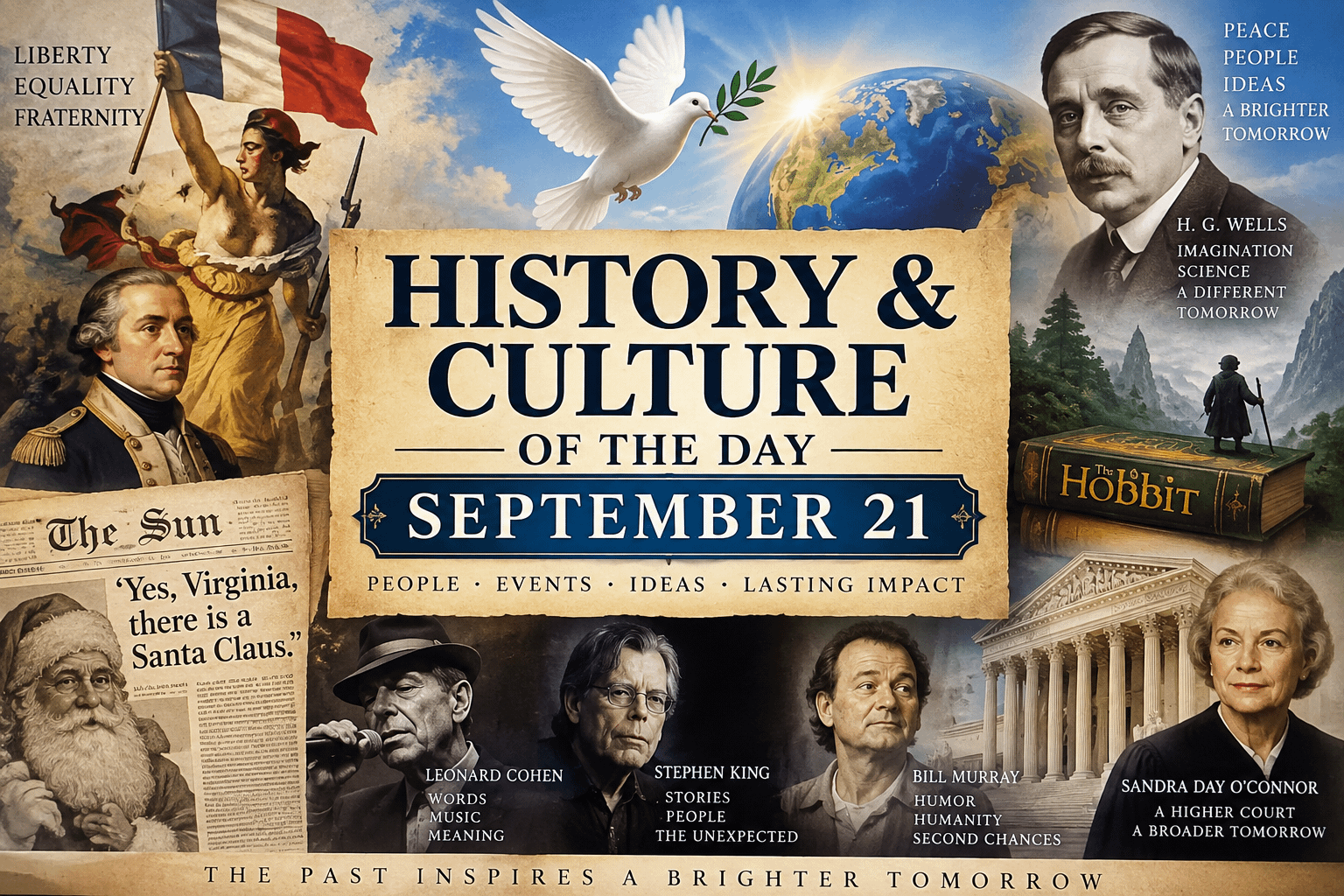
September 21 is a date filled with moments that connect history, culture, literature, entertainment, science, and the continuing pursuit of peace around the world. Like every day on the calendar, September 21 carries stories from different generations—some famous, some nearly forgotten, and others that continue to influence the way we live today.
From the birth of influential writers and entertainers to major developments in publishing, science, and international cooperation, September 21 provides an opportunity to look beyond a single historical event and explore the people, ideas, and cultural changes associated with this date.
Perhaps most importantly, September 21 has become internationally associated with the hope that humanity can resolve disagreements without violence. It is observed as the International Day of Peace, giving the date a meaning that reaches far beyond any one country or culture.
Let’s explore the history and culture connected with September 21.
September 21 and the International Day of Peace
One of the most important modern associations with September 21 is the International Day of Peace.
The United Nations General Assembly established the International Day of Peace in 1981. Two decades later, the observance was designated as September 21 each year.
The purpose of the day is simple in principle but enormously challenging in practice: encourage peace among people and nations.
Around the world, communities, schools, governments, religious organizations, humanitarian groups, and individuals use the occasion to promote ideas such as nonviolence, cooperation, understanding, reconciliation, and respect.
Peace does not only refer to ending wars.
It can also mean finding peaceful solutions to disagreements within communities, treating people with dignity, helping those who are suffering, and refusing to allow hatred to determine how we treat one another.
September 21 therefore represents something unusual on the historical calendar. Instead of only remembering something that happened in the past, the date encourages people to think about what kind of future they want to create.
1780 – Benedict Arnold’s Treasonous Plot Moves Forward
September 21, 1780, became an important date in one of the most infamous episodes of the American Revolution.
American General Benedict Arnold had secretly agreed to help the British obtain control of West Point, an enormously important American fortification on the Hudson River.
Arnold met with British Major John André during the night of September 21 into September 22 to discuss the plan.
The conspiracy ultimately failed.
André was captured while carrying documents related to West Point, exposing Arnold’s betrayal. Arnold escaped to British-controlled territory and later served with British forces.
His name would become synonymous with betrayal in American culture.
Calling someone a “Benedict Arnold” eventually became a way of describing a traitor, demonstrating how historical figures can become part of everyday language long after their deaths.
1792 – A New Political Era Begins in France
September 21, 1792, marked an extraordinary political transformation in France.
During the French Revolution, the newly assembled National Convention abolished the monarchy.
France was moving away from centuries of royal government and toward the establishment of a republic.
The French Revolution would become one of the defining events of modern history. Its consequences spread far beyond France, influencing political movements and debates about citizenship, equality, liberty, government, and individual rights.
The revolution also demonstrated the dangers of political instability and extreme violence.
Its legacy remains complicated.
Ideas associated with the revolution helped inspire democratic and republican movements, while the bloodshed of the revolutionary period demonstrated how quickly political upheaval could descend into terror.
September 21 therefore stands near an important turning point in European political history.
1866 – H. G. Wells Is Born
On September 21, 1866, Herbert George Wells—better known as H. G. Wells—was born in England.
Wells became one of the most influential writers associated with early science fiction.
His novels included works such as The Time Machine, The War of the Worlds, The Invisible Man, and The Island of Doctor Moreau.
What made Wells particularly important was his ability to combine imaginative storytelling with questions about science, society, morality, class, and humanity’s future.
His stories were entertaining, but they also encouraged readers to consider the consequences of scientific and technological progress.
Could humans travel through time?
What might happen if Earth encountered an advanced extraterrestrial civilization?
What ethical limits should exist when scientists experiment with living creatures?
What happens when extraordinary power is placed in the hands of an individual?
Those questions helped establish themes that continue to appear throughout modern science fiction.
Movies, television programs, novels, comics, and video games still explore ideas that writers such as Wells helped popularize more than a century ago.
1897 – The Famous “Yes, Virginia, There Is a Santa Claus” Editorial Appears
September 21, 1897, is associated with one of the most famous newspaper editorials in American cultural history.
Eight-year-old Virginia O’Hanlon wrote to The Sun, a New York newspaper, asking whether Santa Claus really existed.
The newspaper responded with an editorial written by Francis Pharcellus Church.
The response became famous for the line:
“Yes, Virginia, there is a Santa Claus.”
But the editorial was about considerably more than Christmas.
It discussed childhood wonder, faith, generosity, imagination, and the importance of believing in things that cannot always be physically seen or scientifically measured.
The editorial became a holiday tradition and has been reprinted countless times.
More than a century later, the phrase “Yes, Virginia” remains recognizable in American popular culture.
1934 – Leonard Cohen Is Born
September 21, 1934, was the birthday of Canadian poet, novelist, songwriter, and singer Leonard Cohen.
Cohen became known for deeply reflective writing that explored love, loneliness, spirituality, desire, loss, faith, and the complicated nature of human relationships.
Before becoming internationally recognized as a musician, Cohen had already established himself as a writer and poet.
His transition into music produced a distinctive body of work characterized by poetic lyrics and an unmistakable voice.
One of his most famous compositions, “Hallelujah,” eventually became one of the most widely interpreted songs of the modern era, recorded and performed by numerous artists.
Cohen’s cultural influence demonstrates how poetry and popular music can intersect.
His work frequently addressed subjects that people struggle to explain in ordinary conversation—the tension between love and heartbreak, belief and doubt, hope and despair.
That emotional complexity helped his writing survive across generations.
1937 – J. R. R. Tolkien’s The Hobbit Is Published
September 21, 1937, became a landmark date in fantasy literature with the publication of J. R. R. Tolkien’s The Hobbit in Britain.
The story introduced readers to Bilbo Baggins, a seemingly ordinary hobbit who is pulled into an extraordinary adventure involving dwarves, trolls, goblins, a dragon, and a mysterious ring.
The success of The Hobbit helped lead Tolkien toward the creation and publication of The Lord of the Rings.
Together, those works transformed modern fantasy literature.
Tolkien’s influence can be seen throughout books, movies, television, tabletop games, role-playing games, and video games.
Entire generations of writers and creators have drawn inspiration from the detailed worlds, languages, histories, and mythology he developed.
What began as a children’s fantasy novel ultimately helped establish one of the largest cultural movements in modern entertainment.
1947 – Stephen King Is Born
Another enormously influential writer was born on September 21, 1947.
Stephen King became one of the world’s most recognizable authors, particularly in horror, suspense, supernatural fiction, and psychological drama.
His books have included Carrie, The Shining, It, Misery, Pet Sematary, The Stand, and many others.
King’s influence extends far beyond books.
Numerous novels and stories have been adapted into movies and television productions, making his characters and ideas familiar even to people who have never read one of his novels.
Part of King’s cultural importance comes from his ability to place frightening or supernatural events inside recognizable everyday settings.
Small towns, families, friendships, childhood fears, addiction, grief, isolation, and ordinary human weaknesses often become just as important as the supernatural threats.
His work demonstrates that some of the most powerful stories are not simply about monsters.
They are about people.
1947 – Don Felder Is Born
September 21, 1947, was also the birthday of guitarist and songwriter Don Felder.
Felder became widely known through his work with the Eagles, one of the most successful rock bands of the 1970s.
He played an important role in the creation of “Hotel California,” one of the most recognizable songs in rock history.
The song’s famous guitar work helped make it a defining recording of its era.
Classic rock continues to occupy a significant place in American cultural memory, and songs from this period remain staples of radio, streaming services, concerts, movies, and television.
1950 – Bill Murray Is Born
Actor and comedian Bill Murray was born on September 21, 1950.
Murray became one of the most recognizable figures in American comedy through television and movies.
After appearing on Saturday Night Live, he built a film career that included movies such as Caddyshack, Stripes, Ghostbusters, Groundhog Day, and later more dramatic and unconventional roles.
His career illustrates an interesting feature of American entertainment culture.
Performers initially known primarily for comedy sometimes evolve into actors capable of portraying complicated, melancholy, or reflective characters.
Groundhog Day, for example, became more than a comedy. Its story about a man repeatedly living the same day has inspired discussions about personal growth, purpose, morality, and what it means to change your life.
1981 – Sandra Day O’Connor Is Confirmed by the Senate
September 21, 1981, was an important date in American legal and cultural history.
The U.S. Senate unanimously confirmed Sandra Day O’Connor to serve on the Supreme Court.
She subsequently became the first woman to serve as a justice of the United States Supreme Court.
Her appointment represented an important milestone for women in American public life.
For much of American history, the country’s most powerful legal and political institutions were overwhelmingly occupied by men.
O’Connor’s appointment demonstrated how those institutions were changing.
Regardless of disagreements surrounding individual Supreme Court decisions, the historical significance of her appointment remains substantial.
1980s and Beyond – September 21 Becomes a Cultural Date of Peace
As the International Day of Peace became more established, September 21 gained an additional identity.
It became a day when people around the world were encouraged to think beyond national boundaries.
That is significant because history is often taught through conflict.
We remember wars.
We remember invasions.
We remember political struggles.
We remember revolutions.
But history is also created by cooperation.
Peace agreements, humanitarian organizations, community leaders, educators, volunteers, families, and ordinary individuals all contribute to history even if their actions rarely receive the same attention as battles.
The International Day of Peace reminds us that preventing conflict can be just as historically meaningful as winning one.
The Cultural Power of September 21
Looking across the events and people associated with September 21 reveals several recurring themes.
One is imagination.
H. G. Wells imagined extraordinary technological possibilities.
J. R. R. Tolkien imagined an entire mythology and world.
Stephen King transformed ordinary places into extraordinary stories.
Leonard Cohen turned complicated emotions into poetry and music.
Another theme is change.
France experienced a dramatic political transformation in 1792.
Sandra Day O’Connor broke an important barrier in American government nearly two centuries later.
And the International Day of Peace represents humanity’s continuing hope that conflict does not have to determine the future.
These stories come from different centuries and different areas of life, yet they share something important.
Culture is built through ideas.
A book can change literature.
A song can become part of a generation’s memories.
A political decision can reshape a nation.
An appointment can break a barrier.
And a simple idea like dedicating one day to peace can encourage millions of people to reconsider how they treat one another.
Why History and Culture Matter
Studying history is not simply about memorizing names and dates.
It is about understanding how people before us confronted the same fundamental questions humanity still faces.
How should societies be governed?
What responsibilities do people have toward one another?
How should technology be used?
What makes a story survive for generations?
How do people respond to fear?
How do cultures change?
And perhaps most importantly, can humanity learn from its past?
Culture gives us another way to explore those questions.
Books, music, movies, art, traditions, and celebrations preserve the emotions and ideas of generations.
Sometimes a novel tells us as much about an era as a political speech.
Sometimes a song captures feelings that historical documents cannot.
Sometimes a movie becomes part of the shared language of an entire generation.
History records what happened.
Culture helps us understand what those experiences meant to people.
A Day to Remember the Past and Think About the Future
September 21 offers an interesting combination of history and culture.
It connects revolutionary politics with fantasy literature.
It connects science fiction with horror.
It connects music with poetry.
It connects entertainment with political milestones.
And through the International Day of Peace, it connects the lessons of the past with hopes for the future.
Every generation inherits a world shaped by people who came before it.
But every generation also gets an opportunity to decide what it will contribute.
The writers, musicians, leaders, artists, and ordinary people remembered throughout history did not necessarily know how far their influence would travel.
Some simply wrote a book.
Some wrote a song.
Some challenged an established barrier.
Some imagined a different future.
Their stories remind us that history is not something that only happened centuries ago.
History is being created every day.
September 21 encourages us to remember the people and events that shaped our world while considering what kind of history we are creating ourselves.
If people look back on our generation 100 years from now, what do you hope they will say we contributed to history and culture?
Leave a ReplyCancel reply