
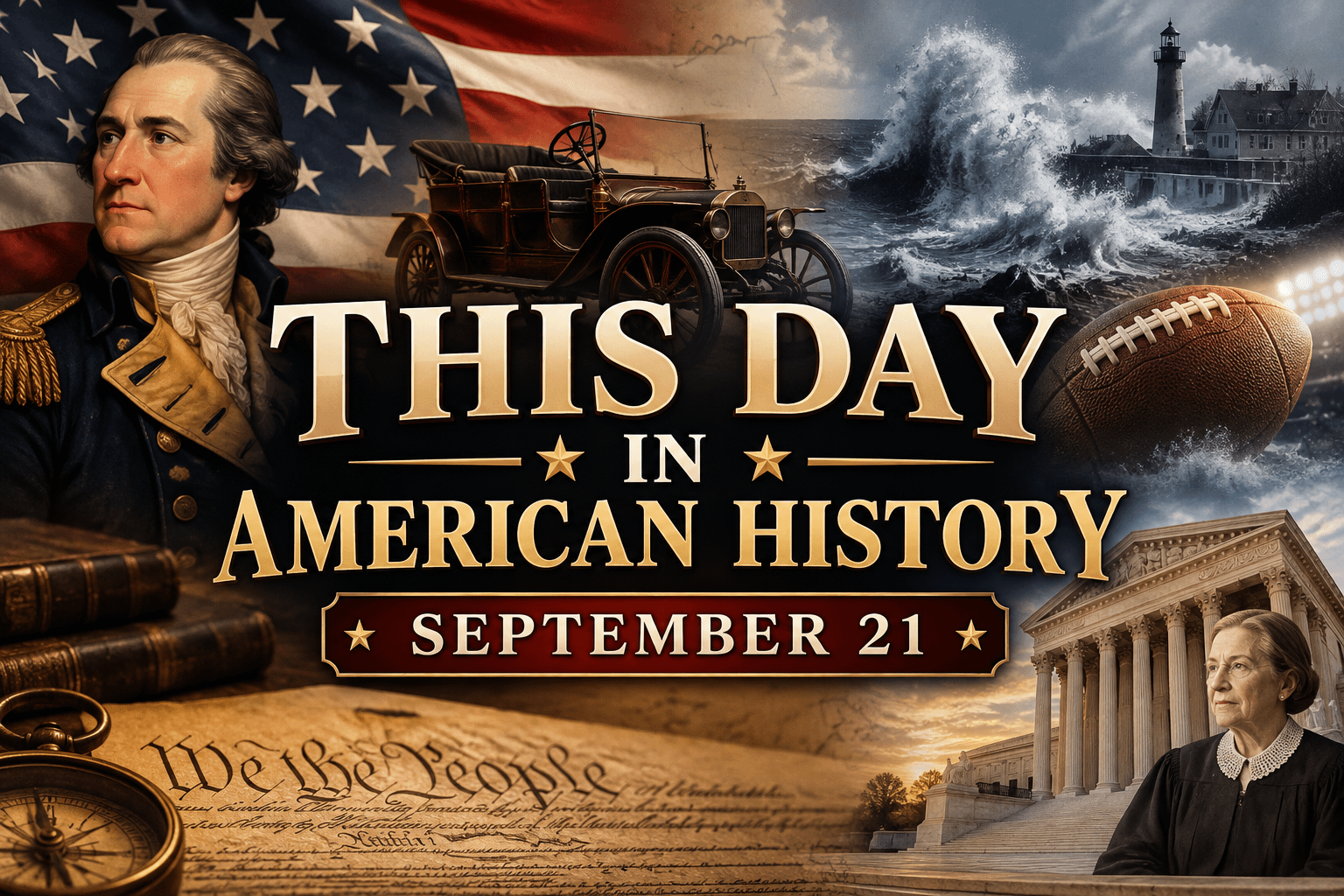
September 21 has witnessed moments of betrayal, disaster, innovation, entertainment, and historic progress in the United States. From Benedict Arnold’s infamous plot during the American Revolution to the confirmation of the first woman to serve on the U.S. Supreme Court, the date offers a fascinating look at how individual decisions and major events have shaped the country.
Some September 21 events are remembered as national milestones. Others are reminders of tragedy and destruction. Together, they show that American history is not a simple story of uninterrupted progress. It is a collection of victories, failures, disasters, breakthroughs, and people whose choices changed what came next.
1780 – Benedict Arnold’s Betrayal Unfolds
Few names in American history are as closely associated with betrayal as Benedict Arnold.
That reputation is especially connected to events unfolding around September 21, 1780.
Arnold had once been considered one of the Continental Army’s most courageous commanders. He played an important role in several battles during the American Revolution and suffered serious injuries while fighting for the American cause.
Yet Arnold became increasingly bitter.
He believed that he had been overlooked for promotions and insufficiently recognized for his military achievements. Financial problems and political disputes added to his resentment.
Eventually, Arnold began secretly communicating with the British.
At the time, Arnold commanded West Point, an enormously important American military position overlooking the Hudson River in New York. Control of the Hudson was strategically valuable because British possession of the river corridor could potentially divide New England from the other American states.
Arnold developed a plan to surrender West Point to the British.
British Major John André became one of the central figures in the conspiracy. Arnold provided the British with sensitive information concerning West Point’s defenses, forces, and vulnerabilities.
Their secret dealings came to a head in September 1780.
The conspiracy ultimately failed after André was captured while carrying incriminating documents. Arnold learned that his plot had been exposed and escaped to British-controlled territory.
He later served with British forces against the Americans he had once commanded.
His name would live on in American culture for an entirely different reason than his early battlefield accomplishments.
To this day, calling someone a “Benedict Arnold” is another way of calling that person a traitor.
The story remains one of the most dramatic examples of how quickly a historical reputation can change. A man once celebrated for bravery became remembered primarily for betrayal.
1893 – An Early American Automobile Takes to the Road
September 21 also has a place in the early history of the American automobile.
In 1893, Frank Duryea reportedly took an early gasoline-powered automobile for a test drive in Springfield, Massachusetts. Frank and his brother Charles Duryea became important pioneers in America’s developing automobile industry.
Their work came at a time when the idea of replacing horses with gasoline-powered machines still seemed extraordinary to many people.
The transformation that followed would be enormous.
Automobiles changed where Americans lived, how they worked, where they shopped, how cities were designed, and how people traveled across the country.
Road networks expanded. Gas stations appeared. Motels and roadside restaurants developed. Suburbs grew. Entire industries were eventually created around manufacturing, selling, maintaining, and fueling automobiles.
The early Duryea experiments therefore represented much more than an unusual mechanical invention.
They were part of the beginning of a transportation revolution that would reshape American life.
1938 – The Great New England Hurricane
September 21, 1938, brought one of the most devastating hurricanes ever experienced in New England.
The Great New England Hurricane—sometimes called the Long Island Express—struck Long Island and southern New England with tremendous speed and power.
The storm made landfall on Long Island before racing into Connecticut and the rest of New England. According to the National Weather Service, hurricane-force winds affected much of southern New England, while an enormous storm surge devastated coastal communities.
At Blue Hill Observatory in Massachusetts, sustained winds reached 121 mph and a peak gust of 186 mph was recorded. Downtown Providence, Rhode Island, was submerged beneath a storm tide approaching 20 feet.
Thousands of homes, cottages, and other buildings were destroyed or damaged.
Boats were smashed or swept away.
Electrical lines fell.
Floodwaters overwhelmed communities.
The National Weather Service records 564 deaths and more than 1,700 injuries in southern New England alone.
The hurricane became an enduring reminder of how dangerous rapidly moving storms can be, particularly when communities have little time to prepare.
1970 – Monday Night Football Makes Its Debut
September 21, 1970, also changed the relationship between American sports and television.
That evening, ABC aired the first regular-season broadcast of Monday Night Football.
The Cleveland Browns defeated the New York Jets 31–21.
The significance of the broadcast went far beyond the final score.
Professional football was already growing rapidly in popularity, but placing a major NFL game in prime time on Monday night turned football into a weekly television event.
Families, friends, coworkers, and football fans had something to discuss at the beginning of the workweek.
The program blended sports with entertainment and helped demonstrate the enormous commercial potential of live professional football on television.
Decades later, nationally televised football remains one of the biggest forces in American broadcasting.
What began on September 21, 1970, helped establish the model.
1981 – Sandra Day O’Connor Makes History
One of the most important events associated with September 21 occurred in 1981.
On that day, the United States Senate confirmed Sandra Day O’Connor to the U.S. Supreme Court.
The vote was 99–0.
Her confirmation was historic.
O’Connor would become the first woman to serve as a justice of the United States Supreme Court.
President Ronald Reagan had nominated her to replace retiring Justice Potter Stewart. Following hearings before the Senate Judiciary Committee, her nomination went before the full Senate.
Her confirmation shattered a barrier that had existed throughout nearly two centuries of Supreme Court history.
O’Connor ultimately served on the Court for approximately a quarter century and became an influential figure in American law. Because of the Court’s ideological balance during portions of her tenure, her vote sometimes became decisive in closely divided cases.
But her influence extended beyond individual rulings.
Her appointment demonstrated to generations of women that positions once effectively closed to them were becoming attainable.
The National Archives notes that women represented about 36 percent of law students when O’Connor was appointed. By the time she retired in 2006, that figure had risen to approximately 48 percent.
September 21, 1981, therefore stands as an important date not only in Supreme Court history but also in the broader history of women in American public life.
1989 – Hurricane Hugo Strikes South Carolina
Just over half a century after the devastating New England hurricane of 1938, September 21 was again associated with a major American hurricane.
Hurricane Hugo struck the South Carolina coast in 1989.
The powerful hurricane caused severe destruction in and around Charleston and across other parts of the Carolinas.
According to the National Weather Service, downtown Charleston recorded sustained winds of 87 mph with gusts reaching 108 mph.
Hugo caused extensive coastal flooding, destroyed homes, knocked down trees and power lines, and left communities facing a massive recovery effort.
The storm became one of the defining natural disasters of its era.
Interestingly, the fact that two historically significant hurricanes struck parts of the United States on September 21—51 years apart—makes the date especially notable in American weather history.
September 21 and the Many Sides of American History
Looking across these events reveals just how different the stories contained within a single date can be.
September 21 includes the betrayal of Benedict Arnold during America’s struggle for independence.
It includes early experiments with an invention that would eventually transform transportation.
It includes natural disasters that destroyed communities and claimed hundreds of lives.
It includes the beginning of a television tradition that became part of American popular culture.
And it includes a groundbreaking moment for women in American government and law.
History rarely follows one theme.
Some moments demonstrate courage.
Others reveal ambition or betrayal.
Some remind us of humanity’s ability to innovate.
Others remind us how vulnerable people remain to the forces of nature.
And occasionally, history records a moment when a barrier that stood for generations finally falls.
Why Remember September 21?
Studying history is about more than memorizing dates.
The value comes from understanding the people, circumstances, choices, and consequences behind those dates.
Benedict Arnold’s story demonstrates how resentment and personal ambition can alter a person’s legacy.
The early automobile experiments remind us that technologies capable of transforming society often begin as uncertain ideas.
The hurricanes of 1938 and 1989 remind us that disaster preparedness and weather forecasting can become matters of life and death.
The debut of Monday Night Football demonstrates how entertainment and technology can reshape American culture.
Sandra Day O’Connor’s confirmation shows how an appointment involving one person can symbolize a much larger change in society.
Each story contributes another piece to the complicated American experience.
Remembering the Past
September 21 is a day filled with dramatically different chapters of American history.
There are stories of betrayal and innovation, devastation and entertainment, tragedy and progress.
Perhaps that is one of the most important lessons history provides.
America’s story has never been written through one event, one generation, or one type of experience. It has been shaped by millions of choices and countless moments—some famous and others nearly forgotten.
When we look back at September 21, we are reminded that today’s events will eventually become tomorrow’s history.
The question is not simply what happened before us.
It is what we will learn from it—and what kind of history we are creating now.
Which September 21 event do you think had the greatest impact on American history?
Leave a ReplyCancel reply