
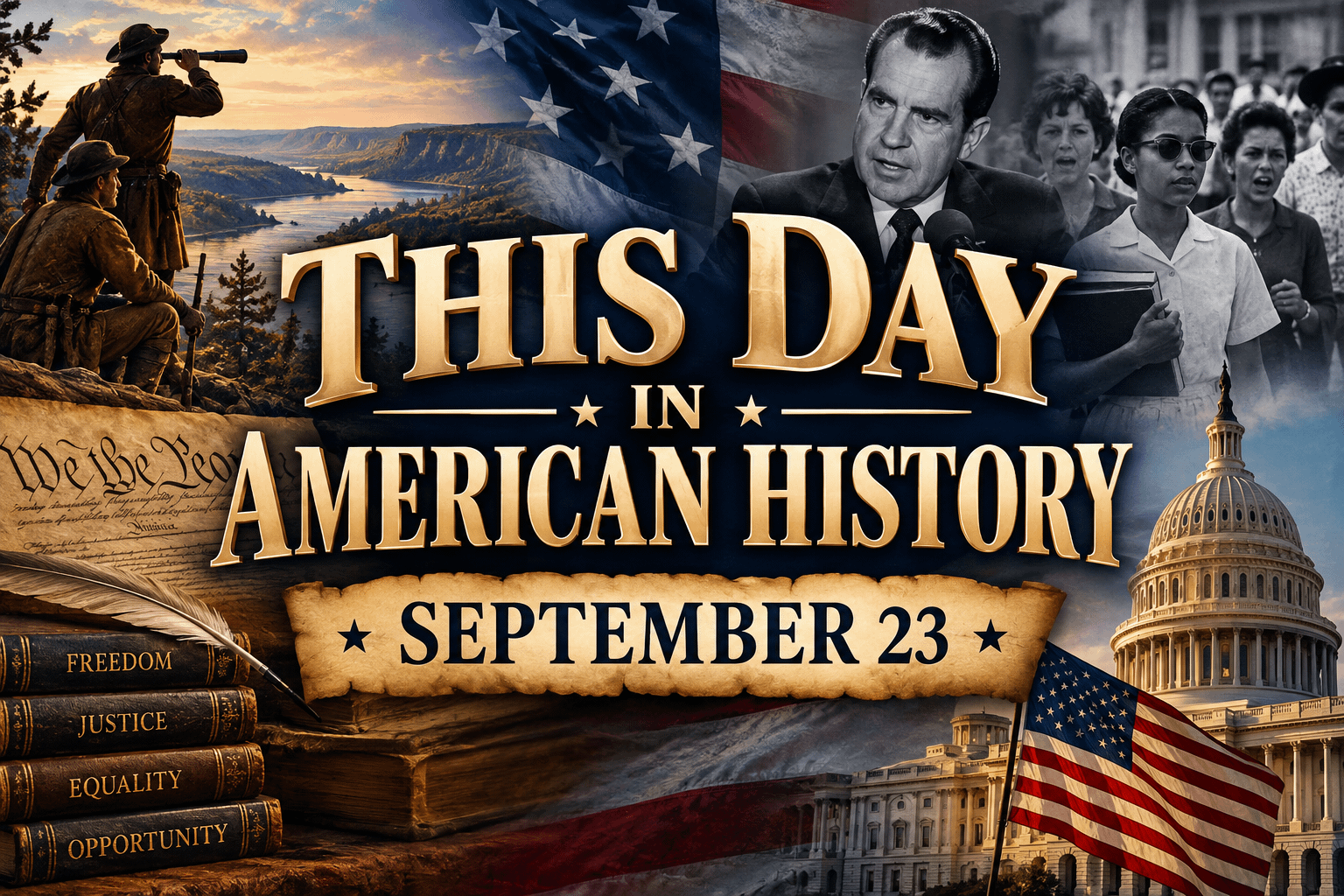
September 23 has witnessed exploration, political drama, struggles over civil rights, and moments that helped shape the United States. From the triumphant return of Lewis and Clark to one of the most famous televised political speeches in American history and the confrontation over school integration in Little Rock, this date offers a fascinating look at the country’s evolving story.
Here are some of the most significant moments connected to September 23 in American history.
1780 – The Plot to Surrender West Point Is Exposed
One of the most infamous acts of betrayal in American history began unraveling around September 23, 1780.
During the Revolutionary War, American General Benedict Arnold secretly negotiated with the British to surrender the strategically important American fortress at West Point, New York.
Arnold had become frustrated with the Continental Congress and increasingly resentful over what he believed was a lack of recognition for his military accomplishments. Eventually, he began communicating with British Major John André.
André was captured by American militiamen while carrying documents connected to Arnold’s plan. His capture exposed the conspiracy before West Point could be surrendered.
Arnold learned that the plot had been discovered and escaped to British-controlled New York City. André was later convicted as a spy and executed.
Benedict Arnold’s name would become synonymous with betrayal in the United States.
The episode demonstrated just how vulnerable the American Revolution remained even several years after the Declaration of Independence. A successful British takeover of West Point could have created serious strategic problems for the Continental Army.
1806 – Lewis and Clark Return to St. Louis
One of America’s greatest expeditions officially reached its conclusion on September 23, 1806.
Meriwether Lewis, William Clark, and the Corps of Discovery arrived in St. Louis after spending more than two years exploring the western portion of the North American continent.
Their journey had begun in 1804 following the Louisiana Purchase.
President Thomas Jefferson wanted the expedition to explore the newly acquired territory, document its geography and natural resources, establish relationships with Native American nations, and search for practical transportation routes toward the Pacific.
The expedition eventually reached the Pacific Ocean before beginning the long journey home.
At approximately noon on September 23, 1806, the expedition arrived back in St. Louis. According to the National Park Service, members of the expedition fired their weapons in salute as they approached the town, where residents gathered to welcome them home.
William Clark recorded that they were greeted warmly by the inhabitants of St. Louis.
Their return was remarkable.
The expedition had been gone for more than two years, four months, and ten days.
The information collected during the journey dramatically expanded American knowledge of the West. Maps, journals, observations of wildlife and plants, and descriptions of Indigenous nations became invaluable records of the early American frontier.
The expedition also became closely connected with the story of Sacagawea, the Lemhi Shoshone woman whose knowledge, interpretation skills, and presence proved important during portions of the journey.
September 23 therefore represents one of the great homecoming moments in early American history.
1846 – The Discovery of Neptune
September 23, 1846, also became an important date in the history of astronomy.
German astronomer Johann Gottfried Galle observed the planet Neptune after calculations by French mathematician Urbain Le Verrier predicted where the unknown planet should appear.
Although the discovery occurred in Europe, it would have a lasting impact on astronomy around the world, including scientific research in the United States.
The discovery was especially important because Neptune’s location had essentially been predicted mathematically before the planet was directly identified.
It demonstrated the extraordinary power of mathematics to reveal something in the universe that human eyes had not yet recognized.
1952 – Richard Nixon Delivers the “Checkers Speech”
On September 23, 1952, Senator Richard Nixon delivered one of the most famous political television speeches in American history.
Nixon was Dwight D. Eisenhower’s Republican vice-presidential running mate during the 1952 presidential campaign.
His position on the ticket came under threat following controversy surrounding a political expense fund supported by donors.
Rather than quietly withdraw from the campaign, Nixon decided to make his case directly to the American people.
He appeared on national television and discussed his personal finances while defending himself against allegations that the fund had been improperly used for personal benefit.
Then came the moment that gave the speech its famous nickname.
Nixon explained that his family had received a gift: a black-and-white cocker spaniel named Checkers.
He made it clear that regardless of political criticism, his daughters loved the dog and the family intended to keep it.
The emotional reference captured enormous public attention.
The address became known simply as the “Checkers Speech.”
The speech helped Nixon remain on Eisenhower’s ticket. Eisenhower and Nixon went on to win the 1952 presidential election, beginning Nixon’s long and complicated place in American political history.
But the speech was significant for another reason.
It demonstrated the enormous political power of television.
Politicians could now speak directly to millions of Americans inside their homes rather than depending entirely on newspapers, radio reports, or campaign rallies.
Television would soon become one of the most powerful forces in American presidential politics.
1955 – The Emmett Till Murder Trial Ends in Acquittal
September 23, 1955, marked a deeply painful moment in American civil rights history.
A Mississippi jury acquitted Roy Bryant and J.W. Milam in the murder of 14-year-old Emmett Till.
Till, a Black teenager from Chicago, had been visiting relatives in Mississippi when he was abducted and brutally murdered.
His mother, Mamie Till-Mobley, made the courageous decision to hold an open-casket funeral so the world could see what had been done to her son.
Photographs of Till’s body were widely circulated and created outrage across the country.
The acquittal of the two defendants demonstrated the enormous racial injustice that existed within the American legal system during the Jim Crow era.
The killing of Emmett Till and the failure to obtain justice became important catalysts for the growing Civil Rights Movement.
His story continues to be remembered as part of America’s ongoing struggle over racism, equality, justice, and civil rights.
1957 – The Little Rock Nine Enter Central High School
Two years later, September 23 became connected with another major chapter in the Civil Rights Movement.
Nine Black students had enrolled at Central High School in Little Rock, Arkansas, as part of the effort to desegregate American public schools following the Supreme Court’s landmark Brown v. Board of Education decision.
They became known as the Little Rock Nine.
On September 23, 1957, the students entered Central High School while a hostile crowd gathered outside. Violence and unrest escalated to the point that police removed the students for their safety.
The crisis forced President Dwight D. Eisenhower to confront the question of whether the federal government would enforce court-ordered desegregation.
Eisenhower signed Executive Order 10730 on September 23 as part of the federal response to the crisis. The confrontation ultimately led him to send soldiers from the 101st Airborne Division to Little Rock and place the Arkansas National Guard under federal authority.
On September 25, the Little Rock Nine entered Central High School under federal military protection.
The confrontation became one of the defining images of the Civil Rights era.
It demonstrated that Supreme Court decisions alone were not always enough to guarantee civil rights. Federal enforcement could be necessary when state or local authorities resisted constitutional protections.
2002 – California Establishes Paid Family Leave
September 23 also has a place in the modern history of American workplace policy.
In 2002, California Governor Gray Davis signed legislation establishing a statewide paid family leave insurance program.
The law made California the first state in the country to create such a program.
The policy allowed eligible workers to receive partial wage replacement while taking time away from work for certain family responsibilities.
California’s action became part of a larger national conversation about balancing employment with caregiving, childbirth, family illness, and other major life events.
Other states would eventually establish their own paid family and medical leave programs.
A Date Filled With Turning Points
What makes September 23 interesting is how different its major historical moments are.
The return of Lewis and Clark represents America’s early period of exploration and territorial expansion.
The Benedict Arnold conspiracy reminds us that the American Revolution was filled with uncertainty, internal conflict, and difficult choices.
The Emmett Till trial and the Little Rock crisis expose painful chapters in America’s struggle with racism and equal rights.
Richard Nixon’s “Checkers Speech” demonstrates how technology transformed American politics.
And the creation of California’s paid family leave program reflects the continuing evolution of American social and workplace policy.
Together, these events show that American history is rarely a simple story of uninterrupted progress.
It is a story of exploration and discovery, courage and injustice, conflict and reform, failure and change.
Remembering September 23
History becomes more meaningful when we recognize that the events described in textbooks happened on ordinary days.
September 23 was simply another date on the calendar when Lewis and Clark finally saw St. Louis again after their extraordinary journey.
It was another September evening when millions of Americans turned on their televisions and watched a young senator named Richard Nixon fight to save his political career.
And it was another school day when nine Black students attempted to exercise a right that should never have been denied to them.
The people living through those moments could not always know how history would remember them.
That is one of the greatest lessons of studying the past.
History is not only something that happened hundreds of years ago.
History is created every day by people responding to the challenges, opportunities, injustices, discoveries, and decisions placed before them.
Which event from September 23 do you believe had the greatest impact on the future of the United States?
Leave a ReplyCancel reply