
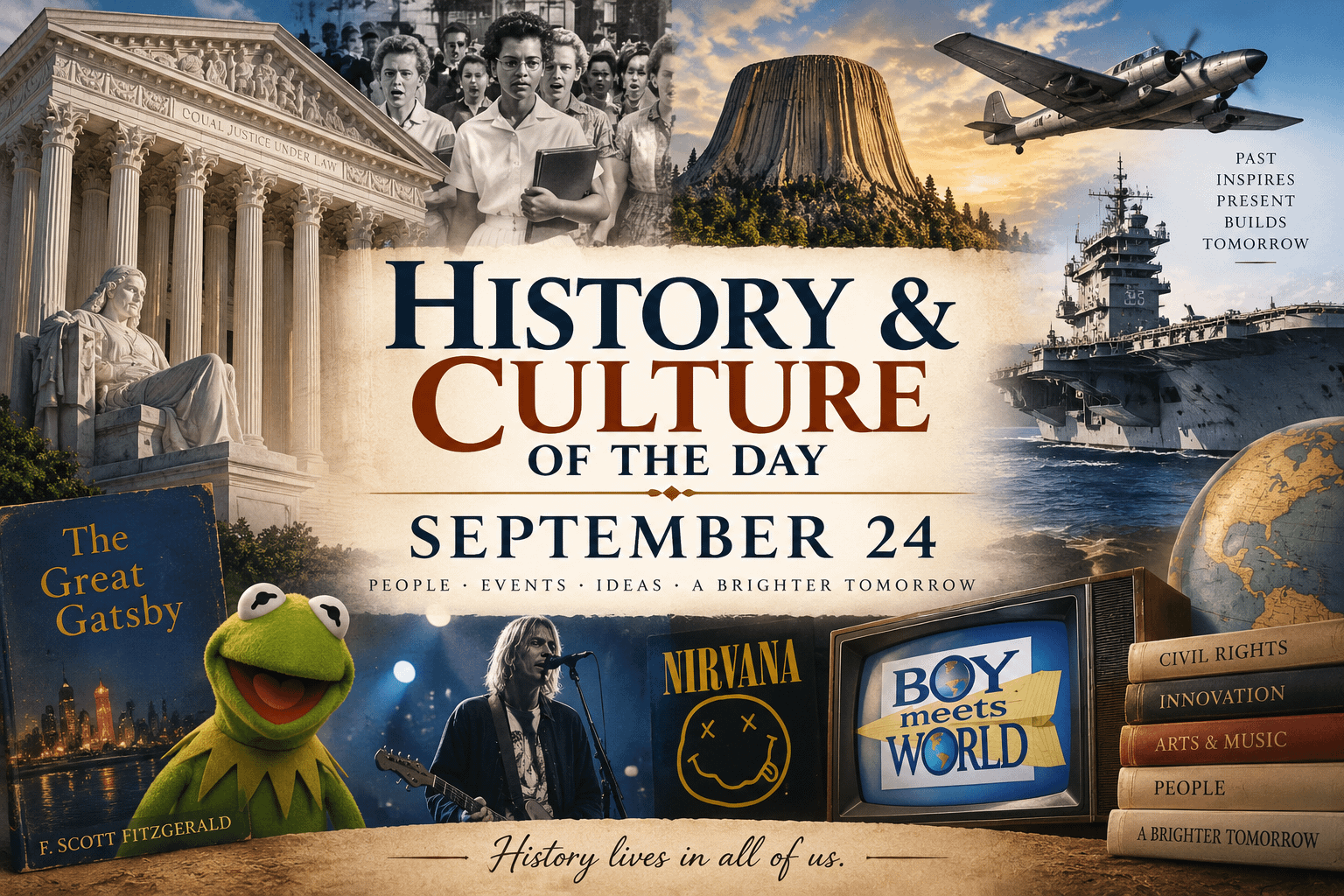
September 24 is a date filled with moments that have influenced politics, science, entertainment, transportation, sports, and popular culture. From the creation of the United States Supreme Court to the arrival of one of the most famous aircraft carriers in American history, September 24 offers a fascinating journey through the past.
History is more than a collection of dates. It is the story of people—their decisions, discoveries, struggles, creativity, and determination. Looking back at September 24 reminds us how events from centuries ago can continue to influence the way we live today.
1789 — The United States Establishes Its Federal Judiciary
One of the most important events associated with September 24 occurred in 1789, when President George Washington signed the Judiciary Act of 1789.
The newly created United States had a Constitution, a president, and Congress, but the federal judicial system still needed to be organized. The Judiciary Act established the structure of the federal courts and provided for a Supreme Court consisting initially of a chief justice and five associate justices.
Washington also nominated the first members of the Supreme Court on September 24, including John Jay as the first chief justice.
The judiciary would eventually become one of the three central branches of the federal government, alongside the executive and legislative branches.
Over the centuries, the Supreme Court has issued decisions affecting civil rights, presidential authority, freedom of speech, voting, criminal justice, business, privacy, and countless other aspects of American life.
September 24 therefore represents an important moment in the development of the American system of government.
1869 — Black Friday Shakes the American Economy
September 24, 1869, became known as “Black Friday” after a dramatic collapse in the United States gold market.
Financiers Jay Gould and James Fisk attempted to gain control over a significant portion of the nation’s gold supply. Their actions contributed to rapidly rising gold prices and widespread speculation.
When the federal government intervened by selling gold, prices suddenly collapsed.
Investors suffered enormous losses, and the disruption spread into other parts of the economy.
This Black Friday should not be confused with the modern shopping day following Thanksgiving. The 1869 event was a financial crisis demonstrating how speculation and attempts to manipulate markets could have consequences far beyond Wall Street.
1890 — The Mormon Church Moves Away From Plural Marriage
September 24, 1890, marked an important turning point in the history of The Church of Jesus Christ of Latter-day Saints.
Church president Wilford Woodruff issued what became known as the 1890 Manifesto, announcing his intention to submit to laws prohibiting plural marriage.
Plural marriage had created intense conflict between the church and the United States government during the nineteenth century.
The Manifesto became a major step toward ending the church-sanctioned practice, although the transition was more complicated and gradual than a single declaration might suggest.
The event illustrates how religious practices, law, culture, and government authority sometimes collide—and how those conflicts can reshape communities over time.
1906 — Devils Tower Becomes America’s First National Monument
On September 24, 1906, President Theodore Roosevelt proclaimed Devils Tower in Wyoming the first national monument established under the Antiquities Act.
The enormous geological formation rises dramatically above the surrounding landscape and has long held deep cultural and spiritual significance for several Indigenous peoples.
Its designation represented a major development in America’s conservation movement.
Theodore Roosevelt became closely associated with efforts to preserve important landscapes, wildlife habitats, forests, archaeological sites, and natural wonders.
Today, America’s national monuments help protect places with historical, scientific, cultural, and environmental importance.
The creation of Devils Tower National Monument demonstrated that preserving America’s heritage could mean protecting both human history and the natural world.
1929 — Jimmy Doolittle Demonstrates Instrument Flight
Aviation history took an important step forward on September 24, 1929.
American aviator James “Jimmy” Doolittle completed an experimental flight using instruments to guide the aircraft rather than relying primarily on what he could see outside the cockpit.
Instrument flying became essential to the development of modern aviation because pilots needed reliable ways to navigate through clouds, darkness, poor visibility, and difficult weather.
Doolittle would later become famous for leading the 1942 Doolittle Raid against Japan during World War II.
His earlier aviation experiments, however, were significant in their own right.
Modern commercial air travel depends heavily on instruments, navigation technology, radar, communications, and sophisticated flight-control systems. The pioneering work of early aviators helped make today’s global aviation network possible.
1941 — The Houston Colt .45s’ Future Home Begins to Take Shape
September 24 also connects with the development of professional sports and the changing cultural landscape of American cities during the twentieth century.
Houston’s eventual rise as a major professional sports city reflected broader changes occurring throughout the United States as baseball expanded and cities invested in increasingly ambitious stadium projects.
That transformation would eventually produce one of the most famous stadiums of its era: the Astrodome.
Opened in 1965, it became known as the “Eighth Wonder of the World” and helped popularize the concept of large indoor stadiums.
The Houston Colt .45s eventually became the Houston Astros, a name inspired by the city’s growing association with America’s space program.
Sports, technology, civic identity, and popular culture were increasingly becoming intertwined.
1957 — President Eisenhower Sends Federal Troops to Little Rock
One of the defining events of the American civil rights era intensified on September 24, 1957.
President Dwight D. Eisenhower ordered federal troops from the 101st Airborne Division to Little Rock, Arkansas, after attempts to integrate Central High School were met with resistance and hostility.
Nine Black students—later known as the Little Rock Nine—were attempting to attend the previously segregated school following the Supreme Court’s decision in Brown v. Board of Education.
Arkansas Governor Orval Faubus had previously used the state’s National Guard to prevent the students from entering.
The confrontation raised a fundamental question: Would federal civil-rights law actually be enforced when state officials resisted it?
Eisenhower ultimately federalized the Arkansas National Guard and sent troops to protect the students.
The Little Rock crisis became one of the most powerful images of the civil rights movement and demonstrated that court decisions alone could not eliminate segregation. Enforcement, courage, activism, and political action were also necessary.
1960 — The USS Enterprise Is Launched
On September 24, 1960, the USS Enterprise was launched.
The ship was revolutionary.
USS Enterprise (CVN-65) became the world’s first nuclear-powered aircraft carrier. Nuclear propulsion allowed the enormous vessel to operate for long periods without the frequent refueling required by conventionally powered ships.
The Enterprise would serve the United States Navy for more than half a century.
Its name also carried tremendous cultural significance.
“Enterprise” had already been used for earlier American naval vessels, and it later became internationally famous through the fictional starship USS Enterprise in Star Trek.
The connection between naval history and science-fiction culture helped make the name synonymous with exploration, technological ambition, and adventure.
1964 — The Warren Commission Report Is Presented to President Johnson
On September 24, 1964, the Warren Commission presented its report to President Lyndon B. Johnson concerning the assassination of President John F. Kennedy.
Kennedy had been assassinated in Dallas, Texas, on November 22, 1963.
The commission, headed by Chief Justice Earl Warren, concluded that Lee Harvey Oswald acted alone in assassinating Kennedy and that Jack Ruby acted alone when he killed Oswald.
The report became one of the most debated government investigations in American history.
Questions and alternative theories surrounding Kennedy’s assassination have remained part of American political culture for generations.
Books, documentaries, films, television programs, government investigations, and public debates have continued examining what happened in Dallas.
Few events demonstrate more clearly how history can remain culturally alive long after the official investigations have ended.
1968 — 60 Minutes Debuts on CBS
Television journalism changed on September 24, 1968, when 60 Minutes premiered on CBS.
Created by producer Don Hewitt, the program developed a distinctive approach that combined investigative reporting, interviews, profiles, and feature stories.
Its famous ticking stopwatch became one of television’s most recognizable sounds and images.
Rather than presenting news exclusively through the traditional nightly-news format, 60 Minutes demonstrated that long-form television journalism could attract a massive audience.
The program would eventually become one of the longest-running and most influential news programs in American television history.
Its success helped establish investigative television journalism as an important part of American culture.
1976 — Newspaper Heiress Patty Hearst Is Sentenced
On September 24, 1976, Patty Hearst was sentenced to prison following her conviction for participating in a bank robbery.
Her story had fascinated the country.
Hearst, granddaughter of newspaper publisher William Randolph Hearst, had been kidnapped in 1974 by the Symbionese Liberation Army, a radical organization.
She later appeared to join the group and participated in criminal activity, including a bank robbery.
Her defense argued that she had been subjected to coercion and psychological manipulation.
The case sparked intense national discussions about kidnapping, coercive control, trauma, personal responsibility, radical political movements, and the power of the media.
President Jimmy Carter later commuted her sentence, and President Bill Clinton granted her a full pardon in 2001.
Her case remains one of the strangest intersections of crime, celebrity, psychology, politics, and media culture in twentieth-century America.
1991 — Nevermind Changes Rock Music
September 24, 1991, became an important date in music history with the release of Nirvana’s album Nevermind.
Led by Kurt Cobain, Nirvana helped bring the Seattle grunge movement into mainstream popular culture.
The album’s breakout song, “Smells Like Teen Spirit,” became an anthem for a generation.
Rock music in the late 1980s had been dominated partly by highly polished arena rock and glam metal. Nirvana’s sound and image offered something different—raw guitars, emotional lyrics, understated fashion, and an anti-celebrity attitude that ironically turned the band into global celebrities.
Nevermind eventually became one of the most influential rock albums of its era.
Grunge fashion also moved into mainstream culture. Flannel shirts, ripped jeans, worn sneakers, and deliberately casual styles became associated with early-1990s youth culture.
September 24, 1991, therefore represents not merely an album release but a cultural shift.
1991 — The Red Hot Chili Peppers Release Blood Sugar Sex Magik
Nirvana was not the only influential rock band releasing a major album on September 24, 1991.
The Red Hot Chili Peppers released Blood Sugar Sex Magik on the same day.
The album included songs such as “Under the Bridge” and “Give It Away” and helped transform the band into international stars.
Their combination of rock, funk, alternative music, and punk influences contributed to the rapidly changing sound of popular music during the early 1990s.
Looking back, September 24, 1991, was an extraordinary day for rock music.
Two albums released that day would help define alternative rock for years to come.
1993 — Boy Meets World Premieres
September 24 also holds a nostalgic place in 1990s television culture.
On September 24, 1993, Boy Meets World premiered on ABC.
The series followed Cory Matthews as he navigated childhood, adolescence, friendships, school, family relationships, love, and eventually adulthood.
Characters such as Cory, Topanga, Shawn, Eric, and Mr. Feeny became familiar figures to a generation of viewers.
Although the program was a comedy, it frequently addressed serious subjects involving friendship, family difficulties, responsibility, identity, relationships, and growing up.
For many viewers who grew up during the 1990s, Boy Meets World became more than another sitcom. It became part of the shared cultural memory of the era.
Jim Henson Was Born on September 24, 1936
September 24 is also the birthday of one of the most imaginative figures in entertainment history.
Jim Henson was born on September 24, 1936.
Henson created the Muppets and helped bring characters including Kermit the Frog, Miss Piggy, Fozzie Bear, and many others into popular culture.
His work also played a central role in Sesame Street, where puppetry became an extraordinarily effective tool for children’s education.
Henson understood something powerful: entertainment could make people laugh while also teaching kindness, curiosity, friendship, creativity, and acceptance.
His influence continues through television, movies, puppetry, children’s entertainment, and generations of performers inspired by his creativity.
F. Scott Fitzgerald Was Born on September 24, 1896
American author F. Scott Fitzgerald was born September 24, 1896.
Fitzgerald became one of the literary voices most closely associated with the Jazz Age.
His best-known novel, The Great Gatsby, explored wealth, ambition, love, class, illusion, and the pursuit of the American Dream.
Although the novel initially experienced only modest commercial success, its reputation grew dramatically after Fitzgerald’s death.
Today, The Great Gatsby is widely taught in American schools and remains one of the most recognizable works of twentieth-century American literature.
Fitzgerald’s writing continues to resonate because many of the questions he explored remain relevant: What does success really mean? Can wealth create happiness? Can people recreate the past? And what happens when dreams become more powerful than reality?
September 24 and the Power of Culture
One of the fascinating things about examining a single date is seeing how different parts of history overlap.
September 24 connects government with music, aviation with civil rights, literature with television, military technology with science fiction, and financial history with popular culture.
The establishment of America’s federal judiciary shaped government.
The Little Rock crisis helped define the struggle for civil rights.
Jimmy Doolittle’s experiments helped transform aviation.
USS Enterprise represented technological innovation.
Jim Henson transformed children’s entertainment.
F. Scott Fitzgerald influenced American literature.
Nirvana and the Red Hot Chili Peppers helped reshape popular music.
Boy Meets World became part of the childhood memories of millions.
Each event belongs to a different era, yet together they demonstrate how history is constantly being created.
Why Remembering History Matters
It can be tempting to think of history as something finished—names, dates, and events locked permanently in the past.
But history surrounds us.
The courts established in the eighteenth century still influence American life. Civil-rights battles of the twentieth century continue to shape discussions about equality. Technologies pioneered by early aviators evolved into systems used on thousands of flights every day.
Music released decades ago continues to find new listeners.
Television programs watched by one generation are rediscovered by another.
Books written more than a century ago still ask questions people struggle with today.
History survives because its consequences survive.
Culture survives because people continue sharing it.
Final Thought
September 24 reminds us that history is not created only during wars, elections, or political crises. It is also created in recording studios, laboratories, classrooms, courtrooms, television studios, airplanes, ships, books, and ordinary communities.
Some moments change laws.
Others change technology.
Some change music or entertainment.
And others change how people understand themselves and the world around them.
Every generation inherits stories from those who came before it while simultaneously creating stories for those who will come next.
That is what makes studying history and culture so fascinating.
Which September 24 moment do you think had the greatest impact on the world we live in today?
Leave a ReplyCancel reply