
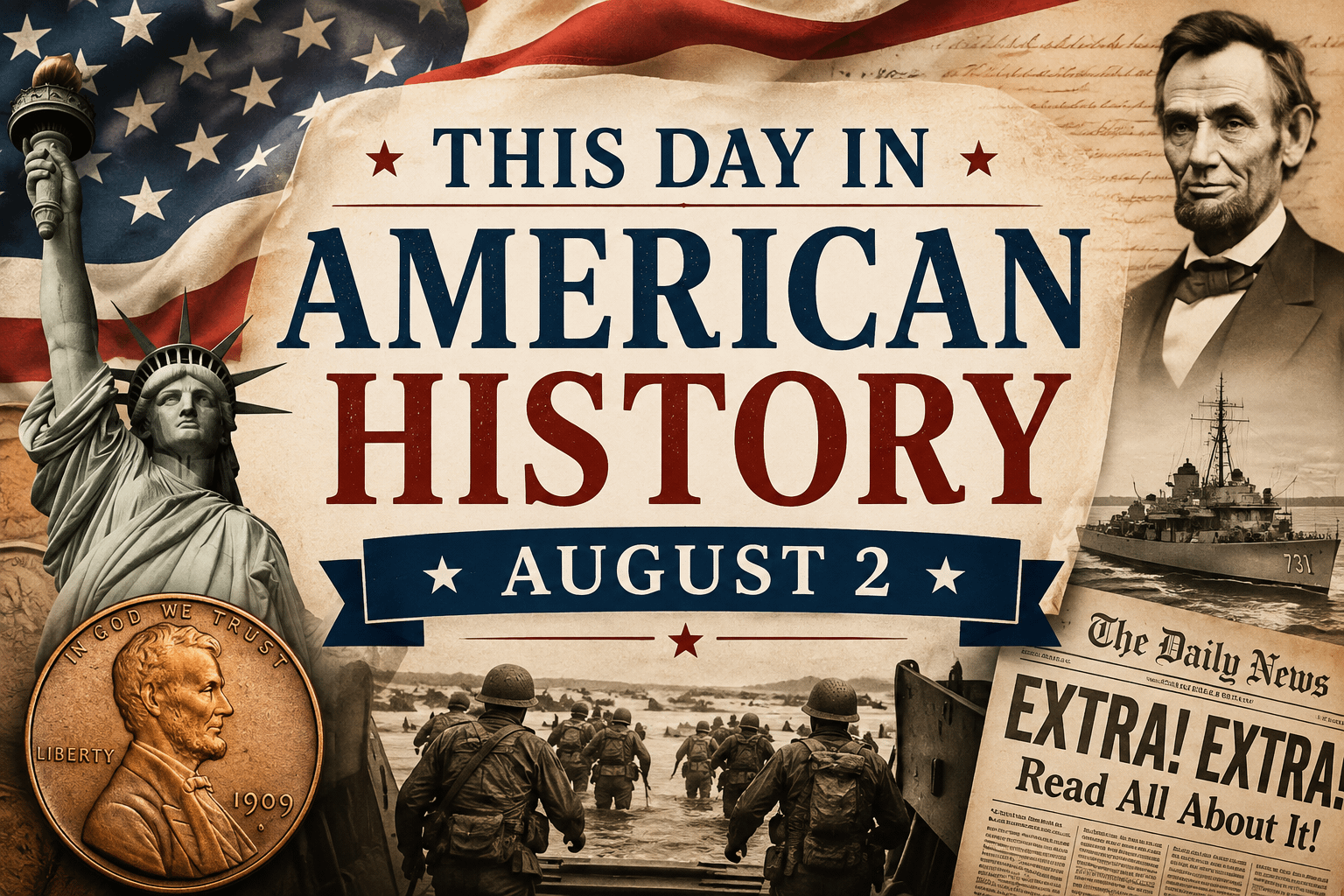
History is more than a collection of dates and events—it is the story of people whose choices, discoveries, courage, and sacrifices shaped the nation we know today. Every day on the calendar offers an opportunity to reflect on moments that changed the course of American history, and August 2 is filled with events that span politics, science, military service, transportation, and the American frontier.
From the nation’s very first census to acts of heroism during World War II, from the birth of one of America’s most recognizable coins to decisions that influenced international conflict, August 2 reminds us that history is often made through both ordinary government actions and extraordinary human courage.
Let’s explore some of the most significant events that occurred on this day in American history.
August 2, 1790 – The First United States Census Begins
One of the most important responsibilities assigned by the U.S. Constitution officially began on August 2, 1790, when the first federal census was conducted.
Following the nation’s independence, leaders understood that a growing country needed an accurate count of its people. Article I, Section 2 of the Constitution required that every resident be counted every ten years to determine representation in the House of Representatives and the distribution of federal taxes.
At the time, the United States consisted of only thirteen states stretching along the Atlantic coast. Vast portions of what is now the Midwest and West had yet to become states.
Federal marshals traveled on horseback, by wagon, and on foot to visit households individually. There were no computers, telephones, or digital records. Every response had to be written by hand.
The census recorded approximately 3.9 million residents, including:
- Free white males
- Free white females
- Other free persons
- Enslaved individuals
While today’s census reflects a much broader and more inclusive population count, the first census established an institution that continues to influence congressional representation, federal funding, community planning, emergency services, schools, hospitals, and transportation infrastructure.
Every ten years, Americans continue participating in a tradition that began more than 230 years ago.
August 2, 1876 – The Death of Wild Bill Hickok
The American West lost one of its greatest legends when James Butler “Wild Bill” Hickok was shot and killed in Deadwood, Dakota Territory.
Hickok had earned fame as a scout, lawman, gambler, Civil War veteran, and gunslinger. Stories of his remarkable shooting ability spread throughout newspapers and dime novels, making him one of the first celebrities of the American frontier.
On the afternoon of August 2, Hickok entered Nuttal & Mann’s Saloon to play poker. Normally, he preferred sitting with his back against the wall, allowing him to watch the room. That day, the preferred seat was unavailable.
Jack McCall approached Hickok from behind and shot him in the back of the head.
According to legend, Hickok was holding two black aces and two black eights—a poker hand forever remembered as the Dead Man’s Hand.
Although historians debate the exact cards he held, the story became deeply rooted in American folklore.
Wild Bill Hickok’s life and death inspired countless Western novels, films, documentaries, and television series, helping shape America’s enduring fascination with the Old West.
August 2, 1909 – The Lincoln Penny Is Released
Few objects pass through American hands as often as the Lincoln penny.
On August 2, 1909, the United States Mint officially released the new one-cent coin honoring President Abraham Lincoln.
The release celebrated the 100th anniversary of Lincoln’s birth and marked a historic first for American currency. Until then, U.S. coins typically featured symbolic figures such as Lady Liberty rather than actual people.
Designed by sculptor Victor David Brenner, the coin featured Lincoln’s profile on the front and two wheat stalks on the reverse.
Americans immediately embraced the new design.
Over the decades, the reverse side evolved from wheat ears to the Lincoln Memorial and later to the Union Shield, while Lincoln’s portrait remained.
Today, billions of Lincoln cents have been produced, making it one of the most recognized and collected coins in U.S. history.
August 2, 1923 – President Warren G. Harding Dies
President Warren G. Harding, the 29th President of the United States, died unexpectedly on August 2, 1923, while traveling across the country.
Harding had embarked on what became known as the “Voyage of Understanding,” hoping to reconnect with Americans after World War I and discuss national priorities.
During a stop in San Francisco, Harding suddenly became ill and passed away at the age of 57.
The nation was shocked.
Because air travel was still in its infancy, news spread primarily through newspapers and radio bulletins.
Vice President Calvin Coolidge, who was visiting his family in rural Vermont, learned of Harding’s death late that evening.
In one of the most unusual presidential transitions in American history, Coolidge was sworn into office by his own father, John Calvin Coolidge Sr., a notary public.
Coolidge would later win election in his own right and become one of the defining leaders of the Roaring Twenties.
August 2, 1939 – Albert Einstein Signs a Historic Letter
Although Albert Einstein was not an American citizen when he first arrived in the United States, his influence on American history became enormous.
On August 2, 1939, Einstein signed a letter addressed to President Franklin D. Roosevelt.
The letter warned that Nazi Germany might be capable of developing an atomic bomb using uranium.
Physicists feared that if Adolf Hitler obtained such a weapon first, the consequences would be catastrophic.
Einstein urged Roosevelt to support American research into nuclear physics.
While Einstein himself did not participate in building the atomic bomb, his letter helped encourage the federal government to begin research that ultimately led to the Manhattan Project.
The project transformed modern science, warfare, international diplomacy, and global politics for generations.
Few letters in American history have had such far-reaching consequences.
August 2, 1943 – The Heroism of PT-109
One of the most remarkable stories of bravery during World War II occurred on August 2, 1943.
Lieutenant John F. Kennedy, then serving in the U.S. Navy, commanded Patrol Torpedo Boat 109 (PT-109) in the Solomon Islands.
During a nighttime mission, the Japanese destroyer Amagiri struck PT-109, cutting the small vessel in half.
Two crew members were killed instantly.
The remaining sailors found themselves stranded in dangerous waters surrounded by enemy forces.
Despite suffering injuries himself, Kennedy refused to abandon his crew.
He famously towed an injured sailor through the ocean by gripping the strap of the man’s life jacket with his teeth while swimming toward safety.
For several days Kennedy and his surviving crew struggled to survive before finally being rescued.
The story became national news after the war and played an important role in Kennedy’s rise to the presidency two decades later.
His leadership under extraordinary circumstances remains one of the most celebrated military stories in American history.
August 2, 1964 – The Gulf of Tonkin Incident
On August 2, 1964, the destroyer USS Maddox encountered North Vietnamese patrol boats in the Gulf of Tonkin.
The resulting confrontation became one of the most consequential military incidents of the twentieth century.
Two days later, reports of a second attack—later the subject of significant historical debate—led Congress to pass the Gulf of Tonkin Resolution.
The resolution granted President Lyndon B. Johnson broad authority to expand American military operations in Southeast Asia without a formal declaration of war.
The conflict eventually grew into the Vietnam War as most Americans remember it, involving more than 2.7 million U.S. service members over the following years.
Historians continue studying the incident because of its enormous political and military consequences.
August 2, 1985 – Delta Flight 191 Changes Aviation Safety
Modern aviation safety has often advanced because investigators carefully studied tragic accidents.
On August 2, 1985, Delta Air Lines Flight 191 encountered a powerful microburst while approaching Dallas/Fort Worth International Airport.
The sudden and intense downdraft caused the aircraft to lose altitude rapidly before crashing short of the runway.
The accident claimed 137 lives.
The tragedy prompted extensive research into wind shear and microbursts.
As a result, airports installed advanced Doppler weather radar systems, airlines enhanced pilot training, and aircraft manufacturers improved warning technologies.
Millions of airline passengers have benefited from the safety improvements that followed.
The legacy of Flight 191 continues to save lives today.
Other Notable August 2 Moments
Throughout history, August 2 has also been associated with numerous milestones in American life, including:
- Scientific advancements that influenced medicine and engineering.
- Military operations that shaped global conflicts.
- Political decisions affecting generations of Americans.
- Cultural developments reflected in literature, film, sports, and entertainment.
- Innovations in transportation that made travel safer and more efficient.
Every generation adds new chapters to the story of America, making each August 2 another opportunity to contribute to history.
Why Remember This Day?
Studying daily history offers more than interesting trivia.
It helps us understand:
- How government institutions developed.
- Why certain laws exist.
- The sacrifices made by military service members.
- The importance of scientific discovery.
- Lessons learned through tragedy.
- The courage displayed by ordinary people facing extraordinary circumstances.
History provides perspective. It reminds us that today’s challenges will someday become tomorrow’s lessons.
Final Thoughts
August 2 reflects the remarkable diversity of the American story. On this date, Americans counted a young nation’s population for the first time, honored one of its greatest presidents on a coin that remains in circulation today, witnessed acts of extraordinary wartime courage, experienced moments that reshaped foreign policy, and learned difficult lessons that made aviation safer for future generations.
Each event represents a different thread woven into the fabric of the United States. Some are stories of innovation. Others are tales of sacrifice, leadership, or resilience. Together, they remind us that history is never confined to the past—it continues to shape the present and inspire the future.
As we remember August 2, we honor those who helped build, protect, and transform America. Their stories encourage us to appreciate our shared history and to consider how our own actions today may become part of tomorrow’s historical record.
Leave a ReplyCancel reply