
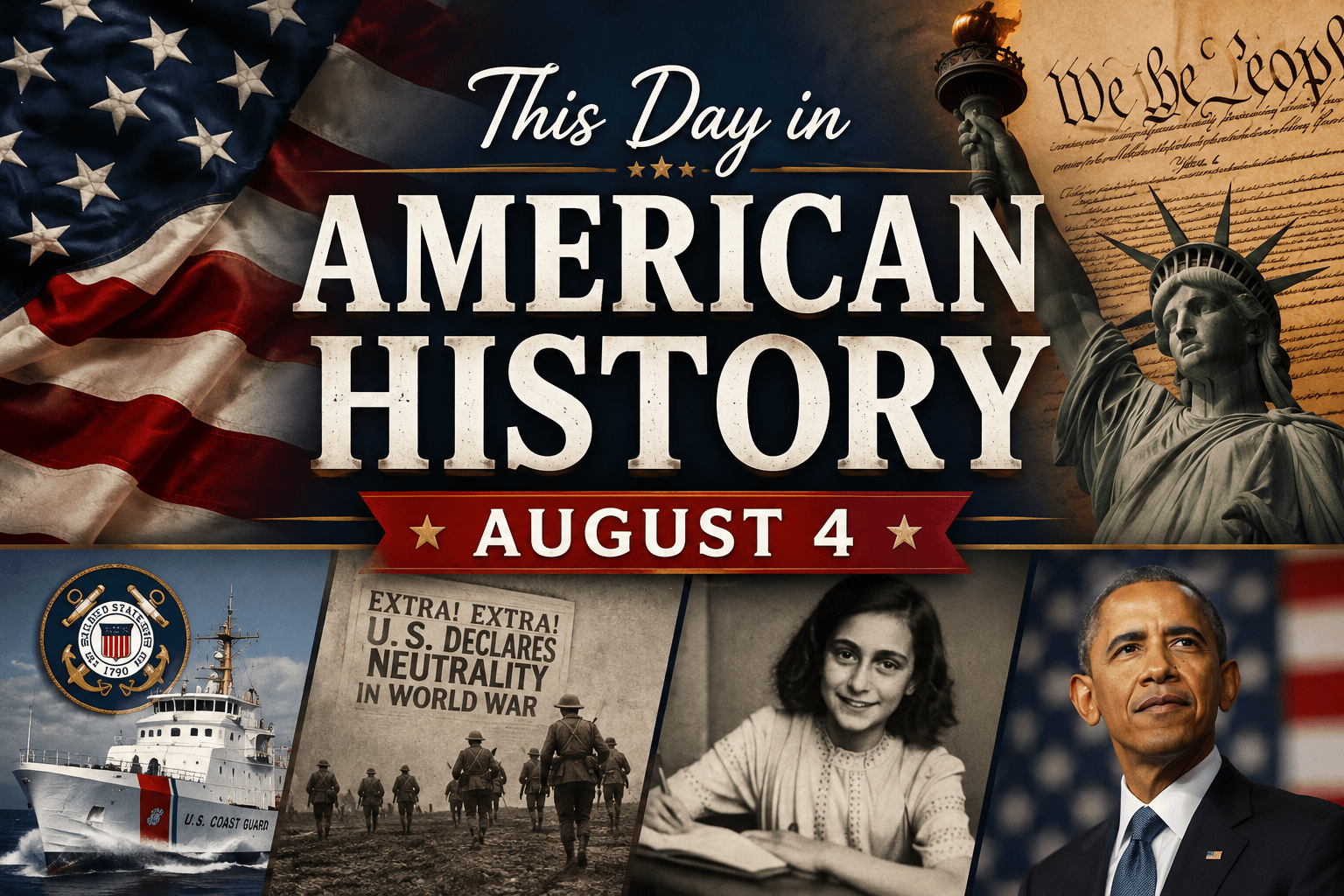
History is more than a collection of dates—it is the story of the people, ideas, and events that have shaped the United States into the nation it is today. Every day on the calendar offers an opportunity to look back at defining moments that influenced America’s government, military, economy, culture, and values.
August 4 has witnessed milestones that span more than two centuries. From the birth of one of America’s oldest military services to pivotal political decisions and influential cultural events, this date reminds us that history is continually being written.
Join us as we explore some of the most significant events that happened on August 4 in American history.
1790 – The Foundation of the United States Coast Guard
One of the most important events associated with August 4 occurred in 1790 when President George Washington signed legislation authorizing the construction of ten revenue cutters.
At the time, the United States was still a young nation recovering from the Revolutionary War. The federal government depended heavily on customs duties and tariffs collected at American ports. Smuggling threatened those revenues, making maritime law enforcement an urgent national priority.
Congress responded by creating the Revenue Cutter Service, whose vessels patrolled the coastline, intercepted smugglers, enforced customs laws, and protected American commerce.
For many years, these cutters represented the nation’s only armed ships because the U.S. Navy had not yet been reestablished.
Evolution into Today’s Coast Guard
The Revenue Cutter Service eventually merged with the U.S. Life-Saving Service in 1915 to become the modern United States Coast Guard.
Today’s Coast Guard performs an extraordinary range of responsibilities, including:
- Search and rescue operations
- Maritime law enforcement
- Drug interdiction
- Environmental protection
- Icebreaking missions
- Port security
- Homeland security
- Disaster response
- Military operations during wartime
Whether rescuing stranded boaters during hurricanes or intercepting illegal trafficking operations, Coast Guard personnel continue a tradition that began more than 230 years ago.
Every August 4, the Coast Guard proudly celebrates its birthday, honoring generations of men and women who have protected America’s waterways.
1914 – America Declares Neutrality as World War I Begins
As Europe erupted into war during the summer of 1914, Americans watched the growing conflict with concern.
On August 4, Germany invaded Belgium, prompting Great Britain to enter what would become World War I.
That same day, President Woodrow Wilson proclaimed America’s neutrality, urging citizens to remain impartial despite the strong cultural ties many Americans had to the nations involved.
Wilson famously appealed for Americans to be:
“Neutral in fact as well as in name.”
The United States hoped to avoid becoming involved in another European conflict.
Why Neutrality Didn’t Last
Remaining neutral proved increasingly difficult.
American businesses traded extensively with Allied nations.
German submarine attacks on civilian and merchant vessels heightened tensions.
Public opinion gradually shifted as reports of the war’s destruction spread.
The sinking of the RMS Lusitania in 1915, unrestricted submarine warfare, and the Zimmermann Telegram ultimately convinced Congress to declare war on Germany in April 1917.
America’s participation helped shape the outcome of World War I and marked the country’s emergence as a major world power.
1944 – Anne Frank Is Discovered
Although this event occurred in Nazi-occupied Amsterdam, its impact on American education and historical awareness has been profound.
On August 4, 1944, Anne Frank, her family, and the others hiding in the Secret Annex were arrested after more than two years in hiding.
Anne later died in the Bergen-Belsen concentration camp, but her diary survived thanks to Miep Gies, who preserved Anne’s writings until after the war.
Published by Anne’s father, Otto Frank, The Diary of Anne Frank has become one of the world’s most widely read books.
For generations of American students, Anne’s diary has served as a powerful lesson about:
- Human rights
- Religious freedom
- Courage
- Compassion
- The dangers of hatred and discrimination
The diary continues to inspire readers around the world to defend freedom and human dignity.
1961 – The Birth of Barack Obama
On August 4, 1961, Barack Hussein Obama II was born in Honolulu, Hawaii.
Nearly five decades later, he would make history by becoming the first African American elected President of the United States.
His election in 2008 represented a historic milestone in American politics and inspired millions of people across the nation and around the world.
Highlights of His Presidency
During Obama’s presidency:
- The Affordable Care Act expanded health insurance coverage.
- The nation continued recovering from the Great Recession.
- Osama bin Laden was killed during a U.S. military operation in 2011.
- New environmental and energy initiatives were introduced.
- Diplomatic efforts reshaped several international relationships.
Regardless of political perspective, Obama’s election remains one of the defining moments in modern American history.
1987 – A Turning Point in American Broadcasting
On August 4, 1987, the Federal Communications Commission (FCC) voted to eliminate the Fairness Doctrine, a long-standing policy that had encouraged broadcasters to present contrasting viewpoints on controversial public issues.
The decision represented a significant shift in federal broadcast policy.
Lasting Effects
In the decades that followed, American media experienced dramatic changes.
Talk radio expanded rapidly.
Opinion-driven programming became increasingly popular.
Cable news networks evolved into major sources of political commentary.
Many historians and media scholars point to this period as a pivotal moment in the development of today’s broadcasting landscape.
Other Noteworthy August 4 Moments
Throughout American history, August has often been a month of preparation, exploration, and innovation.
Some interesting observations include:
- August is one of the busiest travel months in the United States.
- National parks experience millions of visitors during late summer.
- Schools across many states prepare to welcome students back for a new academic year.
- Farmers throughout the country harvest many summer crops, including sweet corn, tomatoes, peaches, and melons.
- Professional football teams begin training camps, signaling the approach of a new sports season.
Although these traditions are modern rather than historic milestones, they help define what early August feels like across America.
Remembering the People Behind History
History is ultimately about people.
The sailors who protected America’s coastline.
The leaders who faced difficult decisions during times of war.
The young girl whose diary revealed the horrors of intolerance.
The presidents who broke barriers and inspired future generations.
Their stories remind us that ordinary individuals often make extraordinary contributions.
Why Looking Back Matters
Understanding history helps us better understand the present.
Many of the debates Americans have today about leadership, freedom, security, immigration, economics, media, and civil rights have deep historical roots.
Learning about the past encourages thoughtful citizenship and helps preserve the lessons earned through sacrifice and perseverance.
History also reminds us that progress rarely happens overnight. Every generation builds upon the work of those who came before it.
Final Thoughts
August 4 serves as a reminder that America’s story is one of resilience, innovation, and continual growth. From safeguarding the nation’s shores in 1790 to moments that reshaped politics, media, and culture, this day reflects the many paths that have shaped the United States.
Whether you’re honoring the service of the Coast Guard, reflecting on the lessons of World War I and the Holocaust, or celebrating milestones in American leadership, August 4 offers an opportunity to appreciate the people and events that continue to influence our nation.
History is more than something we read in books—it is the foundation upon which tomorrow is built. By remembering the past, we become better prepared to shape the future.
Leave a ReplyCancel reply