
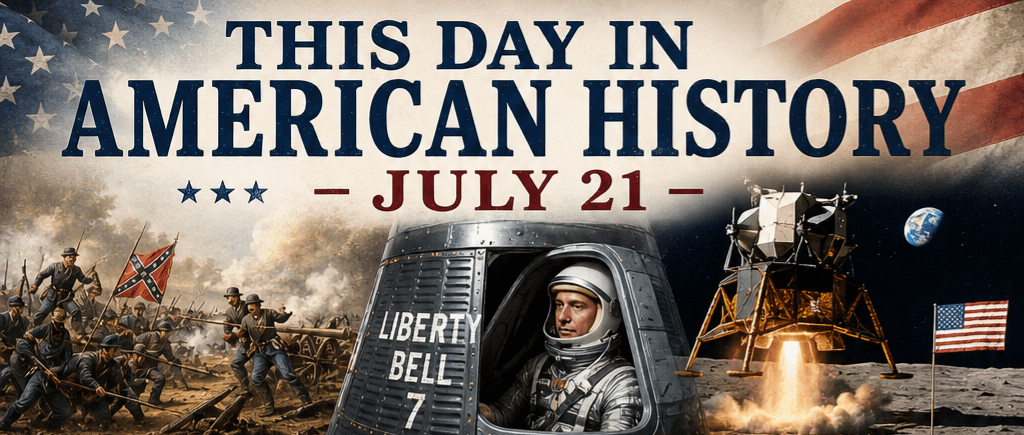
Every day in American history tells a story of innovation, courage, exploration, and determination. July 21 is no exception. From milestones in space exploration and military history to groundbreaking achievements in transportation and technology, this day reminds us how individuals and events have shaped the United States and influenced the world.
Let’s take a look at some of the most significant moments that happened on July 21.
1861 – The First Battle of Bull Run Shocks the Nation
On July 21, 1861, Union and Confederate forces clashed near Manassas, Virginia, in the First Battle of Bull Run (also known as the First Battle of Manassas). It was the first major land battle of the American Civil War.
Many people on both sides believed the war would be short. Instead, the Confederate victory proved that the conflict would become a long and devastating struggle.
More than 4,500 soldiers were killed, wounded, or missing during the battle. The defeat forced the Union Army to regroup and rethink its military strategy, while the Confederacy gained confidence after its first major victory.
Why it matters:
- First large-scale battle of the Civil War
- Ended hopes for a quick resolution
- Changed military planning on both sides
1925 – The Scopes “Monkey Trial” Reaches Its Verdict
On July 21, 1925, high school teacher John T. Scopes was found guilty of violating Tennessee’s Butler Act by teaching evolution in a public school.
The famous trial attracted national attention and featured legendary attorneys Clarence Darrow and William Jennings Bryan.
Although Scopes was fined $100 (later overturned on a technicality), the trial sparked an ongoing national conversation about science, education, religion, and academic freedom.
Legacy of the trial:
- Brought national attention to public education
- Sparked debates that continue today
- Became one of America’s most famous courtroom cases
1961 – Gus Grissom Becomes America’s Second Man in Space
On July 21, 1961, astronaut Virgil “Gus” Grissom flew aboard Liberty Bell 7 during NASA’s Mercury program.
His 15-minute suborbital mission reached an altitude of over 118 miles before safely splashing down in the Atlantic Ocean.
Although the spacecraft sank shortly after landing because the hatch unexpectedly blew open, Grissom survived and later became one of NASA’s most respected astronauts.
His successful mission helped pave the way for America’s future orbital flights and ultimately the Apollo Moon landings.
Historical significance:
- America’s second human spaceflight
- Demonstrated continued progress in Project Mercury
- Advanced U.S. efforts during the Space Race
1969 – Neil Armstrong and Buzz Aldrin Return from the Moon’s Surface
After making history with humanity’s first Moon landing on July 20, Apollo 11 astronauts Neil Armstrong and Buzz Aldrin lifted off from the lunar surface on July 21, 1969 (UTC) in the Lunar Module Eagle to rendezvous with Michael Collins aboard the Command Module Columbia.
The successful ascent from the Moon was another remarkable engineering achievement. It allowed the astronauts to begin their journey home after completing scientific experiments and collecting lunar samples.
For Americans, Apollo 11 represented the culmination of years of scientific innovation, national determination, and the efforts of hundreds of thousands of engineers, scientists, technicians, and support personnel.
1970 – Construction Begins on the Aswan High Dam’s Final Phase (U.S. Perspective)
While occurring outside the United States, global infrastructure projects like the Aswan High Dam reflected the Cold War era in which American diplomacy, technology, and foreign policy were deeply involved in international development and geopolitical competition.
The 1970s marked a period when America’s global influence extended far beyond its borders through science, engineering, and diplomacy.
Birthdays on July 21
Several notable Americans were born on this day, including:
- Ernest Hemingway (1899) – Nobel Prize-winning author whose novels and short stories remain classics of American literature.
- Robin Williams (1951) – Award-winning actor and comedian remembered for films including Good Will Hunting, Mrs. Doubtfire, Dead Poets Society, and Aladdin.
- Josh Hartnett (1978) – American actor known for roles in films such as Pearl Harbor and Black Hawk Down.
Quote of the Day
“There is nothing noble in being superior to your fellow man; true nobility is being superior to your former self.”
— Ernest Hemingway
Why July 21 Matters
July 21 reflects many of the qualities that have defined American history:
- Courage during times of conflict
- Scientific innovation and exploration
- The pursuit of knowledge
- Freedom of inquiry and debate
- Determination to overcome extraordinary challenges
From the battlefields of Virginia to the surface of the Moon, this day reminds us that history is shaped by ordinary people accomplishing extraordinary things.
Final Thoughts
Every date on the calendar carries stories that continue to influence our nation. July 21 stands out for moments that changed military history, expanded human knowledge, challenged society to think critically, and inspired generations to dream bigger.
Whether remembering the sacrifices of Civil War soldiers, celebrating the achievements of America’s early astronauts, or honoring literary and cultural icons, July 21 serves as another reminder that the American story is one of perseverance, innovation, and hope.
As we reflect on this day, we also remember that today’s actions become tomorrow’s history.
Leave a ReplyCancel reply