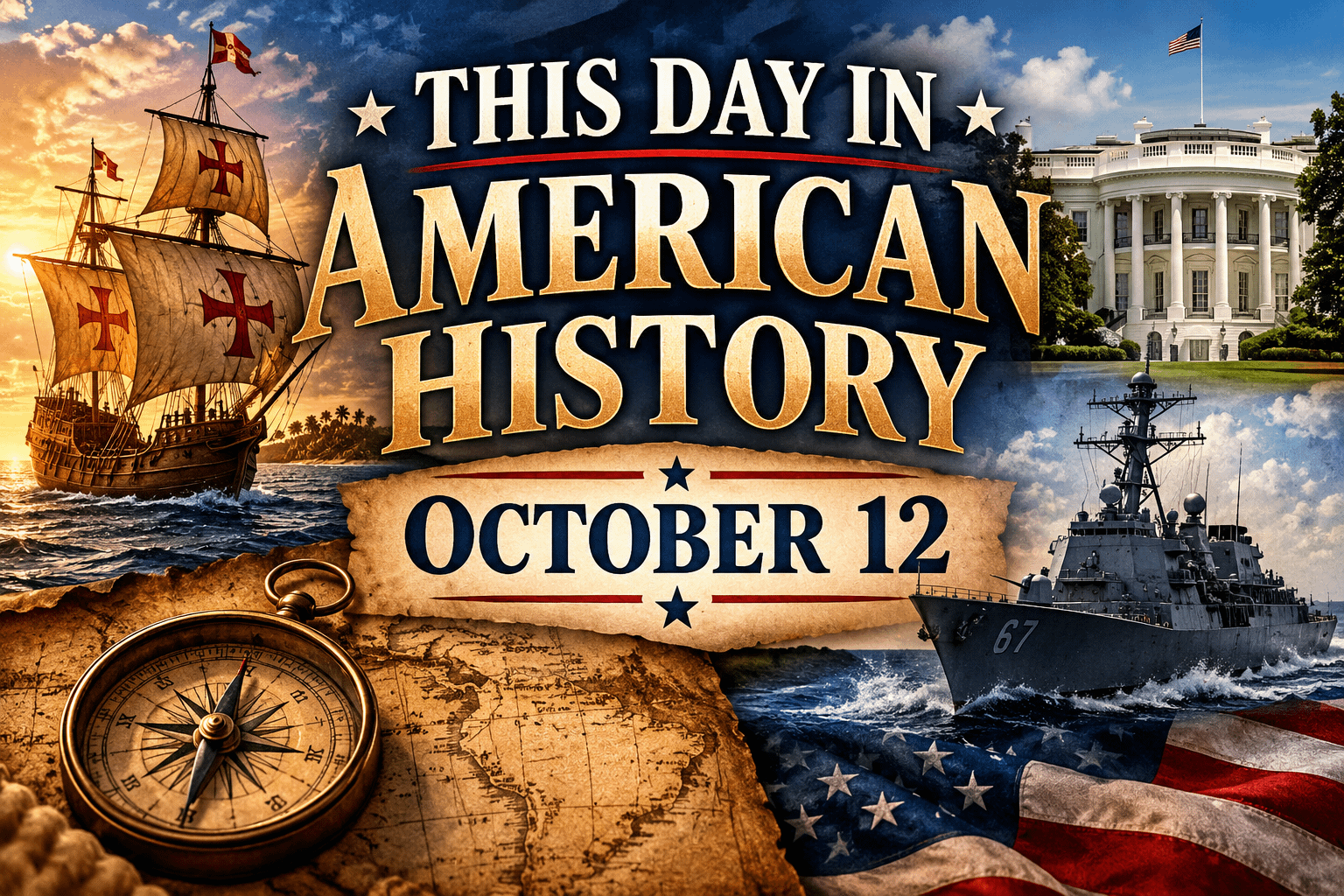
October 12 is a date tied to exploration, changing interpretations of America’s past, presidential history, popular culture, and one of the deadliest terrorist attacks ever carried out against a U.S. Navy warship.
From Christopher Columbus’s 1492 voyage to the attack on the USS Cole in 2000, October 12 provides an opportunity to look at both celebrated and painful chapters of American history.
1492 – Christopher Columbus Reaches the Caribbean
The event most closely associated with October 12 occurred before the United States existed.
Early on October 12, 1492, a sailor aboard the Pinta, one of the three ships in Christopher Columbus’s expedition, spotted land after the fleet had spent weeks crossing the Atlantic Ocean.
Columbus had sailed west under the sponsorship of Spain, hoping to find a route to Asia. Instead, his expedition reached an island in the Bahamas. The Indigenous people already living there called the island Guanahaní; Columbus named it San Salvador.
The voyage became a major turning point in world history. It helped begin sustained European exploration and colonization of the Americas and dramatically increased contact between Europe and the Western Hemisphere.
For generations in the United States, Columbus was often presented primarily as a heroic explorer. Modern discussions are more complicated.
Columbus did not “discover” an empty continent. Indigenous peoples had lived throughout the Americas for thousands of years before his arrival. European colonization that followed voyages such as his also brought warfare, forced labor, displacement, disease, and enormous population losses among Indigenous communities.
Because of this history, Americans today view Columbus and the October 12 anniversary in very different ways.
1792 – One of America’s Earliest Columbus Celebrations
Three hundred years after Columbus’s arrival, October 12 became the date of an organized commemoration in the young United States.
According to the Library of Congress, the first recorded celebration of Columbus Day in the United States occurred on October 12, 1792. The Society of St. Tammany, also called the Columbian Order, organized the celebration to mark the 300th anniversary of Columbus’s landing.
A century later, the 400th anniversary received national recognition.
President Benjamin Harrison issued a proclamation in 1892 encouraging Americans to observe the anniversary. Columbus Day eventually developed into a federal holiday, although its meaning and observance have continued to evolve.
Today, some communities continue to recognize Columbus Day, while others observe Indigenous Peoples’ Day or use the date to focus on Native American history and the consequences of European colonization.
1901 – Theodore Roosevelt and the Name “White House”
October 12 is also associated with President Theodore Roosevelt and the name of America’s presidential residence.
The presidential mansion had been known by several names throughout the nation’s history, including the President’s House, President’s Palace and Executive Mansion.
In 1901, during Theodore Roosevelt’s presidency, “White House” became the official designation used on presidential stationery.
The change reflected a name that Americans had already been using informally for years.
The White House itself dates to the earliest years of the federal government. George Washington selected its site in 1791, Irish-born architect James Hoban designed the building, and its cornerstone was laid on October 13, 1792—not October 12, as is sometimes reported.
President John Adams became the first president to live there when he moved into the still-unfinished residence in 1800.
1960 – The Cold War and a Changing America
By the middle of the 20th century, October dates often unfolded against the backdrop of the Cold War.
In October 1960, Americans were approaching one of the closest and most significant presidential elections of the era, between Vice President Richard Nixon and Senator John F. Kennedy.
Television was transforming American political communication, while tensions between the United States and Soviet Union increasingly shaped foreign policy.
Within two years, those tensions would reach one of their most dangerous moments during the Cuban Missile Crisis of October 1962.
The period reminds us that October has repeatedly been an important month in American political and Cold War history.
1997 – The Death of John Denver
On October 12, 1997, singer-songwriter John Denver died when the experimental aircraft he was piloting crashed into Monterey Bay near Pacific Grove, California. He was 53 years old.
Denver had become one of America’s most recognizable musicians during the 1970s.
Songs including “Take Me Home, Country Roads,” “Rocky Mountain High,” and “Sunshine on My Shoulders” helped define his career.
His music frequently celebrated nature, home, love and the American landscape. Decades after his death, “Take Me Home, Country Roads” remains particularly connected with West Virginia and American popular culture.
2000 – Terrorist Attack on the USS Cole
One of the darkest events associated with October 12 occurred in 2000.
The guided-missile destroyer USS Cole was refueling in the harbor of Aden, Yemen, when a small boat carrying explosives approached the American warship.
At approximately 11:18 a.m. local time, the explosives detonated alongside the ship.
The explosion tore a massive hole into the destroyer’s port side.
Seventeen American sailors were killed and 37 others were wounded, according to the U.S. Navy’s historical account.
Despite catastrophic damage, the crew fought flooding and worked for days to keep the Cole afloat.
The FBI launched an enormous investigation involving agents, laboratory personnel, Joint Terrorism Task Force members and other investigators.
The attack was attributed to al-Qaeda and occurred less than a year before the terrorist attacks of September 11, 2001.
Remembering the 17 Sailors
The USS Cole attack is not simply a historical event. It represents the loss of 17 individual Americans who were serving their country.
Their deaths are commemorated at the USS Cole Memorial at Naval Station Norfolk, Virginia.
The ship itself was repaired and eventually returned to active service.
The actions of the surviving crew members also became an important part of the Cole’s history. Sailors worked under extraordinarily difficult conditions to control flooding, assist the wounded, rescue trapped shipmates and prevent the severely damaged destroyer from sinking.
Their response demonstrated how training, teamwork and determination can become critical during a disaster.
October 12 and the Complexity of American History
Few dates illustrate the complexity of American history quite like October 12.
The date connects us to an event in 1492 that profoundly altered world history. It also forces Americans to consider how historical events can look very different depending on whose experiences are being remembered.
For some, October 12 traditionally represented exploration and discovery.
For many Indigenous Americans, the same history represents the beginning of centuries of colonization, displacement and suffering.
Neither history nor remembrance remains frozen in time. As historians uncover additional evidence and society listens to perspectives that were once overlooked, our understanding of the past becomes broader and more complete.
October 12 also reminds us that history isn’t limited to events from centuries ago.
The sailors killed aboard the USS Cole in 2000 belonged to our recent history. Their families, friends and fellow sailors continue to carry their memories.
Why This Day Matters
Studying American history isn’t about pretending every chapter is heroic, nor is it about ignoring the accomplishments that helped shape the country.
It is about understanding the full story.
October 12 contains exploration and expansion, national traditions and changing perspectives, music and culture, military service and tremendous sacrifice.
The meaning of historical events can change as generations reconsider the evidence and ask new questions. What doesn’t change is the importance of remembering the people whose lives were affected by those events.
History becomes most valuable when we do more than memorize dates.
We ask what happened.
We ask why it happened.
We consider who benefited, who suffered and what consequences followed.
And perhaps most importantly, we ask what the past can teach us about the country we live in today.
What event from October 12 do you believe has had the greatest impact on American history?