
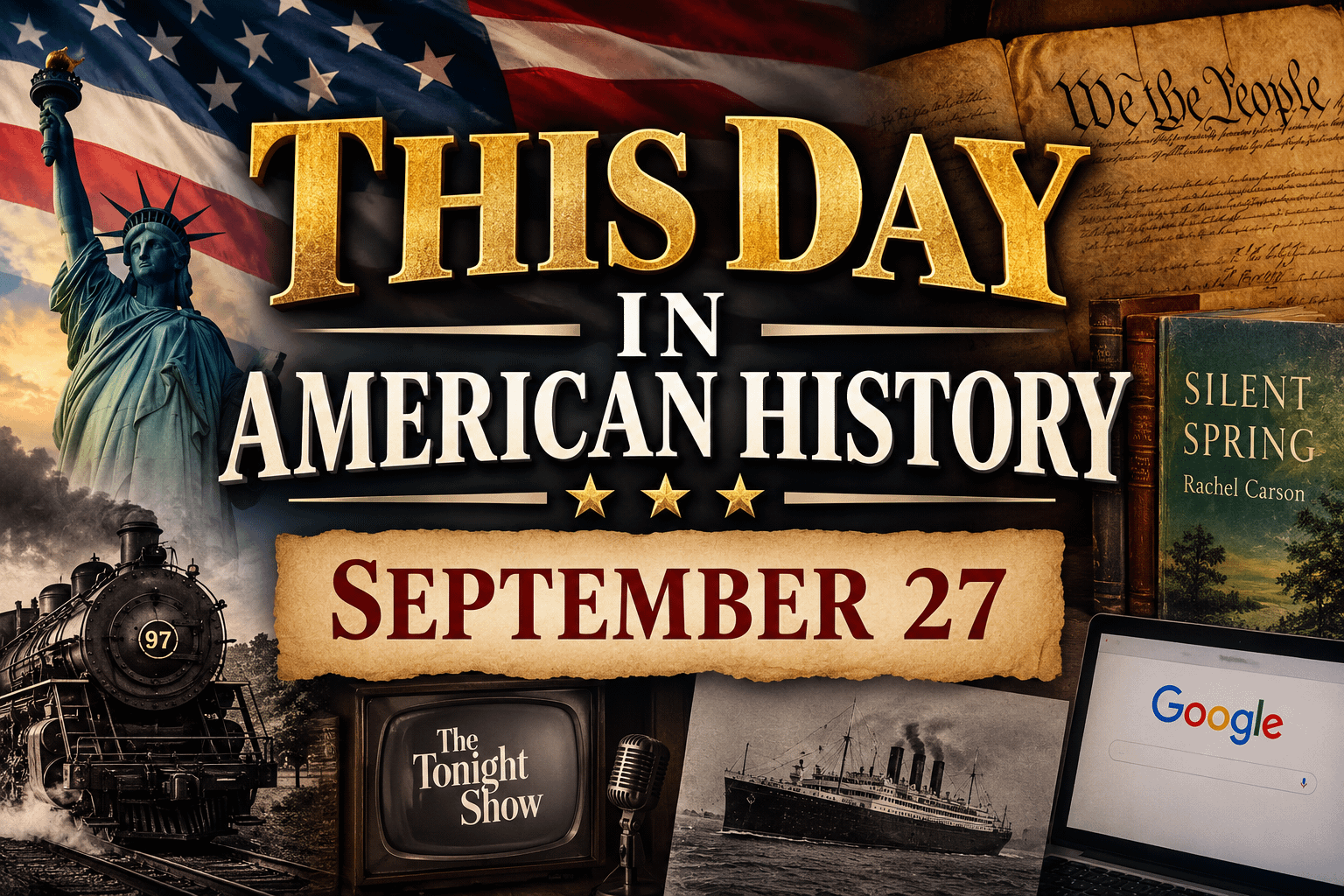
September 27 has witnessed moments that helped shape the United States through war, diplomacy, transportation, exploration, conservation, entertainment, and technological progress. Some events changed the nation immediately, while others became more significant as the years passed.
From the Revolutionary War and the founding of the United States to the launch of the world’s most famous search engine, September 27 offers an interesting journey through American history.
1777 – Lancaster Becomes a Temporary U.S. Capital
During the American Revolution, September 27, 1777, became an unusual day in Pennsylvania history.
British forces had captured Philadelphia, forcing the Continental Congress to leave the city. Members of Congress traveled west and gathered in Lancaster, Pennsylvania.
For one brief day, Lancaster served as the seat of the Continental Congress.
Concerned that British forces could continue advancing, Congress quickly moved farther west to York, Pennsylvania.
Lancaster’s moment as the center of the revolutionary government was extremely short, but it demonstrates just how uncertain the American struggle for independence remained in 1777.
The United States had not yet secured its independence, and its political leaders sometimes had to conduct the nation’s business while staying ahead of an advancing British army.
1779 – John Adams Is Chosen for a Diplomatic Mission
On September 27, 1779, the Continental Congress appointed John Adams to negotiate treaties of peace and commerce with Great Britain.
Adams would eventually become one of America’s most important early diplomats, as well as the nation’s first vice president and second president.
Diplomacy was essential to the American Revolution. Winning battles was only part of achieving independence. American representatives also needed European recognition, financial assistance, trade relationships, and eventually a formal peace agreement.
The peace process ultimately resulted in the Treaty of Paris of 1783, which formally ended the Revolutionary War and recognized the independence of the United States.
1854 – The Steamship Arctic Disaster
September 27, 1854, was also the date of one of the most horrifying maritime disasters of the nineteenth century.
The American steamship Arctic collided with the French vessel Vesta in the Atlantic Ocean while traveling toward New York.
The Arctic eventually sank.
Hundreds of people died in the disaster, and the tragedy became especially notorious because of the chaos surrounding the evacuation. Accounts of crew members and male passengers occupying lifeboats while women and children were left behind caused outrage.
The sinking became a major news story and highlighted the dangers of transatlantic travel during an era when steam-powered passenger ships were becoming increasingly important.
It was also another reminder that technological progress could move faster than safety standards.
1903 – The Wreck of the Old 97
One of America’s most famous railroad disasters occurred on September 27, 1903.
Southern Railway’s Fast Mail train No. 97 was traveling near Danville, Virginia, when it derailed at the Stillhouse Trestle.
The train was running behind schedule and entered a dangerous section of track at high speed. It plunged from the trestle, killing members of the crew and others aboard.
The tragedy might have remained primarily a regional historical event if it had not become part of American music.
The disaster inspired the famous ballad “Wreck of the Old 97.”
Versions of the song were recorded by numerous musicians, helping transform a real railroad tragedy into part of American folk and country music history.
It is an example of how historical events can survive not only in books and museums but also through music and storytelling.
1937 – The First Santa Fe Super Chief Reaches Los Angeles
Railroad history also plays an important role in September 27.
The Santa Fe Railway’s Super Chief became one of the most recognizable passenger trains in American history. Designed as a luxurious, streamlined service between Chicago and Los Angeles, it became strongly associated with Hollywood celebrities and glamorous long-distance rail travel.
In September 1937, the train began operating on a regular weekly schedule.
The Super Chief represented an era when railroads were one of America’s primary methods of long-distance transportation.
Before widespread commercial aviation and the construction of the Interstate Highway System transformed American travel, trains connected cities, businesses, families, and communities across enormous distances.
The Super Chief became a symbol of that era.
1940 – The Tripartite Pact Is Signed
On September 27, 1940, Germany, Italy, and Japan signed the Tripartite Pact in Berlin.
The agreement formally strengthened the alliance among the three countries that became the principal Axis powers during World War II.
The United States was not yet officially involved in the war.
At the time, Americans remained deeply divided over how involved the country should become in conflicts overseas. President Franklin D. Roosevelt’s administration increasingly supported nations fighting the Axis powers, particularly Great Britain, while isolationist sentiment remained significant within the United States.
The Tripartite Pact contributed to the rapidly changing international environment confronting American leaders.
A little more than a year later, Japan attacked Pearl Harbor on December 7, 1941.
The United States entered World War II the following day.
1954 – The Tonight Show Makes Its Debut
American television history changed on September 27, 1954, when NBC premiered Tonight, hosted by Steve Allen.
The program eventually evolved into The Tonight Show, one of the longest-running entertainment programs in American television history.
Its format helped define late-night television.
Comedy monologues, celebrity interviews, musical performances, comedy sketches, and conversations with unusual guests became familiar elements of the genre.
Later hosts would include Jack Paar, Johnny Carson, Jay Leno, Conan O’Brien, Jimmy Fallon, and others.
Johnny Carson’s three decades as host were particularly influential, helping turn The Tonight Show into a major institution in American popular culture.
The show’s origins on September 27, 1954, helped establish a television format that continues decades later.
1962 – Rachel Carson’s Silent Spring Is Published
September 27, 1962, brought the publication of one of the most influential environmental books in modern American history.
Rachel Carson’s Silent Spring raised concerns about the widespread use of chemical pesticides, particularly DDT, and their effects on wildlife and ecosystems.
Carson’s arguments generated enormous public discussion.
The chemical industry challenged parts of her work, while environmental advocates credited the book with helping Americans think differently about pollution, pesticides, and humanity’s relationship with nature.
Silent Spring became an important influence on the modern environmental movement.
The growing environmental awareness of the 1960s eventually contributed to major developments in American environmental policy, including the establishment of the Environmental Protection Agency in 1970 and new federal environmental protections.
Carson demonstrated how scientific writing intended for the public could influence national conversations and public policy.
1998 – Google Is Born
September 27 is also closely associated with a company that transformed how people access information.
Google traces its beginnings to Stanford University graduate students Larry Page and Sergey Brin, who developed a search engine originally known as BackRub.
Google was incorporated earlier in September 1998, but the company has traditionally celebrated its birthday on September 27.
What began as a search-engine project eventually grew into one of the world’s most influential technology companies.
Google Search changed how millions—and eventually billions—of people found information online.
Before powerful search engines became commonplace, navigating the rapidly expanding World Wide Web could be difficult. Search technology made the internet far more accessible to ordinary users.
Google later expanded into email, online video, maps, mobile operating systems, cloud computing, advertising, artificial intelligence, and many other areas of technology.
The rise of Google also reflected the growing importance of Silicon Valley and the technology industry to the American economy.
September 27 and the Changing American Story
Looking across the history of September 27 reveals just how dramatically the United States has changed.
In 1777, members of the Continental Congress were fleeing Philadelphia while fighting to establish an independent nation.
A century later, expanding railroad networks were transforming transportation and commerce.
By the twentieth century, Americans were confronting world wars, mass media, environmental challenges, and revolutionary advances in communication.
By the end of the century, the internet was beginning to reshape everyday life.
These events may appear unrelated, but together they demonstrate an important feature of American history: the country is continually being transformed by political decisions, technological innovation, cultural movements, tragedies, discoveries, and the actions of individuals.
Remembering the People Behind History
History can sometimes feel like a collection of dates.
But every date represents people.
The Continental Congress consisted of individuals facing the possibility that their revolution could fail.
Passengers aboard the Arctic expected to reach their destination safely.
Railroad workers aboard Old 97 were simply doing their jobs.
Rachel Carson spent years researching and writing about environmental dangers she believed the public needed to understand.
Innovators such as Larry Page and Sergey Brin were experimenting with technology without knowing exactly how dramatically the internet would eventually transform society.
Remembering the human stories behind historical events makes history more meaningful.
Why This Day in History Matters
Studying individual days in American history gives us a different way of understanding the past.
Instead of looking only at presidents, wars, elections, or major historical eras, we can examine individual moments and see how they connect.
September 27 includes revolution, diplomacy, tragedy, transportation, war, entertainment, environmental awareness, and technology.
Each event represents a different chapter of the American experience.
Some moments were celebrated.
Others were devastating.
Some changed American life almost immediately, while the significance of others became clearer only years later.
Together, they remind us that history is not created in a single dramatic moment. It is built day after day through millions of decisions, discoveries, struggles, failures, and achievements.
September 27 is one of those days.
Which September 27 event do you think had the greatest long-term impact on American life?
Leave a ReplyCancel reply