
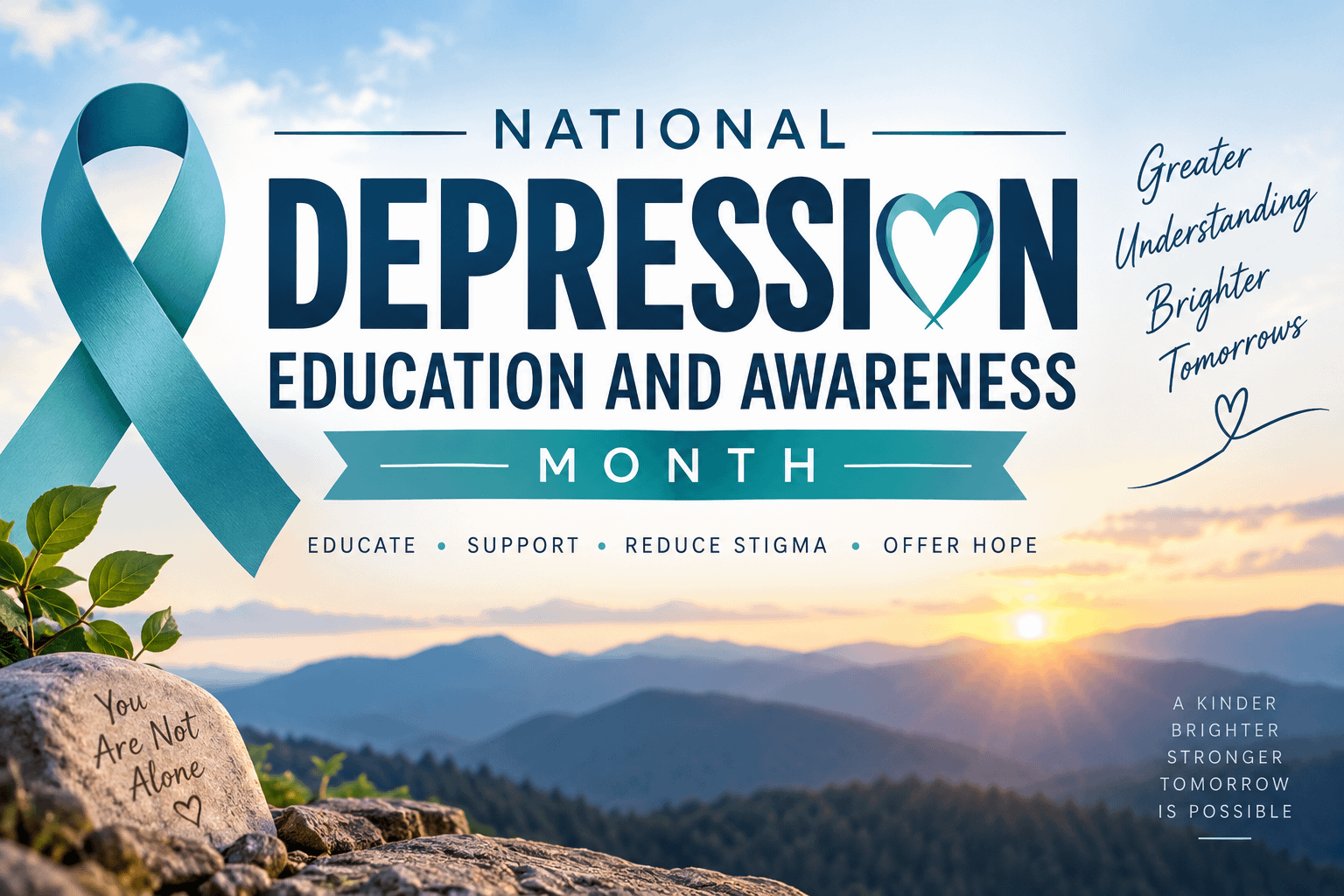
Every October, National Depression Education and Awareness Month provides an important opportunity to talk openly about depression, mental health, treatment, support, and hope.
Depression can affect people from every background and walk of life. It does not care about age, career, income, family status, or how strong someone appears on the outside. A person can smile, go to work, take care of a family, laugh with friends, and still be struggling privately.
That is one of the reasons awareness matters.
Many people experiencing depression do not necessarily look the way others expect depression to look. Some struggle openly, while others become very good at hiding their pain. They may continue meeting their responsibilities while internally feeling exhausted, hopeless, disconnected, or overwhelmed.
National Depression Education and Awareness Month reminds us that mental health deserves the same compassion and attention we give physical health.
It is also a reminder of something equally important:
There is hope. Help is available. And nobody should have to face depression completely alone.
What Is Depression?
Everyone experiences sadness from time to time. Difficult days, disappointment, stress, grief, relationship problems, financial struggles, and other challenges can leave us feeling down.
Depression is different from simply having a bad day or temporarily feeling sad.
Clinical depression can involve persistent changes in mood, thinking, energy, motivation, sleep, appetite, concentration, and the ability to experience pleasure. These symptoms can interfere with work, relationships, responsibilities, and everyday life.
Depression can look different from one person to another.
Possible symptoms can include:
- Persistent sadness, emptiness, or hopelessness
- Losing interest in activities that were once enjoyable
- Feeling tired or lacking energy
- Difficulty concentrating or making decisions
- Changes in sleep
- Changes in appetite or weight
- Feelings of guilt or worthlessness
- Irritability or frustration
- Withdrawing from friends or family
- Moving or speaking unusually slowly, or feeling unusually restless
- Physical aches or discomfort without an obvious explanation
- Thoughts about death, self-harm, or suicide
Having one or two of these experiences does not automatically mean someone has depression. Diagnosis should be made by a qualified healthcare professional who can consider the person’s symptoms, duration, medical history, and circumstances.
But when symptoms persist or begin interfering with daily life, seeking professional support can be an important next step.
Depression Doesn’t Always Look Like Sadness
One of the most important lessons during Depression Education and Awareness Month is that depression does not have one appearance.
Sometimes depression looks like crying.
Sometimes it looks like silence.
Sometimes it looks like anger or irritability.
Sometimes it looks like sleeping all day.
Sometimes it looks like being unable to sleep.
Sometimes it looks like withdrawing from everyone.
And sometimes it looks like someone getting dressed, going to work, making jokes, helping everyone around them, and saying, “I’m fine.”
That is why we should be careful about assuming we know what another person is experiencing simply because they appear okay.
People can become extremely skilled at hiding emotional pain.
A little kindness can matter more than we realize.
Why People Sometimes Hide Depression
There are many reasons someone may hesitate to tell others that they are struggling.
They may fear being judged.
They may worry that people will see them differently.
They may believe they should be able to handle everything themselves.
They may not want to burden their family.
They may have grown up believing emotional struggles should remain private.
Others simply may not know how to explain what they are feeling.
This can be particularly difficult for people who have spent their lives being the person everyone else depends on.
Admitting, “I’m struggling,” can feel incredibly vulnerable.
But needing help is not a character flaw.
Mental health struggles are not evidence that someone lacks strength, faith, gratitude, determination, or love for the people around them.
Sometimes people are carrying more than others can see.
Depression and Men
Mental health conversations involving men deserve particular attention.
Many boys grow up hearing messages such as:
“Be strong.”
“Don’t cry.”
“Handle it yourself.”
“Get over it.”
While resilience is valuable, these messages can sometimes teach men to suppress emotions rather than process them.
A man experiencing depression may not always describe himself as sad. His struggles might instead appear as irritability, isolation, exhaustion, increased risk-taking, substance use, loss of motivation, or throwing himself completely into work.
Some men wait until they are in severe emotional distress before reaching out.
We need to make it easier for men to say:
“I’m not doing okay right now.”
Those words should be met with compassion rather than judgment.
Strength is not pretending pain does not exist.
Sometimes strength means admitting that you need another person beside you while you work through it.
Depression, Grief, and Loss
Depression and grief are not the same thing, although they can overlap.
Grief is a natural response to losing someone or something deeply meaningful. It can bring intense sadness, anger, guilt, loneliness, exhaustion, confusion, and changes in sleep or appetite.
For someone grieving the death of a child, spouse, parent, sibling, friend, or another loved one, life can feel permanently divided into “before” and “after.”
There is no simple timetable for grief.
Birthdays, anniversaries, holidays, songs, photographs, familiar places, smells, and ordinary moments can suddenly bring memories rushing back.
Some people gradually learn to carry their grief while rebuilding parts of their lives.
Others may experience symptoms that warrant additional professional support, including depression.
A person does not have to choose between honoring someone they lost and taking care of their own mental health.
Both can exist together.
Seeking support does not mean forgetting the person you love.
Sometimes continuing to live, heal, love, and find purpose becomes another way of carrying that love forward.
The Importance of Checking on People
One of the simplest things we can do during National Depression Education and Awareness Month is check on people.
Not only the person who obviously appears to be struggling.
Check on the strong friend.
Check on the father who rarely talks about his feelings.
Check on the mother carrying everyone else’s problems.
Check on the coworker who suddenly became quiet.
Check on the person who recently experienced a loss.
Check on the friend who stopped answering messages.
Check on the person who always says they’re fine.
You don’t need perfect words.
Sometimes something as simple as:
“I’ve been thinking about you. How are you really doing?”
can open a door.
Then listen.
You don’t necessarily have to fix anything.
Being present can be powerful.
What Not to Say
People usually mean well when trying to comfort someone experiencing depression, but certain statements can unintentionally make the person feel misunderstood.
Comments such as “Just cheer up,” “Other people have it worse,” “You have so much to be thankful for,” or “Just think positively” can oversimplify a complicated mental health condition.
Encouragement can be valuable, but encouragement works best when combined with empathy.
Instead, you might say:
“I’m here for you.”
“You don’t have to explain everything right now.”
“What would help you today?”
“Would you like me to help you find someone to talk to?”
“You don’t have to handle this by yourself.”
Sometimes support begins with listening instead of advising.
Treatment and Support
Depression is treatable, and different approaches work for different people.
Treatment may involve psychotherapy, medication, lifestyle changes, social support, or combinations of these approaches. A healthcare professional can help determine appropriate options based on the individual’s situation.
Therapy can provide a confidential environment to explore thoughts, emotions, relationships, grief, trauma, stress, and coping strategies.
Medication can also be helpful for some people and should be discussed with an appropriate healthcare professional.
Healthy daily habits may complement professional treatment as well. Regular movement, adequate sleep, nutritious meals, time outdoors, maintaining social connections, reducing alcohol or substance use, and developing manageable routines may support overall mental well-being.
These strategies should not be presented as simple cures for depression.
Someone with serious depression may need professional care even if they are doing everything they can to maintain healthy habits.
Small Steps Still Count
When depression becomes overwhelming, even ordinary responsibilities can feel enormous.
Getting out of bed can feel difficult.
Taking a shower can feel difficult.
Preparing food can feel difficult.
Answering a message can feel difficult.
Going outside can feel difficult.
On those days, small victories deserve recognition.
Take the shower.
Drink some water.
Eat something nourishing.
Step outside for five minutes.
Text someone you trust.
Schedule the appointment.
Take the next manageable step.
You do not have to solve your entire life today.
Sometimes progress is simply making it through the next hour and giving tomorrow another chance.
There Is No Shame in Asking for Help
One of the biggest goals of National Depression Education and Awareness Month is reducing stigma.
We need a culture where asking for mental health support is treated as normally as asking for help with physical health.
If your back hurts for weeks, you might see a doctor.
If you cannot breathe properly, you seek medical attention.
If emotional pain is interfering with your ability to live your life, seeking help should not be considered embarrassing either.
Therapists, counselors, psychologists, psychiatrists, physicians, support groups, crisis counselors, faith communities, trusted friends, and family members can all potentially become parts of a person’s support network.
The important thing is not remaining completely isolated.
When Someone Is in Crisis
Statements about wanting to die, having no reason to live, feeling like a burden, or believing everyone would be better without them should be taken seriously.
So should sudden behavioral changes, giving away meaningful possessions, saying goodbye unexpectedly, or other concerning signs.
If you believe someone may be in immediate danger, stay with them when possible and contact emergency services or an appropriate crisis service.
In the United States, people experiencing suicidal thoughts, emotional distress, or a mental health crisis can call or text 988 to reach the Suicide & Crisis Lifeline.
If there is immediate danger or a life-threatening emergency, call 911 or go to the nearest emergency department.
Reaching out during a crisis can save a life.
Education Can Change the Conversation
Awareness months matter because education can replace misconceptions with understanding.
When people understand depression better, they may become less likely to judge someone experiencing it.
They may recognize warning signs sooner.
They may become more comfortable talking about mental health.
And someone who has been silently struggling may finally realize:
Maybe I can tell somebody.
That single decision can become the beginning of change.
Be the Person Who Makes It Safe to Talk
You do not need to be a therapist to make a difference in someone’s life.
You can be the person who listens without judging.
You can be the friend who checks in twice instead of assuming silence means everything is okay.
You can be the parent who teaches children that emotions are not weaknesses.
You can be the coworker who notices when someone seems different.
You can be the man who tells another man that asking for help is acceptable.
You can be the person who says:
“You matter to me, and I’m here.”
We may never completely know what another person is carrying.
That is why compassion should never depend on knowing someone’s entire story.
Hope Doesn’t Always Feel Like Happiness
When someone is deeply depressed, telling them to “stay positive” may feel impossible.
Hope can be much smaller than that.
Hope can be making an appointment.
Hope can be answering the phone.
Hope can be getting out of bed.
Hope can be telling someone the truth.
Hope can be surviving a terrible day.
Hope can be deciding that although today hurts, you are willing to see what tomorrow brings.
Healing rarely happens in a perfectly straight line.
There may be good days followed by difficult ones.
There may be progress followed by setbacks.
That does not erase the progress.
Keep going.
National Depression Education and Awareness Month Is About More Than October
Awareness should not disappear when the month ends.
Mental health conversations should continue throughout the year.
We should keep checking on people.
Keep listening.
Keep educating ourselves.
Keep challenging stigma.
Keep encouraging people to seek professional help when they need it.
And keep reminding those who are struggling that their lives have value.
Somebody around you may currently be fighting a battle you know nothing about.
Your kindness may not solve everything they are facing.
But it might remind them that they are not invisible.
And sometimes that reminder matters more than we will ever know.
This National Depression Education and Awareness Month, make an effort to learn more about depression, check on someone you care about, and create spaces where people can speak honestly about mental health without shame.
Most importantly, if you are the person struggling, consider reaching out.
You do not have to have the perfect words.
You can simply say:
“I’m having a hard time, and I think I need someone to talk to.”
That is enough to begin.
Who is someone in your life you can check on today—not just by asking if they’re okay, but by taking the time to truly listen to the answer?
Leave a ReplyCancel reply