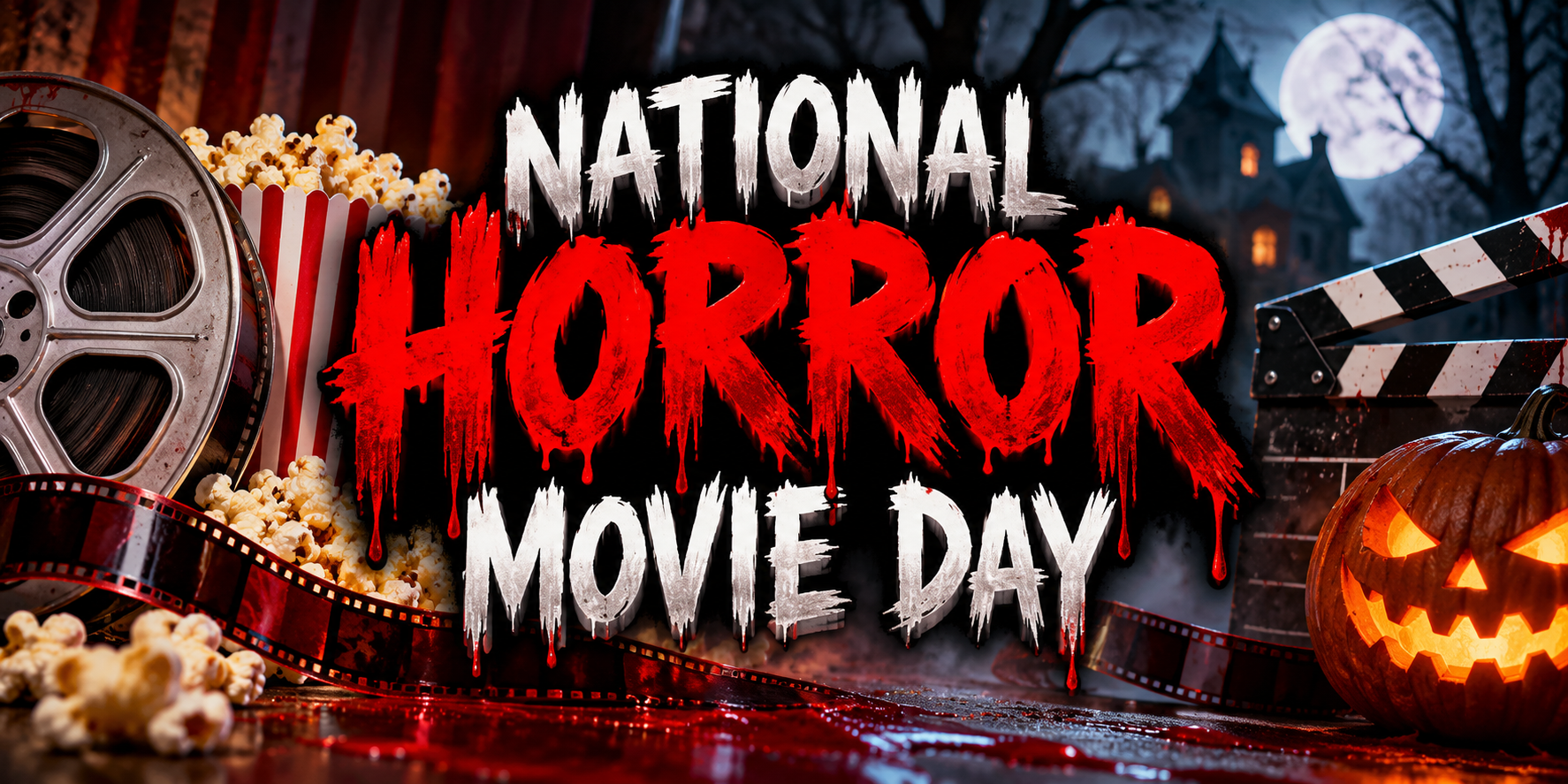
There is something strangely enjoyable about turning off the lights, grabbing a bowl of popcorn, and intentionally watching something designed to scare you.
For horror fans, that feeling is part of the fun.
National Horror Movie Day, celebrated on October 23, is a day dedicated to the movies that have frightened, shocked, disturbed, and entertained audiences for generations. From mysterious creatures hiding in the shadows to masked killers stalking unsuspecting victims, horror movies have become an enormous part of popular culture.
And October is the perfect time to celebrate them.
As Halloween approaches, horror movies seem to be everywhere. Television networks schedule marathons, streaming services highlight their scariest collections, haunted attractions open their doors, and people revisit the movies that made them afraid to turn off the lights when they were younger.
National Horror Movie Day gives horror fans another excuse to revisit the classics, discover something new, and appreciate a genre that has been evolving for more than a century.
Why We Love Being Scared
It sounds strange when you think about it.
Most of us spend our lives trying to avoid frightening situations. We lock our doors, stay away from dangerous places, and generally prefer feeling safe.
Then we sit on the couch and voluntarily watch someone walk into a dark basement after hearing a mysterious noise.
Horror movies give us the opportunity to experience fear from a safe distance.
Our hearts might race.
We might jump when something suddenly appears on the screen.
We may even cover our eyes while still peeking through our fingers.
But somewhere in the back of our minds, we know we are safe.
That combination of fear and safety creates the thrill that makes horror movies so entertaining for millions of people.
There is also something communal about being scared.
Watching a horror movie with friends can turn fear into laughter. Someone screams during a jump scare, everyone else laughs, and suddenly the frightening moment becomes a memory people talk about for years.
Horror Movies Have Been Around Almost as Long as Movies
Horror is not a recent invention.
Filmmakers were experimenting with frightening imagery during the earliest days of cinema.
One of the earliest movies commonly associated with the horror genre is Georges Méliès’ 1896 film Le Manoir du Diable, often translated as The House of the Devil or The Haunted Castle.
The short film featured supernatural imagery including bats, skeletons, ghosts, and the Devil.
It may not frighten modern audiences, but at the time it demonstrated something filmmakers would continue exploring for generations:
Movies could bring nightmares to life.
During the silent-film era, horror became darker and more atmospheric.
Movies such as The Cabinet of Dr. Caligari and Nosferatu helped establish many of the visual techniques still associated with horror today.
Dark shadows.
Unusual camera angles.
Creepy environments.
Mysterious villains.
The foundations of cinematic horror were already being built.
The Monsters That Built Horror
The 1930s brought some of the most recognizable monsters in movie history to the screen.
Universal Pictures helped transform horror into a major Hollywood genre with characters including:
Dracula.
Frankenstein’s Monster.
The Mummy.
The Invisible Man.
The Wolf Man.
These characters became larger than the movies themselves.
Even people who have never watched the original films recognize Frankenstein’s Monster or Dracula.
Their appearances have been recreated in cartoons, television programs, Halloween decorations, costumes, toys, advertisements, and countless later movies.
The monsters of early Hollywood helped prove that horror characters could become cultural icons.
Horror Became More Psychological
As filmmaking evolved, horror filmmakers discovered that monsters did not always need supernatural powers.
Sometimes people could be far more frightening.
Alfred Hitchcock demonstrated this brilliantly with Psycho in 1960.
The movie shocked audiences and helped redefine what horror and suspense could accomplish.
Rather than relying entirely on supernatural creatures, filmmakers increasingly explored psychological fear.
What happens when someone who appears normal is hiding something terrifying?
What happens when danger exists inside ordinary places?
A motel.
A neighborhood.
A family home.
The familiar suddenly became frightening.
And horror would never be the same.
The Rise of the Slasher Movie
Few horror subgenres are as recognizable as the slasher movie.
The formula became famous:
A group of unsuspecting people.
An isolated or vulnerable location.
A seemingly unstoppable killer.
And one terrifying night.
Movies such as The Texas Chain Saw Massacre and Black Christmas helped shape the genre during the 1970s.
Then came one of horror’s most influential films.
Halloween was released in 1978.
Michael Myers became one of the most recognizable villains in movie history.
The expressionless white mask, slow movements, and seemingly unstoppable pursuit of his victims created a terrifying character who would influence generations of horror filmmakers.
Then came more icons.
Jason Voorhees became synonymous with the Friday the 13th franchise.
Freddy Krueger invaded people’s dreams in A Nightmare on Elm Street.
Ghostface terrorized teenagers while questioning their horror-movie knowledge in Scream.
Each villain brought something different to the genre.
Michael Myers represented relentless evil.
Jason became the unstoppable killer of Camp Crystal Lake.
Freddy transformed dreams into nightmares.
Ghostface brought mystery and self-awareness to the slasher formula.
Together, they became some of horror’s most famous faces.
Horror Movies Are About More Than Monsters
Great horror often works because the monster is not the only thing the story is about.
Horror can explore very human fears.
Isolation.
Loss.
Death.
Family conflict.
Guilt.
Trauma.
Disease.
Violence.
Technology.
The unknown.
The supernatural.
The fear of losing control.
Filmmakers can take those fears and transform them into monsters, ghosts, killers, or terrifying situations.
That is one reason horror constantly changes.
Every generation has different fears.
Horror movies reflect them.
The Supernatural Side of Horror
Not everyone wants masked killers.
For some horror fans, nothing is scarier than ghosts, demons, haunted houses, and supernatural forces.
Movies including The Exorcist, Poltergeist, The Conjuring, and The Ring have demonstrated the lasting popularity of supernatural horror.
These movies tap into a particularly powerful question:
What if something exists that we cannot understand or control?
A physical villain can sometimes be defeated.
But how do you fight something you cannot see?
That uncertainty makes supernatural horror particularly effective.
A strange sound upstairs suddenly becomes frightening.
A door moving by itself becomes suspicious.
A shadow in the hallway becomes terrifying.
And after the movie ends, your own house can suddenly feel slightly different.
Zombies Changed Horror Too
Another creature that became enormously influential in horror is the zombie.
George A. Romero’s Night of the Living Dead, released in 1968, helped establish the modern zombie movie.
The concept evolved dramatically afterward.
Zombie stories became more than movies about people running from monsters.
They became stories about survival.
What happens when society collapses?
Who can you trust?
How far would you go to protect the people you love?
Would ordinary people cooperate during a disaster—or turn against each other?
Those questions helped zombie horror grow into a massive subgenre appearing in movies, television, books, comics, and video games.
Horror Learned How to Laugh at Itself
Horror does not always have to be completely serious.
Some of the most entertaining horror movies combine scares with comedy.
Films such as Shaun of the Dead demonstrated how zombies and comedy could exist together.
Other movies intentionally parody familiar horror clichés.
Why does someone always investigate the strange noise?
Why do people separate when they should stay together?
Why does someone enter the abandoned building?
Horror fans know these clichés.
That allows filmmakers to play with audience expectations.
The result can be funny, frightening, or sometimes both at the same time.
Scream Reinvented the Slasher Movie
By the 1990s, audiences were extremely familiar with slasher-movie formulas.
Then Scream arrived in 1996.
The movie did something clever.
Its characters understood horror movies.
They knew the rules.
They discussed the clichés.
And they still found themselves trapped inside a horror story.
Ghostface quickly became a new horror icon, while Scream helped introduce slasher movies to another generation.
It proved that horror could acknowledge its own history while still finding new ways to frighten audiences.
Found-Footage Horror Changes the Perspective
Another major evolution came with found-footage horror.
Instead of watching events through traditional filmmaking, audiences were shown footage supposedly recorded by the characters themselves.
The Blair Witch Project became one of the most famous examples when it arrived in 1999.
The style made horror feel more immediate.
The camera shook.
Characters spoke directly into it.
The footage sometimes looked amateurish.
That was the point.
It could create the illusion that you were watching something that had actually happened.
Later films expanded the concept, using security cameras, smartphones, webcams, and other technology to tell frightening stories.
Modern Horror Keeps Reinventing Itself
Horror continues to evolve.
Modern filmmakers regularly combine horror with drama, mystery, science fiction, comedy, social commentary, and psychological storytelling.
Movies such as Get Out, Hereditary, A Quiet Place, The Babadook, and others have shown how flexible the genre can be.
Some horror movies rely on terrifying imagery.
Others create tension slowly.
Some have monsters.
Others barely show the threat at all.
Sometimes what you imagine is scarier than anything a filmmaker could put on the screen.
That flexibility is one reason horror has survived for so long.
Horror Villains Became Pop-Culture Icons
Think about some of horror’s most recognizable characters:
Michael Myers.
Jason Voorhees.
Freddy Krueger.
Ghostface.
Leatherface.
Chucky.
Pinhead.
These characters have escaped the boundaries of their original movies.
They appear on shirts, posters, collectibles, Halloween decorations, costumes, video games, memes, and countless pieces of merchandise.
People who have never watched Friday the 13th still recognize a hockey mask associated with Jason.
People who have never watched A Nightmare on Elm Street may recognize Freddy’s glove.
That level of recognition demonstrates how deeply horror has become embedded in popular culture.
Why October Is Horror Movie Season
You can watch horror movies anytime.
But October feels different.
The days become shorter.
Night arrives earlier.
Halloween decorations appear.
Pumpkins sit on porches.
Haunted houses open.
Costume stores fill with masks.
Everything seems designed for spooky entertainment.
That makes National Horror Movie Day a perfect excuse to organize a horror movie marathon.
Turn down the lights.
Grab some popcorn.
Invite a few friends.
Then choose your movies.
Build Your Own Horror Movie Marathon
One fun way to celebrate National Horror Movie Day is by watching movies from different eras.
You could start with classic monsters.
Move into psychological horror.
Watch a 1970s or 1980s slasher.
Add some supernatural horror.
Then finish with something modern.
You could also choose a specific theme.
Try an all-zombie marathon.
Watch haunted-house movies.
Spend the night with classic Universal Monsters.
Watch several Halloween movies.
Revisit Friday the 13th.
Have a Scream marathon.
Or challenge yourself to watch a horror movie you have never seen before.
The possibilities are nearly endless.
Create the Right Atmosphere
A horror movie is much more effective when you create the right environment.
Turn off unnecessary lights.
Close the curtains.
Put away your phone.
Make some popcorn.
Turn up the sound.
Then let yourself become absorbed in the movie.
Of course, if you are watching something particularly frightening, you may want to leave at least one light on.
We won’t judge.
Introduce Someone to a Horror Classic
National Horror Movie Day can also be an opportunity to share one of your favorite movies with someone else.
Maybe they have never seen Halloween.
Maybe they have somehow avoided A Nightmare on Elm Street.
Perhaps they have never watched Psycho.
Sharing classic movies allows new generations to experience the films that helped shape the genre.
And watching someone’s reaction to a famous scare can sometimes be almost as entertaining as watching the movie itself.
Horror Is One of Cinema’s Most Creative Genres
Horror filmmakers constantly face a difficult challenge.
Audiences know they are watching a movie.
They know the monster is not real.
They know the actor playing the killer is not actually chasing anyone.
Yet filmmakers still have to convince the audience to feel afraid.
That requires creativity.
Music.
Lighting.
Sound effects.
Camera movement.
Editing.
Makeup.
Practical effects.
Visual effects.
Performance.
Storytelling.
Sometimes the most frightening moment involves showing the monster.
Other times the scariest decision is refusing to show it.
A creaking floorboard can sometimes accomplish more than an expensive visual effect.
The Sound of Horror
Imagine watching your favorite horror movie without music.
It probably would not feel nearly as frightening.
Sound plays an enormous role in horror.
Sometimes filmmakers use loud noises to create jump scares.
Other times they do the opposite.
Everything becomes quiet.
Too quiet.
The audience begins waiting for something to happen.
Every second increases the tension.
Then—
something happens.
That combination of silence, music, and sudden sound has helped horror filmmakers frighten audiences for generations.
Horror Movies Create Memories
Most horror fans remember certain movies because of when and where they watched them.
Maybe you watched your first scary movie during a sleepover.
Maybe someone introduced you to Halloween when you were younger.
Maybe you watched Friday the 13th late at night and suddenly every sound outside seemed suspicious.
Perhaps you went to the theater expecting a normal horror movie and walked out completely shocked.
Those experiences become memories.
Years later, watching the same movie can bring those memories back.
That nostalgia is another reason people return to horror classics again and again.
Celebrate National Horror Movie Day
National Horror Movie Day is ultimately about appreciating a genre that has entertained audiences for generations.
Horror movies allow us to confront frightening ideas while sitting safely on our couches or inside movie theaters.
They introduce unforgettable monsters.
They create iconic villains.
They make us scream.
They make us laugh.
They make us cover our eyes.
And sometimes they make us check behind the shower curtain before going to bed.
Whether your favorite horror character is Michael Myers, Jason Voorhees, Freddy Krueger, Ghostface, Dracula, Frankenstein’s Monster, or something entirely different, October 23 is the perfect day to celebrate the movies that made being scared so much fun.
So grab the popcorn.
Turn down the lights.
Choose your favorite horror movie.
And enjoy National Horror Movie Day.
Just remember one important rule.
If you hear a strange noise coming from the basement during the movie…
don’t go investigate it.
What Horror Movie Still Scares You?
What is the one horror movie you can watch again and again—and which movie genuinely scared you the first time you saw it?
Happy National Horror Movie Day!
Leave a Reply