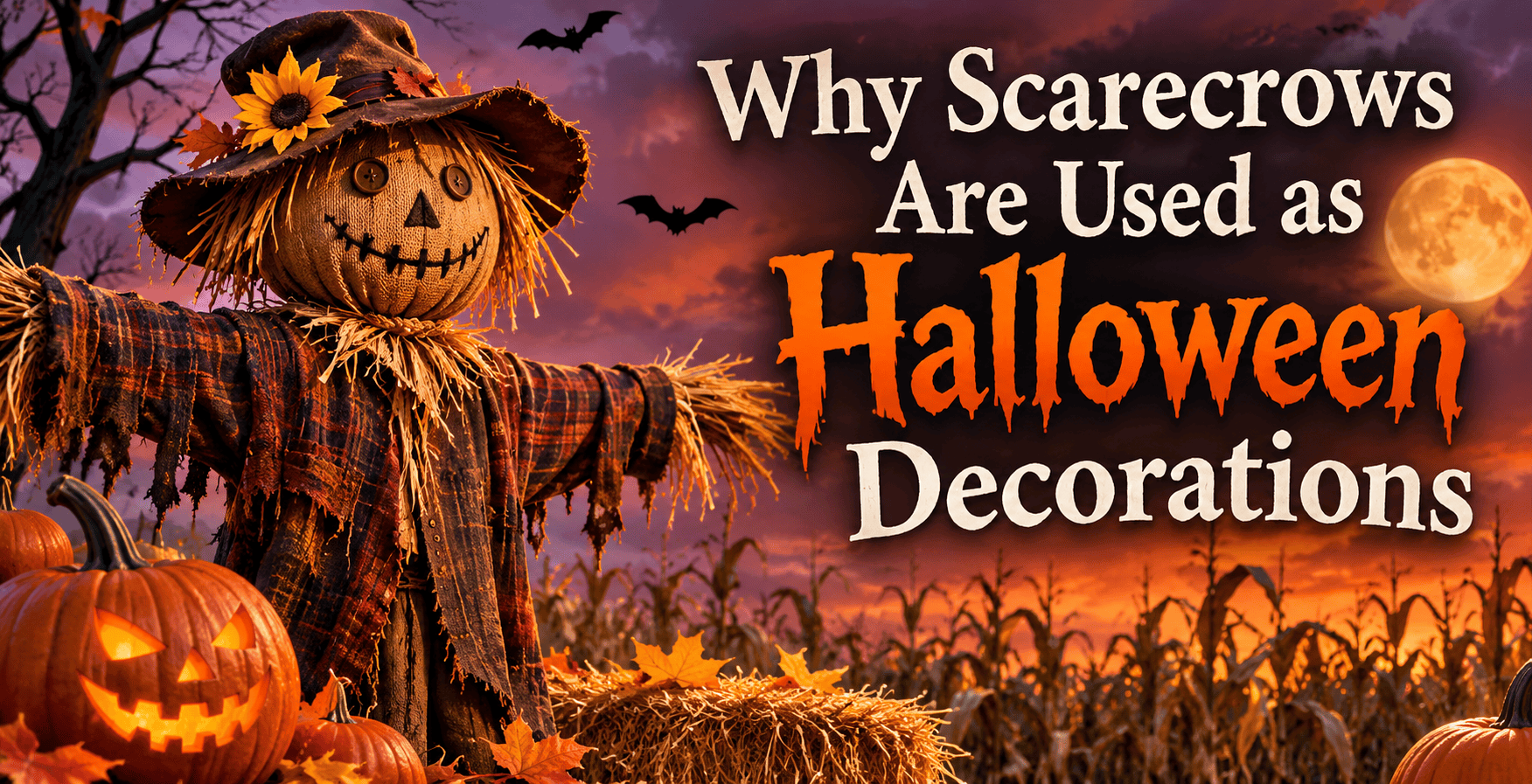
When autumn arrives and Halloween approaches, scarecrows begin appearing on front porches, in gardens, outside haunted houses, and throughout neighborhoods decorated for the spooky season. With their straw-filled bodies, worn-out clothing, floppy hats, and sometimes frightening faces, scarecrows have become one of the most recognizable symbols of fall and Halloween.
But why are scarecrows used as Halloween decorations? How did a simple farming tool designed to protect crops become associated with haunted fields, ghostly figures, and frightening Halloween displays?
The answer lies in centuries of agricultural history, ancient harvest traditions, folklore, and the human fascination with figures that look almost alive.
Scarecrows were originally created for practical purposes, but their mysterious appearance and connection to the autumn harvest eventually made them a natural part of Halloween celebrations.
What Is a Scarecrow?
A scarecrow is a human-shaped figure traditionally placed in fields or gardens to discourage birds from eating seeds, fruits, and crops.
Farmers commonly constructed scarecrows using wooden poles, straw, old clothing, and hats. By giving these figures a human appearance, they hoped birds would mistake them for people and avoid the surrounding crops.
Although scarecrows can temporarily discourage certain birds, their effectiveness varies. Birds may eventually become accustomed to stationary figures, which is why farmers sometimes move scarecrows or combine them with other deterrents.
Throughout history, scarecrows have represented more than agricultural protection. Their humanlike shapes have inspired stories, superstitions, and artistic traditions.
Today, scarecrows are equally familiar as cheerful autumn decorations and frightening Halloween characters.
The Ancient History of Scarecrows
The history of scarecrows stretches back thousands of years, long before Halloween became the holiday celebrated today.
Scarecrows in Ancient Egypt
Ancient Egyptian farmers used methods to protect grain fields from birds, including devices and techniques for trapping or frightening birds away.
Because birds could damage valuable crops, protecting fields was an important part of agricultural life along the Nile River.
These early bird-deterrent practices helped establish the agricultural purpose that later scarecrows would serve.
Scarecrows in Ancient Greece
In ancient Greece, farmers sometimes placed wooden figures associated with Priapus, a fertility deity connected with gardens and agricultural abundance, near their crops.
These figures were believed to offer protection and were sometimes used to discourage birds and other unwanted visitors.
They demonstrate how agricultural guardians could carry both practical and symbolic meaning.
Scarecrows in Japan
Japan developed its own scarecrow traditions, including figures known as kakashi.
Historically, Japanese farmers used various methods to frighten birds away from crops, including devices that produced smoke or unpleasant smells.
Over time, human-shaped scarecrows became common in agricultural landscapes.
Japanese scarecrows also developed cultural and symbolic associations beyond their original farming purpose.
Scarecrows in Medieval Europe
In medieval Europe, farmers used different techniques to keep birds away from their fields.
Children sometimes worked as bird scarers, making noise or chasing birds away from crops.
Human-shaped figures made from available materials eventually became a familiar alternative in many farming communities.
As scarecrows spread across agricultural landscapes, they became closely connected with the changing seasons and the annual harvest.
How Scarecrows Became Associated With Autumn
One of the biggest reasons scarecrows became Halloween decorations is their strong connection to the fall harvest.
For centuries, autumn represented the time when farmers gathered crops and prepared for winter.
Scarecrows were commonly associated with fields of corn, grain, and other crops approaching harvest.
As the growing season ended, these figures remained part of the familiar autumn landscape.
Their appearance naturally complemented other seasonal symbols, including pumpkins, hay bales, dried cornstalks, colorful leaves, and harvested vegetables.
Eventually, scarecrows became decorative representations of rural life and the harvest season.
When Halloween celebrations increasingly incorporated autumn imagery, scarecrows fit perfectly into the tradition.
Their transformation from working farm equipment into seasonal decorations was gradual rather than the result of one specific event.
The Connection Between Scarecrows and Halloween
Halloween has historical connections to autumn festivals, seasonal change, and traditions surrounding the supernatural.
The ancient Celtic festival of Samhain, celebrated around the transition from October into November, marked an important seasonal boundary.
In some traditions, this time of year was associated with spirits, the dead, and the changing relationship between the living world and the supernatural.
However, there is no strong historical evidence that scarecrows were a central feature of ancient Samhain celebrations.
The modern association between scarecrows and Halloween developed primarily through their connection to autumn harvest imagery and their naturally unsettling appearance.
As Halloween decorations became more elaborate, scarecrows offered an easy way to combine traditional fall scenery with frightening themes.
A friendly scarecrow could welcome visitors to a pumpkin patch, while a shadowy figure standing alone in a field could create an entirely different atmosphere.
This flexibility helped scarecrows become a lasting part of Halloween decorating.
Why Scarecrows Can Look So Creepy
Although scarecrows were designed to resemble humans, they rarely look completely natural.
Their faces may be stitched, painted, covered with burlap, or hidden beneath hats.
Their arms often stretch outward unnaturally, and their bodies hang loosely from wooden frames.
These characteristics can make scarecrows disturbing, especially in darkness.
Their Humanlike Appearance
People are naturally sensitive to human faces and body shapes.
When something resembles a person but appears slightly unnatural, it can create discomfort.
This reaction is sometimes discussed in relation to the psychological concept known as the uncanny valley.
A scarecrow standing motionless in an empty field may appear ordinary during daylight but frightening at night.
The uncertainty of whether the figure is simply a decoration or something more creates suspense.
Their Motionless Bodies
Scarecrows often stand completely still, even when everything around them moves in the wind.
Their silence and lack of movement can make them seem mysterious.
In horror stories, this stillness becomes especially effective because audiences begin wondering whether the figure might suddenly move.
Their Hidden Faces
A scarecrow with a burlap-covered head or shadowed face leaves much to the imagination.
Without recognizable facial expressions, people cannot easily determine whether the figure looks friendly or threatening.
Halloween decorations frequently exaggerate this uncertainty by adding glowing eyes, crooked smiles, or frightening masks.
Scarecrows in Folklore and Superstitions
Because scarecrows resemble people while standing alone in fields, they have inspired folklore and supernatural storytelling.
Their role as guardians of crops also gives them symbolic meaning.
In some modern stories, scarecrows are portrayed as protectors that continue watching over the land even after the harvest ends.
Other tales imagine scarecrows coming to life, seeking revenge, or frightening people who enter abandoned fields.
However, many popular claims about ancient scarecrow superstitions are difficult to verify historically.
There is no single universal tradition in which scarecrows were believed to contain spirits or possess supernatural powers.
Instead, their mysterious reputation developed through a combination of local storytelling, agricultural symbolism, and later horror fiction.
Their appearance made them ideal characters for ghost stories and frightening legends.
Why Scarecrows Became Popular in Halloween Horror
Scarecrows became especially useful in horror because they combine familiar rural imagery with unexpected danger.
A quiet cornfield or isolated farm may appear peaceful, but it can also feel threatening when darkness falls.
Scarecrows add to that atmosphere because they resemble silent watchers.
Writers and filmmakers have used this imagery to create suspense and fear.
In horror fiction, scarecrows are sometimes depicted as possessed figures, supernatural guardians, or disguises worn by dangerous characters.
Their simple construction also makes them visually effective.
A frightening scarecrow does not require elaborate features. A worn coat, crooked hat, and shadowed face can be enough to create an unsettling scene.
The contrast between their harmless agricultural purpose and their frightening fictional portrayals has helped establish scarecrows as Halloween horror symbols.
The Influence of Movies, Television, and Literature
Popular entertainment has played an important role in shaping how people view scarecrows.
One of the most recognizable scarecrow characters appears in The Wonderful Wizard of Oz, published by L. Frank Baum in 1900.
Unlike frightening Halloween scarecrows, this character is friendly, thoughtful, and memorable for his desire to have a brain.
The character helped establish the scarecrow as a familiar figure in popular culture.
Later horror stories presented a darker interpretation.
Films such as Dark Night of the Scarecrow (1981) used scarecrow imagery to create an atmosphere of mystery and terror.
Comic books and television also introduced frightening scarecrow characters, including the Batman villain known as Scarecrow, who uses fear as a weapon.
These fictional portrayals reinforced the idea that a scarecrow could represent something more sinister than a harmless farming tool.
As Halloween became increasingly influenced by horror entertainment, frightening scarecrows became common decorations.
Why Scarecrows Are Often Displayed With Pumpkins
Scarecrows and pumpkins are frequently displayed together because both are closely associated with the autumn harvest.
Pumpkins mature during the fall season and became especially important in North American Halloween traditions.
Scarecrows, meanwhile, represent the agricultural work of protecting crops.
When combined, they create a recognizable harvest scene.
A typical autumn display might include a scarecrow sitting on a hay bale, surrounded by pumpkins, dried corn, and colorful leaves.
These decorations evoke the atmosphere of farms, pumpkin patches, and harvest festivals.
The combination also works for different audiences.
Families may prefer cheerful scarecrows with smiling faces, while haunted attractions may use frightening versions surrounded by carved jack-o’-lanterns.
This versatility explains why scarecrows remain popular throughout the Halloween season.
Why Cornfields and Scarecrows Are Common Halloween Themes
Cornfields have become a familiar setting in Halloween attractions, haunted mazes, and horror stories.
Tall cornstalks can block visibility, create narrow pathways, and produce rustling sounds in the wind.
These characteristics make cornfields effective environments for suspense.
A scarecrow positioned among the stalks adds another layer of uncertainty.
Visitors may struggle to distinguish between a stationary decoration and a person wearing a costume.
Haunted attractions often take advantage of this confusion by placing actors among ordinary scarecrows.
The experience creates anticipation because guests never know which figures might suddenly move.
This combination of agricultural scenery and controlled fear has made scarecrows particularly popular in haunted corn mazes.
Friendly Scarecrows vs. Scary Halloween Scarecrows
Not every Halloween scarecrow is intended to frighten people.
Scarecrow decorations generally fall into two broad styles.
Friendly Autumn Scarecrows
Friendly scarecrows are designed to celebrate the harvest season.
They often feature smiling faces, colorful clothing, straw hats, and cheerful expressions.
These decorations are commonly found at family farms, schools, fall festivals, and residential entrances.
They emphasize warmth, tradition, and the beauty of autumn.
Frightening Halloween Scarecrows
Scary scarecrows are designed to create fear or suspense.
They may feature torn clothing, skeletal hands, glowing eyes, sinister masks, or dark, weathered materials.
Some decorations include motion sensors that activate movement or sound effects when someone approaches.
Others are designed to resemble monsters or supernatural creatures.
Both styles remain popular because they appeal to different sides of Halloween: seasonal celebration and spooky entertainment.
How Scarecrows Became Popular Front Porch Decorations
Scarecrows are particularly well suited for front porch displays because they are relatively inexpensive and easy to customize.
Traditional scarecrows can be assembled from materials already found around the home.
Old shirts, jeans, hats, wooden supports, and straw can create a recognizable figure.
Their upright shape also makes them noticeable from the street.
As seasonal home decorating became more popular, scarecrows became a convenient way to celebrate autumn without relying entirely on frightening imagery.
They can remain on display throughout much of the fall season, from early harvest celebrations through Halloween and sometimes Thanksgiving.
This extended seasonal usefulness makes them appealing decorations.
The Symbolic Meaning of Scarecrows
Beyond their practical history and frightening appearance, scarecrows can represent several broader ideas.
Protection
Their original purpose was to protect crops from birds.
Because of this, scarecrows symbolize guardianship and the protection of something valuable.
Harvest and Abundance
Scarecrows are closely associated with fields, farming, and the gathering of crops.
They represent the work involved in producing food and the rewards of a successful growing season.
The Changing Seasons
Scarecrows often appear when summer transitions into autumn.
Their presence can symbolize the passage of time and the approaching winter.
Mystery and Fear
Their humanlike appearance makes them effective symbols of uncertainty.
In Halloween settings, scarecrows represent the unsettling possibility that something ordinary may conceal something frightening.
These meanings are not universal historical beliefs, but they help explain why scarecrows work so well as seasonal decorations.
How Different Cultures Celebrate Scarecrows Today
Scarecrows appear in seasonal festivals and agricultural celebrations in several parts of the world.
In the United States, scarecrow displays are common at pumpkin patches, harvest festivals, farms, and Halloween attractions.
In the United Kingdom, some communities hold scarecrow festivals where residents create figures representing fictional characters, occupations, celebrities, or humorous scenes.
In Japan, scarecrow festivals and exhibitions celebrate agricultural heritage and creative craftsmanship.
Although these events do not all have a Halloween connection, they demonstrate how scarecrows have evolved from farming equipment into cultural and artistic displays.
Their recognizable shape allows people to transform them into almost any character imaginable.
How to Make a Traditional Halloween Scarecrow
Creating a homemade scarecrow is a popular seasonal activity.
A traditional design requires only a few basic materials.
Materials:
-
An old long-sleeved shirt
-
A pair of jeans or overalls
-
Straw or other stuffing material
-
A wooden frame or sturdy support
-
A burlap sack or fabric for the head
-
A hat
-
String or rope
-
Fabric markers or paint for facial details
Instructions:
-
Construct a sturdy frame using wooden supports.
-
Dress the frame in the shirt and pants.
-
Fill the clothing with straw or another suitable material.
-
Tie the sleeves and pant legs to prevent the stuffing from falling out.
-
Create a head using a stuffed burlap sack or fabric.
-
Add a painted or stitched face.
-
Place a hat on the head.
-
Secure the completed scarecrow in a safe location.
For a friendly autumn decoration, use bright colors and a smiling expression.
For a frightening Halloween version, choose dark clothing, distressed fabric, and a more mysterious face.
Outdoor scarecrows should be secured against wind and kept away from open flames, candles, and other ignition sources because straw and fabric can burn easily.
Interesting Facts About Scarecrows
Scarecrows have a surprisingly rich history that extends far beyond Halloween.
1. Scarecrows have existed in various forms for thousands of years. Ancient agricultural societies developed ways to frighten birds away from valuable crops.
2. Not all scarecrows resemble humans. Some bird deterrents use reflective materials, moving objects, or predator shapes.
3. Scarecrows do not always work permanently. Birds may learn that a stationary figure poses no danger.
4. Japan has a long scarecrow tradition. The Japanese word kakashi refers to a scarecrow.
5. Scarecrows appear in famous literature. The Scarecrow from The Wonderful Wizard of Oz remains one of the best-known examples.
6. Some communities hold scarecrow competitions. Residents create imaginative figures and display them throughout towns or villages.
7. Scarecrows are popular in haunted attractions. Their humanlike shapes make it difficult to distinguish decorations from costumed performers.
8. Scarecrows are not originally Halloween inventions. Their association with Halloween developed from their agricultural role, autumn imagery, and later horror traditions.
Frequently Asked Questions About Halloween Scarecrows
Why do people put scarecrows outside for Halloween?
People display scarecrows during Halloween because they symbolize the autumn harvest and can create either a festive or frightening atmosphere. Their humanlike appearance also makes them effective decorations for haunted houses and spooky outdoor displays.
Are scarecrows originally associated with Halloween?
No. Scarecrows were originally agricultural devices used to discourage birds from damaging crops. Their association with Halloween developed later through autumn decorating traditions and horror imagery.
What do scarecrows symbolize at Halloween?
Halloween scarecrows can symbolize the harvest, protection, mystery, and fear. Their meaning depends largely on how they are presented.
Why are scarecrows scary at night?
Scarecrows can appear frightening because they resemble people but remain motionless. Darkness, shadows, hidden faces, and unexpected movement from the wind can make them seem mysterious.
Are scarecrows connected to witches?
Scarecrows and witches are both familiar Halloween images, but they developed from different traditions. There is no established historical connection showing that scarecrows originated as witchcraft symbols.
Why are scarecrows placed in cornfields?
Scarecrows were placed in agricultural fields to discourage birds from eating or damaging crops. Cornfields also became popular Halloween settings because their tall stalks create a mysterious atmosphere.
Final Thoughts: Why Scarecrows Remain a Halloween Tradition
Scarecrows have traveled a remarkable path through history.
What began as a practical way for farmers to protect their crops eventually became a recognizable symbol of autumn, harvest celebrations, and Halloween.
Their connection to the farming season explains why they appear alongside pumpkins, hay bales, and cornstalks. Their unusual humanlike appearance explains why they also became popular characters in horror stories, haunted attractions, and frightening decorations.
Perhaps the most interesting thing about scarecrows is their ability to represent two completely different sides of the season.
During the day, a cheerful scarecrow sitting beside a pumpkin patch can symbolize the warmth and beauty of autumn.
At night, that same figure standing silently beneath the moonlight can suddenly seem mysterious and unsettling.
That contrast between comfort and fear is exactly what makes scarecrows such enduring Halloween decorations.
Whether they are smiling from a front porch or lurking in a haunted cornfield, scarecrows continue to remind us that some of Halloween’s most memorable symbols began with the ordinary traditions of everyday life.
Do you prefer friendly harvest scarecrows or frightening Halloween scarecrows that look like they might come alive after dark?
Leave a Reply