There is something unmistakable about the sweetness of real sugar.
Whether it is sprinkled over warm cinnamon rolls, stirred into a morning cup of coffee, baked into homemade cookies, or caramelized over a favorite dessert, sugar has been part of our kitchens, celebrations, traditions, and memories for generations.
National Real Sugar Day is an opportunity to recognize real sugar, learn a little more about where it comes from, appreciate the people involved in producing it, and perhaps enjoy one of our favorite sweet treats.
Of course, celebrating sugar does not mean we need to eat unlimited amounts of it. Like many foods, sugar can be enjoyed as part of an overall balanced diet. National Real Sugar Day can simply be a day to appreciate the ingredient, understand what we are eating, and enjoy something sweet intentionally.
What Is National Real Sugar Day?
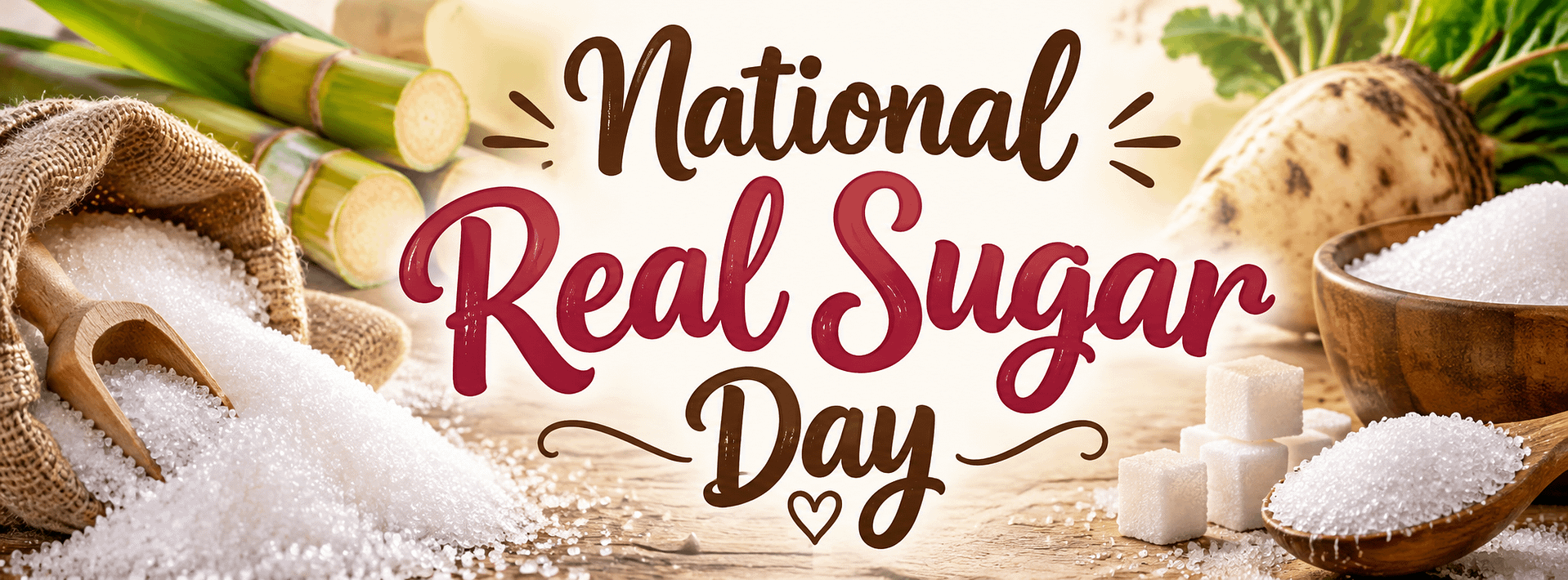
National Real Sugar Day celebrates real sugar and the agricultural process behind bringing it from the farm to our kitchens.
When we see a bag of granulated sugar sitting on a grocery-store shelf, it is easy to forget that sugar begins with plants.
Two of the primary agricultural sources of sugar are sugar cane and sugar beets.
Sugar cane grows as a tall grass in warm climates. The stalks contain naturally occurring sucrose that can be extracted and processed into sugar.
Sugar beets look very different. They are root crops that also contain sucrose. After harvesting, the beets are processed so their sugar can be extracted, purified, crystallized, and prepared for use.
The result is the familiar sugar found in countless kitchens.
National Real Sugar Day gives us an excuse to look beyond the sugar bowl and recognize the agricultural story behind something we often take for granted.
Sugar Has Been Part of Food Culture for Generations
Think about some of your favorite childhood foods.
Maybe you remember homemade chocolate chip cookies cooling on the kitchen counter.
Maybe it was birthday cake covered in frosting.
Perhaps you remember pancakes with something sweet on top, cinnamon rolls on a weekend morning, lemonade during summer, pumpkin pie at Thanksgiving, or Christmas cookies during December.
Sugar often appears in foods connected to memories.
That is one reason sweetness can feel like more than simply a flavor.
Food can remind us of people, places, holidays, traditions, and moments in our lives.
A particular dessert might immediately remind you of your grandmother.
A cookie recipe might take you back to childhood.
A birthday cake might remind you of celebrations with people you love.
Recipes are often passed from one generation to another, and sugar has been an ingredient in countless family recipes.
National Real Sugar Day can therefore be about more than satisfying a sweet tooth. It can also be about appreciating the traditions connected to food.
What Does Sugar Actually Do in Cooking?
Sugar obviously makes food taste sweet, but sweetness is only part of its job.
In baking especially, sugar can affect texture, moisture, browning, structure, and appearance.
Consider a cookie.
Without sugar, you would not simply have a cookie that was less sweet. Depending on the recipe, you could end up with something substantially different in texture, spread, browning, and moisture.
Sugar contributes to caramelization and other browning reactions that help produce the beautiful golden surfaces we associate with baked goods.
It can also help retain moisture, which contributes to the softness of cakes and other desserts.
Sugar is also important in foods such as jams and preserves, where sufficient concentrations of sugar traditionally play a role in texture and preservation.
In frozen desserts, sugar can influence freezing characteristics and texture.
So while we usually think about sugar primarily because of its flavor, it performs numerous culinary functions.
Different Types of Real Sugar
Walk down the baking aisle and you will probably notice that sugar comes in many forms.
Granulated sugar is the familiar white sugar commonly used for baking, beverages, and everyday cooking.
Brown sugar contains molasses, giving it a deeper flavor and additional moisture. It is especially popular in cookies, sauces, glazes, and fall desserts.
Powdered sugar, sometimes called confectioners’ sugar, is finely ground sugar commonly used in frosting, glazes, candies, and as a decorative dusting over desserts.
Coarse and sanding sugars have larger crystals and are often used to add sparkle and crunch to baked goods.
Different varieties can serve different purposes, which is why experienced bakers know that swapping one type of sugar for another can sometimes change the finished recipe.
Sugar Cane and Sugar Beets
One interesting part of National Real Sugar Day is learning where sugar originates.
Sugar cane thrives in warm environments and can grow impressively tall. After it is harvested, the cane is crushed so its juice can be extracted. The juice is then purified, concentrated, and processed until sugar crystals form.
Sugar beets follow a different journey.
After harvesting, they are washed and sliced before their sugar is extracted. The resulting liquid is purified and concentrated before crystallization.
By the time sugar reaches our tables, it can be difficult to imagine the crops, farms, harvesting equipment, transportation, processing facilities, and workers involved in producing something as ordinary as a spoonful of sugar.
That agricultural connection is worth remembering.
A Day to Appreciate Farmers
Whenever we celebrate food, we should remember the people who grow it.
Farmers are responsible for producing the crops that eventually become many of the ingredients we use every day.
National Real Sugar Day offers an opportunity to recognize sugar cane and sugar beet growers and everyone else involved in getting sugar from agricultural fields to grocery-store shelves.
Farming requires planning, knowledge, equipment, hard work, and the ability to deal with factors that cannot always be controlled.
Weather conditions, pests, disease, input costs, transportation, and changing markets can all affect agricultural operations.
Behind an everyday ingredient can be an entire network of people working to produce it.
Sugar and Moderation
A celebration of sugar should also include some perspective.
Something does not need to be consumed excessively simply because we enjoy it.
Public-health guidance generally recommends limiting added sugars as part of a healthy eating pattern. That does not necessarily mean someone can never enjoy cake, cookies, ice cream, or a sweetened drink.
It means moderation matters.
There is a major difference between enjoying a favorite dessert occasionally and consuming large quantities of added sugar throughout the day without paying attention to it.
One useful habit is reading nutrition labels.
Added sugars can appear in many foods and beverages, including products that people might not immediately think of as desserts.
Paying attention to what we consume allows us to make informed choices while still leaving room for foods we enjoy.
National Real Sugar Day does not have to be an excuse to overload on sweets.
It can simply be an opportunity to enjoy something you genuinely like.
Make Something From Scratch
One of the best ways to celebrate National Real Sugar Day is to get into the kitchen.
Instead of simply grabbing a packaged dessert, consider making something yourself.
Bake chocolate chip cookies.
Make cinnamon rolls.
Prepare an apple crisp.
Bake a homemade cake.
Make brownies.
Try homemade caramel.
Prepare a fruit cobbler.
Bake your family’s favorite pie.
Making food from scratch gives you an opportunity to see exactly how ingredients work together.
It can also create memories.
Invite your children, grandchildren, spouse, partner, friends, or other family members into the kitchen.
Cooking together does not have to be perfect.
The cookies might be different sizes.
Flour might end up everywhere.
Someone might accidentally crack an egg onto the counter instead of into the bowl.
That is part of the fun.
Sometimes the memories created while preparing food become more meaningful than the finished dessert.
Pull Out an Old Family Recipe
National Real Sugar Day is also a great excuse to look through old family recipes.
Many families have recipes that have survived for decades.
Maybe you have your grandmother’s cookie recipe.
Perhaps there is a pie your mother always made during the holidays.
Maybe your father made pancakes every Sunday morning.
Food traditions help connect generations.
If you have an old handwritten recipe card, protect it.
Take a picture of it.
Make a digital copy.
Write down the story behind the recipe.
Tell younger family members who originally made it and why it became important to your family.
Recipes can become pieces of family history.
Someday, someone may treasure that recipe card because it reminds them of you.
Share Something Sweet With Someone
You do not have to keep your National Real Sugar Day creation for yourself.
Bake an extra batch of cookies and share them.
Bring dessert to a neighbor.
Take cupcakes to work.
Surprise a friend with brownies.
Drop off something sweet for someone who has been having a difficult week.
Food has always been one way people show kindness.
A plate of homemade cookies cannot solve someone’s problems, but the gesture behind it can communicate something important:
I thought about you.
Sometimes that small reminder matters.
Support a Local Bakery
If baking is not your thing, National Real Sugar Day is an excellent opportunity to visit a local bakery.
Try a pastry you have never had before.
Buy a fresh cinnamon roll.
Pick up a slice of cake.
Try a seasonal dessert.
Ask the bakery what its specialty is.
Independent bakeries often become important parts of their communities, and buying a treat can also mean supporting a local business and the people who work there.
You get dessert.
They get a customer.
That sounds like a pretty sweet arrangement.
Try Something You’ve Never Made Before
You could also use National Real Sugar Day as an excuse to experiment.
If you normally make cookies, try pie.
If you normally make cake, try homemade caramel.
If you have never baked bread with a sweet filling, try cinnamon rolls.
You could experiment with:
- Caramel sauce
- Fudge
- Fruit preserves
- Homemade marshmallows
- Toffee
- Crème brûlée
- Pecan pie
- Bread pudding
- Apple crisp
- Cinnamon rolls
- Sugar cookies
- Homemade lemonade
Cooking becomes more interesting when we occasionally challenge ourselves.
And even when a recipe does not turn out perfectly, you usually learn something.
The Sweetness of Memories
One of the most beautiful things about food is its ability to carry memories.
Taste and smell can suddenly bring back moments you have not thought about in years.
The smell of cookies baking might remind you of coming home from school.
Pumpkin pie might remind you of Thanksgiving around a crowded table.
A birthday cake might make you remember someone who is no longer here.
Food becomes connected to our stories.
That is why certain recipes become precious.
We are not simply trying to recreate a flavor.
Sometimes we are trying to reconnect with a moment.
We are remembering the kitchen.
The conversations.
The laughter.
The people who sat around the table.
The hands that prepared the meal.
The people we loved.
A recipe cannot bring the past back, but sometimes it can make the past feel a little closer.
Sweetness Doesn’t Always Have to Come From Food
There is another way to think about National Real Sugar Day.
Maybe we can use the idea of sweetness as a reminder to bring a little more kindness into someone’s life.
Call someone you have not spoken to recently.
Check on a friend who has been struggling.
Thank someone who helped you.
Leave an encouraging comment.
Tell someone you appreciate them.
Spend time with your family.
Buy a stranger a cup of coffee.
Bring your coworker a treat.
Small acts can change someone’s day.
We often underestimate how powerful kindness can be.
The world has plenty of bitterness.
Adding a little sweetness is rarely a bad idea.
Enjoy the Moment
We spend so much time rushing from one responsibility to another that even enjoyable moments can become hurried.
National Real Sugar Day can be an excuse to slow down.
Make a cup of coffee.
Sit down with a cookie.
Enjoy a slice of pie.
Talk with someone you love.
Put the phone away for a few minutes.
Taste your food instead of rushing through it.
Sometimes enjoyment comes from giving ourselves permission to actually experience the moment we are in.
You do not need an enormous celebration.
Sometimes happiness is warm cinnamon rolls, fresh coffee, a quiet morning, and good conversation.
Final Thoughts
National Real Sugar Day may sound like another fun food holiday, but there is more behind that spoonful of sweetness than we usually consider.
Sugar begins with agriculture.
It passes through the hands of farmers, processors, distributors, bakers, cooks, and families.
It plays an important role in cooking and baking.
And perhaps most importantly, it appears in countless foods connected to celebrations and memories.
So celebrate National Real Sugar Day however feels right for you.
Bake something from scratch.
Pull out an old family recipe.
Visit your favorite local bakery.
Share cookies with a neighbor.
Learn something about sugar cane or sugar beets.
Or simply enjoy your favorite dessert in moderation.
Life gives us plenty of difficult days.
There is nothing wrong with appreciating a little sweetness when it comes our way.
What dessert or sweet recipe immediately brings back a special memory for you?