There are some foods you can prepare in a few minutes, eat, clean up, and move on with your day.
Whole hog barbecue is not one of them.
Whole hog barbecue is an event.
It takes fire, smoke, patience, experience, and plenty of time. More importantly, it has traditionally been the kind of food that brings people together. When an entire hog is slowly cooked over hot coals for hours, you are usually not preparing dinner for one or two people. You are preparing food for a gathering.
That is part of what makes National Whole Hog Barbecue Day worth celebrating.
Observed on the third Saturday of October, National Whole Hog Barbecue Day recognizes one of the South’s most enduring barbecue traditions.
In 2026, the third Saturday of October falls on October 17.
But this day isn’t simply an excuse to eat barbecue.
It is an opportunity to recognize the pitmasters who keep traditional cooking methods alive, appreciate the regional barbecue traditions that developed across the American South, and remember that some of our greatest food traditions are really stories about family and community.
What Is Whole Hog Barbecue?
The name tells you almost everything you need to know.
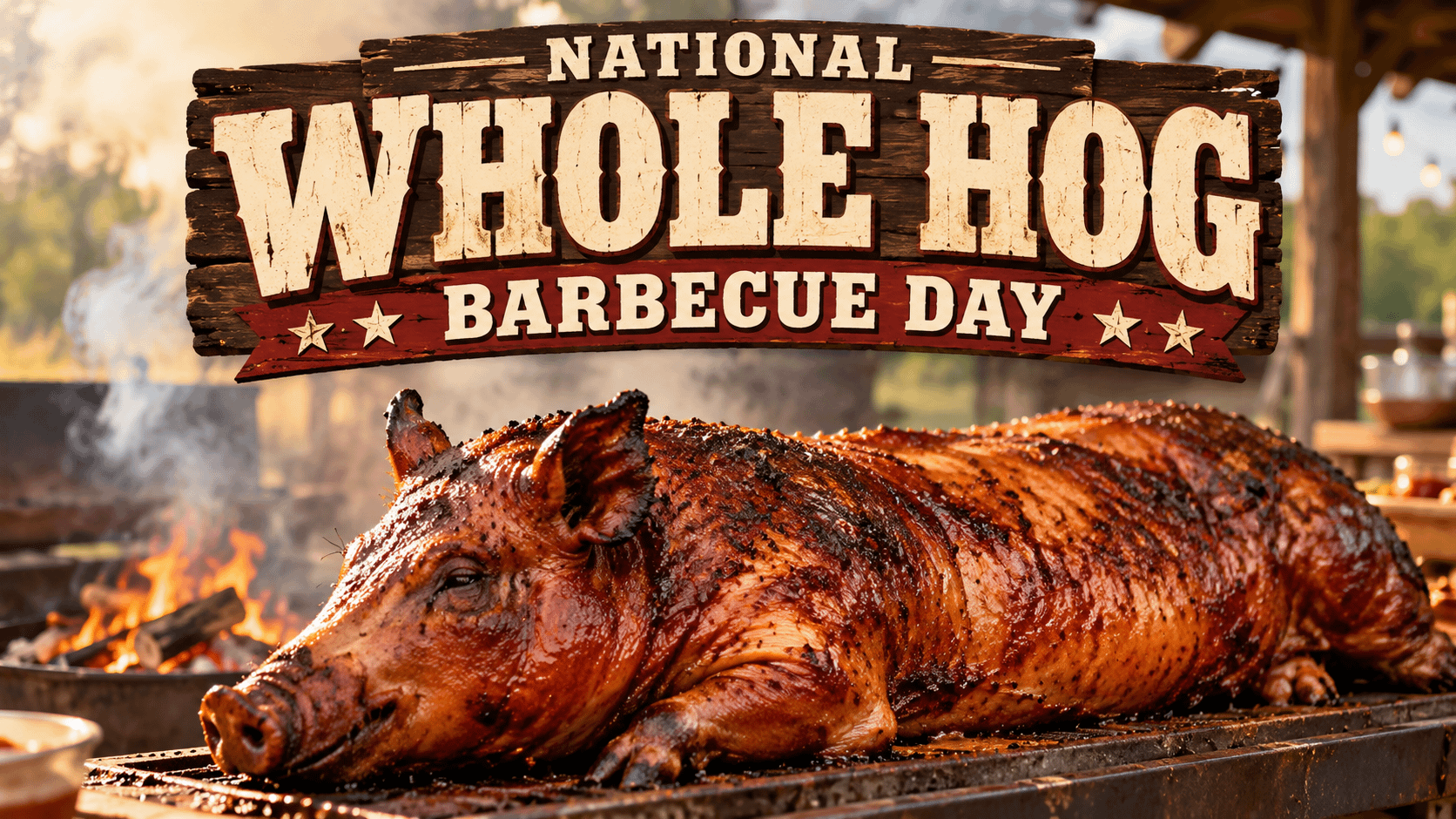
Instead of smoking individual pork shoulders, ribs, or other cuts, traditional whole hog barbecue involves cooking essentially the entire hog slowly over a fire or bed of coals.
It sounds simple until you actually think about what that requires.
Different parts of a hog contain different amounts of fat, connective tissue, and muscle. They don’t necessarily cook at exactly the same rate.
A pitmaster has to manage the fire carefully.
Too much heat can ruin the meat.
Too little heat can dramatically increase an already lengthy cooking process.
The goal is low, controlled heat over a long period of time, allowing smoke and fire to transform the pork.
Traditional pitmasters often cook with hardwood or hardwood coals. The Southern Foodways Alliance has documented North Carolina barbecue restaurants where whole hogs continue to be slow-smoked using woods such as oak and hickory.
Once the hog has finished cooking, meat from different areas can be chopped or pulled together.
That combination is one of the things that makes whole hog barbecue distinctive.
You aren’t necessarily eating meat from just one portion of the animal. Leaner and fattier sections can be mixed together, creating a balance of textures and flavors.
Add smoke, crispy pieces of skin, seasoning, and sauce, and you have something very different from the average backyard pork chop.
A Tradition Much Older Than the Holiday
National Whole Hog Barbecue Day itself is relatively new.
According to National Day Calendar, The Pit Authentic Barbecue in Raleigh, North Carolina, founded National Whole Hog Barbecue Day in 2022 to celebrate the history and traditions surrounding whole hog barbecue.
The barbecue tradition being celebrated, however, goes back generations.
The history of American barbecue is complicated and reflects contributions from Indigenous peoples, Europeans, Africans and African Americans, and Caribbean cooking traditions.
Over generations, those influences developed into regional barbecue traditions throughout the South.
Whole hog cooking became particularly important in parts of North Carolina.
The Southern Foodways Alliance notes that whole-hog barbecue remains associated with eastern North Carolina, where the pork is traditionally seasoned with a relatively simple mixture involving vinegar and peppers.
The result isn’t the thick, sugary barbecue sauce many people might immediately picture.
Eastern North Carolina barbecue sauce tends to be thin, tangy, peppery, and vinegar-forward.
That acidity works particularly well with rich smoked pork.
And if you travel around the Carolinas, you quickly discover something important:
There isn’t just one barbecue.
Barbecue Changes When You Cross Regional Lines
Ask ten barbecue enthusiasts what makes “real barbecue,” and you may start an argument that lasts longer than the cook itself.
Different regions developed different traditions.
Eastern North Carolina became famous for whole hog barbecue and vinegar-and-pepper seasoning.
Elsewhere in North Carolina, pork shoulder became more common, and sauces incorporating tomato developed.
Cross into parts of South Carolina and you’ll encounter barbecue sauces featuring mustard.
Travel farther west and the definition changes again.
The Southern Foodways Alliance documents these regional differences, including the continuation of whole-hog barbecue along the Atlantic side of North Carolina and mustard-based traditions associated with parts of South Carolina.
None of that makes one style automatically superior to another.
It makes American barbecue more interesting.
Barbecue is a culinary map.
The meat, wood, sauce, side dishes, cooking equipment, and techniques can tell you something about where you are and the people who developed those traditions.
The Pitmaster Makes the Difference
You can buy an expensive smoker.
You can purchase premium meat.
You can follow instructions.
But great barbecue still requires something technology can’t completely replace:
Experience.
Traditional pitmasters learn to read a fire.
They understand how quickly wood is burning, when additional coals are needed, where heat is concentrating, and how the meat is progressing.
There isn’t always a button to push or a timer telling you exactly what happens next.
That knowledge was often passed from one generation to another.
The Southern Foodways Alliance’s oral histories contain numerous examples of pitmasters learning barbecue from parents, grandparents, relatives, and community members.
At Grady’s Barbecue in North Carolina, for example, Stephen Grady recalled helping his grandfather, who served as a neighborhood pitmaster, from the time he was very young. The restaurant continued the tradition of slow-smoking whole hogs over oak and hickory coals.
At the Skylight Inn, another famous North Carolina barbecue institution, the Jones family’s whole-hog cooking tradition has similarly passed through generations.
That kind of knowledge isn’t merely a recipe.
It’s a craft.
And National Whole Hog Barbecue Day helps recognize the people keeping that craft alive.
Why Whole Hog Barbecue Takes Patience
We live in a world built around speed.
Fast food.
Same-day shipping.
Instant entertainment.
Meals you can microwave in three minutes.
Whole hog barbecue belongs to a completely different philosophy.
You can’t rush it.
Fire doesn’t care that you’re hungry.
The hog doesn’t care that your guests arrived early.
The pitmaster has to work according to what the fire and meat require.
That might mean starting the process late at night so food will be ready the following day.
It might mean checking the pit while everyone else is sleeping.
It means accepting that something worthwhile sometimes requires hours of work before anyone gets to enjoy the finished product.
There is something refreshing about that.
Whole hog barbecue reminds us that slow isn’t always bad.
Sometimes slow is exactly what creates something special.
Barbecue Has Always Been About More Than Meat
The most important part of barbecue might not be what is sitting on your plate.
It might be who is sitting beside you.
Whole hog barbecue has long been associated with gatherings.
Family reunions.
Church events.
Community celebrations.
Political gatherings.
Festivals.
Fundraisers.
Cookouts.
Weddings.
Neighborhood parties.
Holiday weekends.
And the classic Southern pig pickin’.
The basic idea is simple: cook enough pork to feed a crowd and invite people to gather around it.
Barbecue pitmaster Ed Mitchell described that connection between barbecue and celebration in an oral history collected by the Southern Foodways Alliance. He recalled growing up in a culture where significant celebrations were accompanied by barbecue and family gatherings.
That may be one of the greatest reasons this food has survived.
People aren’t simply preserving a cooking technique.
They’re preserving memories.
The Story Behind National Whole Hog Barbecue Day
The modern holiday also grew from a tradition of people gathering around barbecue.
National Day Calendar traces part of the story to 1980 in Halifax County, North Carolina, when friends gathered near the Roanoke River for a pig pickin’.
By 1983, the annual gathering had moved to Raleigh during the third weekend of October, where participants combined visits to the North Carolina State Fair with a fall whole-hog barbecue celebration.
The tradition eventually became connected with The Pit Authentic Barbecue in downtown Raleigh.
In 2022, The Pit established National Whole Hog Barbecue Day as an annual celebration on the third Saturday of October.
What began as people gathering around barbecue ultimately became a national food celebration.
That’s appropriate because gathering is what barbecue has always done so well.
The Importance of Preserving Traditional Barbecue
Food traditions can disappear surprisingly quickly.
A restaurant closes.
A pitmaster retires.
Children choose different careers.
Old cooking pits are replaced with modern equipment.
Recipes disappear.
Techniques that once seemed ordinary become rare.
That’s why documenting and celebrating traditional cooking methods matters.
Organizations such as the Southern Foodways Alliance have recorded oral histories with barbecue cooks and restaurant owners throughout the South, preserving stories that otherwise could eventually disappear.
And many pitmasters themselves understand that responsibility.
Samuel Jones of the Skylight Inn spoke about wanting traditional whole-hog barbecue to remain something people can actually experience rather than merely read about historically.
That idea captures much of what National Whole Hog Barbecue Day represents.
Tradition stays alive when people continue practicing it.
What Goes With Whole Hog Barbecue?
Of course, barbecue rarely arrives alone.
Part of the fun is everything surrounding it.
Depending on where you are, a whole hog barbecue plate might include:
- Coleslaw
- Hush puppies
- Baked beans
- Potato salad
- Cornbread
- Collard greens
- Macaroni and cheese
- Brunswick stew
- Corn on the cob
- Pickles
- Green beans
- Sweet potatoes
- Banana pudding
- Peach cobbler
Then comes another important question:
What sauce are you putting on the pork?
For an Eastern North Carolina-inspired meal, vinegar and peppers are the natural choice.
But barbecue lovers elsewhere might prefer mustard sauce, tomato-based sauce, something spicy, or something sweet and smoky.
National Whole Hog Barbecue Day is a perfect excuse to try a style you haven’t experienced before.
How to Celebrate National Whole Hog Barbecue Day
You don’t have to cook an entire pig in your backyard to participate.
In fact, unless you have the proper equipment and experience, supporting someone who already knows how to do it may be the better option.
Visit a barbecue restaurant that still cooks whole hog.
Attend a barbecue festival or competition.
Talk to a local pitmaster.
Try traditional Eastern North Carolina barbecue if you’ve never had it.
Learn about the barbecue traditions of your own state.
Invite friends and family over for a barbecue meal.
Try making a vinegar-and-pepper barbecue sauce.
Support a locally owned barbecue restaurant.
Or simply use the day as an opportunity to learn more about the history behind the food you’re eating.
National Day Calendar also encourages people to attend whole-hog barbecue competitions and other celebrations surrounding the tradition.
Support the People Keeping the Fires Burning
National food days can sometimes seem silly.
Do we really need a holiday for every sandwich, dessert, cocktail, and snack?
Maybe not.
But celebrations such as National Whole Hog Barbecue Day can serve a bigger purpose.
They put attention on traditions that deserve to be remembered.
Every time you visit an old-fashioned barbecue restaurant, you’re supporting more than another place to eat.
You may be supporting a family business.
You may be helping preserve a cooking method that has survived generations.
You may be supporting pitmasters who spend hours tending fires while most of us are asleep.
And you may be helping make sure another generation gets to taste barbecue cooked the traditional way.
A Meal That Forces Us to Slow Down
Perhaps there is another lesson hidden inside whole hog barbecue.
Good things don’t always happen quickly.
Sometimes you prepare.
Sometimes you wait.
Sometimes you tend the fire.
Sometimes you trust a process that can’t be rushed.
And eventually, after hours of smoke and heat, you get to sit down with people you care about and enjoy what all that patience created.
That’s a pretty good metaphor for life.
We spend so much time searching for shortcuts that we sometimes forget there is value in the process itself.
Whole hog barbecue doesn’t offer many shortcuts.
Maybe that’s exactly why people remain fascinated by it.
Celebrating Smoke, Food, and Community
On National Whole Hog Barbecue Day, take some time to appreciate one of America’s great regional food traditions.
Appreciate the pitmasters waking up early—or staying awake all night—to tend the fire.
Appreciate the restaurants that refuse to abandon traditional cooking methods just because there are faster alternatives.
Appreciate the families who passed their techniques from grandparents to parents to children.
And most of all, appreciate what happens when food gives people an excuse to gather.
Because barbecue has never really been only about pork.
It’s about smoke drifting through the air.
It’s about hearing conversations around a table.
It’s about someone asking whether you want another helping.
It’s about recipes and techniques passed down through generations.
It’s about communities coming together.
It’s about taking something simple—meat, wood, fire, seasoning, and time—and turning it into something people remember.
That is worth celebrating.
So this National Whole Hog Barbecue Day, find some authentic barbecue, grab your favorite sides, bring a few people together, and raise a plate to the pitmasters who keep the fires burning.
If you could build your perfect whole hog barbecue plate, what barbecue sauce and side dishes would you choose?