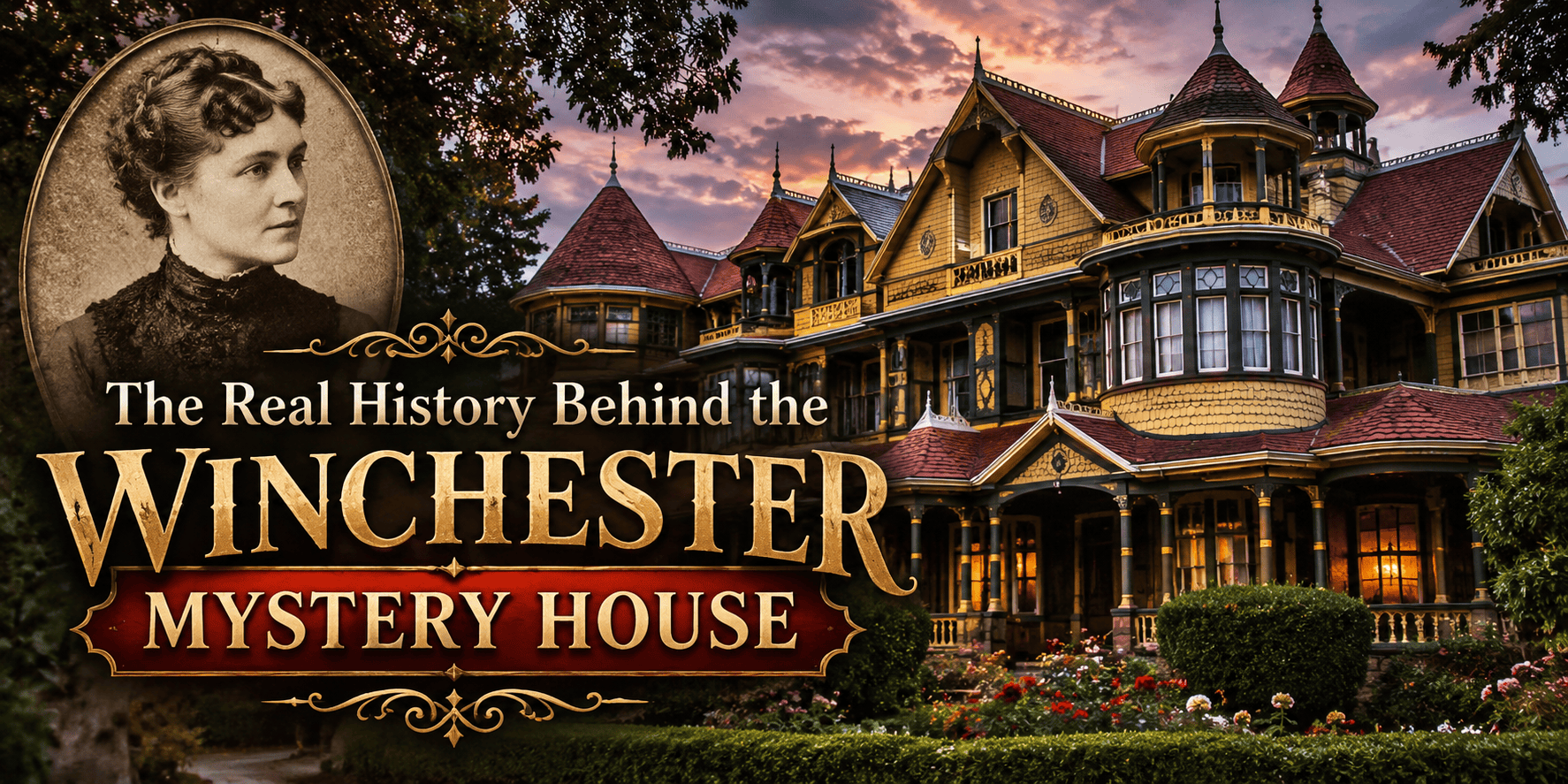
In the heart of San Jose, California, stands one of America’s most unusual and mysterious historic mansions. With staircases that appear to lead nowhere, doors that open onto unexpected spaces, twisting hallways, and an architectural design that seems to defy logic, the Winchester Mystery House has fascinated visitors for generations.
For more than a century, stories have circulated about the mansion’s eccentric owner, Sarah Winchester, and her supposed obsession with building a house to confuse the spirits of people killed by Winchester rifles.
According to popular legend, Sarah believed she was haunted by the ghosts of those who had died because of the firearms manufactured by her husband’s family. Some versions of the story claim that a medium warned her that construction must never stop or she would die.
But how much of this famous haunting is actually true?
The real history of the Winchester Mystery House is a fascinating combination of family tragedy, extraordinary wealth, Victorian architecture, personal privacy, and legends that grew increasingly elaborate after Sarah Winchester’s death.
Understanding the woman behind the mansion reveals a story that may be even more interesting than the ghost stories themselves.
Who Was Sarah Winchester?
Sarah Lockwood Pardee Winchester was born around 1839 in New Haven, Connecticut. She grew up in a respected family and received an education that was considered impressive for a woman of her time.
In 1862, she married William Wirt Winchester, the son of Oliver Winchester, whose firearms company would become one of the most recognizable manufacturers in American history.
The Winchester Repeating Arms Company became famous for producing repeating rifles, including the Winchester Model 1873, often associated with the phrase “The Gun That Won the West.”
The Winchester family’s business success brought tremendous wealth, but Sarah’s personal life was marked by devastating losses.
In 1866, Sarah and William welcomed a daughter named Annie Pardee Winchester. Tragically, their daughter died in infancy.
The loss was heartbreaking for the young couple.
Then, in 1881, William Winchester died of tuberculosis, leaving Sarah a widow.
Sarah inherited substantial wealth and an ownership interest in the Winchester firearms business. The inheritance gave her financial independence at a time when few women possessed comparable resources.
These family tragedies would eventually become central to the legends surrounding her mysterious California home.
However, there is an important distinction between documented history and the supernatural explanations that emerged later.
Although Sarah experienced profound personal losses, there is no reliable contemporary evidence proving that she believed her family was cursed by the spirits of people killed with Winchester firearms.
Why Did Sarah Winchester Move to California?
After her husband’s death, Sarah eventually relocated from Connecticut to California.
In 1886, she purchased a farmhouse and surrounding property in the Santa Clara Valley, near what is now San Jose.
At the time, the region was very different from today’s Silicon Valley.
The Santa Clara Valley was primarily agricultural, with orchards, farms, and large estates covering much of the landscape.
California’s relatively mild climate, available land, and opportunities for privacy made the area appealing to wealthy Eastern families.
Sarah’s decision to relocate has often been explained through supernatural legends. According to one version, a spiritual medium instructed her to travel west and build a house for the restless dead.
However, historians have not established that such a consultation actually occurred.
A more grounded explanation is that Sarah wanted a fresh beginning, greater privacy, and a comfortable place to live after years of personal tragedy.
Once she acquired the property, she began transforming the existing farmhouse into an increasingly elaborate residence.
What started as a relatively modest home would eventually become one of the most architecturally unusual houses in American history.
How the Winchester Mystery House Became So Large
One of the most remarkable facts about the Winchester Mystery House is the scale of its construction.
Sarah Winchester spent decades expanding and modifying the property.
The house eventually developed into a sprawling Victorian mansion containing approximately 160 rooms.
Its complicated interior includes numerous bedrooms, staircases, fireplaces, hallways, and architectural features that have puzzled visitors for decades.
The mansion also contains an extraordinary collection of decorative details, including stained-glass windows, ornate woodwork, and custom-designed fixtures.
Sarah was deeply involved in the design and development of her home.
Rather than following a single comprehensive architectural plan, the residence evolved through numerous additions, renovations, and changes.
This approach helped produce its famously confusing layout.
Rooms were added, spaces were repurposed, and existing architectural features sometimes became unnecessary as construction continued.
Over time, the house became a maze of interconnected structures.
For visitors unfamiliar with its history, the resulting design can seem almost impossible to understand.
Yet its unusual appearance does not automatically mean it was created to confuse ghosts.
The mansion’s layout can also be understood as the result of decades of experimental construction, changing preferences, and repeated remodeling.
The Legend of the Never-Ending Construction
Perhaps the most famous story about the Winchester Mystery House claims that Sarah Winchester believed she would die if construction ever stopped.
According to the legend, workers were employed around the clock, hammering, sawing, and building new rooms throughout the day and night.
The story suggests that Sarah believed continuous construction would protect her from supernatural forces.
However, the historical evidence tells a more complicated story.
Construction did continue for decades, but there is no convincing proof that Sarah maintained an uninterrupted, 24-hour building operation because of a supernatural warning.
The earliest known newspaper story suggesting that Sarah feared dying when her house was completed appeared in the San Francisco Chronicle on February 24, 1895.
That article helped establish the foundation for the mansion’s mysterious reputation while Sarah was still alive.
Over time, the story evolved from a superstition about finishing the house into an elaborate tale involving ghosts, curses, and revenge.
Sarah herself never publicly confirmed these supernatural explanations.
Her silence allowed the rumors to spread without being challenged.
Why Does the Winchester Mystery House Have Staircases to Nowhere?
One of the mansion’s most famous attractions is its collection of unusual staircases and doorways.
Some staircases appear to end abruptly. Certain doors open onto walls, while others lead to unexpected spaces.
These architectural oddities have inspired countless theories.
According to the supernatural explanation, Sarah intentionally created confusing passages to prevent ghosts from finding her.
However, several practical explanations are more consistent with the historical record.
First, the house underwent continuous remodeling over many years. When new rooms were constructed, old staircases and doorways sometimes lost their original purposes.
Second, Sarah experimented with architectural arrangements rather than following a fixed plan.
Third, the mansion experienced significant earthquake damage that permanently changed its structure.
Finally, some of the unusual design features may have reflected Sarah’s personal needs and preferences.
For example, the mansion contains a staircase with unusually shallow steps. Such a design would have made climbing easier for someone experiencing physical difficulties.
Although the house certainly contains strange features, their existence does not prove that Sarah was attempting to escape supernatural beings.
The 1906 San Francisco Earthquake Changed the Mansion
One of the most important events in the history of the Winchester Mystery House occurred on April 18, 1906.
That morning, a powerful earthquake struck Northern California, devastating San Francisco and damaging communities throughout the Bay Area.
The Winchester mansion suffered extensive damage.
Before the earthquake, the house had reached an impressive height, with portions rising as high as seven stories.
The earthquake damaged its upper levels, including its tower.
Following the disaster, significant portions of the damaged upper structure were removed.
Other damaged areas were altered, abandoned, or incorporated into subsequent renovations.
This helps explain some of the mansion’s unusual interior arrangements.
What appears today to be an intentionally mysterious architectural feature may originally have served an entirely practical purpose.
The earthquake also demonstrates why the mansion should not be understood as a building that remained unchanged throughout Sarah’s lifetime.
It was a constantly evolving structure affected by both human decisions and natural disasters.
Did Sarah Winchester Hold Séances Inside the House?
Another popular legend claims that Sarah regularly conducted séances to communicate with spirits.
According to some stories, she entered a special room every night to receive instructions from ghosts about what to build next.
The mansion contains a small room that has become popularly known as the Séance Room.
Tourists have long been fascinated by its unusual layout and mysterious reputation.
However, there is no reliable contemporary documentation establishing that Sarah Winchester regularly conducted séances there.
Some historians have questioned whether the room was ever used for spiritualist activities at all.
The supernatural interpretation became especially popular after Sarah’s death, when the mansion was transformed into a tourist attraction.
During the late nineteenth century, spiritualism was a significant cultural movement in the United States.
Many Americans attended séances, consulted mediums, and explored the possibility of communicating with deceased loved ones.
The movement became particularly influential after the enormous loss of life during the Civil War.
Because Sarah had experienced personal tragedy, later storytellers found it easy to connect her life with the spiritualist beliefs of her era.
But the popularity of spiritualism does not establish that Sarah herself practiced it.
The distinction between historical possibility and documented fact remains essential.
Why Is the Number 13 Associated With the Winchester Mystery House?
The number 13 appears frequently in stories about the Winchester Mystery House.
Visitors are often told about architectural details featuring thirteen steps, thirteen windows, or other arrangements associated with the number.
In Western superstition, thirteen has long been considered unlucky.
Because of this association, the number fits naturally into the mansion’s mysterious reputation.
Some people believe Sarah intentionally incorporated the number into her home for spiritual or protective reasons.
Others suggest that these features reflected personal preferences, design experiments, or ordinary architectural decisions.
Although certain features involving the number thirteen can be observed, there is no conclusive evidence establishing that Sarah assigned the number a supernatural meaning.
Its significance has been amplified by generations of storytelling.
Was Sarah Winchester Really a Recluse?
Sarah Winchester has frequently been portrayed as an isolated woman who avoided human contact and spent her life hiding inside her enormous mansion.
This characterization is misleading.
Although Sarah valued her privacy, she maintained relationships with relatives, employed household staff, and managed extensive financial and property interests.
Her niece Marion Merriman, commonly known as Daisy, lived at the estate for many years.
Sarah also owned other properties and spent time away from the famous mansion.
Historical accounts describe her as intelligent, financially capable, and interested in architecture.
Her preference for privacy was unusual enough to attract public attention, especially because she was a wealthy woman living independently during the Victorian era.
Newspapers and local residents speculated about her activities.
Because she rarely offered public explanations, sensational stories were able to flourish.
The image of Sarah as a frightened, irrational recluse became one of the most enduring parts of the Winchester legend.
Yet the surviving historical record suggests a more complex and capable individual.
Was the Winchester Mystery House Actually Haunted?
The question of whether the Winchester Mystery House is haunted has attracted visitors for more than a century.
Guests and employees have reported unexplained footsteps, mysterious voices, moving doors, and unusual sensations inside the mansion.
Some visitors claim to have seen shadowy figures or experienced sudden changes in temperature.
Others describe the feeling that someone is watching them while they explore the hallways.
These accounts have contributed to the mansion’s reputation as one of America’s most famous haunted houses.
However, paranormal experiences are difficult to verify scientifically.
Old buildings naturally produce unusual sounds as materials expand, contract, and respond to changing temperatures.
Air currents can cause doors to move, while unfamiliar layouts and dim lighting can make ordinary shadows appear unsettling.
The mansion’s confusing design can also influence how visitors interpret their surroundings.
People entering a building with a famous haunted reputation may be more likely to associate unexpected experiences with supernatural activity.
There is no scientifically established evidence that ghosts inhabit the Winchester Mystery House.
Nevertheless, the reports and legends remain an important part of its cultural identity.
What Happened When Sarah Winchester Died?
Sarah Winchester died on September 5, 1922, at her San Jose estate.
She had spent approximately 36 years transforming the original farmhouse into an extraordinary mansion.
Her death brought an end to the remarkable period of construction associated with her ownership.
The property was subsequently sold.
On June 30, 1923, the mansion opened to the public for tours.
Thousands of curious visitors reportedly attended its opening day.
For the first time, members of the general public could explore the unusual residence that had inspired so much speculation.
The house’s architectural eccentricities quickly became a major attraction.
Tour guides shared stories about Sarah, her wealth, the building’s strange design, and the supernatural legends surrounding the property.
As more visitors arrived, the mansion’s reputation continued to grow.
What had once been a private home became a nationally recognized destination.
How Harry Houdini Became Connected to the Winchester Mystery House
One of the most interesting chapters in the mansion’s history involves the famous magician and escape artist Harry Houdini.
Houdini was well known for investigating claims of supernatural activity.
Although he performed astonishing illusions, he was also skeptical of mediums who claimed to communicate with the dead.
In 1924, Houdini visited the Winchester mansion.
His visit became an important part of the property’s developing reputation.
According to accounts associated with the attraction, Houdini helped popularize the description of the building as a mystery house.
Stories about his reaction have been repeated for decades, although some details have become embellished through retelling.
His connection to the property added another famous name to its history.
By the 1930s, the mansion was being officially promoted as the Winchester Mystery House.
The name captured exactly what made the property so appealing: its combination of unusual architecture, unanswered questions, and supernatural folklore.
The Winchester Mystery House Became a California Landmark
As the decades passed, the mansion became more than a tourist attraction.
It was increasingly recognized for its architectural and historical importance.
The house represents an unusual example of Queen Anne Victorian architecture, featuring elaborate decorative details, complex rooflines, and distinctive interior craftsmanship.
It also reflects the wealth and technological ambitions of the late nineteenth century.
Sarah incorporated features that were sophisticated for their time, including innovative plumbing and heating arrangements.
The mansion’s extensive woodwork, stained glass, and custom-designed architectural elements demonstrate the skill of the craftsmen who worked on the property.
In 1974, the Winchester Mystery House received California historic landmark recognition and was listed on the National Register of Historic Places.
These designations helped acknowledge its significance beyond its ghost stories.
Preservation and restoration efforts have continued to protect the building for future generations.
How Hollywood Helped Keep the Legend Alive
The Winchester Mystery House has inspired books, television programs, documentaries, paranormal investigations, and fictional entertainment.
Its reputation grew as haunted-house stories became increasingly popular in American culture.
The combination of a wealthy widow, a mysterious mansion, and a supposed supernatural curse provided the perfect foundation for dramatic storytelling.
In 2018, the supernatural horror film Winchester, starring Helen Mirren as Sarah Winchester, introduced the legend to another generation.
The movie portrayed a fictionalized version of Sarah’s life, emphasizing the supernatural elements associated with the property.
Although entertaining, the film should not be treated as a historically accurate account.
Like many Hollywood productions based on real people and places, it blends historical details with invented events.
The popularity of such stories demonstrates how the Winchester mansion has become part of American folklore.
The Real Woman Behind the Winchester Mystery House
Perhaps the greatest mystery surrounding the Winchester Mystery House is not whether ghosts inhabit its hallways.
It is why the public became so fascinated with the idea that Sarah Winchester was haunted.
She was an exceptionally wealthy widow who made independent decisions about her property and personal life.
She experienced heartbreaking family losses, but she also demonstrated determination, creativity, and financial independence.
Her interest in architecture produced a residence unlike almost any other in the country.
Instead of publicly explaining her choices, Sarah largely allowed the house to speak for itself.
Unfortunately, that silence also allowed others to define her story.
Newspapers, neighbors, and later generations transformed her private building project into a supernatural legend.
The idea of a grieving woman constructing an endless mansion to escape death was dramatic, memorable, and commercially appealing.
But reducing Sarah’s life to that explanation overlooks her accomplishments.
She was more than the widow of a firearms heir.
She was a property owner, an architectural enthusiast, and a woman who created something extraordinary during a period when women’s independence was often questioned.
Her mansion remains a physical reminder of that independence.
Why the Winchester Mystery House Still Fascinates People Today
More than a century after Sarah Winchester’s death, the mansion continues to attract people interested in history, architecture, mysteries, and the paranormal.
Part of its appeal comes from the unusual building itself.
Walking through its winding hallways and unexpected rooms creates an experience unlike visiting a conventional historic home.
Another part comes from the unanswered questions surrounding Sarah’s intentions.
Why did she continue remodeling for so many years?
What inspired particular architectural decisions?
How much of the mansion’s design reflected practical needs, and how much represented artistic experimentation?
Some questions may never receive definitive answers.
Sarah left no comprehensive public explanation of her architectural vision.
The passage of time has also made it difficult to separate original intentions from later modifications and tourist-era interpretations.
That uncertainty gives the house a lasting sense of mystery.
But the mansion does not need actual ghosts to be remarkable.
Its history already includes extraordinary wealth, personal tragedy, innovative design, a devastating earthquake, sensational journalism, and a woman whose independence challenged the expectations of her era.
Final Thoughts: The Truth Is Just as Fascinating as the Legend
The real history behind the Winchester Mystery House is more complicated than the familiar story of a frightened widow building endless rooms to escape vengeful spirits.
Sarah Winchester was a wealthy, independent woman who spent decades creating an enormous and unconventional Victorian residence in San Jose, California.
Her home developed through years of construction, experimentation, renovation, and unexpected events.
The 1906 earthquake dramatically altered its structure, while newspaper speculation helped transform the property into a legendary haunted mansion.
Although stories about curses, séances, and restless spirits remain popular, much of the supernatural narrative lacks reliable historical evidence.
What remains undeniable is the extraordinary building Sarah left behind.
The Winchester Mystery House is not simply a monument to superstition. It is a remarkable piece of California history and a testament to one woman’s unusual architectural vision.
Perhaps the most important lesson of its history is that mystery does not always require a supernatural explanation.
Sometimes the truth is hidden beneath generations of assumptions, exaggerations, and stories that people simply want to believe.
And sometimes the real person behind a legend deserves to be remembered for much more than the legend itself.
What do you believe makes the Winchester Mystery House so mysterious: its unusual architecture, the stories of restless spirits, or the unanswered questions about Sarah Winchester herself?

Leave a Reply